
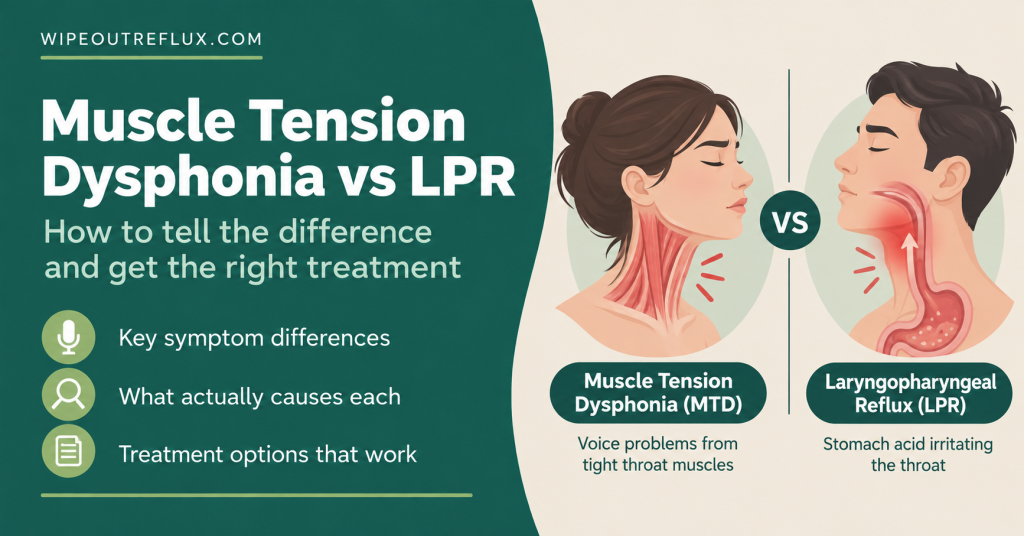
Muscle tension dysphonia (MTD) is a voice problem caused by your larynx and the muscles around it working too hard. LPR is reflux — stomach contents, and specifically the enzyme pepsin — reaching your throat. They are completely different mechanisms, and they produce almost identical symptoms: hoarseness, throat tightness, a lump in the throat, constant throat clearing, a voice that tires out by the afternoon.
The quickest way to separate them is to ask what your symptoms track. MTD symptoms track voice use — they get worse the more you talk, worse after a long meeting or a phone-heavy day, and better after a quiet weekend. LPR symptoms track eating and position — worse after certain meals, worse after lying down, often worst first thing in the morning.
And here’s the part that matters most to the people who email me: if you’ve done eight weeks of proper anti-reflux treatment and your throat still feels exactly the same, MTD is one of the most likely explanations — not a reason to double your PPI dose. In one study of people whose voice complaints hadn’t responded to acid suppression, voice therapy alone cut their reflux symptom scores nearly in half [Schneider et al., The Laryngoscope, 2019].
Key Takeaways
- MTD is excessive tension in the muscles that control and surround the voice box. LPR is reflux reaching the larynx. Both irritate the same structures, so the symptom lists overlap almost completely.
- The most useful distinguisher is the pattern: MTD follows how much you talk, LPR follows what and when you eat.
- Reflux is one of the recognized causes of MTD — the throat gets irritated, you squeeze to protect it, and the squeezing becomes a habit that outlives the reflux.
- In 150 people diagnosed with MTD, reflux was judged a contributing factor in 49% and heavy voice use in 63% — most had more than one driver [Altman et al., Journal of Voice, 2005].
- A 2026 study of 128 MTD patients investigated for suspected reflux found a third had neither reflux nor any swallowing abnormality on testing [Saltsgaver et al., The Laryngoscope, 2026].
- Fewer than 40% of people given an LPR diagnosis on laryngoscopy alone had reflux confirmed on impedance-pH testing [de Bortoli et al., World Journal of Gastroenterology, 2012].
- MTD is treated with voice therapy and hands-on laryngeal work, not with acid suppression. Reflux medication does nothing for a muscle pattern.
- Most people I speak to who are stuck have both — and treating only one half is why they stay stuck.
What Muscle Tension Dysphonia Actually Is
Your voice box doesn’t work alone. It sits in a sling of muscles — inside the larynx, around it in the neck, and down into the chest and shoulders — and producing an easy voice depends on those muscles doing the right amount of work and no more.
In muscle tension dysphonia, they do far more. The larynx sits higher in the neck than it should, the surrounding muscles stay contracted between phrases instead of releasing, and the vocal folds get squeezed together with more force than sound production needs. Sometimes the false folds above them squeeze inward too, which is called supraglottic compression and is visible on a scope.
The result is a voice that sounds strained, rough, or thin, and — crucially — a voice that feels effortful. People describe it as pushing the words out, or as their throat gripping. The defining feature is that there’s nothing structurally wrong. No nodule, no paralysis, no lesion. The equipment is fine; the way it’s being driven is not.
Primary vs secondary MTD
This distinction is the whole reason this article exists.
Primary MTD is muscle tension with no underlying cause driving it. It’s typically tied to voice demand, technique, and stress — teachers, salespeople, call-center staff, anyone who talks for a living, and anyone who holds tension in their neck and jaw when under pressure.
Secondary MTD is muscle tension that developed as compensation for something else irritating or weakening the larynx. A review of the MTD literature sorts the causes into three groups: psychological and personality factors, vocal misuse and overuse, and compensation for an underlying disease — with laryngopharyngeal reflux named explicitly in that third group, alongside upper airway infections and organic lesions [Van Houtte et al., Journal of Voice, 2011].
So reflux doesn’t just resemble MTD. It can cause it. Hold that thought, because it explains the most frustrating pattern in this whole area.
What LPR Is Doing, Briefly
LPR is reflux that travels past the upper esophageal sphincter and reaches the larynx and pharynx. The damaging agent isn’t mainly acid — it’s pepsin, the stomach’s protein-digesting enzyme, which binds to throat tissue and can be reactivated later by anything acidic you eat or drink, long after the reflux event itself.
Throat tissue has none of the defenses the esophagus has, so tiny amounts do disproportionate damage. That’s why LPR symptoms can be severe in people with no heartburn at all, and why acid-suppressing drugs so often disappoint — they lower the acid, but the enzyme is still arriving. I’ve written separately about why PPIs don’t work for LPR, and that failure is the doorway most people walk through into the MTD question.
Why These Two Get Confused
Because the symptom lists are nearly the same. Here’s the overlap laid out honestly.
| Symptom | Muscle tension dysphonia | LPR |
|---|---|---|
| Hoarseness | Yes — often strained or effortful | Yes — often rough, worse in the morning |
| Lump in the throat (globus) | Very common | Very common |
| Throat clearing | Common | Common |
| Vocal fatigue | Hallmark feature | Present, usually milder |
| Throat or neck ache | Yes — often tender to touch | Yes — usually a burn or rawness |
| Excess mucus | Sometimes | Common |
| Heartburn | No | Only in about half of cases |
| Worse after talking a lot | Yes — the defining pattern | Mildly |
| Worse after meals or lying down | No | Yes — the defining pattern |
Now add the diagnostic problem. The two questionnaires most often used to identify LPR — the Reflux Symptom Index and the Reflux Finding Score — were never designed to exclude MTD. Someone with pure muscle tension will score highly on the RSI, because the RSI asks about hoarseness, throat clearing, globus and excess mucus. Those are MTD symptoms too.
That’s how you end up with the finding that fewer than 40% of people diagnosed with LPR by laryngoscopy had reflux confirmed when they were properly tested with impedance-pH monitoring — the visible signs simply aren’t specific enough [de Bortoli et al., World Journal of Gastroenterology, 2012].
Six Ways to Tell Them Apart
1. What your symptoms track
This is the single most useful question, so it’s worth being systematic about it. For two weeks, note your worst hour each day and what preceded it. If your bad hours cluster after long conversations, teaching, presenting or phone calls, that’s MTD. If they cluster after meals, after certain foods, or after lying down, that’s reflux. A simple two-week log settles this faster than another appointment will.
2. What happens on a quiet day
Take a weekend where you barely speak. MTD improves noticeably — often dramatically. LPR doesn’t care whether you talked; if anything, a relaxed weekend of rich food makes it worse. This test is crude but it’s genuinely informative.
3. The shape of your day
LPR is classically worst on waking, because you’ve spent the night horizontal. MTD is classically best on waking and deteriorates as vocal load accumulates — people describe a voice that “runs out” by mid-afternoon.
4. Whether your neck is tender
Press gently on either side of your voice box, and on the muscles running from your jaw down to your collarbone. In MTD these are often genuinely sore, and the larynx may feel hitched up high and stiff when you swallow. Reflux irritation is felt inside the throat, not in the muscles outside it. A speech-language pathologist palpating your neck can usually tell within a minute.
5. How the voice fails
Reflux-related hoarseness tends to be rough or breathy and fairly constant through the day. MTD tends to be strained and variable — fine on some phrases, cutting out on others, sometimes better when you laugh or hum than when you speak. Many people with MTD can produce a clear voice for a second or two in an unusual pitch, which is a strong clue, because true tissue damage doesn’t switch off like that.
6. Whether reflux treatment did anything
This is the retrospective test, and it’s the one most of my readers arrive with. If you’ve done a genuine eight-to-twelve-week trial — diet changes, meal timing, alginates, raising the head of the bed, medication if prescribed — and your throat feels identical, the reflux hypothesis has been tested and it under-delivered. That doesn’t prove you never had reflux. It strongly suggests something else is now carrying the symptoms.
The Overlap Nobody Explains Properly
Here’s the mechanism that makes this whole topic confusing, and the reason “is it reflux or is it muscle tension?” is often the wrong question.
Reflux irritates the larynx. An irritated larynx is a threatened larynx, and the body’s response to a threatened larynx is to protect it — by bracing. You clear your throat more, you hold tension in the neck, you speak with more effort because speaking doesn’t feel reliable anymore. Over weeks, that bracing stops being a response and becomes your default setting. The nervous system also turns up the gain on laryngeal sensation, so a level of irritation that used to be unnoticeable now registers as a constant lump or tickle.
Then you fix the reflux. And the bracing stays. The muscles have learned a pattern, and the larynx has become hypersensitive. That’s secondary MTD, and it’s why people write to me saying their diet is immaculate, their pH testing came back clean, and their throat still feels exactly the same as it did two years ago.
The current international consensus statement on this area makes the same point in clinical language: laryngeal hyperresponsiveness and hypervigilance commonly contribute to throat symptoms whether or not objective reflux is present, and they respond to behavioral retraining rather than to acid suppression [Yadlapati et al., American Journal of Gastroenterology, 2026].
The numbers support the messy reality. In 150 patients diagnosed with MTD, reflux was a contributing factor in 49%, excessive voice use in 63%, high stress in 18%, and half had some visible laryngeal finding as well — almost nobody had a single clean cause [Altman et al., Journal of Voice, 2005]. And in a recent series of 128 MTD patients who were investigated for suspected reflux, 24% had reflux only, 31% had an esophageal motility problem only, 12% had both, and 33% had neither [Saltsgaver et al., The Laryngoscope, 2026]. Roughly a third were being investigated for a reflux problem they didn’t have.
What Changed in How Doctors Think About This
If your last ENT appointment was a few years ago, the framework has shifted under your feet, and in your favor.
The 2026 San Diego Consensus — a joint effort between ENT and gastroenterology — drew a hard line between laryngopharyngeal symptoms (cough, voice change, throat clearing, throat phlegm, throat pain) and laryngopharyngeal reflux disease, which means those symptoms plus objective evidence of reflux. Having the symptoms does not mean you have the disease. Laryngoscopy is useful for spotting non-reflux problems, but the panel stated plainly that laryngoscopic findings alone cannot diagnose reflux disease [Yadlapati et al., American Journal of Gastroenterology, 2026].
Practically, that means if your throat symptoms are isolated — no heartburn, no regurgitation — an empiric PPI trial is no longer the recommended endpoint. Proper reflux monitoring is, and behavioral therapy sits alongside it rather than after everything else has failed.
How Each One Is Diagnosed
MTD is diagnosed by a laryngologist and a speech-language pathologist together. It involves listening to the voice across tasks, watching the larynx on a scope during speech (looking for the larynx riding high and the false folds squeezing in), and palpating the neck muscles. There’s no blood test and no imaging that settles it. A normal-looking pair of vocal folds attached to a strained, effortful voice is the diagnosis.
LPR needs objective testing to be confirmed: 24-hour pH-impedance monitoring, pharyngeal pH monitoring or a wireless pH capsule, usually with an endoscopy. Questionnaires and scope appearances raise suspicion; they don’t confirm. I’ve covered the full diagnostic pathway separately.
If you’re pushing for answers, the single most valuable request is a referral to a voice clinic where both are assessed in the same room. That’s where the “which of these is it, and how much of each?” question actually gets answered.
How Treatment Differs
If it’s MTD
The front-line treatment is voice therapy with a speech-language pathologist — retraining breath support, reducing laryngeal effort, semi-occluded vocal tract exercises (the straw-phonation and lip-trill work), resonant voice techniques, and vocal hygiene. A systematic review of trials in MTD found consistent improvements in vocal function across these approaches, though it was blunt about the methodological weaknesses in the field [da Cunha Pereira et al., Journal of Voice, 2018].
Hands-on work often comes with it. Manual circumlaryngeal therapy — the therapist massaging and repositioning the larynx and surrounding muscles — has been shown in a meta-analysis to improve objective measures of voice quality with large effect sizes, although only six studies met inclusion criteria and none were randomized controlled trials [Barsties v. Latoszek et al., The Laryngoscope, 2024]. It’s genuinely useful; the evidence base is thinner than it should be.
There’s also a newer approach aimed squarely at the hypersensitivity side. Laryngeal recalibration therapy combines desensitization with cognitive work on throat hypervigilance. In 65 people with chronic throat symptoms referred for reflux evaluation, 85% responded — and response rates were similar whether or not reflux was actually proven on testing: 86% in those with confirmed GERD, 77% in those with none [Walsh et al., American Journal of Gastroenterology, 2024]. When a treatment works equally well in people who don’t have reflux, that tells you something about what was actually driving the symptoms.
If it’s LPR
Different tools entirely. Reducing the number and reach of reflux events, and clearing pepsin from the throat: meal timing, trigger removal, keeping throat-level pH above the threshold where pepsin reactivates, alginate rafts after meals and at night, elevating the head of the bed, and medication where it’s justified. That’s the ground my silent reflux treatment guide covers in detail, and it’s the logic the Wipeout Diet Plan is built on.
If it’s both — which is the usual answer
Do both, in the right order. Get the reflux side controlled properly first, because leaving active irritation in place while you retrain the muscles is like resurfacing a road with traffic still on it. Then treat the muscle pattern deliberately rather than waiting for it to fade on its own, because established secondary MTD generally doesn’t. I’ve written more about the voice side in voice therapy for silent reflux and about repair in healing vocal cords after reflux damage.
One thing worth saying to anyone who talks or sings for a living: the vocal demands themselves are a driver, not a bystander. Professional voice users need the technique side addressed regardless of what the reflux testing shows.
What I’d Do If I Were Stuck
If you’ve been treating this as reflux for months and you’re not moving, here’s the sequence I’d suggest.
- Log two weeks properly. Worst hour each day, and what preceded it. Voice load in one column, food and position in another. Let the pattern show itself.
- Run a voice-rest test. Two or three days of minimal talking, diet unchanged. Clear improvement points hard at muscle tension.
- Be honest about the reflux trial. Was it actually eight weeks of proper LPR management, or was it a PPI and some vague food avoidance? If it was the latter, the reflux hypothesis hasn’t been tested yet.
- Ask for a voice clinic referral, not another gastroenterology appointment — specifically a laryngologist and speech-language pathologist who assess together.
- Deal with the throat clearing. It’s mechanically traumatic, it maintains the muscle pattern, and it’s the most self-perpetuating habit in this entire condition. My guide on stopping constant throat clearing exists precisely for this.
- Take the anxiety component seriously rather than defensively. Throat hypervigilance is a measurable, treatable contributor, not a suggestion that you’re imagining anything — see silent reflux and anxiety.
Conclusion
Muscle tension dysphonia and LPR feel almost the same from the inside, and the tests most people get can’t reliably separate them. What separates them is pattern: voice use versus meals and position. And the honest answer for most people who’ve been stuck for a long time is that both are in play — reflux started it, muscle tension kept it going, and only one of the two has been treated.
If reflux is part of your picture, get that half right first, because you can’t retrain a larynx that’s still being irritated every night. That’s exactly what the Wipeout Diet Plan is for. It’s the deeper, more complete program — built around the mechanisms that actually drive throat symptoms, including pepsin reactivation, meal timing, and the clearance side that generic reflux advice leaves out. I designed it first and foremost around LPR and silent reflux, the stubborn throat-based form that so often survives medication, but since it works on the same underlying reflux mechanisms it helps GERD, heartburn and everyday acid reflux just as well.
If you’d rather start with the food decisions while you wait on appointments, the Wipeout Food Reference Guide is the lighter companion — the essential reference for which foods and drinks are safe with acid reflux and LPR, and their pH values, so you can stop guessing at the supermarket this week.
And if a month of doing the reflux side properly changes nothing at all, take that seriously as information. It isn’t failure. It’s your answer pointing somewhere else — and the good news is that somewhere else has treatments that work.
Frequently Asked Questions
Can you have muscle tension dysphonia and LPR at the same time?
Yes, and it’s common. Reflux is one of the recognized causes of secondary MTD — the throat gets irritated, you compensate by bracing, and the bracing becomes self-sustaining. In one series of MTD patients, reflux was judged a contributing factor in about half.
How do I know if my throat tightness is muscle tension or reflux?
Track what it follows. Tightness that worsens with talking and eases on a quiet day is muscle tension. Tightness that worsens after meals, after certain foods, or after lying down is reflux. If both patterns are present, both are probably active.
Will a PPI help muscle tension dysphonia?
No. Acid suppression does nothing to a muscle pattern. If your throat symptoms haven’t budged after a proper trial, that’s a reason to look at the muscle and sensitivity side, not to escalate the dose.
Does muscle tension dysphonia cause a lump in the throat?
Yes — globus is one of its most common features, which is exactly why it gets mistaken for reflux. A persistent lump sensation is a symptom shared by both conditions and doesn’t identify either one on its own.
How long does voice therapy take to work?
Most courses run from around four to twelve sessions over a few weeks to a few months. In the study of PPI non-responders, more frequent sessions correlated with greater symptom improvement — turning up consistently matters more than any single technique.
Can anxiety cause muscle tension dysphonia?
Psychological and personality factors are one of the three recognized etiological groups. Stress raises baseline muscle tension everywhere, including the neck and larynx, and worry about your voice makes you brace harder — which makes the voice worse. It’s a real loop, and it’s treatable.
Does muscle tension dysphonia show up on a laryngoscopy?
Sometimes. An ENT may see the larynx sitting high, the false folds squeezing inward, or a persistent gap during phonation. But the vocal folds themselves usually look normal, which is why MTD is so often missed on a scope that’s being read for signs of reflux.
Research Sources
- [Schneider et al., The Laryngoscope, 2019] — In 18 patients with dysphonia unresponsive to proton pump inhibitors and treated with voice therapy alone, median Reflux Symptom Index fell from 18.5 to 10.5 and median Voice Handicap Index-10 from 25.5 to 13.5. The authors concluded that symptoms typically attributed to LPR may in fact stem from inefficient voice use or anxiety about dysphonia.
- [Altman et al., Journal of Voice, 2005] — Review of 150 patients diagnosed with muscle tension dysphonia found contributing factors of gastroesophageal reflux in 49%, excessive voice use in 63%, excessive loudness demands in 23%, and high stress in 18%, confirming multifactorial causes.
- [Van Houtte et al., Journal of Voice, 2011] — Review categorizing MTD causes into psychological/personality factors, vocal misuse and abuse, and compensation for underlying disease including laryngopharyngeal reflux, and identifying voice therapy and circumlaryngeal manual therapy as the effective direct treatments.
- [Saltsgaver et al., The Laryngoscope, 2026] — Among 128 MTD patients who underwent barium esophagram for suspected LPR, findings were dysmotility only in 31%, reflux only in 24%, both in 12%, and neither in 33%; the authors note esophageal dysmotility is prevalent in MTD and may mimic LPR.
- [de Bortoli et al., World Journal of Gastroenterology, 2012] — Impedance-pH monitoring confirmed gastroesophageal reflux disease in fewer than 40% of patients previously diagnosed with LPR by laryngoscopy, attributed to the low specificity of laryngoscopic findings.
- [Yadlapati et al., American Journal of Gastroenterology, 2026] — The San Diego Consensus separates laryngopharyngeal symptoms from laryngopharyngeal reflux disease, states that laryngoscopic findings alone cannot diagnose reflux disease, and identifies laryngeal hyperresponsiveness and hypervigilance as common contributors responsive to laryngeal recalibration therapy.
- [Walsh et al., American Journal of Gastroenterology, 2024] — Of 65 patients with chronic laryngopharyngeal symptoms who completed laryngeal recalibration therapy, 85% met criteria for symptom response, with similar rates in those with proven reflux (86%) and those with none (77%).
- [Barsties v. Latoszek et al., The Laryngoscope, 2024] — Meta-analysis of six studies finding manual circumlaryngeal therapy produced large improvements in acoustic measures of voice quality in MTD, while noting the absence of randomized controlled trials.
- [da Cunha Pereira et al., Journal of Voice, 2018] — Systematic review of nine clinical trials of voice therapy in MTD reporting improvements in subglottal pressure, glottal contact, fundamental frequency and maximum phonation time, with methodological quality identified as the field’s main shortcoming.

David Gray
12 years living with LPR · Consultant & researcher
I've lived with LPR for twelve years — the misdiagnoses, the PPI courses that did nothing, the slow work of figuring out what actually helps. Wipeout Reflux is where I translate the research into plain terms for people stuck in the same place. Every claim here is sourced to peer-reviewed work, and I consult one-to-one with LPR sufferers.