
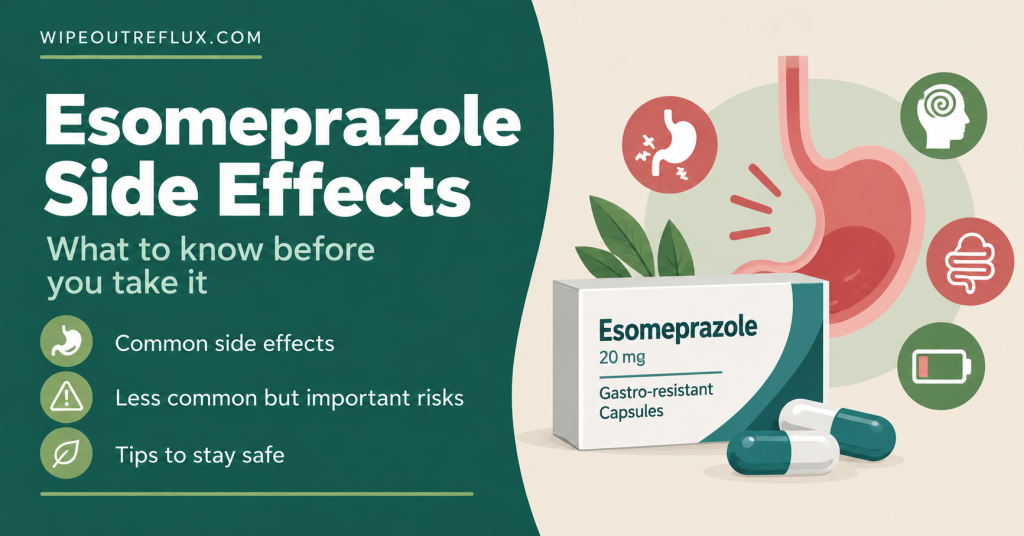
The short answer: most people who take esomeprazole get no side effects at all, and the ones who do usually get something mild and short-lived. In the manufacturer’s own trials, the most frequently reported complaints were headache, diarrhea and abdominal pain, each at around 4–5% — rates barely different from omeprazole and, in the placebo-controlled studies, not far off placebo [AstraZeneca, NEXIUM Prescribing Information, U.S. Food and Drug Administration, 2021].
The longer answer is the one worth reading, because the side effect that causes the most trouble isn’t on that list. It’s what happens when you stop. In a randomized trial of 120 healthy volunteers with no reflux at all, eight weeks of esomeprazole 40 mg left 44% of them reporting heartburn, acid regurgitation or dyspepsia in the four weeks after withdrawal, compared with 15% on placebo [Reimer et al., Gastroenterology, 2009]. The drug can manufacture the symptom it treats.
I’ve spent 12 years managing silent reflux and I’ve talked to a lot of people about this drug. Below is what the evidence actually supports, what it doesn’t, and the question I’d be asking instead if you’re on esomeprazole long term and still symptomatic.
Key Takeaways
- Common short-term side effects are headache, diarrhea, nausea, flatulence and abdominal pain — each reported by roughly 3–5% of people in trials, similar to omeprazole.
- Esomeprazole is the S-isomer of omeprazole and is cleared more slowly, so it gives somewhat stronger, steadier acid suppression: 40 mg held stomach pH above 4 for 14.0 hours a day versus 11.8 for omeprazole 20 mg [Miner et al., The American Journal of Gastroenterology, 2003].
- Rebound acid hypersecretion after stopping is real, demonstrated in a placebo-controlled trial using esomeprazole itself, and is the reason so many people conclude they “can’t come off it.”
- Long-term concerns — B12, magnesium, kidneys, bones, infections — come almost entirely from observational data, where the increases are modest and confounding is hard to rule out.
- The one large randomized safety trial, 17,598 people followed for three years, found no increase in fractures, kidney disease, dementia, pneumonia or death — only a small rise in enteric infections [Moayyedi et al., Gastroenterology, 2019].
- Esomeprazole should not be combined with clopidogrel; it cuts the active metabolite of that drug by 35–40%.
- For throat-based silent reflux, the risk-benefit question is different, because acid suppression often isn’t treating the mechanism causing the symptoms in the first place.
What Esomeprazole Is, and Why That Matters Here
Omeprazole is a mixture of two mirror-image forms of the same molecule. Esomeprazole is just one of them — the S-isomer — isolated and sold on its own as Nexium. The reason anyone bothered is that the S-isomer is broken down more slowly by the liver enzyme CYP2C19, so more of it survives to reach the acid pumps, and the effect varies less from person to person.
In a five-way crossover study comparing standard doses of all five PPIs, esomeprazole 40 mg kept stomach pH above 4 for a mean of 14.0 hours a day, against 12.1 for rabeprazole, 11.8 for omeprazole, 11.5 for lansoprazole and 10.1 for pantoprazole [Miner et al., The American Journal of Gastroenterology, 2003].
Keep that in mind as you read the rest. Nearly everything on the side effect list is a consequence of suppressing stomach acid, not of the molecule being toxic. A drug that suppresses acid a bit more thoroughly is, logically, going to produce those downstream effects a bit more readily — though no trial has been built to test that head to head, so treat it as reasoning rather than fact. If you’re weighing the two specifically, I’ve compared them directly in Prilosec vs Nexium.
The Side Effects That Showed Up in Trials
These are the ones on the label, taken from the clinical trial programme rather than from anecdote.
- Headache — the most common, reported by 5.5% on 20 mg and 5% on 40 mg in erosive esophagitis trials, against 3.8% on omeprazole.
- Diarrhea — around 4% in placebo-controlled symptomatic GERD studies, with no significant difference between esomeprazole and omeprazole groups.
- Abdominal pain — also around 4%.
- Nausea, flatulence, constipation and dry mouth — reported at rates similar to omeprazole [AstraZeneca, NEXIUM Prescribing Information, U.S. Food and Drug Administration, 2021].
Two things are worth noticing. First, these are small numbers — 95 out of 100 people don’t get a headache. Second, placebo groups in reflux trials report these same symptoms at rates that are often close, because headache and bloating are common in life generally.
The bloating one deserves a note, because it’s the complaint I hear most and it isn’t really on the label. Stomach acid is part of how you break down food and part of how you keep bacterial populations in check in the upper gut. Turn it down for months and some people get more gas, more fullness, and slower-feeling digestion. It’s a plausible consequence of the drug working, and for some people it’s worse than the reflux was. Bacterial overgrowth is one proposed route.
Rebound Acid: The Side Effect You Only Meet at the End
This is the one I’d most want you to know about before you start, because it changes how you interpret everything that happens later.
When you suppress acid for weeks, the stomach compensates. Gastrin rises, the acid-producing cells expand, and the machinery is primed to produce more acid than before. Remove the drug and that capacity is unmasked for a few weeks.
The definitive demonstration used esomeprazole specifically. Researchers randomized 120 healthy volunteers — people with no reflux problem — to either 12 weeks of placebo, or eight weeks of esomeprazole 40 mg followed by four weeks of placebo. In the four weeks after the drug was withdrawn, 44% of the esomeprazole group reported at least one clinically relevant acid-related symptom, against 15% of the placebo group [Reimer et al., Gastroenterology, 2009].
Read that again: nearly half of people with no reflux developed reflux symptoms purely from stopping the drug.
Now picture what that does to someone who genuinely has reflux. They try stopping, feel dramatically worse within a week, conclude they clearly still need it, and restart. That interpretation is wrong at least some of the time — what they felt was withdrawal, and it fades. But you can only discover that by tapering slowly rather than stopping dead, which is why I wrote a separate guide on getting off PPIs and managing acid rebound.
The Long-Term Concerns, Put in Proportion
Here’s where most articles either terrify you or dismiss everything. Both are wrong. The honest position is that these associations are real in observational data, small in size, and mostly unconfirmed when tested properly.
Vitamin B12
Acid helps release B12 from food protein, so suppressing it long-term can reduce absorption. In a case-control study comparing 25,956 people with new B12 deficiency against 184,199 without, two or more years of PPI supply was associated with a 65% higher odds of deficiency, and the association was stronger at higher doses [Lam et al., JAMA, 2013]. This is the long-term effect I’d actually monitor, because it’s easy to check and easy to fix. More detail in my piece on PPIs and B12 deficiency.
Magnesium
A meta-analysis of nine observational studies covering 109,798 patients found a pooled relative risk of low magnesium of 1.43 with PPI use [Cheungpasitporn et al., Renal Failure, 2015]. Severe cases are rare but genuinely serious, causing cramps, palpitations and arrhythmias, and it’s a labelled warning. If you’re also on a diuretic, the risk stacks. I’ve covered the practical side in PPIs and low magnesium.
Kidneys
PPIs can cause acute interstitial nephritis, which is rare, idiosyncratic and reversible if caught. The bigger question is chronic kidney disease. In the ARIC cohort of 10,482 people, PPI use was associated with a 50% higher adjusted risk of incident CKD, replicated in a second cohort of 248,751 patients, with twice-daily dosing carrying more risk than once-daily [Lazarus et al., JAMA Internal Medicine, 2016]. That’s an association in observational data, not a demonstrated cause — and, as you’ll see below, it didn’t reproduce in the randomized trial.
Bones
Fracture risk is a labelled warning based on observational studies, mostly in people taking high doses for a year or more. The proposed mechanism is reduced calcium absorption. The size of the effect in those studies is modest, and it too failed to appear in randomized data.
Dementia
This scare came from a 2016 German claims analysis and was amplified everywhere. Better-designed work has not supported it. A prospective analysis of 18,934 adults aged 65 and over, with medications reviewed in person at annual visits and dementia diagnosed by formal criteria, found no association between PPI use and incident dementia, cognitive impairment, or decline in cognitive test scores over time [Mehta et al., Gastroenterology, 2023]. I’d consider this one largely answered.
Gut infections
This is the concern that holds up best. Stomach acid is a barrier against swallowed organisms, and lowering it raises the risk of enteric infection, including C. difficile. It’s the one signal that survived randomized testing.
Fundic gland polyps
Long-term acid suppression raises gastrin, and gastrin drives the formation of small benign polyps in the stomach lining. They’re on the label, they’re usually found incidentally at endoscopy, and in people without familial adenomatous polyposis they’re not considered dangerous. Worth knowing so the finding doesn’t frighten you.
What the Randomized Evidence Says
Almost everything above comes from observational research, which struggles with a basic problem: people prescribed long-term acid suppression are different from people who aren’t. They’re older, heavier, on more medications, and sicker in ways that don’t get fully captured.
One trial cut through that. COMPASS randomized 17,598 people to pantoprazole 40 mg daily or placebo and followed them for a median of three years, collecting safety data every six months. Across pneumonia, C. difficile, fractures, gastric atrophy, chronic kidney disease, diabetes, chronic lung disease, dementia, cardiovascular disease, cancer, hospitalization and all-cause mortality, there was no statistically significant difference between the groups. The single exception was enteric infections: 1.4% versus 1.0% [Moayyedi et al., Gastroenterology, 2019].
That trial used pantoprazole rather than esomeprazole, and three years is not thirty. But it’s the best safety evidence the class has, and it should calm most of the fear. The reasonable conclusion isn’t “PPIs are dangerous.” It’s that they’re safer than the headlines suggest, and still not something to take indefinitely without a reason.
The Interaction Worth Checking
Esomeprazole reduces the plasma concentration of the active metabolite of clopidogrel by 35–40%, blunting its antiplatelet effect, and the label says to avoid using them together [AstraZeneca, NEXIUM Prescribing Information, U.S. Food and Drug Administration, 2021]. If you’re on clopidogrel after a stent or a cardiac event and someone has added esomeprazole for stomach protection, that combination is worth raising with your doctor — other acid-suppressing options don’t interact the same way.
The label also flags methotrexate (PPIs can raise and prolong its levels), St John’s wort and rifampin (which reduce esomeprazole levels), and interference with tests used to diagnose neuroendocrine tumours. Absorption of drugs that need stomach acid — certain antifungals and HIV medications among them — can also drop.
The Question That Matters More If Your Symptoms Are in Your Throat
Everything above assumes the drug is doing something useful for you. For classic heartburn and erosive esophagitis, it usually is, and the risk-benefit maths is straightforward.
If your symptoms are throat-based — hoarseness, a lump sensation, constant throat clearing, post-nasal drip, a cough that won’t settle — the maths changes, because the primary damaging agent in silent reflux isn’t acid. It’s pepsin, the digestive enzyme that comes up with the reflux, binds to throat tissue and sits there. Acid-suppressing drugs lower the acid; the enzyme still arrives, and it can be reactivated by anything acidic you eat or drink afterwards.
That’s the mechanism behind the pattern I see constantly: someone on esomeprazole for two years, throat no better, still taking it because stopping felt worse. They’re carrying the full side effect profile of long-term acid suppression to treat something the drug was never well suited to. I’ve set out the evidence on that in why PPIs don’t work for LPR.
If that’s you, the productive move isn’t to decide the drug is poisoning you. It’s to build the approach that actually targets the mechanism — meal timing, trigger control, keeping throat pH above the level where pepsin reactivates, alginate rafts — which is exactly what the Wipeout Diet Plan is built around, and then taper with your doctor from a position of strength rather than desperation.
If You’ve Been on Esomeprazole for Years
A short, practical checklist rather than a scare.
- Ask why you’re still on it. Plenty of long-term prescriptions began as an eight-week course that nobody ever reviewed. Barrett’s esophagus, severe erosive disease or long-term NSAID use are good reasons to continue. “It was started in 2019” isn’t one.
- Get B12 and magnesium checked if you’ve been on it more than a couple of years. These are the two deficiencies worth catching, and both are straightforward to correct.
- Review the dose, not just the drug. Twice-daily dosing carried more risk than once-daily in the kidney data. If you’re on 40 mg twice a day because of a bad patch three years ago, that’s worth revisiting.
- Check your medication list for clopidogrel and methotrexate.
- Never stop abruptly. Taper over weeks, with something in place for the rebound period, or you’ll misread withdrawal as proof you need the drug forever.
- Do the non-drug work first. Coming off is much easier when reflux is genuinely better controlled rather than merely masked.
And none of this means throwing the tablets away tomorrow. If you’re taking esomeprazole for a clear reason and it’s working, the evidence says you’re taking a reasonably safe drug. The problem isn’t the drug. It’s the drug taken indefinitely, unreviewed, for a problem it may not be solving.
Conclusion
Esomeprazole’s short-term side effects are mild and uncommon. Its long-term risks are real but smaller than the headlines, and the one properly randomized safety trial found almost nothing beyond a modest increase in gut infections. The side effect that causes the most practical trouble is rebound acid on withdrawal — proven in a trial using esomeprazole itself — and knowing about it in advance is what stops you concluding you’re stuck on it for life.
The better question is usually not “is this drug safe?” but “is this drug still the right tool?” If you’ve been taking it for months and your throat symptoms haven’t shifted, that’s worth acting on. Getting reflux under control at the source is what makes the drug question easy, and that’s what the Wipeout Diet Plan is for — the deeper, more complete program, built around the mechanisms that drive reflux rather than around suppressing acid and hoping. I designed it first and foremost for LPR and silent reflux, the stubborn throat-based form that medication so often fails to touch, but because it works on the same underlying causes it’s just as effective for GERD, heartburn and everyday acid reflux.
If you want to start with the food side while you talk to your doctor about the prescription, the Wipeout Food Reference Guide is the lighter companion — the essential reference for which foods and drinks are safe with acid reflux and LPR, and their pH values, so you can make better decisions from your next meal onwards.
Whatever you decide, decide it with your prescriber rather than alone, and taper rather than stop. The rebound is the trap, and it’s an avoidable one.
Frequently Asked Questions
What are the most common side effects of esomeprazole?
Headache, diarrhea, nausea, flatulence and abdominal pain, each reported by roughly 3–5% of people in clinical trials. Most are mild and settle within the first week or two.
Is esomeprazole safe to take long term?
For most people with a genuine indication, yes. The largest randomized trial found no increase in fractures, kidney disease, dementia, pneumonia or death over three years, with only a small rise in enteric infections. The concern is less about danger and more about taking it indefinitely without anyone reviewing whether it’s still needed.
Does esomeprazole have more side effects than omeprazole?
The trial data show broadly similar rates — headache was reported slightly more often with esomeprazole, other reactions at similar rates. Esomeprazole suppresses acid somewhat more strongly, so it’s reasonable to expect acid-dependent effects to follow the same direction, but that hasn’t been tested directly.
Why do I feel worse when I stop esomeprazole?
Rebound acid hypersecretion. Your stomach adapted to the drug and briefly overproduces acid once it’s removed. In healthy volunteers with no reflux, 44% developed acid symptoms after eight weeks of esomeprazole was withdrawn. It’s temporary, but it’s why tapering beats stopping abruptly.
Does esomeprazole cause weight gain or bloating?
Bloating and gas are common complaints, plausibly linked to reduced acid affecting digestion and upper-gut bacteria. Weight gain isn’t an established effect, though people whose reflux improves sometimes eat more comfortably and gain a little as a result.
What should I not take with esomeprazole?
Clopidogrel is the main one — esomeprazole reduces its active metabolite by 35–40% and the combination should be avoided. Also flag methotrexate, St John’s wort and rifampin with your prescriber, along with any medication that needs stomach acid to be absorbed.
How do I come off esomeprazole safely?
Slowly, and with your doctor. Typically that means stepping the dose down over several weeks rather than stopping dead, often with an alginate or an H2 blocker to cover the rebound window, and with the non-drug side of reflux control already in place before you start.
Research Sources
- [AstraZeneca, NEXIUM Prescribing Information, U.S. Food and Drug Administration, 2021] — Reports headache in 5.5% (20 mg) and 5% (40 mg) versus 3.8% for omeprazole in erosive esophagitis trials, and diarrhea, headache and abdominal pain at about 4% each in placebo-controlled symptomatic GERD studies. Lists warnings including acute interstitial nephritis, C. difficile diarrhea, fracture, B12 deficiency, hypomagnesemia, fundic gland polyps, and the clopidogrel and methotrexate interactions.
- [Reimer et al., Gastroenterology, 2009] — Randomized, double-blind, placebo-controlled trial in 120 healthy volunteers: after eight weeks of esomeprazole 40 mg, 44% reported a clinically relevant acid-related symptom in the following four weeks versus 15% on placebo, demonstrating that PPI withdrawal induces acid-related symptoms.
- [Miner et al., The American Journal of Gastroenterology, 2003] — Five-way crossover study in 34 patients: on day 5, intragastric pH was held above 4 for 14.0 hours with esomeprazole 40 mg, 12.1 with rabeprazole, 11.8 with omeprazole, 11.5 with lansoprazole and 10.1 with pantoprazole.
- [Moayyedi et al., Gastroenterology, 2019] — Randomized trial of 17,598 participants given pantoprazole 40 mg or placebo for a median of three years found no significant difference in pneumonia, fractures, chronic kidney disease, dementia, cancer or mortality; only enteric infections were raised (1.4% vs 1.0%).
- [Lam et al., JAMA, 2013] — Case-control study of 25,956 patients with incident vitamin B12 deficiency and 184,199 controls: two or more years of PPI supply was associated with an odds ratio of 1.65 for deficiency, rising to 1.95 at higher daily doses.
- [Cheungpasitporn et al., Renal Failure, 2015] — Meta-analysis of nine observational studies totalling 109,798 patients found a pooled relative risk of hypomagnesemia of 1.43 with PPI use, rising to 1.63 when restricted to higher-quality studies.
- [Lazarus et al., JAMA Internal Medicine, 2016] — In 10,482 ARIC participants, PPI use was associated with incident chronic kidney disease (adjusted hazard ratio 1.50), replicated in 248,751 Geisinger patients, with twice-daily dosing carrying higher risk than once-daily.
- [Mehta et al., Gastroenterology, 2023] — Prospective analysis of 18,934 adults aged 65 and over found no association between PPI use and incident dementia, cognitive impairment without dementia, or decline in cognitive test scores over time.

David Gray
12 years living with LPR · Consultant & researcher
I've lived with LPR for twelve years — the misdiagnoses, the PPI courses that did nothing, the slow work of figuring out what actually helps. Wipeout Reflux is where I translate the research into plain terms for people stuck in the same place. Every claim here is sourced to peer-reviewed work, and I consult one-to-one with LPR sufferers.