
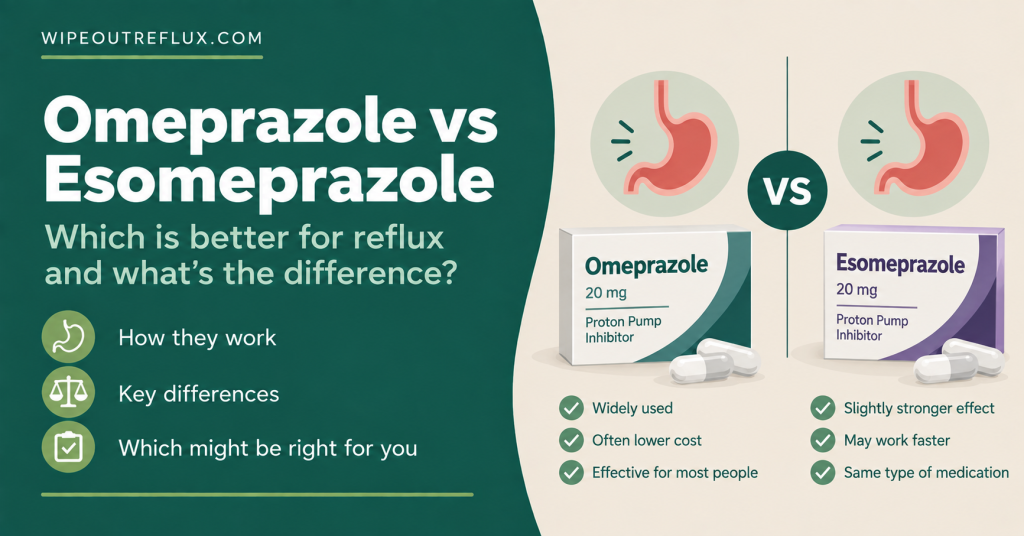
The difference between omeprazole and esomeprazole is smaller than the branding suggests: esomeprazole is one half of omeprazole. Omeprazole is a 50/50 mixture of two mirror-image versions of the same molecule, and esomeprazole is just the “S” half, isolated and sold on its own. Same target, same mechanism, same class.
The half that was kept happens to be the half your liver clears more slowly, so milligram for milligram esomeprazole hangs around a bit longer and delivers slightly more acid suppression. That’s a real pharmacological difference. Whether you can feel it is a separate question — and for most people, at the doses actually sold, the answer is no.
I’ve been managing my own LPR for 12 years and I’ve taken both. Below is what actually separates them at the level of chemistry, metabolism and dosing — not marketing — and how to work out which one makes sense for you.
Key Takeaways
- Omeprazole is a racemic mixture of R- and S-omeprazole. Esomeprazole is the S-isomer on its own — literally half of omeprazole, purified.
- The S-isomer is cleared more slowly by the liver enzyme CYP2C19, so it reaches higher blood levels per milligram and suppresses acid a little more consistently.
- Most trials that made esomeprazole look better compared 40 mg of esomeprazole against 20 mg of omeprazole — a double dose against a single one.
- Pooled evidence shows esomeprazole’s advantage is real but modest, and concentrated in severe erosive esophagitis rather than everyday reflux.
- “Esomeprazole magnesium” is just a salt form for the tablet or capsule — it is not a different or stronger drug, and the magnesium in it does nothing for your reflux.
- If you’re a CYP2C19 poor metabolizer, omeprazole levels rise far more than esomeprazole levels do — which is one reason individual response varies so much.
- Both interact with clopidogrel (Plavix) by blocking the same enzyme; pantoprazole is usually the safer pairing.
- Neither is more effective than the other for silent reflux, because the limiting factor in LPR isn’t how much acid you suppress.
The chemistry: one molecule, two mirror images
Omeprazole is what chemists call a chiral molecule. It exists in two forms that are identical in composition but arranged as mirror images of each other, the way your left and right hands are. Standard omeprazole — Prilosec, Losec, every generic omeprazole capsule — contains a 50/50 mix of both: R-omeprazole and S-omeprazole.
Esomeprazole is the S-isomer, separated out and sold alone. The “es” in the name is literally “S” spelled out. So when you swallow 20 mg of esomeprazole, you’re getting 20 mg of the S-form. When you swallow 20 mg of omeprazole, you’re getting roughly 10 mg of S and 10 mg of R.
Here’s the part people assume and get wrong: the R-isomer is not inert. Once either isomer is converted into its active form inside the acid-producing cell, both bind the proton pump the same way. The isomers aren’t different drugs at the business end. The difference is entirely in what happens before that — in how fast your liver disposes of each one.
Why the S-isomer lasts longer in your body
Both isomers are broken down mainly by a liver enzyme called CYP2C19, but it doesn’t handle them equally. CYP2C19 chews through R-omeprazole quickly and works on S-omeprazole more slowly. Strip out the R half and what’s left is the slower-clearing half, so blood levels run higher and stay up longer for the same milligram dose [Andersson et al., Clinical Pharmacokinetics, 2001].
That matters because of how proton pump inhibitors work. A PPI is a prodrug. It circulates in the blood in an inactive form, gets trapped inside the acid-secreting canaliculus of a parietal cell, and only there — in a strongly acidic environment — converts into the form that binds and disables the pump. Crucially, it can only disable pumps that are actively switched on at that moment. So the amount of acid suppression you get from a dose depends on how much drug is circulating during the window when your pumps are firing.
More drug in circulation for longer means more pumps caught. That’s the entire pharmacological case for esomeprazole, and it’s a legitimate one. It also explains why the effect builds over several days: each dose knocks out a fraction of the pump population, and it takes repeat dosing to reach a steady state. I go through that build-up in detail in how long omeprazole takes to work and how long Nexium takes to work.
There’s a second-order effect worth knowing: esomeprazole inhibits CYP2C19 as it’s metabolized, meaning it slows down its own clearance with repeated dosing. The manufacturer’s own data show systemic availability climbing from roughly 64% after a single 40 mg dose to around 90% at steady state [Nexium Prescribing Information, U.S. Food and Drug Administration, 2021]. Day five is not day one.
What the head-to-head trials actually compared
This is where the story gets sold badly. The trials that established esomeprazole’s reputation were real, large and well conducted — but look at the doses.
The landmark US study randomized 1,960 patients with reflux esophagitis to esomeprazole 40 mg or omeprazole 20 mg (with a 40 mg omeprazole arm), and esomeprazole came out ahead on healing at eight weeks and on symptom resolution [Kahrilas et al., Alimentary Pharmacology & Therapeutics, 2000]. A later multicenter trial was even titled as a comparison of “standard doses” — defined as esomeprazole 40 mg versus omeprazole 20 mg [Schmitt et al., Digestive Diseases and Sciences, 2006].
Read that again. The “standard dose” comparison is double the milligrams on one side. It’s a fair comparison of label doses, but it is not a fair comparison of the two molecules.
When the randomized evidence was pooled, esomeprazole did show a statistically significant edge over other PPIs for healing erosive esophagitis — but a modest one, and one that grew with the severity of the esophagitis rather than applying evenly [Gralnek et al., Clinical Gastroenterology and Hepatology, 2006]. If you have grade C or D erosive disease, that difference is worth caring about. If you have mild heartburn or throat symptoms with a clean endoscopy, it is close to invisible.
Esomeprazole magnesium vs omeprazole: what the salt actually means
“Esomeprazole magnesium” appears on every Nexium box, and it causes a surprising amount of confusion. People read it as a combination product, or assume the magnesium is doing something therapeutic.
It isn’t. Esomeprazole in its raw form is unstable, so it’s formulated as a salt to make a stable, manufacturable solid. Magnesium is simply the counter-ion. Nexium 24HR, for example, lists 22.3 mg of esomeprazole magnesium trihydrate to deliver 20 mg of esomeprazole [Nexium 24HR Drug Facts Label, DailyMed, U.S. National Library of Medicine]. The dose that matters is the 20 mg.
And here’s the detail that dissolves the comparison entirely: over-the-counter omeprazole is also a magnesium salt. Prilosec OTC is omeprazole magnesium 20.6 mg, delivering 20 mg of omeprazole [Prilosec OTC Drug Facts Label, DailyMed, U.S. National Library of Medicine]. So “esomeprazole magnesium vs omeprazole” is not salt versus no salt. It’s the same salt on both sides, and the only real variable is the isomer.
One practical footnote: the magnesium quantity in these tablets is trivial and has nothing to do with the low magnesium that can develop on long-term PPI therapy. That’s a genuine and separate issue, covered in omeprazole and low magnesium.
CYP2C19 genotype: why your friend’s experience doesn’t predict yours
CYP2C19 activity varies a lot between people, and it’s genetic. Roughly speaking, people fall into rapid, normal, intermediate and poor metabolizer groups, and the proportions differ substantially between populations — poor metabolizer status is considerably more common in East Asian populations than in European ones.
This has a measurable effect on acid control. In healthy volunteers dosed for eight days, acid suppression from omeprazole was significantly dependent on CYP2C19 genotype [Shirai et al., Alimentary Pharmacology & Therapeutics, 2001]. A rapid metabolizer clears omeprazole fast and may get genuinely poor 24-hour coverage from a standard dose. A poor metabolizer may get far more suppression than the label implies.
Esomeprazole is affected too — it’s the same enzyme — but less dramatically. The manufacturer’s steady-state data put exposure in poor metabolizers at only about 1.5 times that of the general population [Nexium Prescribing Information, U.S. Food and Drug Administration, 2021].
The practical upshot: if omeprazole has underwhelmed you at a proper dose taken at the right time, switching to esomeprazole is a reasonable experiment rather than a placebo move. You may simply be a fast metabolizer of the isomer mix. It’s also worth reading why acid reflux medication stops working before assuming the drug is the problem.
Timing, food and dose: identical rules, one small difference
Both drugs need to be in your blood when your pumps switch on, which is why both should be taken before a meal rather than with it or after it. Taking a PPI before breakfast produces measurably better acid control than taking it without a meal at all [Hatlebakk et al., Alimentary Pharmacology & Therapeutics, 2000].
The labels differ slightly on the interval. Omeprazole is conventionally taken 30–60 minutes before eating; Nexium’s prescribing information specifies at least one hour before meals. Food also blunts esomeprazole absorption substantially when the two are taken together [Wiesner et al., International Journal of Environmental Research and Public Health, 2021]. If you’ve been taking either one with breakfast, that alone may explain a disappointing result — see the best time of day to take omeprazole.
On strengths: both come as 20 mg over the counter, and both are available on prescription at 20 mg and 40 mg. Generic esomeprazole has been available for years, so the old price gap has largely closed. If you’re weighing up the branded boxes specifically, I compare those directly in Prilosec vs Nexium.
Side effects and interactions: nearly identical, one exception
Because they’re the same molecule, the side effect profiles overlap almost completely: headache, diarrhea, nausea, flatulence, abdominal pain and constipation lead both lists, and the long-term class concerns — B12, magnesium, bone density, enteric infection, kidney — apply to both equally. I cover those separately in omeprazole side effects and esomeprazole side effects, and the nutrient picture in what nutrients PPIs deplete.
The one genuine divergence is drug interactions, and it comes back to CYP2C19. Clopidogrel (Plavix) is itself a prodrug that needs CYP2C19 to become active. Both omeprazole and esomeprazole inhibit that enzyme, and esomeprazole 40 mg reduces levels of clopidogrel’s active metabolite [Nexium Prescribing Information, U.S. Food and Drug Administration, 2021]. If you take clopidogrel and need acid suppression, this is a conversation to have with your doctor — pantoprazole is generally the preferred PPI in that situation because it leans far less on CYP2C19.
If your symptoms are in your throat
This is where I have to be blunt, because it’s the question I get most.
Switching from omeprazole to esomeprazole rarely fixes silent reflux. The reason is mechanistic. In LPR, the damaging agent reaching your larynx isn’t only acid — it’s pepsin, the stomach’s protein-digesting enzyme, which binds to laryngeal tissue and can be reactivated later by anything acidic you eat or drink. A PPI reduces how acidic the refluxate is. It doesn’t stop the reflux events, and it doesn’t remove pepsin from your throat. Raising acid suppression by a modest increment does very little about a problem that isn’t acid-limited.
That’s why trials of PPIs in LPR have been so much less impressive than trials in erosive esophagitis, and why so many people with throat symptoms cycle through every PPI on the shelf without much to show for it. I’ve written that up properly in why PPIs don’t work for LPR, with the broader picture in proton pump inhibitors for LPR and the pepsin mechanism in what pepsin is.
If that’s your situation, the leverage isn’t in the isomer. It’s in cutting the acidic dietary load that reactivates deposited pepsin, and in reducing reflux events themselves. That’s exactly what the Wipeout Diet Plan is built around.
So which should you take?
A reasonable way to decide:
- Start with omeprazole if you’re beginning PPI therapy for typical heartburn. It’s cheap, thoroughly studied, and equally effective for most people at an equivalent dose.
- Consider esomeprazole if you have confirmed severe erosive esophagitis, or if a correctly taken omeprazole course at a proper dose genuinely hasn’t delivered. The pooled evidence supports a real, if modest, edge in more severe disease.
- Look elsewhere if you’re on clopidogrel, or if you’re a poor responder for reasons that have nothing to do with the isomer — lansoprazole, dexlansoprazole and vonoprazan all work differently enough to be worth a look.
- Don’t switch on the strength of the box. Fix your timing and dose first. Most “this one doesn’t work” conclusions I hear turn out to be timing problems.
Conclusion
Omeprazole and esomeprazole are the same molecule sold two ways. The S-isomer clears more slowly and gives a little more acid suppression per milligram, which shows up in trials of severe erosive esophagitis and largely disappears in everyday reflux — especially once you notice that most of those trials compared 40 mg against 20 mg. The magnesium on the label is a salt, not an ingredient that does anything for you, and it’s on both boxes anyway.
What neither one does is address why you’re refluxing in the first place. They lower the acidity of what comes up. They don’t reduce how often it comes up, they don’t repair the barrier, and in silent reflux they don’t touch the pepsin that’s already sitting in your throat tissue. That’s the ceiling you eventually hit on any PPI, and it’s the reason so many people end up on one indefinitely without ever feeling properly well.
That gap is what I built the Wipeout Diet Plan to fill. It’s the complete, structured approach — what to eat and in what order, how to sequence your day, how to bring pepsin reactivation down week by week, and how to taper acid suppression safely once your throat and esophagus have had a genuine chance to settle. I designed it first and foremost around LPR, the stubborn throat-based form that PPIs handle worst, but because it works on the same underlying reflux mechanisms it does just as much for classic GERD and everyday heartburn.
If you want somewhere lighter to start, the Wipeout Food Reference Guide is the essential companion — every food and drink worth knowing about for acid reflux and LPR, with its pH, so you can stop guessing at labels while you work out what your own triggers are.
Frequently Asked Questions
Is esomeprazole stronger than omeprazole?
Per milligram, slightly — the S-isomer clears more slowly, so blood levels run higher and acid suppression is a little greater. But the gap is modest, and much of esomeprazole’s reputation comes from trials that used 40 mg of esomeprazole against 20 mg of omeprazole.
Is 20 mg of esomeprazole the same as 20 mg of omeprazole?
Not exactly. Twenty milligrams of esomeprazole is 20 mg of the slower-clearing isomer, while 20 mg of omeprazole is roughly 10 mg of each isomer. Expect somewhat more acid suppression from the esomeprazole, though for most people the practical difference at that dose is small.
What is the difference between esomeprazole magnesium and omeprazole?
Magnesium is a salt used to stabilize the drug for manufacturing, not an active ingredient — and over-the-counter omeprazole is a magnesium salt too. The only meaningful difference is that esomeprazole contains just the S-isomer, while omeprazole contains both.
Can I switch from omeprazole to esomeprazole directly?
Usually yes, and there’s no need to taper between them since they’re the same class — but check with your prescriber, particularly if you’re on 40 mg or have been taking a PPI long term. Coming off PPIs entirely is different: stopping abruptly can cause rebound acid hypersecretion, which I cover in the PPI taper schedule.
Which one is better for silent reflux or LPR?
Neither, meaningfully. LPR isn’t limited by how much acid you suppress — it’s driven by reflux events and by pepsin deposited in the throat. Changing isomer doesn’t change either of those.
Does esomeprazole have fewer side effects than omeprazole?
No. The side effect profiles are essentially the same, because it’s the same molecule. The main divergence is in drug interactions, and even there both inhibit CYP2C19 — esomeprazole just does so somewhat differently at equivalent exposure.
Why is esomeprazole more expensive if it’s half of omeprazole?
Historically it was patent protection — isolating a single isomer created a new, separately patentable product as omeprazole’s patent expired. Generic esomeprazole is now widely available, so in most markets the price difference has narrowed considerably.
Research & References
- [Andersson et al., Clinical Pharmacokinetics, 2001] — Reviews the pharmacokinetics of esomeprazole as the (S)-isomer of omeprazole, including its slower CYP2C19-mediated clearance and the resulting higher systemic exposure per dose.
- [Kahrilas et al., Alimentary Pharmacology & Therapeutics, 2000] — Randomized trial in 1,960 patients with reflux esophagitis; esomeprazole 40 mg produced higher healing rates and faster symptom resolution than omeprazole 20 mg over eight weeks.
- [Schmitt et al., Digestive Diseases and Sciences, 2006] — Multicenter, double-blind, 8-week trial comparing the label “standard doses” of esomeprazole 40 mg and omeprazole 20 mg in erosive esophagitis.
- [Gralnek et al., Clinical Gastroenterology and Hepatology, 2006] — Meta-analysis of randomized trials finding a statistically significant but modest advantage for esomeprazole over other PPIs in erosive esophagitis, with the benefit greatest in more severe disease.
- [Shirai et al., Alimentary Pharmacology & Therapeutics, 2001] — Eight-day dosing study in healthy volunteers showing that acid suppression from omeprazole was significantly dependent on CYP2C19 genotype.
- [Hatlebakk et al., Alimentary Pharmacology & Therapeutics, 2000] — Demonstrated that proton pump inhibitors produce better acid suppression when taken before a meal than when taken without one.
- [Wiesner et al., International Journal of Environmental Research and Public Health, 2021] — Literature review of food and dosing-regimen effects on PPI therapy, including the substantial reduction in esomeprazole absorption when taken with food.
- [Nexium Prescribing Information, U.S. Food and Drug Administration, 2021] — Manufacturer data on esomeprazole’s half-life, autoinhibition of CYP2C19, poor-metabolizer exposure ratio and the clopidogrel interaction.
- [Nexium 24HR Drug Facts Label, DailyMed, U.S. National Library of Medicine] — Confirms the over-the-counter product delivers 20 mg of esomeprazole as 22.3 mg of esomeprazole magnesium trihydrate.
- [Prilosec OTC Drug Facts Label, DailyMed, U.S. National Library of Medicine] — Confirms over-the-counter omeprazole is also supplied as a magnesium salt, 20.6 mg delivering 20 mg of omeprazole.

David Gray
12 years living with LPR · Consultant & researcher
I've lived with LPR for twelve years — the misdiagnoses, the PPI courses that did nothing, the slow work of figuring out what actually helps. Wipeout Reflux is where I translate the research into plain terms for people stuck in the same place. Every claim here is sourced to peer-reviewed work, and I consult one-to-one with LPR sufferers.