
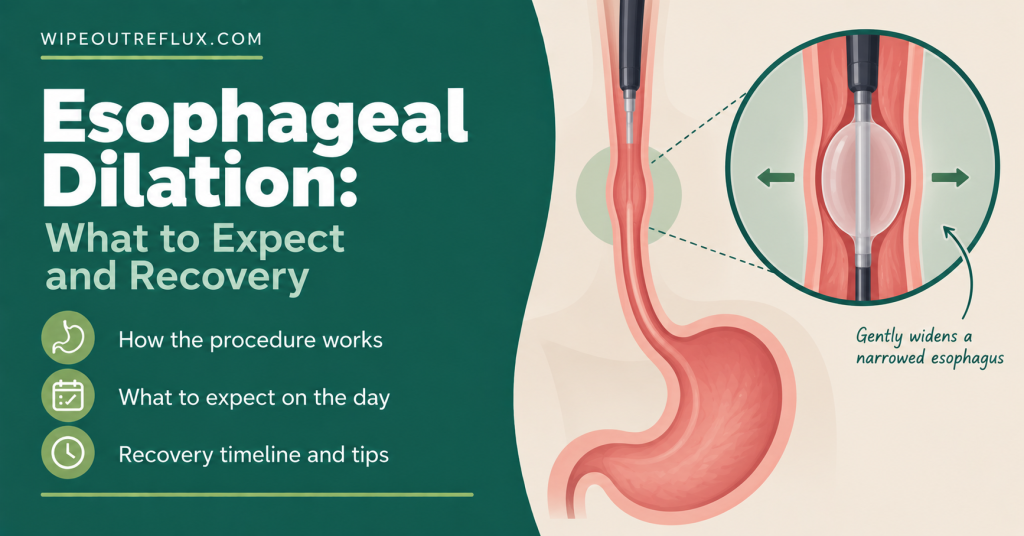
Esophageal dilation is a procedure that stretches a narrowed section of the esophagus so food can pass normally again. It’s done during an endoscopy, usually under sedation, takes around 15 to 30 minutes, and you go home the same day.
Most people are back to eating normally within a day or two. The common after-effects are a sore throat, a bit of chest discomfort when swallowing, and tiredness from the sedation. Serious complications are rare — an older UK regional audit put perforation at 1.1% for benign strictures, and a more recent large series reported no perforations at all in ordinary benign strictures [Sami et al., Gut, 2018].
The bigger question, which nobody tends to explain properly before you leave the recovery bay, is why the narrowing happened and what stops it coming back. If the cause was reflux, the dilation treats the consequence and nothing else — and that’s the part that determines whether you’re back for another one in six months.
Key Takeaways
- Dilation stretches a narrowed esophagus during endoscopy; it’s an outpatient procedure taking 15–30 minutes under sedation.
- Two methods are used — bougie dilators passed through the narrowing, and balloons inflated across it. Neither has shown a clear advantage over the other.
- Expect a sore throat and mild chest discomfort for a day or so; most people eat normally within 24 hours.
- Perforation is the serious risk, but it is uncommon — a recent large series found none at all in ordinary benign strictures, and rates in eosinophilic esophagitis are well under 1%.
- Severe chest or back pain, fever, breathlessness or vomiting blood after the procedure needs urgent assessment — don’t wait it out.
- More than 95% of people need five dilations or fewer; simple strictures often resolve in one to three sessions.
- If reflux caused the stricture, acid suppression afterwards substantially reduces the need for repeat dilations — this is the step that makes it stick.
- A stricture that keeps recurring despite adequate dilation is called refractory, and there are further options beyond stretching it again.
What esophageal dilation actually is
Your esophagus is a muscular tube roughly 2 cm across at rest. When scarring narrows part of it — a stricture — solid food starts catching. People usually notice bread and meat first, then describe food sticking mid-chest, needing extra water to wash things down, or occasionally a piece of food lodging outright.
Dilation is the mechanical fix. A dilator is passed across the narrowed segment and expanded, tearing the fibrous scar tissue in a controlled way so the lumen opens up. It isn’t subtle — you are deliberately creating a small, controlled injury — but it works, and it works quickly. Many people notice the difference at their next meal.
What it doesn’t do is remove the scar or stop it reforming. That’s why what happens after the procedure matters as much as the procedure itself.
Why reflux causes strictures in the first place
The common cause of a benign esophageal stricture is chronic acid reflux. The sequence is straightforward: repeated acid exposure inflames and ulcerates the lining of the lower esophagus. That’s erosive esophagitis. Healing lays down fibrous tissue, and fibrous tissue contracts as it matures. Repeat that cycle over years and the lumen gradually tightens into a peptic stricture.
Two things follow from that. First, a stricture is evidence of substantial, prolonged acid exposure — often in people whose heartburn was mild or absent, because a narrowing lower esophagus can actually reduce the reflux symptoms while causing swallowing ones. Second, the scarring only stops progressing if the acid exposure stops. Stretch the esophagus and leave the reflux untreated, and the same process simply starts again.
Not every stricture is peptic. Eosinophilic esophagitis causes narrowing and rings through an allergic inflammatory process, radiation and caustic injury cause their own patterns, and achalasia is a motility disorder that mimics stricture symptoms without scarring. The cause changes the aftercare completely, which is why biopsies are usually taken at the same endoscopy. More on the full picture in esophageal stricture.
The two techniques: bougie and balloon
Bougie dilators are weighted or wire-guided tapered tubes passed down through the narrowing. As the widening taper moves across the stricture, it applies both radial and lengthwise shearing force. Maloney and Hurst dilators are weighted and passed blindly; Savary-Gilliard dilators run over a guidewire placed at endoscopy, which is the usual approach for tighter or more complex strictures.
Balloon dilators are passed through the endoscope and inflated across the narrowing, applying radial force along the whole length of the stricture at once rather than progressively.
Which is better? Neither, on the evidence. UK guidelines find no difference in clinical outcomes — safety or efficacy — between wire-guided bougie and balloon dilators, and recommend choosing on clinician preference, local expertise, equipment availability and cost [Sami et al., Gut, 2018]. Endoscopists also factor in the stricture’s shape, length and tightness. If you’ve had both and one felt easier, that’s worth mentioning.
One principle you may hear referenced is the “rule of three”: no more than three successively larger diameter increments in a single session. It’s a safety brake against over-stretching, and it’s the reason a tight stricture is often opened over two or three appointments rather than all at once. Worth knowing that it’s convention rather than proven — UK guidelines still recommend it while noting openly that no study has shown it improves safety or efficacy [Sami et al., Gut, 2018].
What to expect on the day
The practical run-through, since this is what most people actually want to know:
- Before. Nothing to eat for around six hours and nothing to drink for two, though follow your unit’s specific instructions. You’ll be asked about blood thinners, diabetes medication and allergies. Arrange a lift home — you cannot drive afterwards if you’ve been sedated.
- Sedation. Most units use conscious sedation through a cannula, often with a throat spray. You’ll be drowsy rather than fully asleep, and most people remember little or nothing.
- The procedure. The endoscope goes down first to inspect the esophagus and locate the narrowing. Biopsies may be taken. Then the dilator is passed — either over a guidewire or through the scope — and the stricture stretched, sometimes in a couple of increments. Fifteen to thirty minutes covers most cases.
- Recovery bay. UK guidelines advise monitoring for at least two hours afterwards, and making sure you are well and tolerating water before you leave [Sami et al., Gut, 2018]. Routine scans are not done unless you develop persistent chest pain, fever, breathlessness or a racing pulse during recovery.
- Going home. You’ll need someone to collect you, and you shouldn’t drive, drink alcohol or make important decisions for the rest of the day.
If you’ve never had an upper endoscopy, the general experience is covered in endoscopy for acid reflux.
Recovery: the first 24 hours and the first week
Recovery is genuinely short. What’s normal:
- Sore throat for a day or two, from the scope rather than the dilation.
- Mild chest discomfort or a dull ache behind the breastbone when swallowing, easing over 24 to 48 hours.
- Drowsiness for the rest of the day. No driving, no alcohol, no signing anything important, and ideally someone with you for the evening.
- A small amount of blood in saliva or on a first cough is not unusual.
On eating: most units advise starting with clear fluids once the throat spray has worn off and your swallow feels normal — typically an hour or two — then soft food for the rest of the day, then back to normal. Follow the instructions you’re given, since they vary with how much stretching was done.
What needs urgent attention rather than watchful waiting:
- Severe or worsening chest, back or neck pain
- Fever
- Shortness of breath
- Vomiting blood, or black tarry stools
- Swelling or a crackling sensation under the skin of the neck or chest
Those are the signs of perforation or significant bleeding. They’re uncommon, but they’re time-critical — go to an emergency department, don’t ring the unit in the morning.
Side effects and risks, honestly
The serious risk is perforation, a tear through the esophageal wall. The numbers depend heavily on what is being dilated. An older UK regional audit found an overall perforation rate of 2.6% across all dilations, falling to 1.1% for benign strictures; a more recent large series reported eight perforations (0.53%), all of them in malignant, post-radiation or caustic strictures, with none in any other type [Sami et al., Gut, 2018]. Achalasia dilation sits higher, at 2–4%. For a straightforward peptic stricture — the commonest reason for this procedure — the risk is well below the 1% figure that often gets quoted at patients [Everett, Therapeutic Advances in Gastrointestinal Endoscopy, 2019].
Eosinophilic esophagitis used to carry a reputation for fragile, tear-prone esophagi, and many patients were denied dilation on that basis. The pooled data corrected it: across 1,820 dilations in 845 patients, perforation occurred in 0.38%, bleeding in 0.05%, hospitalization in 0.67% and death in none, while 95% of patients improved clinically [Moawad et al., Alimentary Pharmacology & Therapeutics, 2017]. If you have EoE and have been told dilation is too dangerous, that’s worth revisiting.
Bleeding and aspiration are the other recognized complications, both uncommon. And there’s the background risk of the sedation itself, which is the same as for any endoscopy.
Set against that: an untreated tight stricture means progressive difficulty swallowing, weight loss, and the risk of a food bolus impacting and needing emergency removal. The risk-benefit calculation is usually not close.
Why one dilation often isn’t enough
This is the part I’d most want to know going in. Dilation is frequently not a one-off, and that’s expected rather than a sign something went wrong. Simple strictures usually resolve in one to three sessions, and more than 95% of patients need five or fewer in total [Everett, Therapeutic Advances in Gastrointestinal Endoscopy, 2019].
What decides whether you’re in the one-and-done group or the repeat group, for a peptic stricture, is what happens to the acid afterwards. This is one of the clearest findings in the field:
- In a randomized comparison in dysphagic patients with peptic stricture and esophagitis, those on omeprazole had significantly better healing and symptom relief and needed fewer dilations at both 3 and 6 months than those on H2-receptor antagonists [Marks et al., Gastroenterology, 1994].
- A larger blinded trial comparing omeprazole with ranitidine found the same pattern for preventing recurrence of benign stricture after dilation [Smith et al., Gastroenterology, 1994].
- In follow-up of 69 patients dilated for peptic stricture, omeprazole extended the mean interval between further dilations to 26.3 months, compared with 9.3 months on H2 blockers [Barbezat et al., Alimentary Pharmacology & Therapeutics, 1999].
The guideline position reflects this. UK guidelines make it a strong recommendation backed by high-grade evidence: offer PPI therapy after endoscopic dilatation of peptic strictures in order to reduce the recurrence rate [Sami et al., Gut, 2018].
So if you’ve been dilated for a reflux-related stricture and discharged with no acid suppression and no plan, that’s worth querying. This is the one situation where I’d be firmly in favor of staying on a PPI — the scarring process you’re preventing is considerably worse than the class risks. Everything else still applies too: not eating late, raising the head of the bed, and cutting the dietary load that drives reflux in the first place — which is exactly what the Wipeout Diet Plan sets out step by step.
When the stricture keeps coming back
If a narrowing can’t be opened to a reasonable diameter, or won’t stay open, it has a formal definition. A stricture is called refractory when it can’t be dilated to 14 mm over five sessions at two-week intervals, and recurrent when it can’t be held at 14 mm for four weeks after reaching that diameter [Everett, Therapeutic Advances in Gastrointestinal Endoscopy, 2019]. One caveat before that label gets applied: UK guidelines advise making sure ongoing inflammation is properly controlled with high-dose PPI therapy first [Sami et al., Gut, 2018]. A stricture that keeps closing because the acid was never dealt with isn’t refractory — it’s undertreated.
At that point the options widen:
- Steroid injection into the stricture at the time of dilation, which meta-analyses suggest lengthens the interval between dilations without increasing complications, though the evidence quality is modest.
- Incisional therapy, cutting the scar tissue endoscopically — used mainly for short strictures under about 1 cm, with good immediate success in small series.
- Stents, temporary metal, plastic or biodegradable. The pooled results are sobering: around 40.5% clinical success, with migration in 28.6% and adverse events in 20.6%. Useful in selected cases rather than a general solution.
- Surgery, rarely, when everything else has failed.
A stricture that behaves this way also prompts a rethink of the cause — EoE, a missed motility disorder, or something else — which is where tests like esophageal manometry and a barium swallow earn their place alongside endoscopy.
If your swallowing problem isn’t a stricture
Worth saying plainly, because a lot of people arrive at this page having Googled their symptoms: not every “food sticking” or “lump in the throat” sensation is a narrowing that needs stretching.
A persistent feeling of something in the throat with no trouble actually swallowing food is usually globus sensation, which is common in silent reflux and does not respond to dilation — the esophagus isn’t narrowed. Food that sticks intermittently at the same spot and then passes is more suggestive of a stricture or a ring; food that won’t go down at all, or regurgitates undigested, points towards a motility problem. The differences are laid out in can acid reflux make it hard to swallow and the food stuck in throat feeling.
Any new, progressive or persistent difficulty swallowing needs investigating rather than self-diagnosing — here’s how reflux and its complications are diagnosed.
Conclusion
Esophageal dilation is a short, effective, low-risk procedure that solves a mechanical problem quickly. If food has been sticking, you’ll likely notice the difference within a day, and you’ll be back to normal eating inside 48 hours. The serious risks are real but small, and the symptoms that mean “go now” — severe chest or back pain, fever, breathlessness — are worth memorizing before you go in.
The part that gets under-explained is what the stricture was telling you. A peptic stricture is the end product of years of acid exposure, and stretching it open doesn’t reverse any of that. The evidence on repeat dilations is unambiguous: what you do about the reflux afterwards determines whether the narrowing returns in months or stays away for years. Medication is one lever there. Reducing how often you reflux at all is the other, and it’s the one that actually changes the trajectory.
That’s what the Wipeout Diet Plan is built to do. It’s the complete, structured approach — what to eat and in what order, how to sequence meals and sleep so they stop working against you, how to bring the acid and pepsin load down week by week, and how to taper acid suppression safely if and when that becomes appropriate. I designed it first and foremost around LPR, the throat-based form that’s hardest to treat, but it targets the same underlying reflux mechanisms, so it works just as well for GERD, heartburn and the esophageal damage that leads to strictures.
If you want somewhere easier to begin, the Wipeout Food Reference Guide is the essential companion — every food and drink that matters for acid reflux and LPR, with its pH, so you can make better choices from the first meal after your procedure.
Frequently Asked Questions
How long does esophageal dilation take?
The dilation itself is usually 15 to 30 minutes including the endoscopy. Allow two to three hours at the unit overall, covering preparation, the procedure and recovery from sedation.
Is esophageal dilation painful?
Not during — you’re sedated, and most people remember little of it. Afterwards, expect a sore throat and mild chest discomfort when swallowing for a day or two. Severe or worsening pain is not normal and needs urgent assessment.
What can I eat after esophageal dilation?
Typically clear fluids once your swallow feels normal, then soft food for the rest of the day, then back to your usual diet. Follow the specific instructions from your unit, as they vary with how much dilation was done.
How long does esophageal dilation last?
It varies enormously, and depends mostly on whether the underlying cause is controlled. With effective acid suppression after a peptic stricture, the interval between dilations has been measured at over two years on average, compared with under one year on weaker acid suppression.
How many times can you have your esophagus dilated?
There’s no fixed limit. More than 95% of people need five sessions or fewer. If a stricture can’t be opened to 14 mm over five sessions, it’s classed as refractory and other treatments are considered.
What are the risks of esophageal dilation?
Perforation is the main serious risk, and it is uncommon — around 1.1% for benign strictures in older UK audit data, and lower still in recent series, where perforations clustered in malignant, post-radiation and caustic strictures rather than ordinary peptic ones. Bleeding and aspiration are less common, and sedation carries its own small background risk. Severe chest or back pain, fever, breathlessness or vomiting blood afterwards needs emergency assessment.
Will dilation help my globus sensation or throat tightness?
Almost certainly not. Globus — a persistent lump-in-the-throat feeling without actual difficulty swallowing food — isn’t caused by a narrowing, so there’s nothing to stretch. It’s common in silent reflux and is managed completely differently.
Research & References
- [Sami et al., Gut, 2018] — UK guidelines on oesophageal dilatation: perforation rates by stricture type, no difference in safety or efficacy between wire-guided bougie and balloon dilators, the rule of three as convention rather than proven practice, at least two hours of post-procedure monitoring and tolerating water before discharge, and a strong high-grade recommendation to offer PPI therapy after dilatation of peptic strictures to reduce recurrence.
- [Everett, Therapeutic Advances in Gastrointestinal Endoscopy, 2019] — Review of refractory benign strictures: the Kochman definitions of refractory (not dilatable to 14 mm over five sessions at two-week intervals) and recurrent (unable to hold 14 mm for four weeks), five or fewer dilations needed in over 95% of patients, and outcomes for steroid injection, incisional therapy and stents.
- [Marks et al., Gastroenterology, 1994] — Randomized trial in 34 dysphagic patients with peptic stricture and erosive esophagitis; omeprazole produced better healing, better symptom relief and fewer dilations than H2-receptor antagonists at 3 and 6 months.
- [Smith et al., Gastroenterology, 1994] — Randomized comparison of omeprazole and ranitidine for preventing recurrence of benign esophageal stricture after dilation.
- [Barbezat et al., Alimentary Pharmacology & Therapeutics, 1999] — Review of 69 patients dilated for peptic stricture; omeprazole significantly reduced dilations performed and extended the mean interval between further dilations to 26.3 months versus 9.3 months on H2-receptor antagonists.
- [Moawad et al., Alimentary Pharmacology & Therapeutics, 2017] — Systematic review and meta-analysis of 1,820 dilations in 845 patients with eosinophilic esophagitis: clinical improvement in 95%, perforation 0.38%, hemorrhage 0.05%, hospitalization 0.67% and no deaths.

David Gray
12 years living with LPR · Consultant & researcher
I've lived with LPR for twelve years — the misdiagnoses, the PPI courses that did nothing, the slow work of figuring out what actually helps. Wipeout Reflux is where I translate the research into plain terms for people stuck in the same place. Every claim here is sourced to peer-reviewed work, and I consult one-to-one with LPR sufferers.