
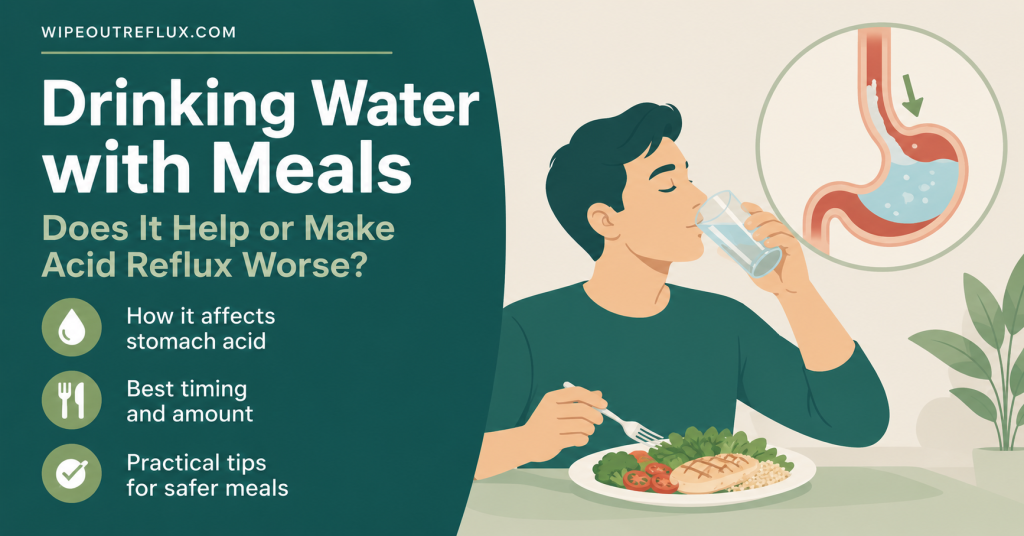
Yes, you can drink water with meals if you have reflux — but volume and pace matter far more than most advice admits, and the reason usually given for avoiding it is wrong.
The popular claim is that water dilutes stomach acid and ruins digestion. It doesn’t, in any way that lasts. A glass of water does raise gastric pH above 4 almost immediately, but in healthy subjects the effect lasted about three minutes [Karamanolis et al., Digestive Diseases and Sciences, 2008]. Your stomach re-acidifies faster than you can finish the glass.
The real issue is mechanical. Water adds volume to an already full stomach, and volume is what drives reflux. My practical rule: a modest glass — roughly 150 to 250 mL — sipped through the meal is fine for most people. A pint downed at the end of a large dinner is a different proposition entirely.
Key Takeaways
- Water does not meaningfully dilute stomach acid. The pH rise from a glass of water lasted around three minutes in healthy subjects.
- The genuine risk is gastric distension. Extra volume stretches the stomach, and stretch is the main trigger for the sphincter relaxations that cause reflux.
- Water drunk alongside a meal doesn’t sit there for hours — the stomach sieves it out, draining water preferentially while nutrients are retained.
- That sieving effect is why sipping steadily is far safer than drinking a large volume in one go.
- Small amounts of water can genuinely help, by clearing residual food and acid from the esophagus after swallowing.
- Using water to wash food down is the habit worth breaking — it lets you swallow poorly chewed boluses and eat faster.
- For LPR, a few sips during and after a meal can help rinse pepsin-containing residue out of the esophagus and throat.
Does Drinking Water With Meals Dilute Stomach Acid?
This is the claim behind almost every “don’t drink with meals” article, and it doesn’t survive contact with the evidence.
When researchers gave healthy subjects a glass of water and monitored intragastric pH, water raised gastric pH above 4 in 10 of 12 subjects within one minute — but that elevation lasted roughly three minutes, compared with about twelve minutes for an antacid [Karamanolis et al., Digestive Diseases and Sciences, 2008].
Three minutes. That’s the entire scope of the “dilution” effect, and it happens against a background of continuous acid secretion that ramps up sharply in response to the meal itself. Your parietal cells are not sitting there defeated by a glass of water.
There’s a mild irony here too: if dilution genuinely worked the way the myth suggests, water with meals would be a reflux treatment rather than a reflux trigger. It’s neither. It’s mechanical.
Why Water With Meals Can Still Trigger Reflux
Here’s the mechanism that actually matters.
Your lower esophageal sphincter doesn’t fail continuously. It opens in brief, unprompted episodes called transient lower esophageal sphincter relaxations — TLESRs — and the dominant trigger for them is stretch of the stomach wall. Distend the stomach and you provoke more of these relaxations [Holloway et al., Gastroenterology, 1985].
Water is volume. It adds to the volume the food has already created. If your meal has put 600 mL in your stomach and you add another 400 mL of water on top, you’ve increased distension by two-thirds at exactly the moment the sphincter is most likely to open.
Volume is measurably the lever. When reflux patients ate three 600 mL liquid meals a day versus six 300 mL meals, the smaller, more frequent pattern produced fewer reflux episodes, less esophageal acid exposure and fewer symptoms [Wu et al., Journal of Gastroenterology and Hepatology, 2014]. Nothing about the composition changed — only how much was in the stomach at once.
So the question isn’t “water or no water.” It’s whether the total volume in your stomach at any moment stays below your personal threshold. I’ve covered the broader hydration side of this in can drinking a lot of water cause acid reflux.
What Actually Happens to the Water You Drink With a Meal
This is the part almost nobody explains, and it changes the advice.
Your stomach doesn’t treat everything you swallow as one homogeneous soup. It layers and sorts. Nutrient-poor liquid drains through the pylorus preferentially while calorie-dense material is held back for further processing. Gastroenterologists call this gastric sieving.
Researchers demonstrated it neatly by giving people a nutrient shake either blended with water or with the same water drunk separately. When the water was drunk separately, 57% of the stomach contents had emptied at 35 minutes, versus 29% when it was blended in [Camps et al., Physiology and Behavior, 2017]. The separately drunk water simply drained off, leaving the nutrient layer behind. Blending prevented that sieving, and the same effect has been shown to increase satiation [Marciani et al., Journal of Nutrition, 2012].
Two practical consequences follow:
- Water with a meal is a short-lived volume problem, not a long one. It isn’t lingering in your stomach for two hours making things worse. The spike in distension is the risk — and the spike is what sipping avoids.
- Blended liquid meals behave differently from food plus water. A smoothie, a thick soup or a meal-replacement shake can’t sieve, so it occupies stomach volume for longer than the same ingredients eaten and drunk separately. That’s worth knowing if you rely on smoothies.
When Water With Meals Actually Helps
There’s a real upside, and it’s on the esophageal side rather than the gastric side.
Clearing acid from the esophagus happens in two stages: a peristaltic wave empties the volume back into the stomach, and swallowed saliva neutralizes the acid film left on the lining. Both are needed — volume clearance alone doesn’t restore pH [Helm et al., New England Journal of Medicine, 1984]. Every swallow you take contributes a peristaltic wave.
So a few sips of water during and just after a meal do three useful things:
- Wash residual food particles out of the esophagus, so there’s less material sitting on the lining to irritate it or be regurgitated.
- Trigger additional peristaltic waves, which improves clearance of anything that has refluxed.
- Rinse the throat and upper esophagus — which matters more than it sounds for LPR, because refluxed pepsin deposited in laryngeal tissue doesn’t clear the way acid volume does. I’ve explained that in how pepsin reactivates in the throat.
This is why I don’t tell people with reflux to eat dry. Choking down dry chicken breast with no liquid is worse for your esophagus, not better.
The Habit Actually Worth Breaking: Washing Food Down
If I had to pick one thing to change about how people drink at meals, it wouldn’t be the volume — it would be using water to wash food down.
When you take a gulp to help a mouthful go down, you’re bypassing the signal that tells you the bolus isn’t ready to swallow. You swallow larger, less broken-down pieces, you chew less, and you eat faster. Faster eating means a larger volume arrives in the stomach in a shorter window, which is exactly the distension spike you’re trying to avoid.
You also swallow more air when you gulp, which contributes to gastric distension in its own right and to the belching many reflux sufferers get after meals.
The fix is boring but effective: chew properly, swallow, then sip. Not sip to swallow. More on the chewing side in does chewing your food help acid reflux.
How Much Water With a Meal Is Reasonable?
There’s no trial that gives an exact threshold, so what follows is my practical read of the mechanism plus what I see working on consults:
- 150–250 mL with a meal — roughly one small glass, sipped across the whole meal rather than at the end. Fine for most people.
- Front-load your hydration. Drink most of your water 30 minutes or more before eating, and again an hour or two after. The stomach has largely cleared a plain water load by then.
- Avoid the end-of-meal pint. Downing a large glass on top of a full stomach is the single worst pattern — maximum distension at the point where the sphincter is already relaxing most often.
- Scale it to the meal. A large or fatty meal leaves you less headroom. On those, sip less.
- Count everything liquid. Soup, sauce, tea and the water you take pills with all contribute. It’s total volume, not water specifically.
And whatever you drink, don’t lie down on it. Adding volume and then going horizontal stacks two mechanisms — I’ve covered that in is lying down after eating bad.
Before, During or After the Meal?
Each has a different profile:
- Before (20–30 minutes ahead). The safest window. Plain water empties quickly, so you arrive at the meal hydrated with a stomach that’s already clearing. It may also blunt appetite slightly, which helps with portion size.
- During. Fine in small sips. This is where you get the esophageal-clearance benefit. Keep it to sips rather than glasses.
- Immediately after. The riskiest, because the stomach is at peak volume. A small sip to clear the throat is sensible; a full glass is not.
- An hour or more after. Safe again, and this is where most of your daily intake should sit.
Special Cases Worth Knowing
Carbonated water
Different rules. Carbonation adds gas volume on top of liquid volume and has been shown to lower sphincter pressure. If you’re drinking anything with a meal, still water is the safer choice — see what to drink with acid reflux for the full ranking.
Very cold water
Some people find ice-cold water with a meal provokes symptoms, possibly through effects on esophageal motility. It’s not well studied and it’s clearly individual. If you notice it, room temperature is an easy swap. The warm-water question is covered in does drinking hot water help acid reflux.
Alkaline water with meals
The case for alkaline water in LPR rests on pepsin inactivation in the throat, which is a different mechanism from anything happening in your stomach during a meal. If you use it, it makes more sense between meals than with them. See alkaline water for LPR and the best water for acid reflux.
Soup as a starter
Soup is liquid volume that behaves more like a blended meal than like water — it can’t sieve out the way plain water does. A large bowl of soup before a full main course is a bigger distension load than most people realise.
Conclusion
Drinking water with meals is not the problem the internet says it is. The dilution argument fails on the evidence — a glass of water buys you about three minutes of raised gastric pH against a stomach that’s actively secreting acid in response to the food. What’s left is a volume question, and volume is entirely manageable: sip a modest glass through the meal, do most of your drinking well before and well after, and stop using water to push food down.
If you’re finding that even small adjustments like this are making a noticeable difference, that usually tells you the mechanical side of your reflux is where the leverage is — meal size, meal timing, eating pace, position — and that’s exactly where most people are leaving the biggest gains on the table. The Wipeout Diet Plan is the full protocol I put together from twelve years of working this out on myself: a structured approach to the foods, the timing and the daily mechanics together, rather than one rule at a time. It was built first around LPR — the throat-based form that’s hardest to shift — but because the underlying mechanisms are the same, it works just as well for GERD and ordinary heartburn.
If you want a simpler starting point, the Wipeout Food Reference Guide is the essential companion — every food and drink worth knowing about for acid reflux and LPR, with their pH values, so you can see at a glance what belongs on the plate next to that glass of water.
Frequently Asked Questions
Does drinking water with meals dilute stomach acid?
Not meaningfully. A glass of water raises gastric pH above 4 within a minute in most people, but the effect lasted around three minutes in healthy subjects. The stomach secretes acid continuously and ramps up in response to a meal, so the dilution is immediately reversed.
How much water can I drink with a meal if I have reflux?
Roughly 150–250 mL sipped through the meal suits most people. The key is pace rather than total: small sips spread across the meal produce much less distension than the same amount drunk in one go at the end.
Is it better to drink water before or after eating?
Before, if you’re choosing one. Twenty to thirty minutes ahead of the meal, plain water has largely cleared the stomach by the time you eat. The riskiest moment is immediately after finishing, when gastric volume is already at its peak.
Why do I get reflux right after drinking water with dinner?
Almost always volume, not the water itself. You’ve added liquid to a stomach that’s already distended from the meal, and stretch is the main trigger for the sphincter relaxations that let reflux through. Try halving the amount and sipping it across the meal instead.
Does water with meals slow down digestion?
No. Plain water drunk alongside food drains out of the stomach preferentially through gastric sieving, leaving the nutrient layer behind. In one study, drinking water separately from a shake left 57% of stomach contents emptied at 35 minutes, versus 29% when blended in.
Should I stop drinking water with meals if I have LPR?
I wouldn’t. A few sips during and after eating help clear food residue and refluxed material out of the esophagus and throat, which matters for LPR because pepsin left in laryngeal tissue doesn’t clear on its own. Keep the volume modest and stay upright afterwards.
What about drinking water to take tablets with a meal?
Take medication with enough water to clear the esophagus properly — a small sip isn’t enough, and tablets that lodge in the esophagus can cause direct irritation. Then stay upright for at least 30 minutes. Count that water towards your meal total.
Research & References
- [Karamanolis et al., Digestive Diseases and Sciences, 2008] — Water raised gastric pH above 4 within one minute in 10 of 12 healthy subjects, but the elevation lasted only about three minutes, compared with roughly twelve minutes for an antacid.
- [Holloway et al., Gastroenterology, 1985] — Established gastric distension as a mechanism for postprandial reflux, showing that stretching the stomach provokes transient lower esophageal sphincter relaxations.
- [Wu et al., Journal of Gastroenterology and Hepatology, 2014] — In reflux patients, six 300 mL liquid meals daily produced fewer reflux episodes, less esophageal acid exposure and fewer symptoms than three 600 mL meals.
- [Camps et al., Physiology and Behavior, 2017] — Water consumed separately from a nutrient shake drained preferentially from the stomach (57% emptied at 35 minutes) compared with the same water blended into it (29%), demonstrating gastric sieving.
- [Marciani et al., Journal of Nutrition, 2012] — Blending a solid meal with water prevented gastric sieving and enhanced satiation in healthy subjects.
- [Helm et al., New England Journal of Medicine, 1984] — Showed that clearing acid from the esophagus requires both peristaltic emptying of the refluxed volume and neutralization by swallowed saliva; volume clearance alone does not restore esophageal pH.

David Gray
12 years living with LPR · Consultant & researcher
I've lived with LPR for twelve years — the misdiagnoses, the PPI courses that did nothing, the slow work of figuring out what actually helps. Wipeout Reflux is where I translate the research into plain terms for people stuck in the same place. Every claim here is sourced to peer-reviewed work, and I consult one-to-one with LPR sufferers.