
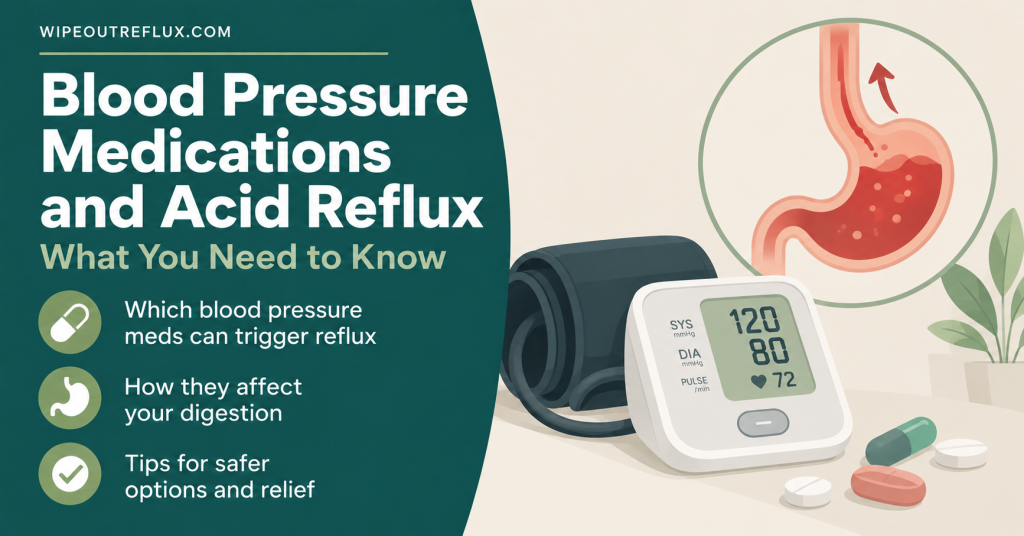
Some blood pressure medications can make acid reflux worse, and the ones most often implicated are calcium channel blockers and nitrates. The mechanism is real and well characterized: your lower esophageal sphincter is smooth muscle, its tone depends on calcium entering the muscle cells, and drugs that block that calcium relax it. Nifedipine lowers sphincter pressure so reliably that it’s been used therapeutically for exactly that purpose in achalasia [Bortolotti and Labo, Gastroenterology, 1981].
But I’m going to be straighter with you than most articles on this topic: the mechanism being real doesn’t mean your particular drug is the cause of your particular reflux. The population-level evidence is patchier than you’d expect, and for amlodipine — by far the most commonly prescribed of these — a 2025 genetic study found the opposite of what the mechanism predicts.
Whatever you conclude from this article, do not stop or change a blood pressure medication on your own. There are almost always alternatives within the same therapeutic goal, and that’s a conversation to have with your prescriber.
Key Takeaways
- Calcium channel blockers and nitrates both relax smooth muscle, including the lower esophageal sphincter — this is a genuine, well-documented mechanism.
- Nifedipine is used to lower sphincter pressure deliberately in achalasia, which tells you how reliably it does it.
- Amlodipine is the exception worth knowing about: a 2025 Mendelian randomization study found genetically predicted amlodipine use associated with lower GERD risk (OR 0.872).
- Diltiazem’s effect on the esophagus is weaker than the class reputation suggests — in healthy volunteers it had minimal effect on baseline contractions.
- Nitrates lowered sphincter pressure and increased reflux, but mainly in people who already had impaired esophageal motility.
- ACE inhibitors don’t relax the sphincter — but the dry cough they cause is routinely mistaken for a reflux cough, and vice versa.
- High blood pressure and reflux share risk factors, so some of the association is the reason you’re on the drug, not the drug.
Why a Blood Pressure Drug Can Affect Your Esophagus at All
The connection surprises people, but it’s straightforward once you see what these drugs actually do.
Most blood pressure medications work by relaxing smooth muscle — specifically the smooth muscle in the walls of your arteries. Relax the arteries, they widen, resistance falls, blood pressure drops.
The problem is that smooth muscle isn’t only in your arteries. Your lower esophageal sphincter — the ring of muscle that keeps stomach contents out of your esophagus — is smooth muscle too, and it maintains its resting tone through the same calcium-dependent machinery. A drug delivered through your bloodstream can’t tell the difference between the smooth muscle you want relaxed and the smooth muscle you very much don’t.
That’s the whole mechanism. Everything below is about which drugs do it, and how much.
Calcium Channel Blockers: The Main Suspects
These are the class with the clearest mechanism. They block calcium entry into smooth muscle cells, and sphincter tone depends on exactly that.
Dihydropyridines — amlodipine, nifedipine, felodipine, lercanidipine
These are the most vessel-selective calcium channel blockers, and the ones most likely to be prescribed for straightforward hypertension. You’ll recognize them by the “-dipine” ending.
Nifedipine has the strongest esophageal evidence, and it’s not subtle. It was studied as a treatment for achalasia specifically because it reduces lower esophageal sphincter pressure [Bortolotti and Labo, Gastroenterology, 1981]. It also potently inhibits contractions in the body of the esophagus [Richter et al., Gastroenterology, 1985].
That second finding matters more than people realize. Weaker esophageal contractions mean slower clearance of whatever refluxes. So the drug can plausibly hit you twice: a slightly leakier valve and a slower clean-up. Given that clearing acid from the esophagus depends on peristaltic emptying followed by saliva neutralization [Helm et al., New England Journal of Medicine, 1984], anything that weakens peristalsis lengthens every episode.
Rate-limiting agents — diltiazem and verapamil
These act on the heart as well as the vessels, and are often assumed to carry the same esophageal risk. The evidence is weaker than the assumption.
When researchers gave oral diltiazem to healthy volunteers, it had no significant effect on esophageal contractions compared with baseline or placebo. It only produced measurable changes in patients who already had abnormally high-amplitude contractions [Richter et al., Digestive Diseases and Sciences, 1984].
That’s a useful corrective. “Calcium channel blockers relax the sphincter” is true as a class statement but not uniformly true drug by drug, and the healthy esophagus seems more robust than the impaired one.
The amlodipine puzzle
Here’s where I’d push back hardest on the standard advice, because amlodipine is the drug most people reading this are actually taking.
A 2025 Mendelian randomization study — which uses genetic variants as proxies for drug exposure to reduce confounding — found a significant negative association between genetically predicted amlodipine use and GERD risk, with an odds ratio of 0.872 (95% CI 0.812–0.937). The authors went as far as suggesting amlodipine might be worth investigating as a GERD treatment [Zhang et al., PLOS ONE, 2025].
I’d treat that cautiously. Mendelian randomization estimates lifetime genetic effects on a drug target, which isn’t the same as what happens when a 62-year-old starts 10 mg of amlodipine tomorrow. But it’s real evidence pointing the opposite way from the mechanistic prediction, and it deserves to be in the picture rather than quietly left out.
The practical takeaway: if you started amlodipine and your reflux got worse, that’s worth reporting and worth a trial of an alternative. But “amlodipine causes reflux” isn’t as settled as the internet implies, and it shouldn’t be the first thing you blame.
Nitrates: A Clearer Case, With a Caveat
Nitrates — glyceryl trinitrate, isosorbide mononitrate, isosorbide dinitrate — work by releasing nitric oxide, which is one of the body’s own signals for relaxing the lower esophageal sphincter. So the mechanism here isn’t a side effect of vascular targeting; it’s the same pathway your body uses to open the sphincter deliberately.
The evidence bears it out, with an important nuance. When isosorbide dinitrate was given to healthy volunteers and to patients with esophageal dysmotility, it significantly increased reflux episodes and severity in the dysmotility group — but the healthy volunteers and those with normal motility showed no increase, despite the drug reducing sphincter pressure [Matsuda et al., Digestive Diseases and Sciences, 1995].
That’s the pattern across this whole topic: these drugs don’t create reflux out of nothing. They remove margin. If your esophagus was coping comfortably, you may notice nothing. If it was already borderline — which describes most people reading a reflux site — the same drug tips you over.
ACE Inhibitors: Not the Sphincter, but Plenty of Confusion
ACE inhibitors — ramipril, lisinopril, perindopril, enalapril — don’t work through smooth muscle relaxation in the way calcium channel blockers do, and they’re not classic sphincter relaxants.
The problem they cause is diagnostic. The dry, tickly, persistent cough that affects a substantial minority of ACE inhibitor users is close to indistinguishable from a reflux cough. Both are dry, both are worse when lying down or talking, both come with throat irritation and throat clearing.
I’ve seen this cut both ways on consults: people treated with escalating reflux medication for what turned out to be an ACE inhibitor cough, and people switched off a perfectly good ACE inhibitor for a cough that was reflux all along. I’ve covered both sides in ACE inhibitor cough and lisinopril and acid reflux.
The distinguishing question that helps most: did the cough start within weeks of starting or increasing the drug? ACE inhibitor cough usually does. Reflux cough tends to have a longer, more fluctuating history and more company — throat clearing, hoarseness, a lump sensation. More on telling them apart in reflux cough and vagal cough.
What About the Rest?
- ARBs (candesartan, losartan, valsartan). No established sphincter-relaxing mechanism, and no cough. This is usually where people are switched when an ACE inhibitor cough is the problem.
- Beta-blockers (bisoprolol, atenolol, propranolol). Sometimes listed as reflux-aggravating. The evidence is thin and the mechanism isn’t clear. Not my first suspect.
- Diuretics (bendroflumethiazide, indapamide, furosemide). No direct sphincter effect, but they can cause dry mouth — and reduced saliva means poorer acid neutralization in the esophagus, since saliva is a required part of acid clearance. Worth knowing if your main complaint is throat symptoms.
- Alpha-blockers (doxazosin). Smooth muscle relaxants by design, so plausible on mechanism, but sparsely studied in the esophagus.
For the wider picture beyond blood pressure drugs, see medications that make acid reflux worse. Aspirin often sits alongside these in the same daily pill box and damages the lining through a completely different route — covered in low-dose aspirin and acid reflux.
Is It the Drug, or the Reason You’re Taking It?
This is the part that almost never gets said, and it matters for how you interpret your own experience.
Hypertension and reflux share a lot of ground. Excess weight — central weight in particular — raises intra-abdominal pressure and is a well-established driver of reflux, and it’s also one of the main reasons people end up on blood pressure medication in the first place. Age, alcohol intake and inactivity sit on both sides too.
So when studies find that people on antihypertensives use more acid-suppressing medication — as they have done [Chow et al., The Journal of Clinical Pharmacology, 2001] — a share of that is confounding rather than causation. The question of whether calcium antagonists genuinely contribute to reflux and non-cardiac chest pain has been asked directly in the pharmacology literature [Hughes et al., British Journal of Clinical Pharmacology, 2007], and it remains a live question rather than a settled one.
None of which means your drug is innocent. It means the timing test is more informative than the class reputation: if symptoms began or clearly worsened within a few weeks of starting or increasing a specific drug, that’s a real signal. If you’ve been on it for six years and your reflux started last spring, look elsewhere. Weight change is a common “elsewhere” — see acid reflux and weight loss.
What to Actually Do About It
In order:
- Don’t stop anything. Uncontrolled blood pressure is a far larger risk than reflux. Some of these drugs also cause rebound effects on abrupt withdrawal.
- Build a timeline. Note when each drug was started or the dose changed, and when symptoms began. Take it to the appointment. This single piece of evidence is worth more than any list of side effects.
- Keep a two-week symptom diary. Time of day, relationship to doses, relationship to meals and position. Reflux that clusters an hour or two after the tablet points at the drug. Reflux that clusters after evening meals points at meal mechanics.
- Ask specifically about switching within or across class. Moving from nifedipine to amlodipine, or from a calcium channel blocker to an ARB, is often clinically straightforward. Frame it as “is there an equivalent option that’s less likely to relax the sphincter?” rather than “I want to stop this.”
- Ask about timing. Where clinically acceptable, moving a dose away from bedtime reduces the overlap between peak drug effect and lying flat. Never change dose timing without asking.
- Take every tablet with a full glass of water, upright. Some of what people call “medication reflux” is a tablet irritating the esophagus directly.
- Tighten the mechanics you do control. If a drug has removed some of your margin, the way to get it back is to reduce the number of reflux events in the first place — meal size, meal timing, and staying upright afterwards. See is lying down after eating bad, and the Wipeout Diet Plan if you want the whole thing structured.
Conclusion
Blood pressure medication and acid reflux do genuinely interact, and calcium channel blockers and nitrates are where the mechanism is strongest — both relax the smooth muscle your sphincter is made of, and calcium channel blockers can weaken the esophageal contractions that clear what escapes. But the honest summary is narrower than most articles admit: nifedipine has clear esophageal effects, nitrates matter most in people whose motility is already impaired, diltiazem’s effect on a healthy esophagus is minimal, and amlodipine — the most-prescribed of the lot — has genetic evidence pointing the other way entirely.
Which brings me to the part you can actually act on. If a medication has taken away some of your margin, you get it back by reducing how often reflux happens at all — and that is almost entirely about meal composition, meal size, timing and daily mechanics. That’s what the Wipeout Diet Plan is built around: the complete protocol I developed across twelve years of managing this myself, aimed at cutting the number of reflux events rather than just treating what arrives. It was designed first for LPR — the throat-based form that responds least well to standard acid suppression — but because it targets the same underlying mechanisms it works just as well for GERD and ordinary heartburn. For anyone who can’t change the drug they’re on, that’s the lever that’s left.
If you want a lighter starting point, the Wipeout Food Reference Guide is the essential companion — the foods and drinks worth knowing about for acid reflux and LPR with their pH values, so you can stop asking a compromised sphincter to do more work than it has to.
This article is general information, not medical advice. Never stop or change a prescribed blood pressure medication without speaking to your doctor.
Frequently Asked Questions
Can blood pressure medication cause acid reflux?
Some can. Calcium channel blockers and nitrates relax smooth muscle, including the lower esophageal sphincter, which can allow more reflux. The effect varies considerably between individual drugs, and it tends to show up in people whose reflux control was already marginal rather than creating reflux from nothing.
Does amlodipine cause acid reflux?
It’s less clear-cut than the class mechanism suggests. Amlodipine is a calcium channel blocker, so relaxing the sphincter is plausible — but a 2025 Mendelian randomization study found genetically predicted amlodipine use associated with lower GERD risk, not higher. If your symptoms began within weeks of starting it, report that; but don’t assume it’s the cause.
Which blood pressure medication is best if I have reflux?
That’s a decision for your prescriber, based on your cardiovascular picture rather than your stomach. That said, ARBs have no established sphincter-relaxing mechanism and no cough, which is why they’re often where people are moved when either problem comes up.
Do ACE inhibitors cause acid reflux?
Not directly. They don’t relax the sphincter the way calcium channel blockers do. The confusion comes from the dry cough a significant minority develop, which is very hard to distinguish from a reflux cough. The timing of onset relative to starting the drug is usually the most useful clue.
Do beta-blockers make reflux worse?
They appear on plenty of lists, but the evidence is thin and there’s no clear mechanism comparable to the calcium channel blockers. If you’re on a beta-blocker and a calcium channel blocker and something has to be suspected, the calcium channel blocker is the better candidate.
Should I take my blood pressure tablet at night if I get reflux?
Ask before changing anything — dose timing is sometimes clinically important. But in principle, a dose taken right before lying down means peak drug effect coincides with the position where you have least protection, so moving it away from bedtime can help where it’s clinically acceptable.
How do I know if my medication is the cause?
Timing. If symptoms started or clearly worsened within a few weeks of starting or increasing a specific drug, that’s a genuine signal worth raising. If you’ve been stable on the drug for years and symptoms appeared recently, the cause is almost certainly something else — weight change, diet, alcohol or a new medication elsewhere on the list.
Research & References
- [Bortolotti and Labo, Gastroenterology, 1981] — Studied the clinical and manometric effects of nifedipine in patients with esophageal achalasia, where the drug is used for its ability to reduce lower esophageal sphincter pressure.
- [Richter et al., Gastroenterology, 1985] — Found nifedipine to be a potent inhibitor of contractions in the body of the human esophagus, in both healthy volunteers and patients with nutcracker esophagus.
- [Richter et al., Digestive Diseases and Sciences, 1984] — Oral diltiazem had no significant effect on esophageal contractions in healthy volunteers, but reduced contraction amplitude and duration in patients with nutcracker esophagus.
- [Matsuda et al., Digestive Diseases and Sciences, 1995] — Isosorbide dinitrate reduced lower esophageal sphincter pressure and significantly increased reflux in patients with esophageal dysmotility, while healthy volunteers and those with normal motility showed no increase.
- [Zhang et al., PLOS ONE, 2025] — Mendelian randomization study finding a significant negative association between genetically predicted amlodipine use and GERD risk (OR 0.872, 95% CI 0.812–0.937), with CACNB2 identified as the core target gene.
- [Hughes et al., British Journal of Clinical Pharmacology, 2007] — Examined whether calcium antagonists contribute to gastro-oesophageal reflux disease and concomitant non-cardiac chest pain.
- [Chow et al., The Journal of Clinical Pharmacology, 2001] — Examined the association between antihypertensive drug use and subsequent use of acid-suppressive therapy.
- [Helm et al., New England Journal of Medicine, 1984] — Showed that clearing acid from the esophagus requires both peristaltic emptying of the refluxed volume and neutralization by swallowed saliva, so anything that weakens peristalsis or reduces saliva prolongs each episode.

David Gray
12 years living with LPR · Consultant & researcher
I've lived with LPR for twelve years — the misdiagnoses, the PPI courses that did nothing, the slow work of figuring out what actually helps. Wipeout Reflux is where I translate the research into plain terms for people stuck in the same place. Every claim here is sourced to peer-reviewed work, and I consult one-to-one with LPR sufferers.