
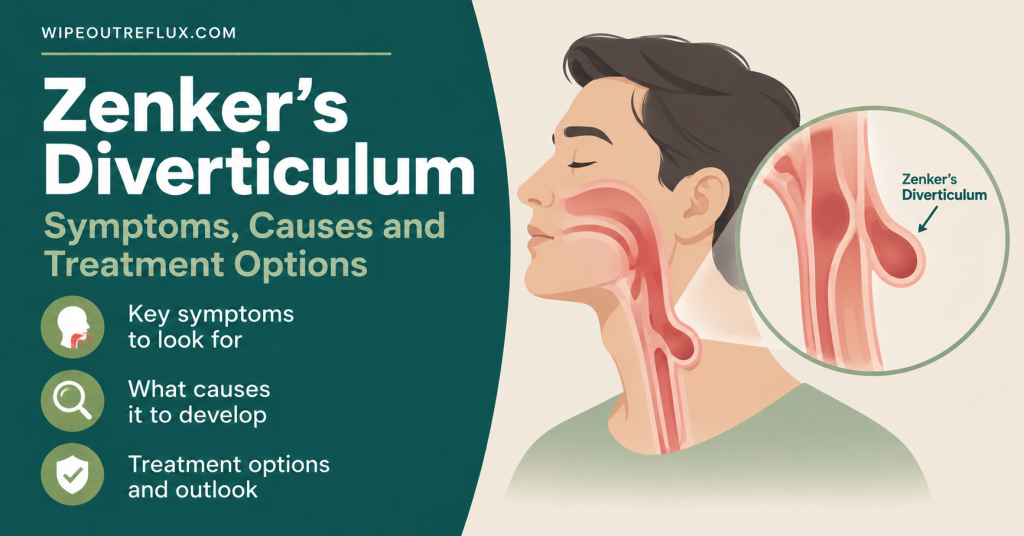
A Zenker’s diverticulum is a pouch that forms in the back wall of the throat, just above the ring of muscle at the top of the esophagus. Food and liquid fall into it instead of passing straight down — which is why the hallmark symptom isn’t heartburn or acid, but bringing back undigested food hours after a meal.
It’s uncommon, affecting somewhere between 0.01% and 0.11% of the population, and it’s overwhelmingly a condition of older adults — most patients are between 70 and 90, with onset before 40 being unusual Nesheiwat and Antunes, StatPearls, 2023. In the UK you’ll hear it called a pharyngeal pouch, which is the same thing under a different name.
I’m covering it on a reflux site for one reason: it is routinely mistaken for silent reflux for months or years before anyone films a barium swallow. Both cause a stuck feeling, throat clearing, cough and bad breath. But one is treated with diet and behavior, and the other is a mechanical problem that only surgery fixes — so telling them apart matters.
Key Takeaways
- A Zenker’s diverticulum is a pouch herniating through a weak point called Killian’s triangle, caused by a cricopharyngeus muscle that fails to open properly during swallowing.
- Dysphagia is the dominant symptom, reported by up to 98% of patients, usually alongside regurgitation of undigested food, bad breath, cough and sometimes weight loss.
- Regurgitating recognizable food hours after eating, with no acid or burning, is the feature that separates it from reflux — reflux brings up acid or sour liquid, not yesterday’s dinner.
- It’s diagnosed with a barium swallow and videofluoroscopy, not by endoscopy alone — and blind scope insertion carries a real perforation risk.
- Small, symptom-free pouches are usually monitored rather than operated on; treatment is driven by symptoms, not size.
- Every effective treatment does the same thing: divides the cricopharyngeus muscle. That myotomy is the operative part, whether done openly or endoscopically.
- Endoscopic approaches have largely replaced open surgery for most patients, with Z-POEM showing the highest clinical success in comparative studies.
- Open surgery still has the edge on durability, which is why frailty and pouch size — rather than fashion — drive the choice.
What Is a Zenker’s Diverticulum?
Start with the anatomy, because the whole condition follows from it.
At the junction between your throat and your esophagus sits the cricopharyngeus, a ring of muscle that stays closed at rest and relaxes to let each swallow through. It forms the bulk of the upper esophageal sphincter. Just above it, there’s a natural weak spot in the throat wall where the transverse fibers of the cricopharyngeus meet the oblique fibers of the inferior pharyngeal constrictor. That gap is Killian’s triangle.
If the cricopharyngeus stops opening properly, every swallow generates a pressure spike against a closed door. Over years, the lining of the throat is pushed out through Killian’s triangle and a pouch forms Nesheiwat and Antunes, StatPearls, 2023.
Two details matter clinically. First, it’s a false diverticulum — only the mucosa and submucosa herniate, not the full muscle wall. Second, it sits above the sphincter, so anything that falls in stays in the throat rather than the esophagus. That’s why the contents come back up recognizable, unchanged, and without acid.
Zenker’s Diverticulum vs Pharyngeal Pouch
There’s no difference. “Pharyngeal pouch” is the standard British term and “Zenker’s diverticulum” the standard American and international one, both describing the same hypopharyngeal pouch through Killian’s triangle. If you’ve been given one term by one doctor and the other by a second opinion, nothing has changed.
Symptoms of Zenker’s Diverticulum
The symptom picture is distinctive once you know what to look for, and it typically builds over months or years before anyone investigates.
- Dysphagia. The dominant symptom, reported by up to 98% of patients. It’s usually a high, throat-level obstruction — food seems to stop at the neck rather than behind the breastbone.
- Regurgitation of undigested food. The signature. Recognizable, unchanged food and pills returning to the mouth, often hours after the meal, and often on bending or lying down.
- Halitosis. Food fermenting in a pouch produces bad breath that brushing doesn’t touch — a symptom reflux can also cause, though by a completely different route.
- Chronic cough and aspiration. Pouch contents spilling into the airway, particularly at night. Recurrent chest infections in an older adult are a genuine warning sign.
- A gurgling noise in the neck, sometimes audible to other people.
- Weight loss. From eating less, eating more slowly, and avoiding foods that get stuck.
- Voice change, throat clearing and a lump sensation, which is precisely where the confusion with reflux comes in.
One practical clue: many people with a Zenker’s develop rituals they no longer notice — coughing after every meal, drinking after each mouthful, turning or pressing on the neck to clear a swallow, avoiding bread and meat. If you recognize those, mention them, because they’re diagnostic gold and patients rarely volunteer them.
Zenker’s Diverticulum Causes
The short version: a cricopharyngeus muscle that doesn’t open properly, plus time.
The underlying abnormality appears to be impaired cricopharyngeal compliance, usually from fibrotic change in the muscle — the tissue becomes stiff and less able to relax and open during a swallow Nesheiwat and Antunes, StatPearls, 2023. The pharynx keeps generating normal or raised pressure to push food through a narrower opening, and the weakest part of the wall gives way.
That makes it a pulsion diverticulum: created by pressure from inside, not by anything pulling from outside. It also explains three things that otherwise look odd:
- Why it takes decades. It’s cumulative mechanical stress, which is why it’s a disease of the seventh to ninth decades.
- Why removing the pouch alone isn’t enough. If the muscle still doesn’t open, the pressure that made the first pouch is still there. This is the single most important fact about treatment.
- Why it’s associated with reflux, without being caused by it. Reflux is common in this age group and has been linked to cricopharyngeal dysfunction, but the evidence doesn’t support the idea that reflux creates the pouch. Treating reflux won’t shrink one.
It’s more commonly reported in Northern Europe, the United States and Canada, and rare in Japan and Indonesia — a geographic pattern that’s been noted for decades without a settled explanation.
Zenker’s Diverticulum Diagnosis
A barium swallow with videofluoroscopy is the test. You swallow a contrast liquid while the radiologist films the swallow in motion, which shows the pouch, its size, its position, and — importantly — how well the cricopharyngeus opens. A static image can miss a small pouch entirely; the movement is the point.
Upper endoscopy complements it and is usually done as part of surgical planning, but it is not the primary diagnostic test Nesheiwat and Antunes, StatPearls, 2023. There’s a specific hazard worth knowing: an endoscope passed blindly can enter the pouch rather than the esophagus, and the pouch wall is thin. If a Zenker’s is suspected, the endoscopist needs to know before the scope goes in.
That’s also why I’d push back gently on the common sequence of events. Plenty of people with these symptoms are scoped for suspected reflux, told everything looks normal, and sent away — when the test that would have found the problem is the one nobody ordered. If you have throat-level dysphagia with regurgitation of undigested food, ask specifically about a barium swallow. More on reflux testing and what endoscopy can and can’t show.
Manometry has a limited role — the pouch itself interferes with catheter placement — but esophageal manometry may be used where the diagnosis is uncertain or another motility disorder is suspected.
How to Tell It Apart From Silent Reflux
This is the section I most wanted to write, because the overlap is real and the consequences of getting it wrong run into years.
Laryngopharyngeal reflux and a Zenker’s diverticulum share a remarkable number of symptoms: a lump or stuck sensation, throat clearing, cough, bad breath, voice change, and the sense that swallowing isn’t working properly. In LPR, that stuck feeling is usually globus — the upper sphincter contracting defensively rather than anything physically blocking the way.
Here’s how they separate:
- What comes back up. Reflux brings up acid, sour or bitter liquid, sometimes a mouthful of froth — see water brash and regurgitation. A Zenker’s brings up recognizable, unchanged food and whole tablets, with no acid taste at all.
- Timing. Reflux symptoms cluster within a couple of hours of eating and on lying down. Pouch regurgitation can happen many hours later, or on bending, because the food never went anywhere.
- Does food actually stick? Globus improves when you eat — a bolus forces the sphincter open. A pouch makes eating worse, progressively, and drives food avoidance.
- Progression. LPR fluctuates: good weeks, bad weeks, responsive to diet. A Zenker’s worsens steadily and never has good weeks.
- Response to treatment. Reflux measures produce at least partial improvement. Nothing dietary touches a pouch.
If the picture fits reflux rather than a pouch, the Wipeout Diet Plan is where I’d start — it’s built around the throat-based form of reflux that produces this exact symptom cluster, and it’s a far better use of a few months than another course of acid suppression. It’s also worth understanding how LPR differs from classic GERD, since the throat presentation is what causes the diagnostic confusion in the first place.
Two symptoms should always trigger imaging rather than a reflux trial: regurgitation of undigested food, and unexplained weight loss. Neither belongs to uncomplicated reflux. It’s also worth reading about the other structural causes of a stuck feeling — peptic stricture, eosinophilic esophagitis and reflux-related swallowing difficulty — since all of them produce genuine dysphagia rather than globus.
Achalasia vs Zenker’s Diverticulum
Both involve a sphincter that won’t open, which is where the similarity ends — and the difference is which sphincter.
Achalasia affects the lower esophageal sphincter, at the bottom of the esophagus. Food collects in the esophagus itself, regurgitation is typically of large volumes of undigested food and saliva, chest discomfort is common, and swallowing difficulty affects liquids as much as solids from early on. A Zenker’s affects the upper sphincter, food collects in a pouch in the neck, regurgitated volumes are smaller, and the sensation is high in the throat. Achalasia is diagnosed with manometry; a Zenker’s with a barium swallow. I’ve compared achalasia and acid reflux separately, and covered esophageal motility more broadly.
One more mimic worth naming: rumination syndrome, where food returns effortlessly within minutes of eating through an unconscious learned contraction. It’s frequently mistaken for both of the above and needs neither surgery nor acid suppression.
Zenker’s Diverticulum Treatment
The governing principle is simpler than the range of options suggests: every effective treatment divides the cricopharyngeus muscle.
Removing or repositioning the pouch without addressing the muscle leaves the cause in place — the pressure that created the first pouch is still there. That’s why the myotomy is the operation, and what happens to the pouch itself is secondary.
What isn’t treatment: acid suppression, dietary change, speech therapy, or watchful waiting for a symptomatic pouch. These may help coexisting problems, but none of them will alter the diverticulum.
The three broad approaches:
- Flexible endoscopic septotomy — cutting the common wall (the “septum”) between pouch and esophagus, including the muscle fibers within it, using a flexible scope under sedation.
- Rigid endoscopic stapling or laser — a rigid scope under general anesthesia, dividing and sealing the septum in one step.
- Open transcervical surgery — an incision in the neck, formal cricopharyngeal myotomy, and removal, inversion or suspension of the pouch.
Then there’s the newer technique that has changed the picture considerably.
Cricopharyngeal Myotomy for Zenker’s Diverticulum
Cricopharyngeal myotomy means cutting through the cricopharyngeus muscle so it can no longer act as an obstruction. It is the therapeutic core of every approach — done under direct vision in open surgery, or through the septum endoscopically.
Performed on its own, without addressing the pouch, it’s sometimes used for very small diverticula or for cricopharyngeal dysfunction with no pouch at all. Combined with diverticulectomy, it’s the classic open operation.
The reason it works is that it removes the pressure gradient. Once the muscle no longer resists, swallows pass without forcing the wall outward — which both relieves symptoms and stops the pouch enlarging further.
Endoscopic Zenker’s Diverticulum Surgery
Endoscopic approaches now handle the majority of cases, and the reasons are practical: no neck incision, shorter hospital stay, quicker return to eating, and — for the flexible technique — no general anesthetic, which matters a great deal in a population whose average age is in the mid-seventies.
The newest variant is Z-POEM (Zenker’s peroral endoscopic myotomy), which borrows the submucosal tunneling technique developed for achalasia. Instead of cutting the septum from the lumen, the endoscopist creates a tunnel under the mucosa, divides the muscle within it under direct vision, then closes the mucosal entry. The theoretical advantage is a complete myotomy with the mucosa left intact over the top.
The outcome data are encouraging. An international multicenter study of Z-POEM reported 100% technical success, a median procedure time of 61 minutes, no adverse events, and clinical success in 23 of 24 patients at a median 10-month follow-up Elkholy et al., Esophagus, 2021. A larger comparison across 12 centers and 245 patients found clinical success of 92.7% for Z-POEM, 89.2% for rigid septotomy and 86.7% for flexible septotomy, with adverse events in 30.0% of rigid septotomy patients, 16.8% of Z-POEM patients and 2.3% of flexible septotomy patients Al Ghamdi et al., Endoscopy, 2022.
A 2025 systematic review and meta-analysis of seven comparative studies covering 747 patients found Z-POEM achieved clinical success in 86.7% versus 71.7% for the alternatives, with perforation rates of 2.25% for Z-POEM, 4.62% for flexible diverticulotomy and 7.78% for rigid diverticulotomy — while noting that randomized trials are still lacking Papaefthymiou et al., Diseases of the Esophagus, 2025.
Zenker’s Diverticulum Repair: Open Surgery
Open transcervical repair is no longer the default, but it hasn’t been retired, and for good reason.
Through a small incision on the left side of the neck, the surgeon performs a formal cricopharyngeal myotomy and then deals with the pouch — removing it (diverticulectomy), turning it inward (diverticular inversion), or suspending it upward so it can’t fill (diverticulopexy). Which of those is chosen depends largely on pouch size.
The trade-off is well characterized. A multicenter comparative study of 144 patients undergoing 165 procedures found clinical success of 97% for open surgery, 79% for rigid endoscopy and 90% for flexible endoscopy, with the endoscopic approaches offering a shorter hospital stay at the cost of a higher risk of symptom recurrence; the authors concluded flexible endoscopy is a reasonable alternative to open surgery, particularly in frail patients Rudler et al., Surgical Endoscopy, 2023.
In practice, open repair tends to be favored for very large pouches, for recurrence after an endoscopic attempt, for very small pouches where there isn’t enough septum to work with endoscopically, and where anatomy — neck extension, dentition, jaw opening — makes endoscopic access difficult. Recovery is longer, usually a few days in hospital, and the specific risks include injury to the recurrent laryngeal nerve, leak, and infection.
Success Rates, Recurrence and Recovery
Bringing the numbers together, since this is what most people actually want to know.
- Success rates are high across the board — broadly 80–97% depending on technique and how success is defined, with Z-POEM at the upper end in comparative work.
- Recurrence is the main limitation of endoscopic repair. In the 245-patient multicenter comparison, 24 patients recurred over a mean follow-up of around 282 days Al Ghamdi et al., Endoscopy, 2022.
- Recurrence is usually retreatable. A repeat endoscopic procedure is common; conversion to open repair is the fallback.
- Complication rates differ meaningfully by technique, with perforation the one to ask about specifically.
How long does Zenker’s diverticulum surgery take? Endoscopic procedures typically run under an hour — the Z-POEM series above reported a median of 61 minutes, and straightforward septotomy is often faster. Open repair generally takes one to two hours. Hospital stay is the bigger difference: often same-day or overnight for flexible endoscopic treatment, versus a few days after open surgery.
Most units restrict you to liquids for a day or two afterward, then soft food, then a normal diet over one to two weeks. Follow the unit’s protocol rather than a general article — it’s tailored to what was done and how the closure was made.
Small Zenker’s Diverticulum: Does It Always Need Treating?
No. Treatment is driven by symptoms, not size.
A small pouch found incidentally on a scan done for another reason, in someone who isn’t struggling to swallow, is usually monitored. Small diverticula are also technically harder to treat endoscopically — there’s less septum to divide — so the risk-benefit calculation is less favorable when symptoms are mild.
What tips the balance toward intervention is not a measurement but a pattern: swallowing getting harder, food being avoided, weight going down, regurgitation becoming frequent, or any sign of aspiration such as coughing at night or a chest infection. Aspiration in particular changes the calculation, because that’s where the genuine risk lies.
If you’re being monitored, the useful thing to track is functional: what you can eat, how long meals take, whether you’ve started avoiding specific foods, and your weight. Those tell your surgeon more than the pouch’s dimensions in centimeters.
Diet for Zenker’s Diverticulum
Let me be straight about this: diet does not treat a Zenker’s diverticulum. It can make life more manageable while you wait for surgery, or if you’re not a candidate for it, but nothing you eat will shrink a pouch.
What genuinely helps in the meantime:
- Smaller mouthfuls, chewed thoroughly. Less bulk is less likely to lodge.
- Softer, moister textures. Dry bread, tough meat, rice and crumbly foods are the classic offenders.
- Sips of liquid between mouthfuls to help clear the pharynx.
- Sitting fully upright to eat, and staying upright for a while afterward.
- Nothing to eat or drink close to bedtime, which is the main defense against overnight aspiration.
- Emptying the pouch deliberately before lying down — many people find a particular head position or a gentle cough does it. If that’s already part of your routine, tell your doctor, because it’s a strong diagnostic clue.
- Watch your weight and protein intake. Unintended weight loss is common and is itself a reason to move toward treatment.
A speech and language therapist with dysphagia expertise is genuinely useful here — more so than any diet sheet — and can assess aspiration risk properly.
Conclusion
A Zenker’s diverticulum is a mechanical problem with a mechanical solution. A cricopharyngeus muscle that won’t open properly generates the pressure that pushes a pouch through a weak point in the throat wall, food falls into it, and it comes back up hours later unchanged. Every effective treatment does the same fundamental thing — divides that muscle — and the choice between open and endoscopic repair is really a choice between durability and recovery, weighted by age, frailty and pouch size.
The reason I’ve covered it here is the overlap that costs people time. A stuck feeling, throat clearing, cough and bad breath sit squarely in silent reflux territory, and plenty of people with a pouch spend a year or more on reflux treatment before anyone films a swallow. The distinguishing questions are worth memorizing: does recognizable food come back up, does it happen long after eating, is it getting steadily worse, and has nothing helped? If those are yes, ask for a barium swallow.
If they’re no — if what you have is a throat that feels tight and full, fluctuates with meals, and improves when you eat — then you’re probably looking at reflux after all, and that is very much treatable. The Wipeout Diet Plan is the full protocol I built over twelve years of managing this myself, aimed at reducing how often reflux happens rather than chasing symptoms afterward. It was designed first for LPR — the throat-based form that produces exactly the stuck, lumpy, throat-clearing picture that gets confused with a pouch — but it works just as well for GERD and everyday heartburn.
The Wipeout Food Reference Guide is the lighter companion — the foods and drinks that matter for acid reflux and LPR with their pH values — and it’s a sensible starting point if you want to test the reflux explanation before committing to anything bigger.
This article is general information, not medical advice. Difficulty swallowing, regurgitation of undigested food and unexplained weight loss all need assessment by a doctor.
Frequently Asked Questions
What is the typical age of onset for Zenker’s diverticulum?
It’s predominantly a condition of older adults, most often diagnosed between 70 and 90, with onset before the age of 40 being uncommon. That fits the mechanism — it takes years of swallowing against a stiff, poorly opening cricopharyngeus muscle for a pouch to form.
Is a Zenker’s diverticulum the same as a pharyngeal pouch?
Yes. “Pharyngeal pouch” is the usual British term and “Zenker’s diverticulum” the usual American and international one. Both describe a mucosal herniation through Killian’s triangle above the cricopharyngeus muscle.
Does a small Zenker’s diverticulum need surgery?
Not necessarily. Treatment is decided on symptoms rather than size, and a small pouch causing little trouble is usually monitored. Small pouches are also harder to treat endoscopically because there’s less septum to divide. Worsening swallowing, weight loss or any sign of aspiration shifts the balance toward treating it.
What is the success rate of Zenker’s diverticulum surgery?
High, with comparative studies reporting roughly 80–97% depending on technique. In one 245-patient multicenter comparison, clinical success was 92.7% for Z-POEM, 89.2% for rigid septotomy and 86.7% for flexible septotomy. Open surgery tends to have the lowest recurrence rate; endoscopic approaches have faster recovery.
How long does Zenker’s diverticulum surgery take?
Endoscopic procedures usually take under an hour — one Z-POEM series reported a median of 61 minutes. Open repair typically takes one to two hours. The larger practical difference is the hospital stay: often overnight or same-day for flexible endoscopic treatment versus several days after open surgery.
Can a Zenker’s diverticulum come back after treatment?
Yes, and recurrence is the main limitation of endoscopic repair — usually because the muscle division was incomplete. It’s normally retreatable, either with a repeat endoscopic procedure or by converting to open repair. Returning symptoms after a successful period should be reported rather than tolerated.
Can acid reflux cause a Zenker’s diverticulum?
There’s no good evidence that it does. Reflux is common in the same age group and has been associated with cricopharyngeal dysfunction, but the pouch is driven by pressure against a poorly opening muscle rather than by acid injury. Treating reflux won’t shrink a diverticulum — though it’s worth treating in its own right, since many people have both.
Research & References
- [Nesheiwat and Antunes, StatPearls, 2023] — Clinical review of Zenker diverticulum reporting a prevalence of 0.01% to 0.11%, predominance in patients aged 70 to 90 with onset before 40 uncommon, herniation through Killian’s triangle due to impaired cricopharyngeal compliance from fibrotic change, dysphagia in up to 98% of patients, and barium swallow with videofluoroscopy as the primary diagnostic tool.
- [Al Ghamdi et al., Endoscopy, 2022] — Multicenter retrospective comparison of 245 patients across 12 centers: clinical success 92.7% for Z-POEM, 89.2% for rigid septotomy and 86.7% for flexible septotomy, with recurrence in 24 patients over a mean follow-up of about 282 days and adverse events in 30.0%, 16.8% and 2.3% of the three groups respectively.
- [Elkholy et al., Esophagus, 2021] — Multi-center international study of peroral endoscopic myotomy for Zenker’s diverticulum in 24 patients of mean age 74.3 years: 100% technical success, median procedure time 61 minutes, no adverse events, and clinical success in 23 of 24 patients at a median follow-up of 10 months.
- [Papaefthymiou et al., Diseases of the Esophagus, 2025] — Systematic review and meta-analysis of seven comparative studies covering 747 patients: Z-POEM achieved clinical success in 86.7% versus 71.7% for alternative techniques, with perforation rates of 2.25% for Z-POEM, 4.62% for flexible diverticulotomy and 7.78% for rigid diverticulotomy, while noting the absence of randomized controlled trials.
- [Rudler et al., Surgical Endoscopy, 2023] — Multicenter retrospective comparison of 144 patients undergoing 165 procedures: clinical success 97% for open surgery, 79% for rigid endoscopy and 90% for flexible endoscopy, with endoscopic approaches giving a shorter hospital stay at the cost of higher symptom recurrence, and flexible endoscopy proposed as an alternative to open surgery particularly in frail patients.

David Gray
12 years living with LPR · Consultant & researcher
I've lived with LPR for twelve years — the misdiagnoses, the PPI courses that did nothing, the slow work of figuring out what actually helps. Wipeout Reflux is where I translate the research into plain terms for people stuck in the same place. Every claim here is sourced to peer-reviewed work, and I consult one-to-one with LPR sufferers.