
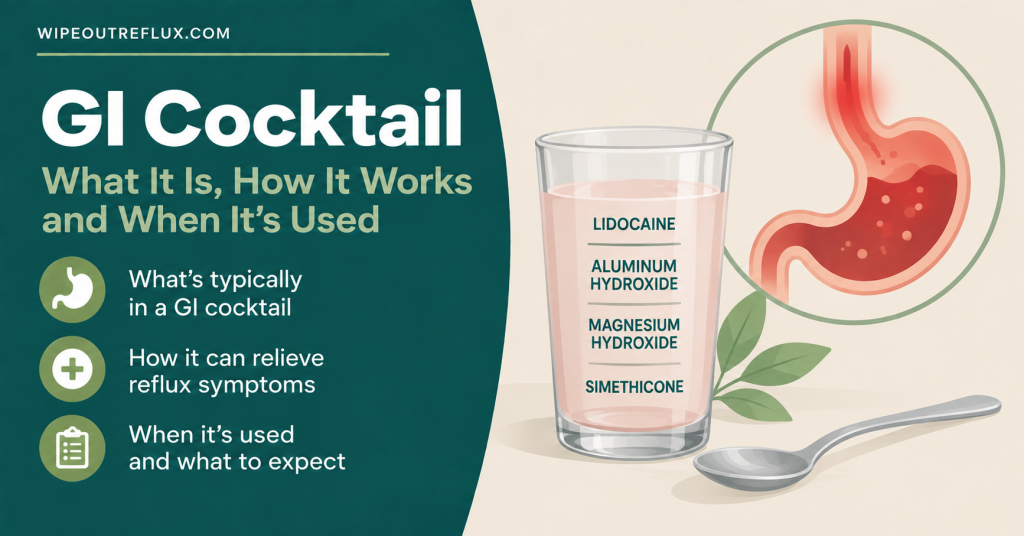
A GI cocktail is a mixture given in emergency departments to settle upper-gut pain fast. The classic version combines three things: a liquid antacid, viscous lidocaine (a numbing gel), and sometimes an anticholinergic such as Donnatal. The idea is that the antacid neutralizes acid, the lidocaine numbs the irritated esophagus and stomach lining, and the anticholinergic calms spasm — all working within a few minutes.
It sounds clever, and for years it was a reflex prescription for anyone who turned up with burning chest or upper-abdominal pain. But two things have changed the picture. First, good randomized trials now show the lidocaine and anticholinergic add nothing — plain antacid works just as well and tastes better. Second, and more importantly, doctors have stopped trusting a GI cocktail to tell them why your chest hurts. Feeling better after one does not mean your heart is fine.
Here I’ll walk through exactly what goes in a GI cocktail, what the evidence says it actually does, why there’s no true over-the-counter version, and the one thing about it that could genuinely catch you out.
Key Takeaways
- A GI cocktail is an antacid combined with viscous lidocaine, often plus an anticholinergic (Donnatal) — a fast-acting mixture used mainly in emergency departments.
- Randomized trials show adding lidocaine gives no more pain relief than antacid alone, while causing more numbness and worse taste.
- There is no true over-the-counter GI cocktail: viscous lidocaine is prescription-only and carries a serious FDA safety warning. An antacid alone covers just one of the three parts.
- Feeling better after a GI cocktail does not rule out a heart problem — cardiac chest pain can ease with it too. This is the single most dangerous myth about it.
- Relief is short-lived, usually 20–30 minutes, because it only masks symptoms rather than treating a cause.
- Common side effects are mouth and throat numbness, drowsiness (from the anticholinergic), dry mouth, and constipation or loose stools depending on the antacid.
- For ongoing reflux, a GI cocktail is the wrong tool — it does nothing to reduce how often you reflux.
What Is a GI Cocktail?
“GI cocktail” is informal shorthand — you’ll also hear it called a “pink lady,” a “green lizard,” or a “GI mix” depending on the recipe and its color. It isn’t a single branded product you can buy. It’s a bedside combination that a nurse or doctor mixes up on the spot, almost always in urgent care or the emergency room, for someone with epigastric (upper-abdominal) or lower-chest burning that looks like reflux, gastritis, or an ulcer flare.
The appeal is speed. A proton pump inhibitor takes days to reach full effect, and even an antacid takes several minutes. A GI cocktail is designed to do something in the first few minutes while the team works out what’s going on. That’s the whole reason it exists: it’s a triage tool, not a treatment plan.
GI Cocktail Ingredients and the Standard Formula
The typical formula uses three components, though the exact recipe varies from hospital to hospital:
- Liquid antacid (about 30 mL) — usually an aluminum hydroxide/magnesium hydroxide product such as Maalox or Mylanta, sometimes with simethicone added for gas. This neutralizes stomach acid on contact.
- Viscous lidocaine 2% (about 5–10 mL) — a thick anesthetic gel meant to numb the lining of the mouth, throat, esophagus, and stomach as it’s swallowed.
- An anticholinergic (about 10 mL), often Donnatal — a combination of hyoscyamine, atropine, scopolamine, and phenobarbital, intended to reduce gut spasm. Not every version includes this.
Those nicknames map onto the recipe. A “pink lady” is antacid plus lidocaine (the antacid often gives it a pink tint). A “green lizard” or “green goddess” is a version where the lidocaine is a green-tinted preparation. When people search for a “Maalox GI cocktail” or a “Donnatal GI cocktail,” they’re just describing which antacid or anticholinergic the local recipe happens to use.
The important thing to notice is that only one of these three ingredients — the antacid — is something you already have access to. Hold that thought, because it’s the key to the over-the-counter question.
What Is a GI Cocktail Used For?
In practice, a GI cocktail is reached for when someone has upper-gut or lower-chest pain that the team strongly suspects is gastrointestinal: acid reflux, heartburn, gastritis, or dyspepsia. It’s used to take the edge off quickly while other, slower assessments happen.
Historically it had a second, more controversial use: as a crude diagnostic test. The reasoning went that if a GI cocktail relieved the pain, the cause must be the gut and not the heart. That idea has not survived scrutiny, and it matters enough that it gets its own section below.
The Diagnostic Trap: Relief Does Not Mean Your Heart Is Fine
This is the part I most want you to remember. For a long time, a “GI cocktail response” — pain easing after the mixture — was treated as reassuring evidence that chest pain was coming from the stomach rather than the heart. It is not.
A systematic review looking specifically at whether a GI cocktail can separate reflux disease from acute coronary syndrome concluded that it cannot reliably do so, and that response to the cocktail should not be used to rule cardiac causes in or out [Chan et al., Heart, Lung and Circulation, 2014]. People having genuine heart events have reported their pain settling after a GI cocktail, and people with pure reflux have had no response at all. The overlap is real and it runs in both directions.
So if you take away one thing: a GI cocktail is a comfort measure, never a cardiac test. Chest pain that could be your heart needs proper cardiac assessment — an ECG and blood tests — regardless of whether an antacid mixture helped. If you’re trying to tell the two apart at home, my guide on heartburn or heart attack walks through the warning signs that mean you stop guessing and get checked.
Does a GI Cocktail Actually Work Better Than Antacid Alone?
Here’s where the evidence has quietly overturned decades of habit. The extra ingredients — the lidocaine especially — were assumed to add meaningful pain relief. They don’t.
A randomized, double-blind trial compared plain liquid antacid against antacid plus an anticholinergic and against the full antacid-lidocaine-anticholinergic cocktail. There was no meaningful difference in pain relief between them — the plain antacid held its own [Berman et al., Journal of Emergency Medicine, 2003]. A later randomized, double-blind trial focused specifically on lidocaine and found the same thing: a 20 mL dose of antacid alone relieved epigastric pain just as well as a 20 mL antacid-plus-lidocaine mixture, and the lidocaine versions tasted worse and caused more numbness [Warren et al., Academic Emergency Medicine, 2020].
An earlier descriptive study of real-world GI cocktail use had already hinted at how blunt a tool it was, with inconsistent responses and no clear diagnostic value [Wrenn et al., Annals of Emergency Medicine, 1995]. Put together, the message from the trials is simple: the antacid is doing the work. The rest is along for the ride.
Is There an Over-the-Counter GI Cocktail?
This is the question a lot of people arrive with, and the honest answer is no — not a real one.
The reason is the lidocaine. Viscous lidocaine 2% is a prescription-only medicine, and in 2014 the FDA added a prominent safety warning after reports of serious harm and deaths, largely in young children who were given or accidentally swallowed too much. It can cause seizures, cardiopulmonary arrest, and in overdose be fatal [FDA, Xylocaine Viscous (lidocaine HCl) 2% prescribing information, 2014]. You cannot buy it over the counter, and given that warning, you shouldn’t be improvising with it at home even if you could.
The anticholinergic component (Donnatal) is also prescription-only. So of the three classic ingredients, exactly one — the antacid — is available over the counter. And since the trials show the antacid is the part that actually relieves pain, that’s genuinely reassuring: the effective ingredient is the one you can already get.
In other words, the closest thing to an over-the-counter GI cocktail is simply a good liquid antacid. A dose of an antacid like Tums or Gaviscon covers the one component that works, without the prescription drug that doesn’t add anything. For heartburn specifically, my rundown of the best over-the-counter medicine for acid reflux covers where antacids fit versus longer-acting options.
Can you make a GI cocktail at home?
People do ask about a “homemade GI cocktail.” You can’t — not the real thing — because two of the three ingredients are prescription-only. What you can do at home is take the part that matters: an antacid for fast, short-term relief, and for reflux that keeps coming back, an alginate. That brings us to a better tool.
A Better Fit for Reflux: Alginates
A GI cocktail is built for a one-off flare in a hospital. If your problem is recurring acid reflux — and especially if it reaches your throat — there’s a more logical over-the-counter option. Alginates (the active ingredient in Gaviscon Advance) form a physical raft that floats on top of your stomach contents and blocks reflux mechanically, rather than just numbing or neutralizing.
That matters most for silent reflux, where the damage is driven by pepsin reaching the throat. Numbing gel and antacid do nothing to stop reflux events reaching your larynx; a raft can. If your symptoms are more throat than chest — hoarseness, throat clearing, a lump sensation — a GI cocktail was never the right tool, and the Wipeout Diet Plan approach of reducing reflux events at the source will do far more than any bedside mixture.
GI Cocktail Side Effects
For a single dose, a GI cocktail is generally well tolerated, but each ingredient brings its own effects:
- From the lidocaine: numbness of the mouth, tongue, and throat — which can briefly make swallowing feel odd — and a bitter taste. Rarely, if too much is absorbed, more serious effects on the heart and nervous system.
- From the anticholinergic (Donnatal): drowsiness, dry mouth, blurred vision, and a faster heartbeat. The phenobarbital component is why some people feel sleepy afterwards.
- From the antacid: magnesium-based antacids can loosen stools; aluminum-based ones can cause constipation. Most combination antacids balance the two.
Does a GI cocktail make you sleepy?
It can, if the version you’re given includes Donnatal — the phenobarbital in it is a mild sedative. A plain antacid-and-lidocaine “pink lady” won’t make you drowsy. If you were given a GI cocktail and felt sleepy afterwards, the anticholinergic component is the likely reason.
How Long Does a GI Cocktail Last?
Not long. Because it’s designed to mask symptoms rather than treat a cause, relief is typically short — roughly 20 to 30 minutes for the lidocaine’s numbing effect, with the antacid’s acid-neutralizing action fading over a similar window. That’s fine for its intended job of buying time during an ED assessment. It’s not a solution for pain that keeps returning. If your reflux is lasting hours or coming back day after day, see how long acid reflux usually lasts and why persistent symptoms point to a different approach.
What If the GI Cocktail Doesn’t Work?
A GI cocktail failing to help is genuinely useful information — but not in the way people assume. It does not confirm the pain is cardiac (just as relief doesn’t rule cardiac out). What a non-response tells your medical team is that a simple acid or spasm explanation is less likely, and that the workup needs to keep going. If you’re at home and an antacid isn’t touching your symptoms, that’s a signal the problem may be more than surface acid — poor response to reflux medication often means the mechanism is different from what’s assumed, which is exactly where a structured approach beats another antacid.
Conclusion
A GI cocktail is a fast, short-term emergency-department mixture — antacid, viscous lidocaine, and often an anticholinergic — used to settle upper-gut pain while doctors work out its cause. The modern evidence has trimmed it right back: the antacid does the real work, the lidocaine adds numbness and a bad taste but no extra relief, and crucially, feeling better after one tells you nothing reliable about whether your heart is involved. There’s no true over-the-counter version because two of its three ingredients are prescription-only — but the one that matters, the antacid, you can already buy.
If you’re reaching for a GI cocktail idea because reflux keeps flaring, that’s a sign the tool doesn’t match the problem. A GI cocktail masks a moment; it does nothing to reduce how often you reflux in the first place. That’s the gap the Wipeout Diet Plan is built to close — a mechanism-first approach to meal size, timing, fat load and trigger foods that cuts the number of reflux events rather than numbing the aftermath. I built it first and foremost around LPR, the stubborn throat-based form of reflux, but because it works on the same underlying mechanisms it helps classic GERD and everyday heartburn just as well. And if you want a concrete place to start this week, the Wipeout Food Reference Guide is the essential companion — every food and drink that’s safe for acid reflux and LPR with its actual pH value, so you’re working from numbers instead of guesswork.
Treat the flare if you must. Then treat the reason it keeps happening.
Frequently Asked Questions
What is in a GI cocktail?
The classic recipe is a liquid antacid (such as Maalox or Mylanta), viscous lidocaine 2% as a numbing agent, and often an anticholinergic like Donnatal to reduce spasm. Recipes vary, and some versions leave out the anticholinergic. Nicknames like “pink lady” and “green lizard” describe different color variations of the same idea.
Can I buy a GI cocktail over the counter?
No. Viscous lidocaine and Donnatal are both prescription-only, and viscous lidocaine carries a serious FDA safety warning. Only the antacid is available over the counter — and since studies show the antacid is the component that actually relieves pain, an ordinary liquid antacid is the closest safe equivalent.
Does a GI cocktail work for acid reflux?
It can ease a reflux or heartburn flare briefly, but only the antacid part is doing the work, and the effect lasts around 20–30 minutes. For recurring reflux — especially throat symptoms — an alginate like Gaviscon Advance or a proper dietary approach is far more effective than a one-off numbing mixture.
Does a GI cocktail rule out a heart attack?
No, and this is the most important myth to drop. A systematic review found the GI cocktail cannot reliably tell gastrointestinal pain apart from a heart problem. Cardiac chest pain can ease after one, and reflux pain sometimes doesn’t respond at all. Chest pain that could be cardiac needs an ECG and blood tests regardless.
Why does a GI cocktail make you sleepy?
If it contains Donnatal, the phenobarbital in that mixture is a mild sedative and can cause drowsiness. Versions without the anticholinergic — just antacid and lidocaine — don’t typically make you sleepy.
How long does a GI cocktail last?
Relief is short, usually about 20 to 30 minutes. It’s designed to mask symptoms quickly during an emergency assessment, not to provide lasting treatment.
Is a GI cocktail safe in pregnancy?
That’s a decision for the treating doctor, not something to improvise. Antacids are often used in pregnancy, but the lidocaine and especially the anticholinergic components carry their own considerations, so a GI cocktail isn’t a default choice. Anyone pregnant with reflux or chest pain should be assessed individually rather than reaching for a mixture like this.
Research & References
- Systematic review assessing whether a gastrointestinal cocktail can distinguish gastro-esophageal reflux disease from acute coronary syndrome in emergency patients, concluding it cannot reliably do so and should not be used to rule cardiac causes in or out [Chan et al., Heart, Lung and Circulation, 2014].
- Randomized, double-blind trial comparing plain liquid antacid, antacid plus anticholinergic, and the full GI cocktail, finding no significant difference in pain relief between them [Berman et al., Journal of Emergency Medicine, 2003].
- Randomized, double-blind trial showing antacid alone relieved epigastric pain as well as an antacid-plus-lidocaine mixture, with better palatability and fewer side effects [Warren et al., Academic Emergency Medicine, 2020].
- Descriptive study of real-world GI cocktail use in the emergency department, documenting inconsistent responses and limited diagnostic value [Wrenn et al., Annals of Emergency Medicine, 1995].
- FDA prescribing information for Xylocaine Viscous (lidocaine hydrochloride) 2% solution, carrying a prominent warning on the risk of serious harm and death, including in young children, and confirming its prescription-only status [FDA, Xylocaine Viscous prescribing information, 2014].

David Gray
12 years living with LPR · Consultant & researcher
I've lived with LPR for twelve years — the misdiagnoses, the PPI courses that did nothing, the slow work of figuring out what actually helps. Wipeout Reflux is where I translate the research into plain terms for people stuck in the same place. Every claim here is sourced to peer-reviewed work, and I consult one-to-one with LPR sufferers.