
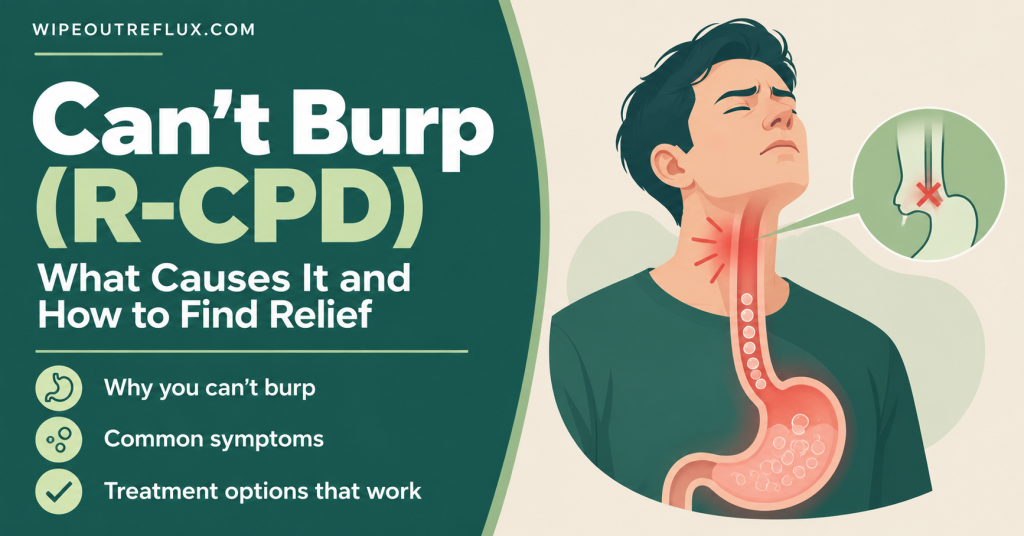
If you’ve never been able to burp — not once, not properly, for as long as you can remember — the condition you’re describing has a name: retrograde cricopharyngeus dysfunction, or R-CPD. You’ll also see it called “no burp syndrome” or “inability to belch syndrome.” It happens when the muscle at the top of your esophagus, the cricopharyngeus, fails to relax and let swallowed air back out. The air gets trapped, and it causes the classic cluster of gurgling noises in the chest and throat, painful bloating, chest pressure and a lot of gas coming out the other end.
It was only formally described in 2019, which is why so many people have lived with it for decades without knowing it was a real, diagnosable thing. And it has a treatment that works for most people: a small dose of Botox injected into that muscle.
Key Takeaways
- Being unable to burp is a recognized condition called retrograde cricopharyngeus dysfunction (R-CPD).
- The cricopharyngeus muscle (your upper esophageal sphincter) doesn’t relax to let air out upward, so gas gets trapped in the esophagus.
- Typical symptoms: inability to burp, gurgling or croaking noises from the chest or neck, bloating, chest pressure or pain, and excessive flatulence.
- Most people have had it since childhood, and many have been misdiagnosed with IBS, reflux or anxiety.
- Botox injected into the cricopharyngeus restores burping in roughly 90% of people in published series.
- For many, the benefit outlasts the Botox itself — the body seems to “learn” to burp once it has experienced it.
- Temporary difficulty swallowing solid food is the most common side effect.
- Chest pain should never be assumed to be trapped air until heart causes have been ruled out.
What Is It Called When You Can’t Burp?
The medical name is retrograde cricopharyngeus dysfunction. Let’s unpack that, because the name actually explains the whole problem:
- Cricopharyngeus is the ring of muscle at the very top of your esophagus, just behind the voice box. It’s the main component of the upper esophageal sphincter (UES).
- Retrograde means “going backward” — in this case, air traveling up from the stomach and esophagus, rather than food going down.
- Dysfunction means the muscle isn’t doing its job in that direction.
The condition was named by laryngologist Robert Bastian and colleagues, who described 51 patients with the same striking pattern of symptoms — all of whom regained the ability to burp after Botox treatment [Bastian and Smithson, OTO Open, 2019]. Since then, hundreds more cases have been reported, and awareness has spread largely through social media, where people finally found others describing exactly what they’d experienced.
Why You Can’t Burp: The Mechanism
Every time you swallow, eat or drink — especially fizzy drinks — some air ends up in your stomach. Normally, when enough gas builds up, your body triggers a belch reflex. The lower sphincter opens, gas rushes up into the esophagus, and then the upper sphincter (the cricopharyngeus) briefly relaxes so the air can escape through your mouth.
In R-CPD, that last step fails. Gas rises into the esophagus, but the cricopharyngeus stays clamped shut. The air is trapped in the esophagus with nowhere to go upward. The esophagus then tries to squeeze it back down, which produces the characteristic gurgling or croaking sounds, and the pressurized air stretches the esophagus, which produces chest pressure and discomfort [Lehmann and Kahrilas, Translational Gastroenterology and Hepatology, 2026].
What’s interesting from a reflux perspective is that this is the opposite of what I usually write about. In silent reflux (LPR), the upper sphincter doesn’t hold tightly enough, and refluxed material escapes into the throat. In R-CPD, the same muscle won’t let go when it should. I cover the tight-muscle side of things in cricopharyngeal spasm vs globus — R-CPD is a related but distinct problem, specific to the muscle failing to relax for air going upward.
R-CPD Symptoms
The symptom pattern is remarkably consistent. In Bastian’s original group of 51 patients [Bastian and Smithson, OTO Open, 2019]:
- Inability to burp: 50 of 51
- Gurgling noises from the chest or neck: 50 of 51
- Bloating and chest pressure or pain: 49 of 51
- Excessive flatulence: 43 of 51
Other features people commonly describe:
- Symptoms since childhood — in larger series, over 80% say they’ve had it for life [Lehmann and Kahrilas, Translational Gastroenterology and Hepatology, 2026].
- Painful bloating after fizzy drinks, beer or large meals.
- Difficulty vomiting, or being unable to vomit at all.
- Social discomfort from loud, uncontrollable gurgling sounds.
- Only managing tiny “micro-burps,” or burping only when lying down or by forcing it.
- Other family members with the same problem — around a quarter of cases report a family history [Lehmann and Kahrilas, Translational Gastroenterology and Hepatology, 2026].
“I Can’t Burp but I Fart a Lot” — Why This Happens
This is one of the most searched questions about R-CPD, and the explanation is simple. Swallowed air has two exits: up and out through the mouth, or down through the whole digestive tract. If the upper exit is blocked, every bit of swallowed air eventually has to travel the long way — through the stomach, the small intestine and the colon. Hence the bloating, and hence the flatulence.
That’s also why so many people with R-CPD get labeled with IBS or SIBO before anyone considers the burp. The gut symptoms look similar, but the root cause is at the top of the esophagus, not in the bowel. If you’re unsure where your gas is coming from, my articles on acid reflux and gas and IBS and acid reflux help separate the possibilities.
“I Can’t Burp and My Chest Hurts”
Chest pressure is common in R-CPD because trapped air physically stretches the esophagus. Many people describe a tight, full feeling behind the breastbone that eases only when the air finally moves on.
But please don’t self-diagnose chest pain as trapped air. Get immediate medical help if chest pain spreads to your arm, jaw, neck or back, comes with shortness of breath, sweating, nausea or lightheadedness, is brought on by exertion, or feels different from your usual pattern. I explain how to tell these apart in heartburn or heart attack? and in my guide to acid reflux chest tightness. An R-CPD diagnosis should always come after heart causes are ruled out, not instead of it.
What Happens If You Can’t Burp?
R-CPD isn’t dangerous in the sense of causing damage or leading to a serious disease. The gas does eventually leave through the gut. But it can have a real impact on quality of life: daily bloating and discomfort, avoiding carbonated drinks and social situations, embarrassment from the noises, and years of unexplained symptoms. It also doesn’t usually go away on its own — most people have lived with it since childhood.
How R-CPD Is Diagnosed
Most people are diagnosed on their history alone. The pattern — lifelong inability to burp, gurgling, bloating and flatulence — is distinctive enough that many ENT specialists will diagnose it clinically, and a good response to Botox effectively confirms it.
Some centers use high-resolution manometry, a test that measures esophageal pressures. When the person drinks something carbonated, the test can show air repeatedly entering the esophagus and being pushed back down, without the upper sphincter ever relaxing to vent it. Reviewers have pointed out that most cases so far have been treated without this kind of objective confirmation, and that more standardized testing would help [Lehmann and Kahrilas, Translational Gastroenterology and Hepatology, 2026].
The right specialist is usually an ENT (otolaryngologist) with an interest in swallowing or a laryngologist. It’s worth asking ahead whether they treat R-CPD, as awareness still varies.
Botox for No Burp Syndrome
The main treatment is Botox (botulinum toxin) injected directly into the cricopharyngeus. Botox temporarily weakens the muscle, so it can open enough for air to escape. It’s done either under brief general anesthesia or, in some clinics, in the office using a needle through the neck guided by EMG or ultrasound. Typical doses in published series range from 50 to 100 units.
The results are impressive for such a simple procedure:
- In Bastian’s original series, all 51 patients regained the ability to burp, with complete or major reduction in symptoms [Bastian and Smithson, OTO Open, 2019].
- Across larger published series, initial success is around 90%, and one series of 200 patients reported 80% success at six months [Lehmann and Kahrilas, Translational Gastroenterology and Hepatology, 2026].
The fascinating part is durability. Botox wears off within a few months, yet many people keep burping long afterward. The leading theory is that once your body experiences a normal belch, it learns the coordination and keeps doing it. Not everyone is so lucky — some people need a second injection, sometimes at a higher dose, and a small number go on to surgery.
Botox side effects
The most common side effect is temporary difficulty swallowing solid food, which usually lasts a couple of weeks. Some people also notice regurgitation, a bit of heartburn, or temporary hoarseness while the muscle is weakened [Lehmann and Kahrilas, Translational Gastroenterology and Hepatology, 2026]. That makes sense mechanically: a relaxed upper sphincter lets things move upward more easily in both directions. If you already have reflux or LPR, mention it to your specialist before treatment, and be careful with meal size and late-night eating in the weeks afterward. My guide to swallowing difficulty and reflux covers what’s normal and what isn’t.
Other Treatments
- Burp retraining: behavioral programs that teach you to coordinate the belch reflex. The evidence is early and small, but one report found relief in 6 of 7 people who hadn’t responded to Botox [Lehmann and Kahrilas, Translational Gastroenterology and Hepatology, 2026].
- Partial cricopharyngeal myotomy: surgically cutting part of the muscle. It’s reserved for people who relapse repeatedly after Botox, and experience is limited.
- Self-taught techniques: many people share tricks online, such as drinking something fizzy then lying flat, or tilting the head and swallowing air. These help some people partially, but they’re not a substitute for proper assessment.
Managing Symptoms While You Wait
Until you can see a specialist, reducing the amount of air and gas you take in helps:
- Avoid fizzy drinks, beer and sparkling water — they’re the biggest trigger.
- Eat slowly, with smaller mouthfuls, and avoid talking while chewing.
- Skip chewing gum, drinking through straws and gulping drinks.
- Eat smaller meals, so less air and gas are generated at once.
- Be cautious with high-FODMAP, gas-producing foods if bloating is severe — see my low-FODMAP guide.
Simethicone products don’t fix R-CPD, but they may take the edge off lower-gut bloating — I discuss what they can and can’t do in does Gas-X help acid reflux? If you also have reflux alongside the gas, the smaller-meal, lower-fat approach in the Wipeout Diet Plan reduces both the volume in your stomach and the pressure pushing things upward.
Conclusion
If you’ve gone your whole life unable to burp, living with gurgling, bloating, chest pressure and more gas than anyone around you, you’re not imagining it, and you’re not alone. It has a name — retrograde cricopharyngeus dysfunction — and a clear explanation: the muscle at the top of your esophagus doesn’t relax to let air out. Most importantly, it has a treatment. Botox into the cricopharyngeus restores burping for the large majority of people, often for good. The first step is finding an ENT or laryngologist who knows the condition.
Where R-CPD overlaps with reflux — and it often does, both before treatment and in the weeks after Botox — your diet makes a real difference. The Wipeout Diet Plan is my complete, step-by-step approach to meal size, timing, fat load and trigger foods. It was built first for silent reflux, where the upper sphincter is the weak point, but it works just as well for GERD and everyday heartburn — and it helps cut down the gas and volume that make trapped-air symptoms worse.
For a lighter starting point, the Wipeout Food Reference Guide lists the foods and drinks that are safe for acid reflux and LPR with their pH values, so you can choose meals that are gentle on both your esophagus and your gut.
Frequently Asked Questions
What is it called when you can’t burp?
It’s called retrograde cricopharyngeus dysfunction (R-CPD), also known as no burp syndrome or inability to belch syndrome. The muscle at the top of the esophagus doesn’t relax to let swallowed air escape upward.
Is not being able to burp a real condition?
Yes. R-CPD was formally described in 2019, and hundreds of cases have been reported since. It has a consistent set of symptoms and a treatment that works for most people.
Why can’t I burp but I fart a lot?
If air can’t escape upward, it has to travel through the entire digestive tract instead. That causes bloating and leads to much more flatulence than normal.
Can R-CPD cause chest pain?
Yes. Trapped air stretches the esophagus, causing chest pressure or pain. But chest pain should always be checked by a doctor first to rule out heart problems, especially if it comes with breathlessness, sweating or pain spreading to the arm or jaw.
How successful is Botox for R-CPD?
Very. Published series report that around 90% of people regain the ability to burp after Botox into the cricopharyngeus, and many keep burping long after the Botox has worn off. Some need a repeat injection.
What are the side effects of Botox for no burp syndrome?
The most common is temporary difficulty swallowing solid foods, usually lasting a couple of weeks. Some people also have temporary regurgitation, heartburn or hoarseness.
Is R-CPD related to acid reflux?
They involve the same general area but are different problems. In R-CPD, the upper sphincter won’t relax to let air out; in silent reflux, it doesn’t keep refluxed material in. The two can coexist, and reflux symptoms can temporarily increase after Botox treatment.
Research & References
- [Bastian and Smithson, OTO Open, 2019] — The first description of R-CPD in 51 patients, all of whom had inability to belch with near-universal gurgling, bloating, chest discomfort and flatulence; every patient regained the ability to belch after Botox into the cricopharyngeus.
- [Lehmann and Kahrilas, Translational Gastroenterology and Hepatology, 2026] — Narrative review of the R-CPD literature covering mechanism, lifelong onset in most patients, around 90% initial Botox success, durable benefit in many beyond the drug’s effect, transient swallowing difficulty as the main side effect, and the need for objective diagnostic testing.

David Gray
12 years living with LPR · Consultant & researcher
I've lived with LPR for twelve years — the misdiagnoses, the PPI courses that did nothing, the slow work of figuring out what actually helps. Wipeout Reflux is where I translate the research into plain terms for people stuck in the same place. Every claim here is sourced to peer-reviewed work, and I consult one-to-one with LPR sufferers.