
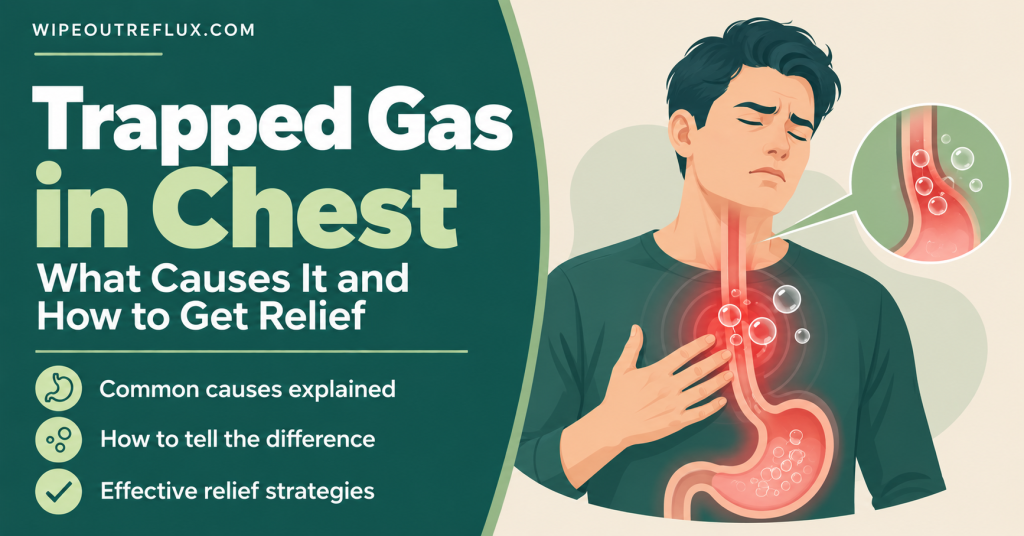
Trapped gas in the chest usually feels like pressure, fullness or a sharp, shifting pain behind the breastbone or under the ribs. It tends to ease when you burp, pass gas or change position. The quickest ways to release it are to get moving (a 10–15 minute walk), try positions that help gas move (lying on your left side or knees to chest), sip a warm, non-fizzy drink, and take simethicone (Gas-X) if you need it.
But before any of that: chest discomfort is exactly the symptom people wrongly write off as gas. If there’s any chance it’s your heart, rule that out first. Read the warning signs below before you try anything else.
Key Takeaways
- Heart first: chest pain with breathlessness, sweating, nausea, lightheadedness, or pain spreading to the arm, jaw, neck or back needs emergency care — call 911 (or your local emergency number).
- A burp that brings some relief does not prove it was gas.
- Gas pain in the chest usually comes from swallowed air, gas in the stomach pressing upward, or gas in the upper colon just under the ribs.
- Walking, positional changes, gentle massage, warm drinks and simethicone are the fastest ways to release it.
- Acid reflux and trapped gas often go together, and reflux can itself feel like chest pressure.
- Trapped gas lasting days or weeks isn’t normal and needs a proper medical look.
- Prevention comes down to eating slowly, cutting carbonation, smaller meals and identifying gassy trigger foods.
Is It Gas or Your Heart? Read This First
I’m putting this first on purpose. Heart attacks, particularly in women, older adults and people with diabetes, don’t always cause the crushing chest pain people expect. They can feel like pressure, tightness, indigestion or “gas.” Cardiology guidelines are clear that chest discomfort described as pressure, tightness or heaviness should be treated as potentially cardiac until proven otherwise, and that symptoms like nausea, sweating and fatigue often accompany it [Gulati et al., Circulation, 2021].
Call 911 (or your local emergency number) right away if chest discomfort:
- Spreads to your arm, shoulder, jaw, neck or back
- Comes with shortness of breath, sweating, nausea, vomiting, lightheadedness or fainting
- Starts with exertion or stress and eases with rest
- Feels like crushing, squeezing or heavy pressure
- Lasts more than a few minutes, or keeps coming back
- Is new to you, or feels different from your usual gas or reflux
Also take it seriously if you have heart disease risk factors: smoking, high blood pressure, high cholesterol, diabetes, a family history of early heart disease, or you’re over 40.
Don’t be reassured just because burping eased it. Belching and a feeling of indigestion can occur during a heart attack too. If you’re unsure, getting checked costs you an hour. Guessing wrong can cost far more. I go through the differences in detail in heartburn or heart attack?
What Does Trapped Gas in the Chest Feel Like?
Once your heart has been ruled out, gas-related chest discomfort typically has these features:
- A feeling of pressure or fullness in the center of the chest or just below the breastbone
- Sharp, stabbing or cramping pains that come and go and may move around
- Discomfort under the left or right ribs that can feel like it’s in the chest
- Bloating in the upper abdomen, with a tight or swollen feeling
- A strong urge to burp, often with the feeling that the burp is “stuck”
- Gurgling sounds from the stomach or chest
- Relief that comes with burping, passing gas or changing position
- Symptoms linked to meals, fizzy drinks or specific foods
Why Gas Gets Trapped in the Chest
Gas can’t technically sit in your chest cavity. What you’re feeling is gas in the parts of your digestive tract that sit right beneath or alongside it — the esophagus, the top of the stomach and the upper colon. Here’s how that happens.
1. Swallowed air
Every time you eat, drink or swallow, a little air goes down too. Eating quickly, talking while eating, drinking through straws, chewing gum, smoking, and drinking fizzy drinks all add a lot more. That air collects in the top of your stomach, which sits right under the diaphragm and the heart, so the pressure is felt as chest discomfort. Anxiety adds to it, because people often swallow air or breathe rapidly when stressed.
2. Gas in the upper colon
Your large intestine loops up high under your ribs on both sides before it turns downward. Gas that builds up in these bends (particularly the left one, under the spleen) can produce pain felt in the lower chest or under the ribs. How much discomfort gas causes depends not only on the amount, but on how well your gut moves it along and how sensitive your gut is. Research in IBS found that people with sensitive guts retain more gas and feel much more discomfort from the same volume [Serra et al., Gut, 2001].
3. Acid reflux
Reflux and gas are closely connected. Gas pressure in the stomach can push contents up past the lower esophageal sphincter, and each time that sphincter relaxes to vent gas, acid can come up too. Reflux itself is also the most common esophageal cause of chest pain that isn’t from the heart, and most people with reflux-related chest pain improve once the reflux is treated [Fass and Achem, Journal of Neurogastroenterology and Motility, 2011]. So the “trapped gas” you feel may partly be reflux. My guides to acid reflux and gas, acid reflux and burping and acid reflux chest tightness go deeper on each.
4. Gas-producing foods
Beans, lentils, onions, garlic, cabbage, broccoli, wheat, apples, pears, dairy (if you’re lactose intolerant) and artificial sweeteners like sorbitol are fermented by gut bacteria, producing gas. These are largely the high-FODMAP foods — see my low-FODMAP diet for acid reflux guide.
5. Less common causes
- Hiatal hernia: part of the stomach sits above the diaphragm, trapping gas and acid higher up. See hiatal hernia and reflux.
- Slow stomach emptying: gastroparesis, or GLP-1 medications like Ozempic and Mounjaro, keep food and gas in the stomach longer. See gastroparesis and acid reflux.
- SIBO: excess bacteria in the small intestine ferment food early, producing gas higher in the gut. See SIBO and acid reflux.
- Inability to burp: if you’ve never been able to burp properly, the gas can’t escape upward. That’s a real condition called R-CPD — I explain it in can’t burp? R-CPD explained.
- Constipation: a backed-up colon traps gas behind it.
How to Get Rid of Trapped Gas in Your Chest
Assuming your heart has been ruled out, these steps help most people within minutes to an hour.
1. Walk
Gentle movement is the single most effective step. Walking stimulates the gut to move gas along, and being upright helps gas in the stomach rise and escape as a burp. Even 10–15 minutes around the house or the block often makes a big difference.
2. Change position
- Sit upright or stand if you want to burp — gas rises.
- Lie on your left side for a few minutes. This follows the natural path of the colon and can help gas move toward the exit. It’s also the better side for reflux.
- Knees to chest: lie on your back and gently pull your knees toward your chest for 20–30 seconds.
- Child’s pose: kneel, sit back on your heels and stretch your arms forward with your forehead on the floor.
3. Gentle abdominal massage
With your palm, slowly massage your belly in a clockwise circle — up the right side, across under the ribs, and down the left side. This follows the direction of the colon and helps nudge gas along.
4. A warm drink
Warm water or ginger tea can help relax the gut and ease gas. Peppermint tea is a classic gas remedy, but it relaxes the lower esophageal sphincter, so if you have reflux it can make heartburn worse — I explain the trade-off in is peppermint tea good for acid reflux? Ginger is usually the better choice for reflux sufferers. Avoid fizzy drinks — they add more gas.
5. Simethicone (Gas-X)
Simethicone is an anti-foaming agent that makes small gas bubbles merge into larger ones that are easier to burp or pass. It isn’t absorbed and is very safe. Evidence is modest, but a placebo-controlled trial in functional dyspepsia found it improved upper-gut symptoms including fullness and bloating [Holtmann et al., Alimentary Pharmacology and Therapeutics, 2002]. It won’t help reflux itself, as I discuss in does Gas-X help acid reflux?
6. Gentle heat
A heating pad or warm water bottle on the upper belly relaxes the muscles and can ease cramping.
What not to do
Don’t force burps by gulping air — it often adds more gas than it releases. And be careful with large doses of baking soda in water. It does neutralize acid, but it produces a burst of carbon dioxide in your stomach, and it’s high in sodium. I explain safe use in baking soda for heartburn.
Trapped Gas in the Chest for Days or Weeks
Ordinary trapped gas clears in minutes to hours. If you’ve had chest “gas” pain for days or weeks, it’s time to see a doctor rather than keep treating it at home. Persistent symptoms can come from:
- Untreated acid reflux or esophagitis
- Gallbladder problems (pain under the right ribs, often after fatty meals)
- Stomach ulcers or gastritis
- Hiatal hernia
- Slow stomach emptying
- Heart or lung problems
- Muscle or rib cartilage inflammation
See a doctor promptly if persistent gas comes with unintended weight loss, difficulty swallowing, vomiting, black or bloody stools, fever, or a change in bowel habits.
How to Prevent Trapped Gas in the Chest
- Eat slowly and chew thoroughly, with smaller mouthfuls.
- Cut back on carbonated drinks, including sparkling water and beer.
- Skip gum, straws and hard candy, which all increase swallowed air.
- Eat smaller meals rather than two or three large ones.
- Don’t lie down within 2–3 hours of eating.
- Identify your gassy foods — a short food diary often reveals the culprits.
- Stay active after meals; a short walk helps digestion.
- Manage stress and notice if you swallow air or breathe rapidly when anxious.
If reflux is part of your picture, the Wipeout Diet Plan covers meal size, timing and trigger foods in a way that reduces both gas pressure and reflux together.
Conclusion
Trapped gas in the chest is common, and in most cases it’s harmless. It usually comes from swallowed air, gas in the top of the stomach pressing upward, or gas caught in the high bends of the colon under your ribs. Walking, positional changes, gentle massage, warm drinks and simethicone are the fastest ways to release it. But because heart problems can feel exactly like gas, any chest discomfort with warning signs — breathlessness, sweating, nausea, or pain spreading to the arm, jaw or back — needs emergency care first.
If trapped gas keeps coming back alongside heartburn, burping or throat symptoms, reflux is likely part of the story. That’s where the Wipeout Diet Plan helps most. It’s my complete, mechanism-first plan for meal size, timing, fat load and trigger foods, designed to reduce the stomach pressure that drives both gas and reflux. I built it originally around silent reflux, the trickier throat-based form, but it targets the same root causes, so it works just as well for everyday heartburn and GERD.
For a simpler starting point, the Wipeout Food Reference Guide lists foods and drinks that are safe for acid reflux and LPR along with their pH values, making it easier to build meals that won’t leave you bloated and burning.
Frequently Asked Questions
How do I know if chest pain is gas or my heart?
You can’t always tell on your own. Gas pain tends to be sharp or shifting, linked to meals, and eased by burping, passing gas or moving. Heart pain is more often pressure or squeezing, brought on by exertion, and may come with breathlessness, sweating, nausea or pain spreading to the arm, jaw or back. If you’re unsure, get emergency care.
How do you get rid of trapped gas in your chest fast?
Go for a short walk, sit upright, try lying on your left side or pulling your knees to your chest, massage your belly clockwise, sip a warm non-fizzy drink and consider simethicone (Gas-X). Most trapped gas eases within minutes to an hour.
Can trapped gas cause chest pain?
Yes. Gas in the top of the stomach or the upper colon can cause pressure, fullness and sharp pain felt in the chest or under the ribs. It’s harmless in most cases, but chest pain should always be checked if there’s any chance it’s heart-related.
Why do I have trapped gas in my chest for days?
Ordinary gas doesn’t usually last days. Persistent symptoms can be due to acid reflux, gallbladder issues, gastritis, a hiatal hernia, slow stomach emptying or, occasionally, heart or lung problems. See a doctor if it lasts more than a few days.
Does Gas-X help trapped gas in the chest?
It can. Simethicone (Gas-X) helps small gas bubbles combine so they’re easier to burp or pass. It’s safe and works quickly for some people, though it doesn’t treat acid reflux itself.
Can acid reflux feel like trapped gas in the chest?
Yes. Reflux can cause chest pressure, burning and a frequent urge to burp, which many people interpret as trapped gas. Gas and reflux also feed each other, since stomach pressure pushes contents up into the esophagus.
What position helps release trapped gas?
Sitting or standing upright helps gas rise so you can burp. Lying on your left side, drawing your knees to your chest, or child’s pose can help gas move through the colon.
Research & References
- [Gulati et al., Circulation, 2021] — The AHA/ACC chest pain guideline, advising that chest pressure, tightness or heaviness be evaluated as potentially cardiac and noting that accompanying symptoms like nausea and sweating are common, especially in women.
- [Fass and Achem, Journal of Neurogastroenterology and Motility, 2011] — Review of noncardiac chest pain finding it affects around a quarter of the population, with GERD the most common esophageal cause; 78–92% of patients with objective reflux improved on antireflux treatment.
- [Serra et al., Gut, 2001] — Gas infusion study showing that people with IBS retain more intestinal gas and develop more symptoms from it than healthy controls, explaining why some people feel gas far more intensely.
- [Holtmann et al., Alimentary Pharmacology and Therapeutics, 2002] — Randomized placebo-controlled trial finding simethicone improved symptoms of functional dyspepsia, including upper-abdominal fullness and bloating, compared with placebo.

David Gray
12 years living with LPR · Consultant & researcher
I've lived with LPR for twelve years — the misdiagnoses, the PPI courses that did nothing, the slow work of figuring out what actually helps. Wipeout Reflux is where I translate the research into plain terms for people stuck in the same place. Every claim here is sourced to peer-reviewed work, and I consult one-to-one with LPR sufferers.