
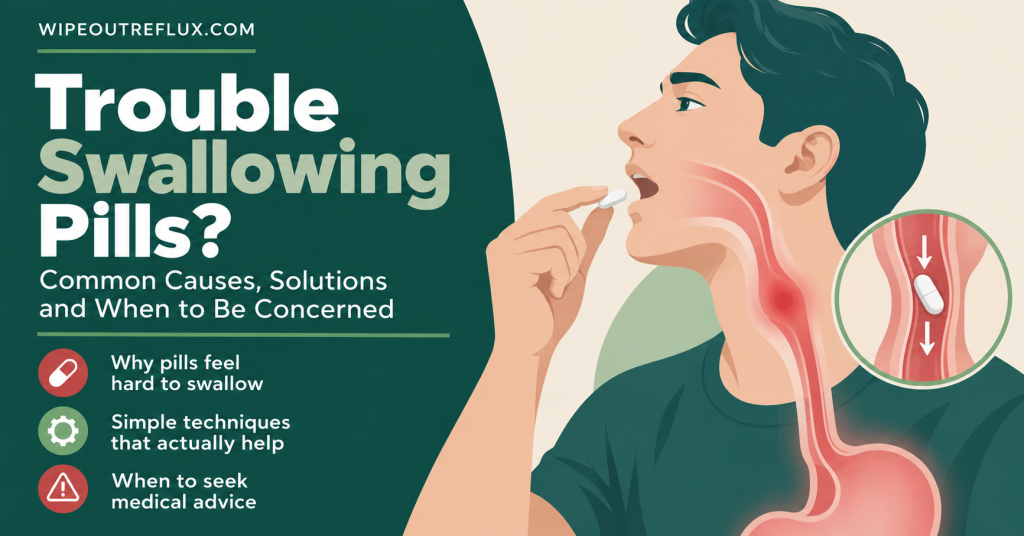
If you have trouble swallowing pills, you’re not alone, and it’s rarely a sign that something is wrong with your throat. For most people it comes down to technique: a pill doesn’t behave like food, and the instinctive way most of us take one (tipping the head back and gulping) actually makes it harder.
Two simple techniques have been tested in a clinical study and work remarkably well. The pop-bottle method for tablets improved swallowing for about 60% of people, and the lean-forward method for capsules helped almost 9 in 10 [Schiele et al., Annals of Family Medicine, 2014]. Below I walk through exactly how to do both, plus other tricks, what to do if nothing works, and when pill trouble is a sign of a wider swallowing problem.
Key Takeaways
- Difficulty swallowing pills is very common. Studies suggest more than a third of adults struggle with it at least sometimes.
- Most of the time it’s a technique and reflex problem, not a medical one.
- Tablets: use the pop-bottle method (lips sealed around a flexible water bottle, sucking the water down).
- Capsules: use the lean-forward method (chin down toward your chest as you swallow), because capsules float.
- Tipping your head back works against you, especially with capsules.
- Never crush or split a pill without checking with a pharmacist. Many tablets aren’t designed for it.
- If food also sticks, you cough or choke, or a pill feels stuck for hours, it may be dysphagia rather than technique, so see a doctor.
Why Swallowing Pills Is Harder Than Swallowing Food
It seems strange that you can swallow a mouthful of food larger than a tablet but freeze at a small pill. There are good reasons for it.
- Food is prepared by chewing. Chewing turns food into a soft, moist, shaped ball (a bolus) that your tongue knows exactly how to push back. A pill is a small, hard, slippery object that arrives unprepared.
- Your throat has a protective reflex. The back of the tongue and throat are designed to detect hard objects and reject them. It’s the same reflex that stops you from swallowing a fish bone. A pill can trigger it, especially if you’re already bracing for it.
- Anxiety tightens the throat. If you’ve gagged on a pill before, you start anticipating it. The throat muscles tense, the swallow gets hesitant, and it becomes a self-fulfilling loop.
- Capsules float. Capsules are lighter than water, so when you tip your head back they float to the front of your mouth, which is the wrong direction.
- Size, shape and coating matter. Large, oval, uncoated or rough-surfaced tablets are hardest.
- Dry mouth makes everything stick. Many medications, aging and mouth breathing reduce saliva. See acid reflux and dry mouth.
It’s a genuinely common problem. In a German general practice population, more than a third of patients reported difficulty swallowing tablets or capsules, with size and shape the most common complaints [Schiele et al., European Journal of Clinical Pharmacology, 2013]. It also has real consequences. People who struggle are more likely to crush, split or skip doses.
Technique 1: The Pop-Bottle Method (for Tablets)
This is the one to try first for tablets. It works by creating suction, which pulls the tablet back with the water in one smooth movement, so you don’t have to consciously push it.
- Use a flexible plastic water bottle with a narrow opening (a standard soft-drink or water bottle). Fill it with still water.
- Place the tablet on your tongue.
- Close your lips tightly around the bottle opening so there’s a full seal.
- Drink with a sucking motion, letting the bottle squash inward as you drink. Don’t let air in.
- Keep your head in a neutral position and swallow immediately. The tablet goes down with the water.
In the study, the pop-bottle method significantly improved tablet swallowing in about 60% of participants, including people who didn’t report any pill problems to begin with [Schiele et al., Annals of Family Medicine, 2014].
Note: it’s not recommended for capsules, and it isn’t suitable for people with known swallowing disorders, because the strong suction swallow can send liquid too fast.
Technique 2: The Lean-Forward Method (for Capsules)
Because capsules float, the trick is to use that. Tilting your head forward makes the capsule float toward the back of your mouth, right where it needs to be.
- Place the capsule on your tongue.
- Take a medium sip of water but don’t swallow yet.
- Tilt your head forward, bringing your chin toward your chest (as if looking at your lap).
- Swallow the water and capsule with your head in that forward position.
This one was even more effective, improving capsule swallowing in about 89% of participants [Schiele et al., Annals of Family Medicine, 2014]. The chin-down position also narrows the entrance to the airway slightly, which is why speech therapists use a similar “chin tuck” to make swallowing safer.
Other Tricks That Help
Wrap it in soft food
Put the pill in a spoonful of applesauce, yogurt, pudding or mashed banana, and swallow it as one mouthful without chewing. Your throat treats it as food, not a foreign object. Check with a pharmacist first, as a few medications shouldn’t be taken with food or dairy, and don’t let it sit so long that a coating softens.
Wet your mouth first
Take a sip of water before the pill goes in. A dry tongue and throat make pills stick, especially coated ones.
Place it well
Put the tablet in the middle of your tongue, roughly halfway back. Too near the front and it gets pushed around. Too far back and it can trigger a gag.
Use a swallowing gel or pill cup
Swallowing gels (such as Gloup or Pill Glide) coat the tablet in a slippery layer, and specially designed pill cups channel the pill into a stream of water. A systematic review of pediatric studies found that a range of approaches, including behavioral training, specialized cups, flavored sprays and head posture, all improved pill swallowing [Patel et al., Pediatrics, 2015]. The same principles help adults.
Practice small to large
Pill-swallowing training starts with tiny sweets (like sprinkles or mini candies), then moves up in size. It’s widely used for children and works for anxious adults too. A few sessions with harmless practice “pills” can reset the reflex.
Calm the swallow
Take a slow breath out before you swallow, relax your shoulders and jaw, and don’t overthink it. Distraction helps some people. Tensing up is what triggers the gag.
What Not to Do
- Don’t tip your head far back, especially with capsules. It pushes the pill away from the swallow and opens the airway.
- Don’t dry-swallow or take pills with a tiny sip. Pills that lodge in the esophagus can burn the lining. Use a full glass of water (about 200–250ml, or 8oz).
- Don’t lie down straight afterward. Stay upright for at least 30 minutes, especially with irritant medications.
- Don’t take several at once if you’re struggling. One at a time is safer and easier.
- Don’t crush, split or open capsules without checking. Extended-release, modified-release and enteric-coated medications can release the whole dose at once, taste terrible, or be destroyed by stomach acid if broken. Your pharmacist can tell you which are safe to alter.
Some pills are much more likely than others to irritate the esophagus if they lodge, including doxycycline and other antibiotics, NSAIDs, aspirin, potassium, iron and bisphosphonates. I list them in medications that make acid reflux worse, and do iron supplements cause heartburn? covers iron specifically.
If You Still Can’t Swallow Them: Ask About Alternatives
If techniques haven’t worked, don’t just skip doses. Ask your doctor or pharmacist about:
- Liquid versions of the same medication
- Chewable, dissolvable (orodispersible) or soluble tablets
- Smaller tablets, or a lower dose taken more often
- Different formulations, such as patches, sprays or granules
- Whether a tablet can safely be split (some are scored for this)
For reflux medications, several PPIs come as capsules that can be opened and sprinkled on applesauce, or in dissolvable form. Your pharmacist can confirm which ones. Timing also matters for these drugs, as I explain in best time of day to take omeprazole.
Pill Dysphagia: When It’s More Than Technique
Pill trouble on its own is usually harmless. But sometimes it’s the first place a real swallowing problem shows up, because a pill is the least forgiving thing you swallow. Take it more seriously if:
- Food sticks too, especially meat or bread
- You cough or choke when swallowing pills, food or drink
- Pills regularly feel stuck in your throat or chest for a long time
- Swallowing is painful
- It’s new and getting worse, or comes with weight loss
Those point toward dysphagia, meaning a problem with the swallowing mechanism itself, which has a wide range of treatable causes. My guide to dysphagia explains the types and tests. If a pill feels stuck right now, see pill stuck in throat for how to dislodge it and when to get help.
The reflux connection
This is the angle I see most often. Reflux, and especially LPR (silent reflux), can make pills harder to swallow in several ways:
- Throat swelling: acid and pepsin reaching the throat inflame the tissue around the voice box and upper esophageal sphincter, narrowing the entrance slightly.
- A tight upper sphincter: reflux can make the muscle at the top of the esophagus tense up, so pills feel like they catch. See upper esophageal sphincter and acid reflux.
- Globus: a lump-in-the-throat sensation makes you hyperaware of every swallow. See lump in throat from reflux.
- Esophageal inflammation or narrowing lower down, which makes pills more likely to lodge. See can acid reflux make it hard to swallow?
It’s an unhelpful loop: the medications meant to treat reflux can be hard to swallow because of reflux. Calming the throat inflammation often makes pills noticeably easier. That’s a big part of what the Wipeout Diet Plan is designed to do.
Conclusion
Trouble swallowing pills is common, frustrating and, for most people, fixable. Stop tipping your head back. Use the pop-bottle method for tablets and the lean-forward method for capsules, wet your mouth first, and give soft-food wrapping, swallowing gels or practice training a try if you need more help. Ask a pharmacist before crushing anything, and ask about liquid or dissolvable versions rather than skipping doses. If food sticks too, or you’re coughing, choking or feeling pills lodge for hours, get it checked, because that’s dysphagia rather than technique.
If your pill trouble goes hand in hand with a tight, swollen or lumpy-feeling throat, reflux is very likely playing a part. The Wipeout Diet Plan is my most complete answer to that. It’s a step-by-step approach to food, meal timing and pepsin control that lets throat and esophageal tissue settle. I designed it primarily for LPR, the throat-based form where swallowing symptoms are most common, but it works just as well for GERD and classic heartburn because it targets the same mechanisms.
For a quick daily reference, the Wipeout Food Reference Guide lists foods and drinks that are safe for acid reflux and LPR, with their pH values, including soft, low-acid options that are good for wrapping pills.
Frequently Asked Questions
Why do I have trouble swallowing pills but not food?
Food is chewed into a soft, moist ball your tongue knows how to move. A pill is a small, hard object that can trigger the throat’s protective reflex, and anxiety about gagging makes the throat tense further. Capsules also float, which works against you if you tip your head back.
What is the easiest way to swallow a pill?
For tablets, the pop-bottle method: seal your lips around a flexible water bottle and suck the water down with the tablet on your tongue. For capsules, the lean-forward method: take a sip of water, tilt your chin toward your chest, then swallow.
Should you tilt your head back to swallow a pill?
Not for capsules. Tipping your head back makes a capsule float to the front of your mouth. Tilting your head forward works much better. For tablets, a neutral head position with the pop-bottle method is most effective.
Can I crush my pills if I can’t swallow them?
Only if your pharmacist confirms it’s safe. Extended-release, modified-release and enteric-coated tablets shouldn’t be crushed, as this can release too much drug at once or stop it working. Many medications come in liquid or dissolvable forms instead.
Is difficulty swallowing pills a sign of something serious?
On its own, usually not. It’s worth seeing a doctor if food also gets stuck, you cough or choke when swallowing, pills often feel lodged for a long time, swallowing is painful, or the problem is new and getting worse.
Can acid reflux make it hard to swallow pills?
Yes. Reflux, especially silent reflux, can swell the throat, tighten the upper esophageal sphincter, cause a lump-in-the-throat sensation and inflame the esophagus, all of which make pills more likely to catch.
How can I get better at swallowing pills?
Practice with very small, harmless items like sprinkles or mini candies, then gradually increase the size. Combined with the pop-bottle or lean-forward technique and relaxed breathing, most people improve within a few sessions.
Research & References
- [Schiele et al., Annals of Family Medicine, 2014] — Study of 151 adults finding the pop-bottle method improved tablet swallowing in about 60% of participants and the lean-forward method improved capsule swallowing in about 89%, with and without reported pill-swallowing difficulty.
- [Schiele et al., European Journal of Clinical Pharmacology, 2013] — Survey of general practice patients finding more than a third reported difficulty swallowing tablets or capsules, most often because of size and shape, with many modifying or skipping doses as a result.
- [Patel et al., Pediatrics, 2015] — Systematic review of pill-swallowing interventions finding that behavioral training, specialized cups, flavored sprays and head-posture techniques all improved pill swallowing.

David Gray
12 years living with LPR · Consultant & researcher
I've lived with LPR for twelve years — the misdiagnoses, the PPI courses that did nothing, the slow work of figuring out what actually helps. Wipeout Reflux is where I translate the research into plain terms for people stuck in the same place. Every claim here is sourced to peer-reviewed work, and I consult one-to-one with LPR sufferers.