
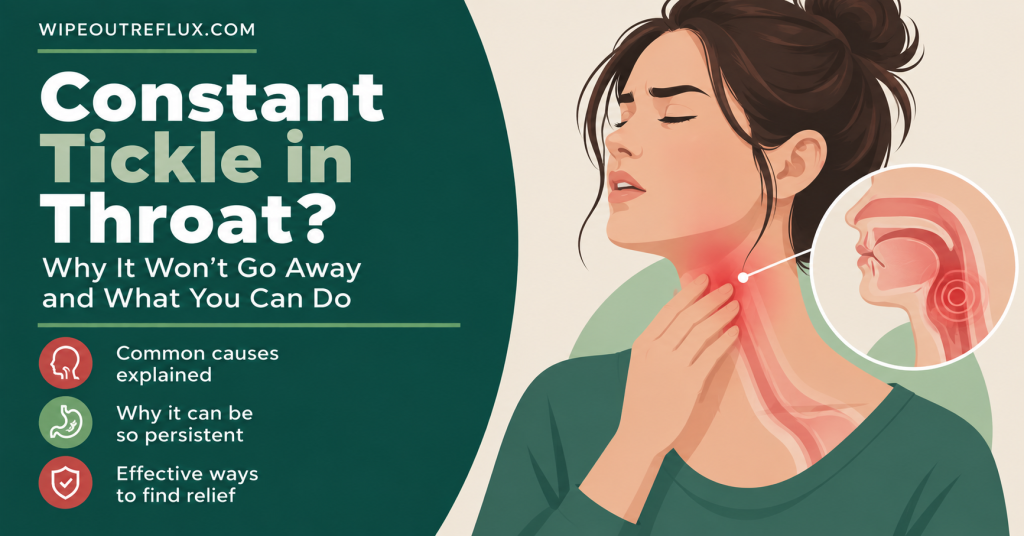
A constant tickle in your throat usually won’t go away because the nerves in your throat have become sensitized and something is still irritating them. The most common reasons are silent reflux (LPR), post-nasal drip, a nerve left oversensitive after a viral infection, asthma, or an ACE inhibitor blood pressure drug. Constant coughing and throat clearing then keep the throat irritated, so the tickle feeds itself.
If your tickle is worse at night or the moment you lie down, reflux and post-nasal drip move to the top of the list. Lying flat lets stomach contents and mucus reach the throat more easily and clear more slowly.
A constant tickle is very rarely a sign of cancer. But a tickle that comes with coughing up blood, a hoarse voice for more than three weeks, weight loss or breathlessness should be checked by a doctor promptly.
Key Takeaways
- A tickle that has lasted more than three weeks after a cold is worth investigating, and a cough lasting more than eight weeks counts as chronic.
- Persistent tickles usually come from an ongoing irritant (reflux, post-nasal drip, an ACE inhibitor) plus throat nerves that have become oversensitive.
- Silent reflux is one of the most missed causes because it often causes no heartburn. Pepsin from the stomach can sit in throat tissue and keep irritating it.
- A tickle that’s worse at night, when lying down or soon after a late meal is one of the strongest pointers toward reflux.
- Post-nasal drip also worsens when lying down, so the overall pattern matters: mucus and nasal symptoms point one way, meals and throat clearing the other.
- Coughing and throat clearing keep the tickle going, so breaking that habit is part of treatment whatever the cause.
- Speech therapy and, for some people, nerve-calming medication can settle a tickle that persists after the trigger is treated.
- A throat tickle on its own is rarely lung cancer. Coughing up blood, hoarseness over three weeks, weight loss or a new cough in a smoker over 40 need prompt checks.
When Does a Tickle Count as “Constant”?
After a cold or flu, a tickly cough commonly lingers for 3 to 8 weeks as the airway lining recovers. Doctors call this post-infectious cough, and it usually settles without treatment [Braman, Chest, 2006]. A cough lasting longer than eight weeks in adults is defined as chronic, and current guidelines describe most chronic cough as a problem of cough hypersensitivity, where the reflex fires far too easily [Morice et al., European Respiratory Journal, 2020].
So if your tickle has hung around for weeks, or keeps coming back, or you’ve had it for months, it’s no longer just “the tail end of a cold.” Something is keeping it going.
Why a Tickle in Your Throat Won’t Go Away
A tickle is the feeling of your throat’s sensory nerves firing the urge to cough. I explain the basics in my guide to a tickle in the throat. A tickle becomes constant when three things stack up:
- An ongoing irritant. Something keeps touching the throat nerves: reflux, mucus, a drug side effect, dry air.
- Sensitized nerves. Repeated irritation lowers the nerves’ firing threshold, so they start reacting to things that never used to bother them, such as talking, laughing or cold air.
- The tickle-cough loop. Every dry cough and throat clear bangs the vocal cords together and irritates the lining further, which makes the nerves fire again sooner.
This is why people get stuck. Treat only the irritant and the sensitized nerve keeps the tickle going. Suppress only the cough and the irritant keeps re-sensitizing the nerve. Lasting relief usually needs both.
The Most Common Reasons a Tickle Lasts for Months
Silent reflux (LPR)
Laryngopharyngeal reflux is reflux that reaches the throat and voice box. In the original research defining it, most patients with throat-based reflux didn’t have heartburn [Koufman, The Laryngoscope, 1991]. That’s why it gets missed: people with a constant tickle and no heartburn rarely think of their stomach.
What makes LPR so persistent is pepsin. This stomach enzyme can be carried into the throat in tiny amounts, taken up into the tissue, and stay there. It remains stable at normal throat pH and reactivates whenever more acid arrives, including from acidic food and drink [Johnston et al., The Laryngoscope, 2007]. That’s a steady, low-level irritant sitting right next to the nerves that produce the tickle. See how pepsin reactivates in the throat.
It also explains why acid-reducing medication often disappoints here. PPIs reduce how acidic the refluxate is, but they don’t remove pepsin already in the throat, don’t stop non-acid reflux, and do nothing to a sensitized nerve. More on that in why PPIs don’t work for LPR.
A nerve left oversensitive after a virus
One of the most common stories I hear goes like this: “I had a bad cold months ago, everything else cleared up, but this tickle never left.” A virus can injure or sensitize the throat’s sensory nerves, and in some people they don’t reset. ENT specialists call the result laryngeal sensory neuropathy, and a constant tickle or abnormal throat sensation that sets off coughing is one of its signature features [Lee and Woo, Annals of Otology, Rhinology & Laryngology, 2005]. If yours is triggered by talking, laughing, cold air or strong smells, read laryngeal sensory neuropathy and vagal cough.
Reflux and a sensitized nerve very often travel together. The reflux sensitizes the nerve, and then the nerve keeps the tickle going even as the reflux improves.
Post-nasal drip
Mucus running down the back of the throat from the nose or sinuses is a classic cause of a persistent tickle and throat clearing, especially in the morning. Ongoing rhinitis, sinus problems and allergies can keep it going for months. LPR can create a very similar feeling of thick mucus in the throat, so it’s worth reading silent reflux and post-nasal drip if nasal sprays haven’t helped.
Asthma
Cough-variant asthma can show up as a constant dry, tickly cough with little or no wheeze. It’s often worse at night, in cold air and with exercise. A doctor can test for it with breathing tests or an inhaler trial. See acid reflux misdiagnosed as asthma.
ACE inhibitor blood pressure drugs
If you take a “-pril” drug such as ramipril or lisinopril, this is the first thing to rule out. The cough can begin months after starting the drug and feels like a tickle or scratch in the throat. Talk to your doctor about switching rather than stopping it yourself. See ACE inhibitor cough.
Habit throat clearing
Sometimes the original cause has resolved but the clearing hasn’t. Frequent throat clearing becomes almost automatic, and it’s enough on its own to keep the throat irritated and tickly. My guide on how to stop constant throat clearing has practical swaps.
Tickle in Throat at Night and When Lying Down
If there’s one pattern that points me toward reflux more than any other, it’s a tickle that starts when you lie down or that wakes you in the night. Here’s why lying flat makes such a difference.
Why lying down brings the tickle on
- Gravity stops helping. Upright, gravity keeps stomach contents down and drains anything that does come up. Lying flat removes that, so reflux can travel higher and stays longer.
- Clearance slows at night. You swallow far less when you’re asleep, and swallowing is what normally washes reflux and saliva back down. Anything that reaches the throat lingers.
- Late meals load the stomach. Lying down with a full stomach is one of the most reliable reflux triggers there is. In one study, people who went to bed within three hours of dinner had several times the odds of reflux compared with those who left four hours or more [Fujiwara et al., American Journal of Gastroenterology, 2005].
- Mucus pools too. Post-nasal drip also runs straight onto the throat nerves when you’re horizontal, which is why it can be hard to separate from reflux at night.
A useful nuance: classic LPR episodes often happen during the day while upright [Koufman, The Laryngoscope, 1991]. So a throat that’s been irritated by reflux all day is already sensitized by bedtime, and the extra reflux and mucus that come with lying down are enough to set it off. You don’t need dramatic nighttime reflux for lying down to trigger the tickle.
Constant tickle causing coughing at night
Most people with a chronic cough cough much less once they’re properly asleep, because the cough reflex is strongly suppressed during sleep [Lee and Birring, Lung, 2010]. That’s why the tickle tends to hit in the window as you’re settling down, during lighter sleep, and when you first wake up. If you’re being woken from deep sleep by coughing, choking or gasping, that’s worth mentioning to your doctor specifically. Asthma and significant nighttime reflux are both possibilities. See waking up choking from acid reflux.
Reflux or post-nasal drip at night?
- Points to reflux: worse after a late or large meal, wine or coffee in the evening, a sour or bitter taste on waking, hoarseness in the morning, throat clearing through the day, and nasal sprays haven’t helped.
- Points to post-nasal drip: a blocked or runny nose, sneezing, a feeling of mucus dripping from behind the nose, seasonal or allergy patterns, and it improves with nasal rinses or sprays.
Many people have both. If you’re not sure, treat the reflux side for a few weeks and see what changes.
What to do about a tickle at night
- Finish eating about three hours before bed. This is the single biggest change for nighttime reflux. See how long before bed you should stop eating.
- Raise the head of your bed. Elevating the head of the bed is one of the few lifestyle measures with consistent evidence for reducing nighttime reflux [Kaltenbach et al., Archives of Internal Medicine, 2006]. Raise the whole bed, not just your head on extra pillows, which bends you at the waist. Here’s how to raise the head of your bed, or a wedge pillow works for many people.
- Sleep on your left side. The same review found lying on the left side reduced reflux compared with the right. See the best sleeping position for silent reflux.
- Consider an alginate before bed. Alginates form a raft on top of the stomach contents and are often used for throat reflux. See alginates for acid reflux.
- Keep water by the bed. Sip and swallow at the first tickle rather than coughing.
- Cut evening triggers. Alcohol, coffee, chocolate, mint and fizzy drinks in the evening are common culprits.
For more, see my guide to acid reflux at night.
How to Break a Constant Tickle: A Practical Plan
Here’s the approach I’d suggest if your tickle has been going for weeks or months and the obvious causes like an ACE inhibitor have been ruled out.
1. Calm the irritant
Give your throat a proper break from reflux for at least four to eight weeks. That means smaller meals, nothing for three hours before bed, head of the bed raised, and cutting the main triggers: coffee, alcohol, fizzy drinks, chocolate, mint, citrus, tomato, and fatty or spicy food. Because pepsin is reactivated by acid, keeping what you eat and drink low in acidity matters especially for the throat. The Wipeout Diet Plan takes you through this step by step. If post-nasal drip is part of the picture, treat that alongside it.
2. Stop feeding the loop
Every time you feel the tickle, swap the cough or throat clear for something gentler:
- A sip of water and a firm swallow
- Closing your lips and breathing slowly in through your nose, out through pursed lips
- A “silent cough”: a gentle puff of air with no voice instead of a hard cough
It’s hard for the first week or two and gets easier. This is the core of the speech-therapy programs that significantly reduced chronic cough in a randomized placebo-controlled trial [Vertigan et al., Thorax, 2006]. A speech and language therapist can guide you through the full version. See voice therapy for silent reflux.
3. Track it
Note when the tickle is worst and what came before it: meals, drinks, lying down, talking, cold air. Patterns show up within a couple of weeks and tell you which cause to focus on. The Reflux Symptom Index is a useful way to score your throat symptoms before and after.
4. Be patient with the nerve
A sensitized nerve takes time to calm down even after the irritant has gone. Most people notice a shift over weeks rather than days. See the LPR recovery timeline for realistic expectations.
Treatments Your Doctor May Suggest
If your tickle persists despite treating the likely causes, a doctor or ENT specialist may look at your larynx and consider:
- Speech and language therapy for cough suppression and throat care
- Nerve-calming (neuromodulator) medication. Gabapentin improved cough-related quality of life in a randomized placebo-controlled trial in refractory chronic cough [Ryan et al., The Lancet, 2012], and low-dose amitriptyline is also used. These are prescription decisions with side effects. See amitriptyline and gabapentin for reflux cough.
- Asthma testing or an inhaler trial if cough-variant asthma is possible
- Reflux testing if the picture is unclear
If you’re not sure whether it’s time to push for referral, my guide on when to see a doctor for LPR may help.
Could a Constant Tickle in My Throat Be Lung Cancer?
This worry is common, so here’s a straight answer. A tickle in the throat on its own is very rarely a sign of lung cancer. Cough of any kind is extremely common in the general population, and in a large UK primary care study, cough by itself had a very low predictive value for lung cancer. Coughing up blood was the strongest single warning sign [Hamilton et al., Thorax, 2005].
Lung cancer coughs also tend to look different from a throat tickle. They’re more often a new cough, or a change in a long-standing cough, in someone with risk factors such as smoking, and they usually come with other symptoms.
See a doctor promptly if your tickle or cough comes with any of these:
- Coughing up blood, even small streaks
- Unexplained weight loss or loss of appetite
- Breathlessness, chest pain or persistent tiredness
- A hoarse voice lasting more than three weeks
- A lump in your neck
- Pain or difficulty swallowing, or pain in one ear
- You’re over 40 and smoke or have smoked, and have a new or changed cough
UK guidance recommends an urgent chest X-ray for people aged 40 and over with unexplained cough plus other symptoms, or with cough alone if they’ve ever smoked. It also recommends considering urgent referral for laryngeal cancer in people aged 45 and over with persistent unexplained hoarseness or a neck lump [National Institute for Health and Care Excellence, NG12, 2015]. A simple examination and, where needed, a chest X-ray or a look at the throat usually settles the question quickly.
If you’re worried about the throat side, I’ve covered reflux and cancer risk honestly in can acid reflux cause cancer? and is silent reflux dangerous?
Conclusion
A constant tickle in your throat that won’t go away is almost always a sign that something is still irritating your throat nerves and that those nerves have become oversensitive. Silent reflux, post-nasal drip, a post-viral nerve, asthma and ACE inhibitors are the usual culprits, and constant coughing and throat clearing keep the whole thing going. A tickle that’s worse at night or when you lie down is one of the clearest signs that reflux is involved, even if you’ve never had heartburn. It’s rarely anything sinister, but the red flags above deserve a prompt check.
If reflux fits your pattern, the Wipeout Diet Plan is the most complete way I know to take the irritation out of your throat. It covers what to eat and drink, meal timing and the habits that lower pepsin activity, so the nerves finally get the quiet they need to settle. It was built first for LPR, the throat-based reflux behind most persistent tickles, but because it targets the same underlying mechanisms, it works just as well for GERD and everyday heartburn.
For a lighter companion, the Wipeout Food Reference Guide is the essential list of foods and drinks that are safe for acid reflux and LPR, with their pH values, ideal for planning evening meals that won’t set your throat off at bedtime.
Frequently Asked Questions
Why do I have a constant tickle in my throat?
Usually because something is still irritating your throat nerves and they’ve become oversensitive. The most common causes are silent reflux, post-nasal drip, a nerve left sensitized after a virus, asthma and ACE inhibitor blood pressure drugs. Frequent coughing and throat clearing keep it going.
Why is the tickle in my throat worse when I lie down?
Lying flat lets reflux and mucus reach the throat more easily, and you swallow less, so they clear more slowly. A tickle that starts as soon as you lie down, especially after a late meal, strongly suggests reflux or post-nasal drip.
Can silent reflux cause a tickle in the throat for months?
Yes. LPR is one of the most common causes of a long-lasting throat tickle, often with throat clearing, a lump feeling or hoarseness, and frequently with no heartburn. Pepsin lodged in the throat tissue can keep irritating the nerves until reflux is properly controlled.
Is a tickle in the throat a sign of lung cancer?
Very rarely on its own. See a doctor promptly if it comes with coughing up blood, weight loss, breathlessness, chest pain, a hoarse voice for over three weeks, or if you’re over 40, have smoked and have a new or changed cough.
How long is too long for a tickle in the throat?
After a cold, a tickly cough can last up to about eight weeks. If it’s lasted longer than three weeks without improving, keeps coming back, or comes with any red-flag symptoms, see a doctor.
Why won’t my tickle go away even on omeprazole?
PPIs lower acid but don’t remove pepsin already in the throat, don’t stop non-acid reflux and don’t calm a sensitized nerve. Diet, meal timing, bed elevation and cough-suppression techniques often make more difference to a throat tickle than medication alone.
Can anxiety cause a constant tickle in the throat?
Anxiety and stress can make you more aware of throat sensations and increase throat clearing, which keeps the tickle going. They’re more likely to amplify an existing cause than to be the only one. See can LPR be caused by anxiety?
Research & References
- [Braman, Chest, 2006] — ACCP guideline on post-infectious cough, which typically lasts 3 to 8 weeks after a respiratory infection and usually resolves on its own.
- [Morice et al., European Respiratory Journal, 2020] — European Respiratory Society guidelines defining chronic cough in adults as lasting over eight weeks and framing it as a cough hypersensitivity problem.
- [Koufman, The Laryngoscope, 1991] — Landmark study defining laryngopharyngeal reflux, showing most patients lacked heartburn and that throat reflux often occurred while upright.
- [Johnston et al., The Laryngoscope, 2007] — Lab study showing pepsin remains stable at throat pH and can be reactivated by acid, explaining persistent throat irritation in reflux.
- [Lee and Woo, Annals of Otology, Rhinology & Laryngology, 2005] — Describes chronic cough with abnormal throat sensations as a sign of laryngeal sensory neuropathy, responding to nerve-directed treatment.
- [Fujiwara et al., American Journal of Gastroenterology, 2005] — Case-control study finding a dinner-to-bed time of under three hours was associated with markedly higher odds of reflux.
- [Lee and Birring, Lung, 2010] — Review explaining that the cough reflex is suppressed during sleep, so people with chronic cough cough mainly while awake.
- [Kaltenbach et al., Archives of Internal Medicine, 2006] — Evidence-based review finding head-of-bed elevation, left-side sleeping and weight loss improved reflux measures.
- [Vertigan et al., Thorax, 2006] — Randomized placebo-controlled trial in which a speech pathology program with cough-suppression techniques significantly reduced chronic cough.
- [Ryan et al., The Lancet, 2012] — Randomized placebo-controlled trial showing gabapentin improved cough-specific quality of life in refractory chronic cough.
- [Hamilton et al., Thorax, 2005] — UK primary care case-control study of symptoms before lung cancer diagnosis, finding coughing up blood the strongest single warning sign and cough alone a weak predictor.
- [National Institute for Health and Care Excellence, NG12, 2015] — UK suspected cancer guidance setting the thresholds for urgent chest X-ray in people with cough and for laryngeal cancer referral with persistent hoarseness.

David Gray
12 years living with LPR · Consultant & researcher
I've lived with LPR for twelve years — the misdiagnoses, the PPI courses that did nothing, the slow work of figuring out what actually helps. Wipeout Reflux is where I translate the research into plain terms for people stuck in the same place. Every claim here is sourced to peer-reviewed work, and I consult one-to-one with LPR sufferers.