
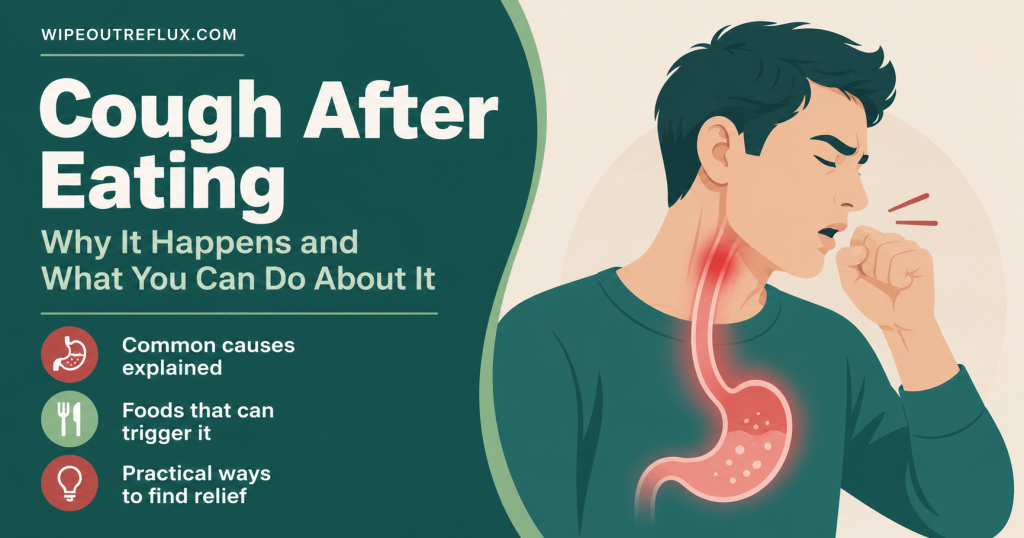
Coughing after eating is most often caused by acid reflux. A meal stretches your stomach, and that stretch makes the valve at the top of your stomach open more often. Stomach contents then move up the esophagus, and they can set off a cough in two ways: through a nerve reflex from the esophagus itself, or by reaching the throat and irritating it directly. Neither one needs heartburn.
The other common causes are food or drink going down the wrong way (a swallowing problem), mucus from a runny nose that some foods trigger, and a throat nerve that has become oversensitive. Timing helps you tell them apart. A cough during a mouthful points toward swallowing. A cough that starts 10 to 60 minutes after a meal points toward reflux.
Most people can stop it by eating smaller meals, cutting back on the foods that relax the stomach valve, and staying upright for a few hours after eating. Coughing or choking during meals, especially with chest infections, needs a swallowing assessment.
Key Takeaways
- Reflux is the most common reason people cough after eating. Meals stretch the stomach, and that stretch triggers the brief valve openings that let reflux happen.
- Reflux can cause a cough without reaching your throat. Acid in the lower esophagus can trigger coughing through a shared nerve reflex.
- Silent reflux (LPR) causes cough, throat clearing and mucus after meals, often with no heartburn at all.
- Coughing during a mouthful, a wet or gurgly voice after swallowing, or repeat chest infections suggest a swallowing problem. These need checking.
- Spicy and hot foods can make your nose run while you eat (gustatory rhinitis), and that drip can make you cough.
- Fatty, sugary and rich foods such as ice cream, chocolate and creamy dishes are common triggers because they relax the stomach valve or sit longer in the stomach.
- Smaller meals, slower eating, and leaving 3 hours between your last meal and bed are the most effective changes you can make.
- See a doctor if you choke regularly, lose weight, cough up blood, have trouble swallowing, or the cough has lasted more than 3 weeks.
Why Do I Cough After Eating?
When people describe this to me, they almost always say the same thing: “I’m fine until I eat, then I start coughing.” Eating changes three things at once. It fills and stretches your stomach. It pushes food and liquid past your airway. And for some foods, it fires up the nerves in your mouth, nose and throat. Each of those can lead to a cough, and each points to a different cause.
The main causes are:
- Acid reflux and silent reflux (LPR): the most common cause by far.
- A swallowing problem (dysphagia): food or liquid briefly entering the airway.
- Gustatory rhinitis and post-nasal drip: a runny nose set off by eating, especially hot or spicy food.
- A sensitized cough nerve: a throat that reacts to things it normally wouldn’t.
- Less common causes: food allergy, asthma and eosinophilic esophagitis.
Reflux: The Most Common Cause of Coughing After Eating
Why meals trigger reflux
Your lower esophageal sphincter, the valve between your stomach and esophagus, doesn’t just weaken and leak. It opens for a few seconds at a time in episodes called transient lower esophageal sphincter relaxations. The main trigger for these openings is stretch of the upper stomach. Distend the stomach and you get more of them [Holloway et al., Gastroenterology, 1985].
That’s why reflux clusters in the hour or two after eating, and why big meals are worse than small ones. Fat adds to the effect. In a controlled comparison, a high-fat meal produced more esophageal acid exposure than a low-fat meal with the same size and calories [Becker et al., American Journal of Gastroenterology, 1989]. I go into this in more detail in does overeating cause acid reflux.
How reflux causes a cough: two routes
Route 1: the esophagus-to-airway reflex. Your esophagus and your airways share the vagus nerve. When acid reaches the lower esophagus, it can trigger coughing through that nerve, even if nothing reaches the throat. In a classic study of people with reflux-related cough, putting acid into the lower esophagus was enough to set off coughing, and numbing the esophagus blocked the response [Ing et al., American Journal of Respiratory and Critical Care Medicine, 1994]. This explains how you can cough after a meal with no burning and no sour taste.
Route 2: reflux reaching the throat (silent reflux). With laryngopharyngeal reflux (LPR), small amounts of stomach contents travel all the way up to the voice box and throat. The voice box lining is far more delicate than the esophagus, so even small amounts irritate it. The main culprit is pepsin, the stomach’s protein-digesting enzyme. Pepsin can be taken up into throat tissue and stay there, then become active again when more acid arrives, including acid from the food and drink you’ve just had [Johnston et al., The Laryngoscope, 2007]. I explain this process in how pepsin reactivates in the throat.
Chronic cough specialists have described a recognizable pattern for reflux cough. In a study of 47 people with chronic cough and confirmed reflux disease, typical triggers included talking, getting up from bed, and certain foods or eating in general. Throat clearing, voice changes, a lump-in-the-throat feeling and trouble swallowing were common alongside. More than a third had no heartburn or indigestion at all [Everett and Morice, Respiratory Medicine, 2007].
This was my experience too. In my years of dealing with LPR, a cough and throat clearing after dinner were among the most reliable signs that I’d eaten something I shouldn’t have, long before any burning showed up. For the full set of throat signs, see LPR symptoms and my main guide to reflux cough.
Signs your cough after eating is reflux
- It starts 10 to 60 minutes after a meal rather than mid-mouthful
- It’s worse after big, late, fatty or rich meals
- Lying down or bending over after eating makes it worse
- You also clear your throat a lot, feel mucus or a lump in your throat, or sound hoarse
- You get a sour taste, burping or heartburn sometimes (but not necessarily)
- Coffee, alcohol, chocolate, fizzy drinks, citrus or tomato make it worse
Mucus, Phlegm or a Wet Cough After Eating
A wet, phlegmy cough after meals is one of the most common versions of this, and it can come from a few different places.
Reflux-driven mucus
When reflux irritates the throat, the lining responds by producing thick mucus to protect itself. That leaves you feeling something stuck that you need to cough or clear up. It usually builds up after meals and in the morning. If that sounds familiar, read phlegm stuck in your throat from acid reflux and GERD and mucus.
Gustatory rhinitis: a runny nose from eating
If your nose runs while you eat, especially with hot or spicy food, you have gustatory rhinitis. It’s a nerve reflex rather than an allergy. Researchers who described it found that spicy foods brought on a watery runny nose within minutes, and that blocking the nerve signal with atropine prevented it [Raphael et al., Journal of Allergy and Clinical Immunology, 1989]. Some of that fluid drips down the back of the throat, and you cough. Unlike reflux, this cough starts while you’re eating and fades soon after. Silent reflux can also mimic a drip, so if you’re unsure which you have, see silent reflux and post-nasal drip.
Does dairy cause mucus?
Many people blame milk for phlegm after eating. The evidence doesn’t really support milk making more mucus. A review for doctors found no good evidence that drinking milk increases mucus production, even in people with asthma, although milk can briefly leave a thicker coating in the mouth and throat that feels like phlegm [Thiara and Goldman, Canadian Family Physician, 2012].
Where dairy does cause trouble is reflux. Whole milk, cream, butter and cheese are high in fat, and fat relaxes the stomach valve. I cover this in does milk help acid reflux and does cheese cause acid reflux.
When a wet cough is a warning sign
A wet, gurgly voice right after you swallow, or a wet cough that starts during the meal, can mean food or liquid is getting into your airway. This is called aspiration, and it’s a different problem from reflux. Read the next section if this sounds like you.
Coughing While Eating: Could It Be a Swallowing Problem?
Swallowing is a tightly timed sequence. As food moves to the back of your throat, the voice box lifts and a flap (the epiglottis) closes off your airway. If that timing slips, a little food or liquid gets into the airway and you cough to clear it. Thin liquids like water are often the hardest to control.
Clues that your cough is about swallowing rather than reflux:
- You cough or choke during a mouthful or straight after swallowing
- Your voice sounds wet or gurgly after you eat or drink
- Food feels like it sticks, or you have to swallow several times
- You’ve had repeated chest infections or pneumonia
- You’ve had a stroke, or have Parkinson’s disease or another neurological condition
Swallowing problems are very common after a stroke and raise the risk of pneumonia considerably, especially when food or liquid is confirmed to be going into the airway [Martino et al., Stroke, 2005]. Unexplained coughing at meals deserves a proper assessment from a doctor or a speech and language therapist rather than guesswork. Reflux and swallowing problems also overlap, which I explain in can acid reflux make it hard to swallow.
Why Do I Always Cough After Eating (Even Small Amounts)?
If you cough after almost every meal, even a light one, two causes are most likely.
A sensitized cough nerve. When the throat’s sensory nerves have been irritated for a long time by reflux, a virus or repeated coughing, they can become oversensitive. Respiratory specialists call this cough hypersensitivity: coughing in response to low levels of triggers that wouldn’t normally bother you [Morice et al., European Respiratory Journal, 2014]. For a sensitized throat, the movement of swallowing, crumbs, a warm or cold drink, or a strong flavor can be enough to set it off. See vagal cough and laryngeal sensory neuropathy.
Ongoing silent reflux. If pepsin is already sitting in your throat tissue, any acidic food or drink can reactivate it. That’s why some people cough after a glass of orange juice or a salad with vinaigrette even though the meal was small.
Less often, coughing after eating anything can come from eosinophilic esophagitis, an allergic inflammation of the esophagus that causes food to stick, or from a pouch in the throat called a Zenker’s diverticulum, which traps food and brings it back up. Both are uncommon, but both are reasons to see a doctor if swallowing feels difficult. More in eosinophilic esophagitis vs acid reflux.
Timing Clues: What Your Cough Is Telling You
- During a mouthful, especially with water: swallowing problem. Get it checked.
- While eating hot or spicy food, with a runny nose: gustatory rhinitis.
- 10 to 60 minutes after a meal: reflux.
- After lying down following a meal, or at night: reflux.
- After almost any food, along with talking and cold air: sensitized cough nerve, often with reflux behind it.
- Within minutes of one specific food, with itching, hives or swelling: possible food allergy. Get urgent help if you have any breathing difficulty.
Foods That Make You Cough After Eating
Certain foods come up again and again when people tell me what sets off their cough. Most of them work through reflux: they relax the stomach valve, stay in the stomach longer, or add acid that reactivates pepsin in the throat.
Coughing after eating ice cream
Ice cream combines several triggers: it’s high in fat, high in sugar, often eaten as dessert on top of a full meal, and very cold. Fat relaxes the valve and slows stomach emptying. The cold can also be a direct trigger for an oversensitive throat. See is ice cream bad for acid reflux for gentler swaps.
Coughing after eating chocolate
Chocolate is one of the best-documented reflux triggers. In a pH-monitoring study, eating chocolate significantly increased acid exposure in the esophagus during the following hour [Murphy and Castell, American Journal of Gastroenterology, 1988]. It contains fat, caffeine and theobromine, all of which relax the valve. More in does chocolate cause heartburn or acid reflux and is hot chocolate bad for acid reflux.
Coughing after dairy
As above, dairy mostly causes trouble through its fat content, not by making mucus. Skim milk, low-fat yogurt and small amounts of hard cheese are usually much better tolerated than cream, whole milk, butter and soft cheeses. Some people with lactose intolerance also get bloating, and the extra pressure can push reflux up.
Coughing after eating bread
Plain bread isn’t acidic and is usually fine for reflux. The problems tend to come from portion size (a sandwich lunch is often a big meal), what goes on the bread (butter, cheese, cured meat, tomato), and, for some people, gluten sensitivity. Dry, crumbly bread can also set off a sensitized throat. See is bread good for acid reflux and gluten and acid reflux.
Coughing after spicy food
Spicy food can cause a cough in two ways. Capsaicin, the compound that makes chili hot, directly stimulates the throat’s cough receptors. It’s so reliable that doctors use inhaled capsaicin to test how sensitive someone’s cough reflex is. It also triggers gustatory rhinitis, and spicy dishes are often fatty or acidic too. More in spicy food and acid reflux.
Coughing after cold food and drinks
A cough set off by cold water, iced drinks or ice cream usually points to a hypersensitive throat or airway rather than reflux alone. The cold acts as a trigger in the same way cold air can for people with asthma. Room-temperature or lukewarm drinks are a simple test. If the cough goes away, temperature was a big part of the problem.
Coughing after sugar and sweets
Sugar itself isn’t strongly acidic, but sugary foods rarely come alone. They’re usually paired with fat (pastries, chocolate, ice cream), acid (sodas, sweets with citric acid, fruit juice) or large portions. Sodas add carbonation, which stretches the stomach. See is sugar acid or alkaline and is sparkling water bad for acid reflux.
Other common triggers
- Fried and fatty foods: slow stomach emptying and relax the valve. See is fried food bad for acid reflux.
- Coffee and alcohol: relax the valve, and many are acidic.
- Citrus, tomato and vinegar: add acid that can reactivate pepsin in the throat.
- Mint: relaxes the valve, so after-dinner mints can backfire.
- Histamine-rich foods (aged cheese, wine, cured meats, leftovers): can cause flushing, a runny nose and throat symptoms in some people. See histamine intolerance and acid reflux.
For a full list of what to cut and why, see LPR foods to avoid, and for the acidity of everyday foods, my food pH chart.
How to Stop Coughing After Eating
Since reflux is behind most cases, most of these steps target it. They also help with a sensitized throat, because they take away the irritation that keeps the nerve on high alert.
- Eat smaller meals. Less stretch in the stomach means fewer valve openings. Four or five smaller meals are easier on reflux than two or three big ones.
- Slow down and chew well. Eating quickly means swallowing more air and overfilling the stomach. Put your fork down between bites.
- Stay upright after eating. Gravity helps keep stomach contents down. Avoid slouching on the sofa or lying down for at least 2 to 3 hours. A gentle walk helps. See does walking after meals help acid reflux.
- Stop eating 3 hours before bed. In one case-control study, people who went to bed within 3 hours of dinner had much higher odds of reflux than those who waited 4 hours or more [Fujiwara et al., American Journal of Gastroenterology, 2005]. More in how long before bed you should stop eating.
- Lower the acid and fat in your meals. In people with stubborn silent reflux who hadn’t improved on medication alone, a strict low-acid diet improved symptoms in most cases [Koufman, Annals of Otology, Rhinology & Laryngology, 2011]. Taking pepsin’s fuel away is the core idea behind the Wipeout Diet Plan.
- Consider an alginate after meals. Alginate products like Gaviscon Advance form a raft on top of your stomach contents that helps block reflux after meals. See alginates for acid reflux.
- Drink water at room temperature, in small sips. This helps if cold triggers you or if thin liquids make you cough. Sip between bites rather than gulping.
- Don’t give in to every cough. Hard coughing and throat clearing irritate the throat more and keep the cycle going. When you feel the urge, swallow, then breathe slowly in through your nose. Speech therapy programs built around these techniques have reduced chronic cough in trials [Vertigan et al., Thorax, 2006]. See how to stop constant throat clearing.
- Keep a food and symptom diary for 2 weeks. Note what you ate, how much, the time, and when you coughed. Patterns show up quickly.
One note on acid-suppressing drugs: PPIs reduce acid, but they don’t stop reflux from happening and don’t remove pepsin. That’s why many people with throat symptoms find they don’t help as much as expected. I explain why in why PPIs don’t work for LPR.
When to See a Doctor
Coughing after eating is usually manageable, but get checked if you have any of the following:
- You cough, choke or splutter during meals on a regular basis
- Your voice sounds wet or gurgly after eating or drinking
- You’ve had chest infections or pneumonia
- Food sticks, or swallowing is painful or difficult
- You’ve lost weight without trying
- You cough up blood or vomit blood
- Your voice has been hoarse for more than 3 weeks
- The cough has lasted more than 3 weeks
- You smoke or used to smoke and have a new or changed cough
If a food ever makes your lips, tongue or throat swell, or you struggle to breathe after eating, treat it as an emergency.
Conclusion
If you cough after eating, reflux is the most likely reason. A meal stretches your stomach and makes the valve open more often. Stomach contents then trigger a cough through a nerve reflex from the esophagus, or by reaching your throat and leaving pepsin behind. Heartburn is optional. Many people with this cough never feel any burning. Pay attention to timing. A cough during a mouthful needs a swallowing check, while a cough 10 to 60 minutes after a meal, especially a big, rich or late one, points squarely at reflux.
The fix starts on your plate. If you want a clear plan instead of guesswork, the Wipeout Diet Plan is where I’d send you first. It’s my complete, step-by-step program for lowering the acid, fat and meal patterns that set reflux off, so your throat and cough nerves can settle down. I designed it around silent reflux, the throat-based kind behind most after-meal coughs, but because it tackles the same root causes, it works just as well if your reflux shows up as classic heartburn.
If you’d like something lighter to start with, the Wipeout Food Reference Guide is the essential companion. It lists the foods and drinks that are safe for acid reflux and LPR, with their pH values, so you can quickly check whether that dessert or drink is likely to set off your cough.
Frequently Asked Questions
Why do I cough after eating but have no heartburn?
Reflux can cause a cough without heartburn in two ways. Acid in the lower esophagus can trigger coughing through a shared nerve reflex, and small amounts of reflux reaching the throat (silent reflux) irritate the voice box without burning the chest. Most people with silent reflux have little or no heartburn.
Why do I cough up mucus after eating?
Reflux irritating the throat makes the lining produce thick protective mucus, which builds up after meals. Hot or spicy food can also make your nose run (gustatory rhinitis), and that drip ends up in your throat. A wet, gurgly cough during meals can be a sign of food or liquid entering the airway and should be checked.
Is coughing after eating a sign of GERD?
It often is. Coughing after meals is one of the classic patterns of reflux-related cough, and it can happen with GERD or silent reflux. It isn’t the only cause, though. Swallowing problems, post-nasal drip and a sensitized cough nerve can all produce it too.
Why do I cough after eating ice cream or drinking cold water?
Cold can directly trigger a sensitive throat or airway. Ice cream is also high in fat and sugar and is usually eaten after a full meal, which makes reflux more likely. If room-temperature drinks don’t trigger you, temperature sensitivity is a big part of it.
Can coughing after eating be serious?
Usually not, but it can be if it’s caused by food or liquid going into your airway, which can lead to chest infections. Regular choking during meals, a wet voice after swallowing, weight loss, food sticking or coughing up blood all need a doctor’s assessment.
How long after eating does a reflux cough start?
Usually within 10 to 60 minutes, when the stomach is fullest and the valve opens most often. It’s typically worse after large, fatty or late meals and when you lie down soon after eating.
How do I stop coughing after eating at night?
Eat your last meal at least 3 hours before bed, keep it small and low in fat and acid, stay upright afterward, and raise the head of your bed. An alginate after dinner can also help block reflux overnight.
Research & References
- [Holloway et al., Gastroenterology, 1985] — Established stomach stretch as a mechanism for after-meal reflux, showing that distending the stomach provokes transient lower esophageal sphincter relaxations.
- [Becker et al., American Journal of Gastroenterology, 1989] — High-fat meals increased esophageal acid exposure after eating compared with low-fat meals of equal size and calories.
- [Ing et al., American Journal of Respiratory and Critical Care Medicine, 1994] — In people with reflux-related cough, acid in the lower esophagus triggered coughing, and numbing the esophagus blocked it, supporting an esophagus-to-airway nerve reflex.
- [Johnston et al., The Laryngoscope, 2007] — Lab study showing pepsin remains stable at throat pH and can be reactivated by acid, explaining ongoing throat irritation in reflux.
- [Everett and Morice, Respiratory Medicine, 2007] — In 47 people with chronic cough and reflux disease, cough was linked to talking, getting up, certain foods and eating in general, often with throat clearing and voice changes rather than heartburn.
- [Raphael et al., Journal of Allergy and Clinical Immunology, 1989] — Described gustatory rhinitis, a watery runny nose triggered by eating spicy foods through a nerve reflex that atropine could block.
- [Thiara and Goldman, Canadian Family Physician, 2012] — Evidence review finding no good support for the belief that milk increases mucus production, including in people with asthma.
- [Martino et al., Stroke, 2005] — Systematic review finding swallowing problems in a large share of stroke patients, with a substantially higher pneumonia risk, especially with confirmed aspiration.
- [Morice et al., European Respiratory Journal, 2014] — European Respiratory Society consensus defining cough hypersensitivity syndrome, a cough triggered by low levels of normally harmless stimuli.
- [Murphy and Castell, American Journal of Gastroenterology, 1988] — pH monitoring showed that eating chocolate significantly increased esophageal acid exposure in the following hour.
- [Fujiwara et al., American Journal of Gastroenterology, 2005] — Case-control study finding a dinner-to-bed time of under 3 hours was associated with markedly higher odds of reflux.
- [Koufman, Annals of Otology, Rhinology & Laryngology, 2011] — A strict low-acid diet improved symptoms in most people with silent reflux that hadn’t responded to medication alone.
- [Vertigan et al., Thorax, 2006] — Randomized placebo-controlled trial showing a speech pathology program, including cough-suppression techniques, significantly reduced chronic cough.

David Gray
12 years living with LPR · Consultant & researcher
I've lived with LPR for twelve years — the misdiagnoses, the PPI courses that did nothing, the slow work of figuring out what actually helps. Wipeout Reflux is where I translate the research into plain terms for people stuck in the same place. Every claim here is sourced to peer-reviewed work, and I consult one-to-one with LPR sufferers.