
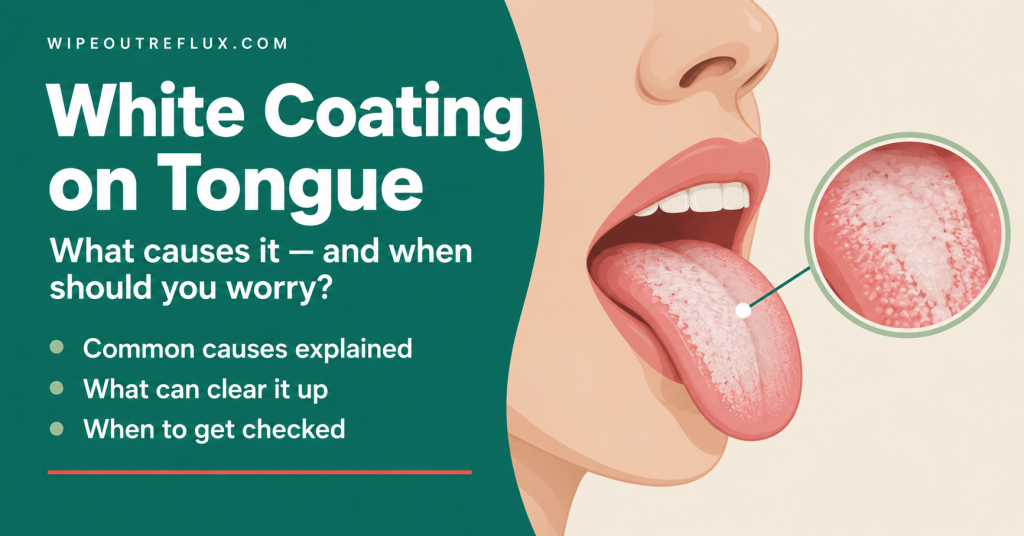
A white coating on your tongue is usually a buildup of dead cells, bacteria and food debris trapped between the tiny bumps (papillae) on its surface. It’s most often caused by a dry mouth, mouth breathing, dehydration, not cleaning your tongue, smoking or alcohol. It’s normally harmless and clears within days to a couple of weeks once the cause is dealt with.
Some white tongues mean more than that. Oral thrush, a yeast infection, causes creamy white patches that wipe off and leave a red, sore surface underneath. And a white tongue that keeps coming back, especially with bad breath, a sour taste or throat symptoms, can be a sign of reflux reaching your mouth. That’s the cause most articles skip, and in one study it showed a striking link.
Here’s how to work out what your white tongue means and how to get rid of it.
Key Takeaways
- Most white tongue coating is debris, bacteria and dead cells caught between swollen papillae. It’s harmless and usually clears within one to two weeks.
- The most common causes are dry mouth, mouth breathing, dehydration, smoking, alcohol, illness and poor tongue cleaning.
- Thrush causes creamy white patches that wipe off, leaving red or sore patches underneath. It’s more likely after antibiotics, with inhaled steroids, dentures or diabetes.
- A white tongue that isn’t thrush and keeps coming back, especially with bad breath or a sour taste, can be linked to reflux. In one study, white tongue was found in almost all people with GERD and only 5% of healthy controls.
- A thicker coating in the morning is normal because saliva flow drops while you sleep. Lower saliva flow is linked to a heavier coating and morning breath.
- Brushing or scraping your tongue daily, drinking more water and treating dry mouth or reflux are the main ways to get rid of it.
- White patches that can’t be scraped off, last more than two weeks, or come with a lump or ulcer need checking by a dentist or doctor.
What a White Coating on Your Tongue Actually Is
The top of your tongue is covered in thousands of tiny projections called papillae. Normally, saliva, eating and talking keep them clean. When the papillae become swollen or inflamed, or there’s not enough saliva to wash them, debris builds up in the gaps between them: dead skin cells, bacteria, food particles and sometimes yeast. That buildup is what you see as a white or off-white coating.
This is also why a coated tongue and bad breath so often go together. The coating is a breeding ground for odor-producing bacteria. In a 2025 study of healthy adults, people with morning bad breath had lower saliva flow and a heavier tongue coating, and the odor compounds rose as saliva fell and coating increased [Popa et al., Journal of Clinical Medicine, 2025].
So most of the time, the real question isn’t “what is this coating?” It’s “why are my papillae inflamed, or why isn’t my mouth clearing itself?”
What Causes a White Coating on Your Tongue?
1. Dry mouth, dehydration and mouth breathing
Saliva is your tongue’s natural cleaning system. Anything that reduces it lets debris settle:
- Not drinking enough water
- Sleeping with your mouth open, snoring or a blocked nose
- Medications that dry the mouth, such as antihistamines, some antidepressants, blood pressure tablets and bladder medications
- Caffeine and alcohol
- Fever or illness
This is the single most common reason for a white tongue. It’s also why reflux and a white tongue can travel together, since reflux is linked to a dry, irritated mouth. See acid reflux and dry mouth.
2. Not cleaning your tongue
Brushing your teeth doesn’t clean your tongue. If you never brush or scrape it, the coating builds up. Mechanical tongue cleaning with a toothbrush, a tongue scraper or both significantly reduces tongue coating and breath odor straight away [Choi et al., International Journal of Environmental Research and Public Health, 2022].
3. Smoking, vaping and alcohol
Tobacco smoke and alcohol irritate the papillae and dry the mouth. Smokers often have a thicker, sometimes yellowish coating. Smoking also raises the risk of leukoplakia (see below), which is a different and more important kind of white patch.
4. Reflux reaching the mouth
This is the cause most articles never mention, and it’s the one I’d look at first when a white tongue keeps coming back despite good hydration and tongue cleaning.
With reflux, and especially silent reflux (LPR), stomach contents can travel up past the throat and reach the back of the mouth, often at night when you’re lying down. Acid and pepsin, the stomach’s digestive enzyme, irritate the tissues they touch. In the mouth, that irritation can inflame the papillae, dry the mouth and change the bacteria living on the tongue.
The evidence for this is still limited, but one study is striking. Researchers compared 100 people with GERD to 100 healthy people matched for age and sex. Every person with GERD had a white tongue at the first exam, and 98% at a second exam, compared with just 5% of the healthy group. The more extensive the coating, the more severe the reflux symptoms [Jamali et al., Advanced Biomedical Research, 2023].
I’d be cautious with numbers like that. It’s one small study from a single center, and other research hasn’t yet confirmed a link that strong. But it fits with the mechanism: if reflux can reach the throat and voice box, it can reach the back of the tongue too.
Clues that reflux could be behind your white tongue:
- It’s thickest first thing in the morning
- You have bad breath that brushing doesn’t fix (see silent reflux bad breath)
- A sour, bitter or metallic taste (see bitter or metallic taste from silent reflux)
- Throat clearing, a lump-in-the-throat feeling, hoarseness or post nasal drip
- A burning tongue or mouth (see burning mouth syndrome)
- Thrush has been ruled out, and better brushing only helps for a few hours
I go into the full reflux-tongue connection, including burning and taste changes, in silent reflux and the tongue.
5. Oral thrush (candidiasis)
Thrush is an overgrowth of Candida, a yeast that normally lives in the mouth in small numbers. The classic form causes creamy, cottage-cheese-like white patches on the tongue, inner cheeks and roof of the mouth. These patches can be wiped off, often leaving a red, raw or slightly bleeding surface underneath [Akpan and Morgan, Postgraduate Medical Journal, 2002].
Thrush is more likely if you:
- Have recently taken antibiotics
- Use a steroid inhaler for asthma or COPD (rinse your mouth and spit after each use)
- Wear dentures, especially overnight
- Have diabetes, particularly if it’s not well controlled
- Have a dry mouth
- Have a weakened immune system, or are very young or elderly
- Smoke
Thrush needs antifungal treatment, so see a pharmacist, dentist or doctor if you think you have it.
6. Illness and medications
A white tongue is common during colds, flu, tonsillitis and stomach bugs, when you eat less, breathe through your mouth and may be mildly dehydrated. It usually clears as you recover. Antibiotics can cause a white tongue both by drying the mouth and by allowing thrush.
7. Other tongue conditions
- Geographic tongue. Smooth, red, map-like patches with white or yellow borders that move around the tongue over days or weeks. It’s harmless, though it can sting with spicy or acidic food [Gonsalves et al., American Family Physician, 2007].
- Oral lichen planus. White, lacy, web-like lines, usually on the inside of the cheeks but sometimes the tongue. It’s an inflammatory condition that needs a dentist or doctor to diagnose and monitor.
- Leukoplakia. Thick white patches that can’t be scraped off, more common in smokers and heavy drinkers. Most are harmless, but some can become precancerous, so any white patch that doesn’t wipe away and lasts more than two weeks should be checked.
- Hairy tongue. Elongated papillae that trap debris, usually appearing brown, black or yellow rather than white.
Thick White Coating on Your Tongue
A thick coating usually means a lot of debris has built up, which points to significant dryness, mouth breathing, smoking, illness or several days without tongue cleaning. It can also be thrush, especially if the coating is creamy and patchy and wipes off to reveal a sore surface.
If a thick coating keeps coming back despite good hydration and daily tongue cleaning, think about what keeps happening overnight. Mouth breathing, snoring and nighttime reflux are the three most common drivers.
White Coating on Your Tongue in the Morning
A slightly thicker coating first thing is normal. Saliva flow drops dramatically while you sleep, so debris and bacteria build up overnight. That’s the same reason most people have some morning breath.
A heavy coating every morning that only partly clears with brushing usually comes down to one of these:
- Mouth breathing or snoring. This dries the tongue for hours. A blocked nose, enlarged tonsils or sleep apnea can all cause it.
- Nighttime reflux. Lying flat lets reflux reach the throat and mouth, and you swallow far less while asleep to clear it. If your white tongue comes with a sour taste, hoarse voice or throat clearing in the morning, this is a likely cause. See acid reflux at night.
- Alcohol or a late, heavy meal the night before.
- Dehydration, or a dry, heated bedroom.
Some people try mouth taping to stop mouth breathing at night. If you have reflux, read is mouth taping safe for acid reflux first.
White Coating on Your Tongue but Not Thrush
This is one of the most common things people search for after being told, or working out for themselves, that it isn’t a yeast infection. Here’s how to tell the difference:
- Thrush: creamy, patchy, raised white spots that wipe off to leave red, sore or bleeding patches. Often on the cheeks and roof of the mouth too. Common after antibiotics or with steroid inhalers.
- Coated tongue: an even, thin-to-thick film across the top of the tongue, usually thickest toward the back. Brushing or scraping lifts it, and the surface underneath looks normal and pink.
If it isn’t thrush, the coating is almost always down to dryness, debris and irritated papillae. If you’ve fixed hydration and tongue cleaning and it still keeps returning, reflux is the cause I’d look at next, especially if you have any throat symptoms. Antifungals won’t help a coating that isn’t caused by yeast. If you’re not sure, a pharmacist or dentist can usually tell at a glance.
White Coating on Your Tongue With a Sore Throat
When the two come together, the usual causes are:
- A viral infection such as a cold or flu, often with a fever and mouth breathing. This normally clears within a week or two.
- Tonsillitis or strep throat, often with fever, swollen glands, very painful swallowing and white spots on the tonsils.
- Glandular fever (mono), with marked tiredness, swollen neck glands and a very sore throat.
- Thrush spreading to the throat, more likely with steroid inhalers or a weakened immune system.
- Silent reflux. A sore, raw or burning throat that’s worst in the morning, with a coated tongue and no fever, is a classic reflux pattern. See acid reflux throat and how long an acid reflux sore throat takes to heal.
A sore throat with a high fever, difficulty swallowing your saliva, a muffled voice or difficulty breathing needs urgent medical attention.
What Does a White Coating on Your Tongue Mean?
In most cases, a white tongue simply means your mouth isn’t clearing itself as well as it should, usually because of dryness, mouth breathing or not cleaning your tongue. It’s a sign to drink more water and add tongue cleaning to your routine, not a sign of anything serious.
It’s worth paying attention to if:
- It wipes off and leaves sore red patches (possible thrush)
- It can’t be scraped off at all (possible leukoplakia or lichen planus)
- It keeps coming back alongside bad breath, a sour taste or throat symptoms (possible reflux)
- It comes with a sore throat and fever (likely infection)
How to Get Rid of a White Coating on Your Tongue
- Clean your tongue every day. Use a tongue scraper or your toothbrush, working gently from back to front, ideally morning and night. Rinse the scraper between strokes.
- Drink water steadily through the day. Sip regularly rather than drinking a lot at once.
- Fix mouth breathing. Treat a blocked nose, and talk to a doctor about loud snoring or possible sleep apnea.
- Cut back on smoking, vaping and alcohol.
- Use an alcohol-free mouthwash. Alcohol-based mouthwashes can dry the mouth further.
- Chew sugar-free gum to stimulate saliva, but avoid mint if you have reflux, since it can relax the valve at the top of the stomach.
- Review your medications with a pharmacist if dry mouth is a side effect.
- Rinse and spit after using a steroid inhaler.
- Treat thrush with an antifungal from a pharmacist or doctor if that’s the cause.
- See your dentist regularly. Gum disease and tooth decay contribute to tongue coating and bad breath.
If reflux is the cause
Scraping your tongue every morning won’t stop the coating returning if reflux is laying the groundwork every night. You need to reduce what’s coming up:
- Stop eating about three hours before bed
- Raise the head of your bed by 6 to 8 inches
- Cut back on the biggest triggers: coffee, alcohol, fizzy drinks, chocolate, mint, citrus, tomato and fatty or fried food
- Reduce acidic food and drink, which reactivates pepsin in the throat and mouth (see how pepsin reactivates in the throat)
- Consider an alginate such as Gaviscon Advance after meals and at bedtime
That diet piece is where most of the progress comes from, and it’s exactly what the Wipeout Diet Plan lays out step by step.
When to See a Doctor or Dentist
See a dentist or doctor if:
- The white coating lasts more than two weeks despite good hydration and tongue cleaning
- White patches can’t be scraped off
- You have a lump, ulcer or sore on your tongue or mouth that hasn’t healed in two to three weeks
- Your tongue is painful, swollen or bleeding
- You think you have thrush, especially if it keeps coming back
- You have a fever, difficulty swallowing or swollen glands
- You smoke or drink heavily and notice any new white or red patch
Conclusion
A white coating on your tongue is usually just debris and bacteria caught between irritated papillae, and it nearly always comes down to a dry mouth, mouth breathing, dehydration, smoking or skipping tongue cleaning. Fix those and it typically clears within a week or two. Thrush is the main thing to rule out, and any white patch you can’t scrape off needs checking. If your white tongue keeps coming back, especially with bad breath, a sour taste or throat symptoms, reflux reaching your mouth is a real possibility and one worth taking seriously.
If that sounds like you, the Wipeout Diet Plan is the best place to start. It’s my complete, step-by-step plan for reducing reflux and pepsin irritation through what you eat, what you drink and when, so the coating stops being rebuilt every night. I built it first for silent reflux, the type that most often shows up in the mouth and throat rather than as heartburn, but since it works on the same underlying causes, it’s just as effective for GERD and everyday acid reflux.
For a lighter companion, the Wipeout Food Reference Guide is the essential list of foods and drinks that are safe for acid reflux and LPR, with their pH values, so you can choose meals that won’t keep irritating your mouth and throat.
Frequently Asked Questions
Is a white coating on the tongue normal?
A thin white coating, especially in the morning, is normal. A thicker coating that lasts all day usually means dryness, mouth breathing or not cleaning your tongue. It’s rarely serious, but white patches that can’t be scraped off or last more than two weeks should be checked.
Can acid reflux cause a white tongue?
It can. Reflux that reaches the mouth, especially at night, can irritate the tongue, dry the mouth and change its bacteria. In one study, almost everyone with GERD had a white tongue compared with 5% of healthy controls, though more research is needed to confirm how strong the link is.
How do I know if my white tongue is thrush?
Thrush causes creamy, raised white patches that wipe off, often leaving red or sore spots underneath. It frequently appears on the cheeks and roof of the mouth too. An ordinary coated tongue is an even film that brushes off to reveal normal pink tissue.
Why is my tongue white every morning?
Saliva flow drops during sleep, so debris and bacteria build up overnight. A heavy coating every morning usually points to mouth breathing, snoring, dehydration, alcohol, or nighttime reflux reaching the mouth.
How long does a white tongue last?
A coated tongue from dryness or illness usually clears within a few days to two weeks once you hydrate and clean your tongue daily. If it lasts longer than two weeks, see a dentist or doctor.
Does scraping your tongue help?
Yes. Daily tongue scraping or brushing removes the coating and reduces bad breath. It’s most effective alongside fixing the cause, such as dryness or reflux, otherwise the coating will keep coming back.
Can dehydration cause a white tongue?
Yes. Dehydration reduces saliva, which normally washes debris from between the papillae on your tongue. It’s one of the most common causes of a white coating and one of the easiest to fix.
Research & References
- [Popa et al., Journal of Clinical Medicine, 2025] — Cross-sectional study of 92 healthy adults finding that lower saliva flow and heavier tongue coating were linked with morning bad breath and higher odor compounds.
- [Choi et al., International Journal of Environmental Research and Public Health, 2022] — Mechanical tongue cleaning with a toothbrush, tongue scraper or both significantly reduced tongue coating and breath odor immediately after cleaning.
- [Jamali et al., Advanced Biomedical Research, 2023] — Case-control study of 100 people with GERD and 100 matched controls; white tongue was present in 98-100% of the GERD group versus 5% of controls, and its extent correlated with symptom severity.
- [Akpan and Morgan, Postgraduate Medical Journal, 2002] — Review of oral candidiasis covering its forms, including white plaques that can be wiped off, and its predisposing factors.
- [Gonsalves et al., American Family Physician, 2007] — Clinical review of common oral lesions, including candidiasis, geographic tongue and lichen planus, and how to tell them apart.

David Gray
12 years living with LPR · Consultant & researcher
I've lived with LPR for twelve years — the misdiagnoses, the PPI courses that did nothing, the slow work of figuring out what actually helps. Wipeout Reflux is where I translate the research into plain terms for people stuck in the same place. Every claim here is sourced to peer-reviewed work, and I consult one-to-one with LPR sufferers.