
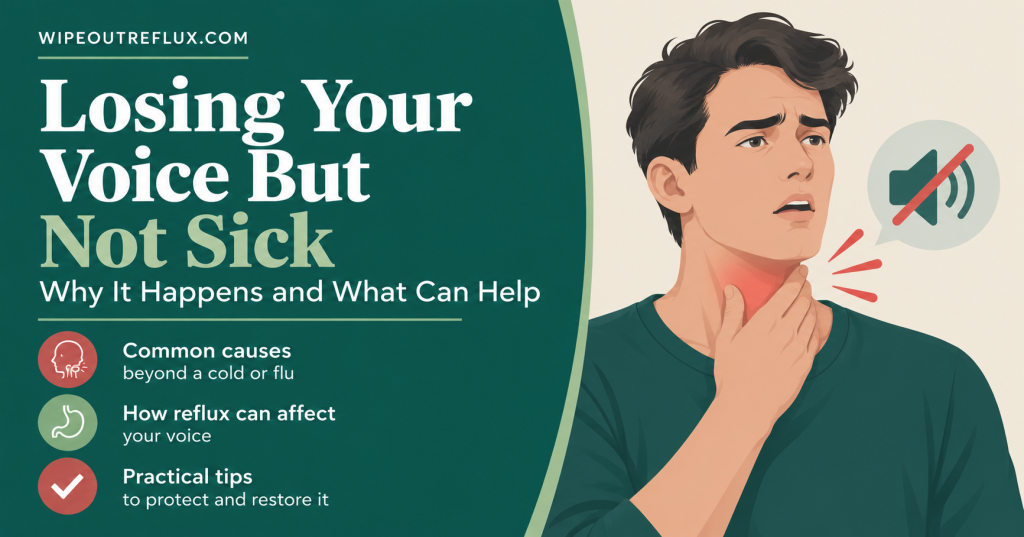
If you keep losing your voice but you’re not sick, the most common causes are silent reflux (LPR), straining or overusing your voice, and a throat that’s dried out or tensed up. Without a cold or infection to blame, something is irritating your vocal cords or making them work harder than they should, again and again.
The timing of your voice loss is the best clue. If your voice is worst in the morning and improves as the day goes on, reflux is the prime suspect. Stomach contents reach the voice box overnight and leave it swollen. If your voice starts fine and fades by evening, overuse or muscle tension is more likely. Other causes include inhaled steroid medications, allergies, constant throat clearing, smoking, and thyroid or hormone changes.
Hoarseness that lasts longer than 4 weeks needs your throat examined, and sooner if you smoke, have trouble swallowing or breathing, cough up blood, or notice a lump in your neck.
Key Takeaways
- Losing your voice with no sore throat and no illness points away from infection and toward something ongoing, most often reflux, voice strain or muscle tension.
- Silent reflux can cause hoarseness with no heartburn at all. Pepsin from the stomach lodges in the voice box tissue and keeps irritating it.
- A voice that’s worst in the morning suggests reflux. A voice that fades through the day suggests overuse or muscle tension.
- Teachers, singers, call-center workers and parents of young kids lose their voices far more often because of how much they talk.
- Inhaled steroid inhalers for asthma or COPD commonly cause hoarseness. Rinsing your mouth and using a spacer help.
- Mouth breathing, dry air, caffeine and alcohol dry the vocal cords and make them work harder.
- Throat clearing and whispering both strain the voice more than gentle, quiet speech.
- Hoarseness for more than 4 weeks needs a laryngoscopy, and sooner if you have warning signs.
Why Do I Keep Losing My Voice When I’m Not Sick?
Your voice comes from two small folds of tissue in your voice box (larynx) that vibrate hundreds of times a second as air passes between them. To produce a clear sound, their edges need to be smooth, flexible and well lubricated, and they need to meet evenly in the middle. Anything that swells them, dries them out, stiffens them or stops them closing properly turns your voice hoarse, breathy or weak. If it’s bad enough, the voice cuts out entirely.
When you lose your voice with a cold, a virus has inflamed your vocal cords, and it clears up in a week or so. When it keeps happening without illness, there’s an ongoing irritant or strain doing the damage. That’s why the phrases “but not sick” and “no sore throat” matter so much. They rule out the obvious and point to a small number of repeat offenders:
- Silent reflux (LPR): stomach contents reaching the voice box, often with no heartburn.
- Voice overuse and strain: talking loudly or for long periods, singing, shouting.
- Muscle tension dysphonia: the muscles around the voice box squeezing too hard.
- Dryness: mouth breathing, dry air, not drinking enough, caffeine and alcohol.
- Throat clearing and post-nasal drip: repeated hard impacts on the vocal cords.
- Medications: especially inhaled steroids.
- Vocal cord lesions: nodules, polyps or cysts that develop from repeated strain.
- Less common causes: thyroid problems, hormone changes, nerve problems and, rarely, cancer.
Silent Reflux: The Most Overlooked Cause
How reflux takes your voice
With laryngopharyngeal reflux (LPR), small amounts of stomach contents travel up past the esophagus and reach the voice box. The vocal cords are covered in a thin, delicate lining that has none of the protective defenses the esophagus has. Even tiny amounts of reflux that would never cause heartburn can irritate it.
The main culprit is pepsin, the stomach’s protein-digesting enzyme. Lab work has shown that pepsin stays stable at the near-neutral pH of the throat and becomes active again whenever more acid arrives, whether from another reflux episode or from acidic food and drink [Johnston et al., The Laryngoscope, 2007]. So the irritation doesn’t stop when the reflux does. The vocal cords swell slightly, can’t vibrate as freely, and the voice goes rough or cuts out. I explain this process in how pepsin reactivates in the throat.
Why there’s often no heartburn and no sore throat
This is the part that throws people off. In Koufman’s landmark study of 225 ear, nose and throat patients using 24-hour pH monitoring, reflux reaching the throat turned out to be common in people with voice and laryngeal problems, and many of them didn’t have typical heartburn [Koufman, The Laryngoscope, 1991]. That’s why it’s called silent reflux. Your chest feels fine, your throat doesn’t really hurt, and your voice keeps going.
Hoarseness is one of the core items on the Reflux Symptom Index, the questionnaire ENT doctors use to screen for LPR, alongside throat clearing, excess mucus, a lump-in-the-throat feeling and cough after eating or lying down [Belafsky et al., Journal of Voice, 2002]. You can score yourself using my guide to the Reflux Symptom Index.
Recurrent voice loss was one of my own clearest LPR signs. I’d wake up sounding like I’d been at a concert the night before, even though I’d barely spoken. By lunchtime it was mostly back. Then a late dinner or a glass of wine would bring it back the next morning. That cycle, with no cold and no real pain, is very typical.
Signs your voice loss is reflux
- Your voice is worst first thing in the morning and improves through the day
- It’s worse after late, large, fatty or spicy meals, or after alcohol or coffee
- You clear your throat constantly or feel mucus stuck in your throat
- You have a lump-in-the-throat feeling, a dry cough, or a sour or bitter taste
- Your voice tires quickly or cracks, especially in the higher range
- Heartburn is mild, occasional or completely absent
For a deeper look at the reflux and voice connection, see can acid reflux cause hoarseness and acid reflux and chronic laryngitis.
Voice Overuse and Strain
Your vocal cords collide with each other every time they vibrate. Talk loudly, for long periods, over background noise, or with poor technique, and those collisions add up. The edges swell, the voice gets husky, and eventually it gives out. With rest it recovers, until the next heavy day.
How much you use your voice makes a huge difference. A large survey found that 11% of teachers had a current voice problem compared with about 6% of people in other jobs, and nearly 58% of teachers had experienced a voice disorder at some point in their lives, about double the rate in non-teachers [Roy et al., Journal of Speech, Language, and Hearing Research, 2004].
Teachers are the classic example, but the same applies to fitness instructors, call-center staff, sales and customer service workers, clergy, coaches, singers, and parents of young children. If you lose your voice after a heavy talking day, a party, a sports event or a long phone call, overuse is likely.
Repeated strain can also lead to small growths on the vocal cords, such as nodules (like calluses), polyps or cysts. These cause a voice that’s hoarse most of the time, gets worse with use and doesn’t fully recover with rest. Reflux makes them more likely because it leaves the vocal cords already irritated. If you use your voice for work, see silent reflux in singers and professional voice users.
Muscle Tension Dysphonia
Sometimes the vocal cords themselves are healthy, but the muscles around the voice box are working far too hard. They squeeze and lift the larynx so the vocal cords can’t vibrate freely. This is called muscle tension dysphonia, and it’s one of the most common reasons people end up at a voice clinic.
Typical signs:
- Your voice sounds strained, tight or effortful, and gets worse as the day goes on
- Your throat or neck feels tight or achy after talking
- The voice cuts in and out, or drops to a whisper
- It’s worse when you’re stressed, anxious or tired
- It may have started after a cold or a period of reflux and never fully recovered
That last point matters. Muscle tension dysphonia often begins as the body’s way of pushing through an irritated voice. You strain to compensate for a hoarse voice during reflux or a virus, and the strain pattern sticks around after the original problem has settled. It responds very well to voice therapy, which I cover in voice therapy for silent reflux. It’s also worth knowing about vocal cord dysfunction vs silent reflux, which can be confused with this.
Dryness: Mouth Breathing, Dry Air and Dehydration
Healthy vocal cords are coated in a thin layer of moisture that lets them vibrate easily. When that layer dries out, the cords become stiffer and it takes more effort to get them going, so the voice tires and cracks sooner.
This can happen quickly. In one study, just 15 minutes of breathing through the mouth, but not the nose, increased the pressure needed to start the voice and made speaking feel more effortful. The effect was greater in people who were already prone to vocal fatigue [Sivasankar and Fisher, Journal of Speech, Language, and Hearing Research, 2003].
Common drying factors include sleeping with your mouth open, heated or air-conditioned rooms, air travel, not drinking enough water, and a lot of caffeine or alcohol. If you wake up with a dry throat and a croaky voice, see my guide to acid reflux and dry mouth, because reflux and dryness often travel together overnight.
Throat Clearing, Allergies and Post-Nasal Drip
Clearing your throat slams your vocal cords together with real force. Do it once and it’s nothing. Do it 50 times a day, as many people with reflux or post-nasal drip do, and it’s a steady source of swelling and irritation. It also becomes a habit, so you keep doing it long after the mucus has gone.
Allergies add to the problem in two ways. Mucus dripping down the back of the throat makes you clear it constantly, and antihistamines dry out the vocal cords. Reflux and allergies also look very similar from the throat’s point of view, so it’s common to treat the wrong one. See LPR vs allergies, silent reflux and post-nasal drip and how to stop constant throat clearing.
Inhalers and Other Medications
If you use a steroid inhaler for asthma or COPD (such as fluticasone, budesonide or beclomethasone, alone or in a combination inhaler), it could be behind your voice loss. Reported rates of hoarseness vary from about 5% to 58% of users, and a meta-analysis found steroid inhalers made dysphonia about five times more likely than placebo. The likely cause is steroid settling on the throat and affecting the muscles and lining of the vocal cords. It appears to be reversible [Galván and Guarderas, Mayo Clinic Proceedings, 2012].
To reduce it: use a spacer, rinse your mouth and gargle after each dose, check your inhaler technique with a pharmacist, and ask your doctor whether a lower dose or a different device would work. Don’t stop your inhaler on your own.
Other medications that can affect the voice include antihistamines and decongestants (drying), some blood pressure drugs (cough and throat irritation), and blood thinners in rare cases (bleeding into a vocal cord after strain).
Other Causes of Recurring Voice Loss
- Smoking and vaping: smoking directly damages the vocal cords and can cause fluid-filled swelling (Reinke’s edema) that gives a deep, rough voice. It’s also the biggest risk factor for laryngeal cancer. See can smoking cause acid reflux and vaping and acid reflux.
- Thyroid problems: an underactive thyroid can thicken the vocal cords and lower the voice, and an enlarged thyroid can press on the nerve that controls them. See thyroid problems and acid reflux.
- Hormone changes: some women notice voice changes around their period, in pregnancy or during menopause.
- Nerve problems: damage to the nerve that controls a vocal cord, for example after neck or chest surgery, causes a weak, breathy voice that doesn’t come back. This needs prompt assessment.
- After an illness: some people keep losing their voice for weeks after a virus, including COVID, often because reflux or muscle tension has taken over. See can COVID cause silent reflux.
Morning or Evening? What Your Voice Loss Is Telling You
- Worst on waking, better by midday: reflux overnight. Also consider mouth breathing and dry air.
- Fine in the morning, fading by evening: overuse or muscle tension dysphonia.
- After a heavy talking day, a party or a game: voice strain. It should recover with rest.
- After meals, alcohol or coffee: reflux.
- Hoarse most of the time, worse with use, never fully clears: possible vocal cord nodules, polyps or cysts. Get it examined.
- Started with a new inhaler: inhaled steroid.
- Weak and breathy since surgery: possible nerve injury. Get assessed promptly.
How to Stop Losing Your Voice
Protect your voice day to day
- Rest it, but don’t whisper. Whispering can strain the voice box more than quiet, relaxed speech. Talk softly and less, rather than whispering.
- Stop throat clearing. Swallow, sip water or do a gentle, silent “huff” of air instead.
- Don’t shout over noise. Move closer, use gestures, or use a small voice amplifier if you teach or present.
- Stay hydrated. Sip water through the day, and keep caffeine and alcohol moderate.
- Breathe through your nose and humidify. Especially at night and in dry, heated rooms.
- Steam can help. Breathing in steam from a bowl of hot water or a hot shower moistens the vocal cords directly.
Tackle reflux if it’s in the picture
- Stop eating 3 hours before bed. This is the most important single change for morning hoarseness. See how long before bed you should stop eating.
- Raise the head of your bed. Gravity helps keep stomach contents away from your voice box overnight. See how to raise the head of your bed.
- Cut the acid and the main triggers. Coffee, alcohol, fizzy drinks, citrus, tomatoes, chocolate and fatty meals all feed reflux or reactivate pepsin. Lowering dietary acid is the foundation of the Wipeout Diet Plan. See also LPR foods to avoid.
- Consider an alginate after meals and before bed. Alginates form a raft that helps block reflux from rising. See alginates for acid reflux.
A note on acid-reducing drugs: PPIs lower acid but don’t stop reflux or remove pepsin, so many people with voice symptoms find they help less than expected. US hoarseness guidelines also advise against prescribing them for hoarseness alone unless there are signs of reflux [Stachler et al., Otolaryngology–Head and Neck Surgery, 2018]. I explain why in why PPIs don’t work for LPR, and the healing process in how to heal vocal cords from acid reflux.
Get voice therapy if it keeps happening
A speech and language therapist who specializes in voice can teach you to produce your voice with less effort, release muscle tension and break the throat-clearing habit. The same US guideline recommends voice therapy whenever hoarseness has a cause it can help, such as muscle tension or nodules [Stachler et al., Otolaryngology–Head and Neck Surgery, 2018]. It’s the main treatment for muscle tension dysphonia and nodules, and it helps a lot alongside reflux treatment.
When to See a Doctor
The US clinical practice guideline on hoarseness recommends having your larynx examined (laryngoscopy) if hoarseness doesn’t clear up within 4 weeks, or sooner if there’s a reason for concern [Stachler et al., Otolaryngology–Head and Neck Surgery, 2018]. If your voice keeps coming and going over months, that counts too, even if each episode clears up.
See a doctor promptly if you have any of these:
- Hoarseness lasting more than 4 weeks, or getting steadily worse
- You smoke or used to smoke, or drink heavily
- Difficulty or pain when swallowing, or pain spreading to your ear
- Noisy breathing, shortness of breath or stridor (a high-pitched sound when breathing in)
- Coughing up blood
- A lump in your neck
- Unexplained weight loss
- Voice loss after neck, chest or heart surgery, or after intubation
- You rely on your voice for work and it’s affecting your job
A laryngoscopy is quick and usually done in the clinic with a thin camera through the nose. It’s the only way to see what’s actually happening to your vocal cords. For more on getting the right referral, see when to see a doctor for LPR.
Conclusion
Losing your voice when you’re not sick means something is repeatedly irritating, drying or straining your vocal cords. Silent reflux is the cause most people never consider, because it rarely brings heartburn or a sore throat. It shows up as a voice that’s rough in the morning, throat clearing and mucus, while pepsin sits in the voice box and keeps it inflamed. Overuse and muscle tension are the other big causes, usually showing up as a voice that fades as the day goes on. Notice when your voice goes, rule out inhalers, dryness and throat clearing, and get your throat examined if hoarseness lasts more than 4 weeks or comes with warning signs.
If reflux is behind it, what you eat and when you eat it make the biggest difference. The Wipeout Diet Plan is the first thing I’d recommend. It’s my complete, step-by-step program for cutting the acid and triggers that keep pepsin active in your throat, so your vocal cords finally get the chance to settle. It was built primarily for LPR, the voice-and-throat kind of reflux, though because it targets the same underlying mechanisms, it works just as well for GERD and everyday heartburn.
If you’d like an easier place to start, the Wipeout Food Reference Guide is the essential companion. It lists the foods and drinks that are safe for acid reflux and LPR, along with their pH values, so you can quickly see what’s helping your voice and what’s working against it.
Frequently Asked Questions
Why do I keep losing my voice but I’m not sick?
The most common causes are silent reflux, overusing or straining your voice, muscle tension around the voice box, and dryness from mouth breathing or dry air. Inhaled steroids, allergies, constant throat clearing, smoking and thyroid problems can also cause it.
Can acid reflux make you lose your voice?
Yes. In silent reflux, stomach contents reach the voice box and pepsin irritates the vocal cords, making them swell. Many people have no heartburn at all. Reflux voice loss is typically worst in the morning and improves through the day.
Why am I losing my voice with no sore throat?
Losing your voice without a sore throat points away from infection and toward reflux, voice strain, muscle tension or dryness. These affect how your vocal cords vibrate without necessarily causing pain. If it lasts more than 4 weeks, get your throat examined.
Why do I lose my voice every morning?
Morning voice loss is most often caused by reflux overnight, when lying down lets stomach contents reach the voice box. Mouth breathing and dry bedroom air can add to it. Stopping eating 3 hours before bed and raising the head of your bed often help.
Is it bad to keep losing your voice?
Repeated voice loss usually means ongoing irritation or strain, which can lead to nodules, polyps or chronic laryngitis if it isn’t addressed. Hoarseness lasting more than 4 weeks, or with warning signs like trouble swallowing, breathing difficulty, a neck lump or a smoking history, needs a doctor.
Should I whisper if I’m losing my voice?
No. Whispering can strain the voice box more than speaking softly. Rest your voice by talking less and quietly, sip water, and avoid throat clearing.
How long does it take to get your voice back?
Voice loss from a single episode of overuse usually recovers within a few days of rest. Reflux-related hoarseness can take weeks to months to fully settle once the reflux is under control, because the vocal cords need time to heal. Voice therapy can speed things up.
Research & References
- [Johnston et al., The Laryngoscope, 2007] — Pepsin remains stable at throat pH and can be reactivated by acid, explaining ongoing laryngeal irritation in reflux.
- [Koufman, The Laryngoscope, 1991] — Landmark study of 225 ear, nose and throat patients using 24-hour pH monitoring that established reflux as a common cause of laryngeal and voice disorders, often without heartburn.
- [Belafsky et al., Journal of Voice, 2002] — Validated the Reflux Symptom Index, a nine-item questionnaire for LPR that includes hoarseness, throat clearing, mucus and cough.
- [Roy et al., Journal of Speech, Language, and Hearing Research, 2004] — Teachers had a current voice disorder prevalence of 11.0% vs 6.2% in non-teachers, and a lifetime prevalence of 57.7% vs 28.8%.
- [Sivasankar and Fisher, Journal of Speech, Language, and Hearing Research, 2003] — 15 minutes of mouth breathing, but not nasal breathing, increased phonation threshold pressure and vocal effort, more so in people prone to vocal fatigue.
- [Galván and Guarderas, Mayo Clinic Proceedings, 2012] — Review reporting hoarseness in 5% to 58% of inhaled corticosteroid users, a roughly fivefold higher risk than placebo, with spacers and mouth rinsing among the preventive steps.
- [Stachler et al., Otolaryngology–Head and Neck Surgery, 2018] — US clinical practice guideline on hoarseness recommending laryngoscopy when hoarseness doesn’t resolve within 4 weeks or sooner if concern, voice therapy, and against antireflux drugs for hoarseness alone without signs of reflux.

David Gray
12 years living with LPR · Consultant & researcher
I've lived with LPR for twelve years — the misdiagnoses, the PPI courses that did nothing, the slow work of figuring out what actually helps. Wipeout Reflux is where I translate the research into plain terms for people stuck in the same place. Every claim here is sourced to peer-reviewed work, and I consult one-to-one with LPR sufferers.