
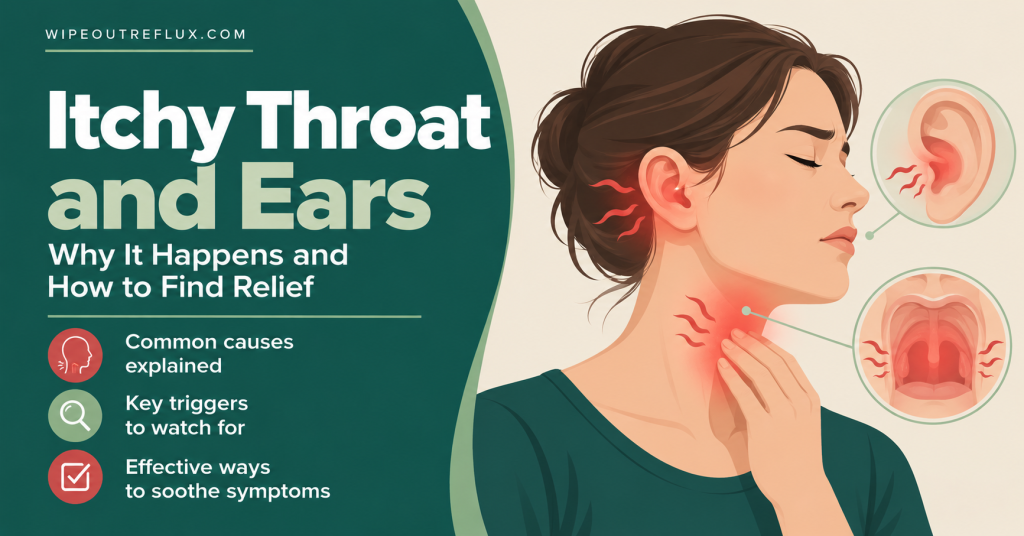
An itchy throat and itchy ears together are most often caused by allergies, especially hay fever. They happen together because the back of your throat and parts of your ear share the same nerves, so irritation in one is often felt in the other. Allergic itching usually comes with sneezing, a runny or blocked nose and itchy eyes, and antihistamines tend to help quickly.
If your throat and ears itch within minutes of eating raw fruit, vegetables or nuts, it’s probably oral allergy syndrome, a pollen-related food reaction. A cold, post-nasal drip and dry air are other common causes. If the itch lasts year-round, your ears feel blocked or full, and allergy tablets don’t help, silent reflux (LPR) is worth considering, because it can irritate both the throat and the tube that connects it to your ears.
Itchy throat and ears with swelling of the lips, tongue or throat, wheezing or difficulty breathing can be a severe allergic reaction and need emergency help.
Key Takeaways
- Allergies are the most common reason your throat and ears itch at the same time.
- Your throat and ear share nerve supply from the glossopharyngeal and vagus nerves, so the brain can feel irritation from one in the other.
- The Eustachian tube connects the back of your nose and throat to your middle ear, so inflammation spreads between them easily.
- Itching in the throat and ears within minutes of eating raw fruit, vegetables or nuts suggests oral allergy syndrome.
- An itchy throat and ears that become sore point toward a cold, tonsillitis or another throat infection.
- Reflux can irritate the throat and affect the ears through the Eustachian tube, which is a common reason the itch doesn’t respond to antihistamines.
- Don’t scratch inside your ear with cotton swabs or other objects. It makes the itch worse and can damage the ear canal.
- Swelling, hives, wheezing or trouble breathing alongside the itch is an emergency.
Why Do My Throat and Ears Itch at the Same Time?
It feels strange that an itch in your throat would show up in your ear, but there are two good reasons it happens.
1. They share the same nerves
Your ear gets its feeling from several different nerves. Two of them, the glossopharyngeal nerve and the vagus nerve, also supply the back of the throat, the tonsils, the back of the tongue and the voice box. The glossopharyngeal nerve sends a branch (Jacobson’s nerve) to the middle ear, and the vagus sends a branch (Arnold’s nerve) to the ear canal and the back of the eardrum [Chen et al., American Journal of Neuroradiology, 2009].
Because the same nerves serve both areas, your brain can’t always tell exactly where a signal is coming from. Irritation at the back of your throat can be felt as an itch or ache deep in your ear. Doctors see this all the time with ear pain: a sore throat or tonsillitis often makes the ear hurt even when the ear itself is completely healthy. This is called referred pain, and itching can be referred the same way.
The link works in reverse too. Some people cough when they scratch or clean inside their ear, because touching the area supplied by Arnold’s nerve triggers the same reflex as an irritated throat. Researchers have described people with chronic cough whose ear-cough reflex is oversensitive, suggesting a wider sensitivity of the vagus nerve [Ryan et al., Journal of Thoracic Disease, 2014]. I explain more about this nerve in the vagus nerve and acid reflux.
2. They’re physically connected
The Eustachian tube runs from your middle ear to the back of your nose, just above your throat. It opens when you swallow or yawn to balance pressure and drain fluid. Anything that inflames the back of the nose and throat, such as allergies, a cold or reflux, can swell the tube’s opening. That makes the ears feel itchy deep inside, full, blocked or popping.
So when you feel an itch in both places, it’s usually one problem felt in two spots, not two separate problems. The job is working out what that one problem is.
Common Causes of an Itchy Throat and Ears
1. Hay fever and other allergies
Allergic rhinitis, from pollen, dust mites, pet dander or mold, is by far the most common cause. When you breathe in an allergen, mast cells in the lining of your nose and throat release histamine. Histamine makes the tissue itchy, swollen and leaky, and the itch spreads across everything those nerves supply: the throat, the roof of the mouth, the ears and the eyes.
Signs it’s allergies:
- Sneezing, a runny or blocked nose
- Itchy, watery eyes
- An itchy roof of the mouth (palate) as well as the throat and ears
- It’s seasonal: spring for tree pollen, early summer for grass, late summer and fall for weeds
- It’s worse outdoors, around pets or when dusting
- A non-drowsy antihistamine clearly helps within an hour or so
2. Oral allergy syndrome
If your mouth, throat and ears start itching within minutes of eating raw apples, peaches, cherries, kiwi, melon, carrots, celery or nuts, you may have oral allergy syndrome (also called pollen food syndrome). Proteins in these foods look like pollen proteins, so a pollen-allergic immune system reacts to them too. A review of the condition describes itching and burning of the lips, mouth, ears and throat as the typical symptoms, starting within minutes of eating the trigger food [Kashyap and Kashyap, Journal of Allergy, 2015].
The itch usually fades within minutes once you stop eating. Cooking or peeling often removes the trigger in fruits like apples, though not in all foods. Swelling, hives, vomiting or breathing difficulty after eating is a more serious food allergy and needs urgent care.
3. Colds and throat infections
An itchy throat is often the first sign of a cold. As the infection takes hold, it spreads to the back of the nose and the Eustachian tubes, so your ears may itch, ache or feel blocked. Tonsillitis and strep throat commonly cause ear pain on the same side through shared nerves.
4. Post-nasal drip
Mucus dripping down the back of your throat irritates it, and the inflammation at the back of the nose can affect the Eustachian tubes too. Allergies, sinus infections and reflux can all cause post-nasal drip. See silent reflux and post-nasal drip.
5. Dry air
Heated or air-conditioned air dries the throat, which feels itchy and scratchy. It also dries the skin of the ear canal, which can itch on its own. If both itch most in winter and first thing in the morning, dry air is a likely part of the picture. See dry throat at night.
6. Ear canal skin problems
Sometimes the ear itch is a separate problem that happens to come at the same time. Eczema, psoriasis, dry skin, an early outer ear infection, an allergy to earrings, earbuds, shampoo or hearing aid materials, and earwax buildup can all make the ear canal itchy. If your ear also flakes, weeps, smells or hurts when you pull the earlobe, it’s probably the ear itself rather than a throat problem.
Itchy Throat and Ears From Silent Reflux
Most articles stop at allergies. But if your throat and ears itch most days, all year round, and antihistamines barely help, there’s a good chance something non-allergic is going on. Silent reflux is one of the most common explanations, and it fits the shared-nerve and shared-tube explanation above perfectly.
How reflux affects the throat
In laryngopharyngeal reflux (LPR), small amounts of stomach contents travel up past the esophagus and reach the throat. The throat lining has very little protection against them, so even tiny amounts cause irritation. The main troublemaker is pepsin, the stomach’s protein-digesting enzyme. It can stick to throat tissue and become active again when more acid arrives, whether from reflux or from acidic food and drink [Johnston et al., The Laryngoscope, 2007]. People describe the result as itchy, scratchy, tickly or raw. I cover the throat side in detail in itchy throat: allergies, reflux or something else?
Most people with LPR never get heartburn, which is why they rarely connect their throat and ear symptoms to their stomach. See LPR symptoms.
How reflux affects the ears
Reflux can affect the ears in two ways. The first is through the shared nerves: irritation at the back of the throat can be felt in the ear. The second is direct. The opening of the Eustachian tube sits at the back of the nose, close to where refluxed material can reach.
Pepsin has been found in middle-ear fluid. In children with glue ear, one study found pepsin or its precursor in 83% of middle-ear fluid samples, at levels up to 1,000 times higher than in blood [Tasker et al., The Lancet, 2002]. A systematic review reported pepsin in an average of about 85% of middle-ear fluid samples, though it noted that cause and effect hasn’t been proven [Miura et al., Otolaryngology–Head and Neck Surgery, 2012].
In adults, a study of 73 people with LPR found abnormal middle-ear function in 54.8% of them, compared with under 7% of people without reflux [Mukherjee and Chatterji, Indian Journal of Otolaryngology and Head & Neck Surgery, 2024]. In animal research, repeated exposure to acid and pepsin made the Eustachian tube harder to open and worse at clearing pressure [White et al., The Laryngoscope, 2002].
Most of this research is about blocked ears, fluid and pressure rather than itching specifically, so I want to be careful not to overstate it. But a swollen, irritated Eustachian tube often feels like a deep itch or tickle inside the ear, along with fullness and popping. For more on this, see acid reflux and Eustachian tube dysfunction, ears feel clogged and acid reflux ear pain.
From my own years with LPR, the ear symptoms were the ones I least expected. A blocked, slightly itchy feeling deep in my ears would come and go with my throat symptoms, and both were worst after a late meal. I spent a long time treating it as hay fever before I made the connection.
Signs your itchy throat and ears might be reflux
- It’s there most days, year-round, not just in pollen season
- Your eyes and nose are mostly fine
- It’s worse at night, on waking or after meals
- Your ears feel full, blocked or pop, but there’s no infection
- You clear your throat a lot, have a hoarse voice or feel a lump in your throat
- It flares after coffee, alcohol, chocolate, tomato, citrus, fizzy drinks or late dinners
- Antihistamines don’t help much, or make your throat feel drier
You can score your symptoms using my Reflux Symptom Index guide, which uses the questionnaire ENT doctors rely on [Belafsky et al., Journal of Voice, 2002].
Allergies vs reflux at a glance
- Timing: allergies are seasonal or trigger-linked. Reflux is year-round and linked to meals and lying down.
- Eyes and nose: usually involved with allergies, usually not with reflux.
- Roof of the mouth: often itchy with allergies, rarely with reflux.
- Voice: rarely affected by allergies, often hoarse with reflux.
- Antihistamines: help allergies, do little for reflux.
Plenty of people have both. Allergies cause mucus and throat clearing, and reflux makes the throat more sensitive, so each makes the other feel worse. My full comparison is in LPR vs allergies.
Itchy Ear and Sore Throat
When the itch turns into soreness, an infection becomes more likely:
- A cold: itchy throat first, then soreness, a runny nose, and itchy or blocked ears as the Eustachian tubes swell. It settles within a week to 10 days.
- Tonsillitis or strep throat: a painful throat, often worse on one side, with ear pain on the same side, fever and swollen glands.
- An ear infection: ear pain, muffled hearing and sometimes fever, often following a cold.
- Reflux: an itchy, sore throat that comes and goes for weeks without fever, with ear fullness. See sore throat that won’t go away.
One-sided ear pain with a sore throat that lasts more than 3 weeks, especially if you smoke, drink heavily or are over 50, should be checked by a doctor, because problems in the throat can show up as pain in the ear.
Itchy Throat and Ears at Night
If your throat and ears itch most at night, the likely causes are:
- Dust mites: they live in bedding and pillows, so dust mite allergy flares in bed.
- Reflux: lying down lets stomach contents reach the throat more easily, and you swallow far less while asleep. See acid reflux at night.
- Dry bedroom air: heating and air conditioning dry the throat and ear canals overnight.
- Post-nasal drip: mucus pools at the back of the throat when you lie down.
How to Relieve an Itchy Throat and Ears
Quick relief
- Sip water or a warm drink. Keeping the throat moist calms the irritated nerves. Chamomile tea with honey is soothing and reflux-friendly.
- Swallow, yawn or chew gum. This opens the Eustachian tubes and often eases the deep itch in the ears.
- Gargle with warm salt water. It rinses away mucus and irritants from the back of the throat.
- Rinse your nose with saline. Clearing allergens and mucus from the back of the nose helps both throat and ears.
- Don’t scratch inside your ear. Cotton swabs, fingernails, pen lids and hairgrips scratch the thin skin of the ear canal and push wax deeper. Clinical guidelines advise against putting cotton swabs in the ear [Schwartz et al., Otolaryngology–Head and Neck Surgery, 2017]. Gently massaging the area in front of the ear or swallowing works better.
If it’s allergies
- Take a non-drowsy antihistamine (cetirizine, loratadine or fexofenadine)
- Use a steroid nasal spray daily through allergy season. It calms inflammation at the back of the nose, including around the Eustachian tubes
- Shower and change clothes after being outdoors on high-pollen days
- Wash bedding weekly in hot water and use dust-mite-proof covers
- Ask about allergy testing or immunotherapy if symptoms are severe or last all year
If it’s oral allergy syndrome
- Avoid the raw foods that trigger it
- Try them cooked, canned or peeled, which often removes the trigger
- See an allergist if you have any swelling, hives or breathing symptoms after eating
If it’s reflux
- Stop eating 3 hours before bed. This helps night-time and morning symptoms more than anything else.
- Raise the head of your bed. Use bed risers or a wedge so your whole upper body is raised. See how to raise the head of your bed.
- Cut acidic and trigger foods. Coffee, alcohol, fizzy drinks, citrus, tomato, chocolate, mint and fatty meals all feed reflux or reactivate pepsin. Removing that fuel is the core of the Wipeout Diet Plan. See also LPR foods to avoid.
- Take an alginate after meals and at bedtime. It forms a raft on top of the stomach contents that helps keep them down. See alginates for acid reflux.
- Go easy on antihistamines. They dry the throat and can make reflux irritation feel worse. See antihistamines and acid reflux.
If you react to histamine-rich foods like aged cheese, wine, cured meats and leftovers with itching, flushing and a stuffy nose, histamine intolerance may be adding to the picture. See histamine intolerance and acid reflux.
When to See a Doctor
Get emergency help if the itching comes with:
- Swelling of the lips, tongue, face or throat
- Wheezing, a tight throat or difficulty breathing
- Difficulty swallowing or drooling
- Hives, dizziness or fainting, especially after eating or an insect sting
See a doctor if you have:
- Sudden hearing loss in one ear. This needs prompt assessment, ideally within days
- Discharge, bleeding or a bad smell from the ear
- Severe ear pain, fever or swelling behind the ear
- One-sided ear pain with a sore throat or hoarseness lasting more than 3 weeks
- Ringing in the ears or dizziness. See can acid reflux cause tinnitus
- Itching that doesn’t improve with allergy treatment, especially with throat clearing or hoarseness. See when to see a doctor for LPR
Conclusion
An itchy throat and itchy ears usually happen together for a simple reason: the throat and ear share nerves, and the Eustachian tube connects them directly. Most of the time the cause is allergies, and if you also have sneezing and itchy eyes and an antihistamine helps, that’s probably all it is. If the itch comes on while eating raw fruit or vegetables, think oral allergy syndrome. But if it lasts all year, your ears feel full or blocked, your voice is hoarse and allergy tablets don’t touch it, look at reflux. It can irritate the throat and affect the ears through the same tube and nerves that link them.
If reflux is part of your picture, changing what and when you eat is where real progress starts. The Wipeout Diet Plan is what I’d recommend first. It’s my full, step-by-step plan for reducing reflux and taking away the acid that keeps pepsin irritating your throat. I originally built it for silent reflux, the throat-based kind most likely to affect your ears, but since it works on the same root causes, it helps just as well with classic heartburn and GERD.
If you’d like a lighter starting point, the Wipeout Food Reference Guide is the essential companion. It lists the foods and drinks that are safe for acid reflux and LPR, along with their pH values, so you can quickly check whether your diet is keeping the irritation going.
Frequently Asked Questions
Why do my throat and ears itch at the same time?
Because they share nerves. The glossopharyngeal and vagus nerves supply both the back of the throat and parts of the ear, so irritation in the throat can be felt in the ear. The Eustachian tube also connects the back of the nose and throat to the middle ear. Allergies are the most common trigger.
How do I stop my throat and ears from itching?
For allergies, take a non-drowsy antihistamine and use a steroid nasal spray. Sip water, rinse your nose with saline, and swallow or yawn to open the Eustachian tubes. Don’t scratch inside your ears with cotton swabs. If it’s reflux, eat earlier, raise the head of your bed and cut acidic trigger foods.
Is an itchy throat and ears a sign of allergies?
Usually, yes. Hay fever and other allergies are the most common cause, especially with sneezing, a runny nose and itchy eyes. Itching straight after eating raw fruit or vegetables points to oral allergy syndrome. If antihistamines don’t help, consider reflux, dry air or a non-allergic cause.
Can acid reflux cause itchy ears?
Reflux can irritate the throat, and that irritation can be felt in the ear through shared nerves. Pepsin from the stomach has also been found in middle-ear fluid, and reflux is linked to Eustachian tube problems that cause fullness, popping and a deep itchy feeling. The evidence is strongest for blocked ears rather than itching specifically.
Why do my ear and throat itch when I eat certain foods?
This is usually oral allergy syndrome. Proteins in some raw fruits, vegetables and nuts resemble pollen, so if you have hay fever, your immune system reacts to them and causes itching in the mouth, throat and ears within minutes. Cooking often removes the trigger. Swelling or breathing difficulty needs urgent care.
Can an itchy throat and ears be COVID or a cold?
Yes. An itchy throat is often an early sign of a viral infection, and as it spreads to the back of the nose it can make your ears itch or feel blocked. A viral cause usually brings a sore throat, runny nose or fever within a day or two. Itching that lasts for weeks without illness is more likely allergies or reflux.
Why does scratching my ear make me cough?
Part of the ear canal is supplied by Arnold’s nerve, a branch of the vagus nerve, which also controls the cough reflex. Touching that area can trigger a cough in some people. It’s called the ear-cough reflex and is usually harmless.
Research & References
- [Chen et al., American Journal of Neuroradiology, 2009] — Review of referred ear pain explaining that the ear is supplied by cranial nerves V, VII, IX and X plus upper neck nerves, and that throat and larynx problems can be felt in the ear through Jacobson’s nerve (IX) and Arnold’s nerve (X).
- [Ryan et al., Journal of Thoracic Disease, 2014] — Report of two patients with refractory chronic cough and a hypersensitive Arnold’s nerve ear-cough reflex, both improving on gabapentin, supporting chronic cough as a sensory vagal neuropathy.
- [Kashyap and Kashyap, Journal of Allergy, 2015] — Review of oral allergy syndrome describing itching of the lips, mouth, ears and throat within minutes of trigger foods, with pollen-food cross-reactions behind most food allergies in pollen-allergic adults.
- [Johnston et al., The Laryngoscope, 2007] — Pepsin remains stable at throat pH and can be reactivated by acid, explaining ongoing throat irritation in reflux.
- [Tasker et al., The Lancet, 2002] — Found pepsin or pepsinogen in 83% of middle-ear fluid samples from children with glue ear, at levels up to 1,000 times higher than in blood.
- [Miura et al., Otolaryngology–Head and Neck Surgery, 2012] — Systematic review reporting pepsin in an average of about 85% of middle-ear fluid samples, while noting cause and effect hasn’t been established.
- [Mukherjee and Chatterji, Indian Journal of Otolaryngology and Head & Neck Surgery, 2024] — Case-control study of 73 adults with LPR and 73 controls, finding abnormal middle-ear function in 54.8% of the reflux group compared with 6.85% of controls.
- [White et al., The Laryngoscope, 2002] — Animal study showing repeated acid and pepsin exposure raised the Eustachian tube’s opening pressure and impaired its ability to clear pressure.
- [Belafsky et al., Journal of Voice, 2002] — Validated the Reflux Symptom Index, a nine-item questionnaire used to screen for laryngopharyngeal reflux.
- [Schwartz et al., Otolaryngology–Head and Neck Surgery, 2017] — Clinical practice guideline on earwax impaction, advising against cotton swabs and ear candling and recommending softening drops, irrigation or manual removal.

David Gray
12 years living with LPR · Consultant & researcher
I've lived with LPR for twelve years — the misdiagnoses, the PPI courses that did nothing, the slow work of figuring out what actually helps. Wipeout Reflux is where I translate the research into plain terms for people stuck in the same place. Every claim here is sourced to peer-reviewed work, and I consult one-to-one with LPR sufferers.