
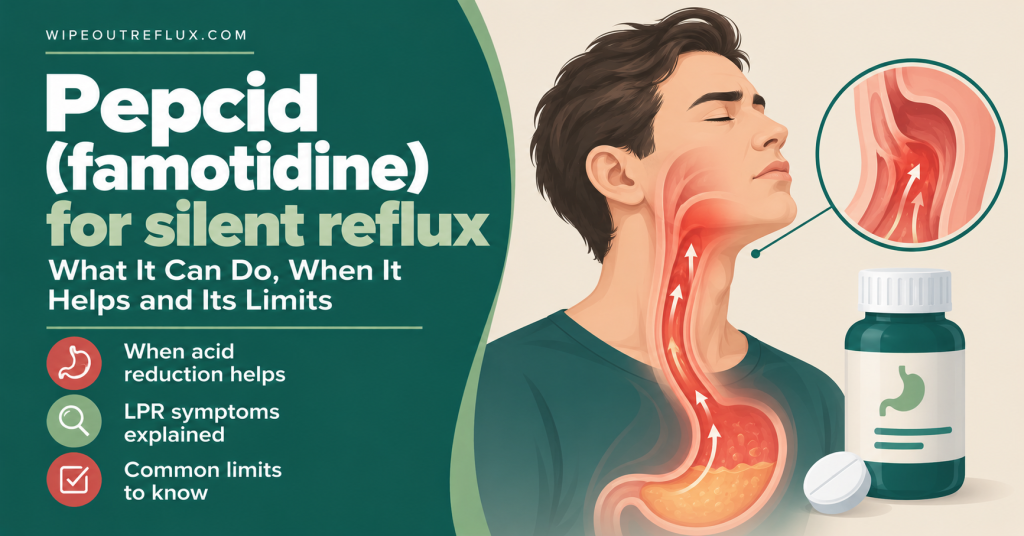
Pepcid (famotidine) can help silent reflux, but only in specific ways. It’s most useful as a bedtime dose to cut night-time acid, as an on-demand dose before a meal you know will cause trouble, or as a step-down when coming off a PPI. It works within an hour and lasts 10 to 12 hours.
It has two big limits for LPR. First, it reduces acid but doesn’t stop reflux happening, so pepsin still reaches your throat. Pepsin can stay active at much higher pH than most people realize. Second, famotidine loses much of its effect within days to weeks of continuous use, a problem called tachyphylaxis. Taken every day, it fades.
That’s why I see Pepcid as a supporting player in silent reflux, not the main treatment. It works best used strategically, alongside an alginate and the diet changes that actually reduce reflux.
Key Takeaways
- Famotidine blocks histamine at the stomach’s H2 receptors, reducing acid production for about 10 to 12 hours.
- It starts working within an hour, faster than a PPI, which makes it useful on demand.
- A bedtime dose can reduce night-time acid, including “nocturnal acid breakthrough” on twice-daily PPIs.
- Tolerance develops quickly with daily use, often within a week or two, so its effect fades if taken continuously.
- Lowering acid doesn’t stop pepsin reaching the throat. Pepsin stays active up to about pH 6.5.
- There’s very little trial evidence for famotidine alone in LPR.
- It works best intermittently or short-term, combined with an alginate and a low-acid diet.
- The dose needs reducing if you have kidney problems, and older adults are more prone to side effects like confusion.
How Pepcid Works
The cells that make stomach acid, called parietal cells, respond to three main signals. Histamine is one of the most powerful. When histamine binds to H2 receptors on these cells, acid production ramps up. Famotidine blocks those receptors, so acid output falls.
Because it only blocks one of the signals, an H2 blocker reduces acid less than a PPI, which shuts down the final acid pump itself. But it works faster. According to the prescribing information, famotidine starts reducing acid within an hour, peaks within 1 to 3 hours and lasts 10 to 12 hours [Pepcid (famotidine) Prescribing Information, 2024].
Famotidine is now the main H2 blocker in the US. Ranitidine (Zantac) was withdrawn in 2020 after a contaminant called NDMA was found to build up in it over time. FDA testing found no NDMA in famotidine [FDA, Drug Safety Communication, 2020]. Cimetidine is still available but interacts with many medicines. See cimetidine for heartburn.
Why Acid Suppression Alone Doesn’t Fix Silent Reflux
To understand where Pepcid fits, you need to know why silent reflux is different from heartburn.
In classic GERD, acid sitting in the esophagus causes the burn, so reducing acid works well. In LPR, stomach contents reach the throat and voice box, which have almost no protection. Most people with LPR don’t have heartburn at all, a pattern first described by ENT researchers using pH monitoring in the early 1990s [Koufman, The Laryngoscope, 1991].
The key damaging agent in the throat is pepsin. Pepsin is fully active in strong acid, but it stays active up to about pH 6.5. Above that it becomes inactive but stable, and it can be switched back on when acid arrives again [Johnston et al., The Laryngoscope, 2007].
That has a big implication. Acid blockers make the stomach less acidic, but they rarely keep it above pH 6.5 for long. Refluxed material that’s less acidic still contains pepsin that’s capable of damaging throat tissue. And pepsin already lodged in your throat can be reactivated by acidic food and drink, whatever your stomach pH. I explain this in how pepsin reactivates in the throat and why PPIs don’t work for LPR. The same logic applies to H2 blockers, only more so, since they’re weaker.
So no acid blocker, Pepcid included, stops reflux. It only changes what the reflux contains.
Where Pepcid Does Help in Silent Reflux
None of that means Pepcid is useless for LPR. It has a few genuinely useful roles.
1. A bedtime dose for night-time acid
Night is the most dangerous time for silent reflux. You’re lying flat, you swallow far less and saliva production drops, so anything that comes up stays in your throat longer. Reducing the acid content of night-time reflux makes sense.
There’s a specific problem here for people on PPIs. Even on twice-daily PPIs, most people’s stomach acid recovers for a stretch overnight. This is called nocturnal acid breakthrough. In one study, it happened in most people on twice-daily PPI, at a median of around 7.5 hours after the evening dose [Peghini et al., The American Journal of Gastroenterology, 1998]. Adding a bedtime H2 blocker can blunt this, because night-time acid production is thought to depend heavily on histamine, which is exactly what H2 blockers block.
The evidence is thinner than many people assume, though. A Cochrane review of bedtime H2 blockers added to PPIs found only small, short studies in healthy volunteers with inconsistent results, and couldn’t recommend it for routine practice [Wang et al., Cochrane Database of Systematic Reviews, 2009]. Reviews still describe it as an option for people with persistent night-time symptoms despite twice-daily PPIs [Shibli et al., Translational Gastroenterology and Hepatology, 2025].
2. On demand before trigger meals
Because famotidine works within an hour, it’s useful as a targeted dose before a meal you know will cause trouble: a meal out, a celebration, or a late dinner you can’t avoid. Taking it 15 to 60 minutes beforehand reduces acid for the evening. Used like this, occasionally rather than daily, it doesn’t build up tolerance in the same way.
3. Coming off a PPI
Stopping a PPI can cause rebound acid, where the stomach temporarily overproduces acid for a few weeks. Famotidine is a common bridge during this period, especially at night. See getting off PPIs and acid rebound.
4. When you have both GERD and LPR
Many people have both throat symptoms and heartburn. If heartburn is part of your picture, reducing acid helps that side, even if it does less for the throat.
The Tachyphylaxis Problem
This is the part most famotidine articles leave out, and it’s the most important thing to understand if you’re taking it for LPR.
Tachyphylaxis means a drug loses its effect with repeated use. With H2 blockers, it happens fast. A review of the evidence found tolerance was present at the first measurement after starting, including by the second day of dosing, across different H2 blockers, doses and patient groups. The authors recommended H2 blockers be reserved for occasional heartburn [McRorie et al., World Journal of Gastrointestinal Pharmacology and Therapeutics, 2014]. Studies of bedtime H2 blockers added to PPIs also suggest their extra effect on night-time acid fades within about a week of daily use [Wang et al., Cochrane Database of Systematic Reviews, 2009].
Nobody knows exactly why. The likely explanation is that the body increases other acid signals to compensate when histamine is blocked.
In practice, this means that taking Pepcid every night for months probably gives you far less than it did in the first week. Many readers tell me famotidine “worked brilliantly at first, then stopped working.” That’s tachyphylaxis, not their reflux getting worse.
How to use it with this in mind:
- Use it on demand, before trigger meals or on bad nights, rather than every day
- If you use it nightly, use it for a defined period, such as during a flare or a PPI taper, then stop
- If it seems to have stopped working, a break of a week or more may restore some effect
- Don’t keep increasing the dose to chase the original effect. Talk to your doctor instead
What the Evidence Shows for LPR Specifically
Honestly, not much. There are few good trials of famotidine alone in LPR. In one randomized trial in 40 people with LPR who had taste disturbance, eight weeks of esomeprazole improved taste scores and thresholds, while famotidine had a much smaller effect [Suzuki et al., Tohoku Journal of Experimental Medicine, 2019]. For healing esophageal damage in GERD, H2 blockers are also clearly weaker than PPIs [Shibli et al., Translational Gastroenterology and Hepatology, 2025].
The treatments with better evidence in LPR are an alginate, which physically blocks reflux, and a low-acid diet, which removes the acid that reactivates pepsin. In a series of people whose LPR hadn’t responded to medication alone, a strict low-acid diet improved symptoms in most [Koufman, Annals of Otology, Rhinology & Laryngology, 2011]. For the full medication picture, see best medication for LPR.
How to Take Pepcid for Silent Reflux
Always agree a plan with your doctor, especially if you’re already on a PPI or other medicines. These are the common approaches:
Doses
- Over the counter: Pepcid AC comes in 10 mg and 20 mg tablets. The OTC label limits use to 2 tablets in 24 hours and 14 days without a doctor’s advice.
- Prescription: for symptomatic GERD, the standard dose is 20 mg twice a day for up to 6 weeks. For erosive esophagitis, 20 or 40 mg twice a day for up to 12 weeks [Pepcid (famotidine) Prescribing Information, 2024].
- Bedtime dosing: doctors commonly use 20 mg (sometimes 40 mg) at bedtime for night-time symptoms.
Timing
- For a trigger meal: 15 to 60 minutes before eating
- For night-time: at bedtime, or with your evening meal if you eat late
- With an alginate: take famotidine before the meal and the alginate after, such as Gaviscon Advance, so each does its job. See Gaviscon Advance
Pepcid Complete vs Pepcid AC
Pepcid Complete combines famotidine with antacids (calcium carbonate and magnesium hydroxide), so it works immediately and keeps working for hours. It’s handy for sudden heartburn. For LPR, plain famotidine plus an alginate is usually a better pairing than an extra antacid.
Side Effects and Safety
Famotidine is generally well tolerated. The most common side effects are headache, dizziness, constipation and diarrhea.
- Kidney problems: famotidine is cleared by the kidneys. The dose should be reduced if your kidney function is moderately or severely reduced (creatinine clearance below 60 mL/min) [Pepcid (famotidine) Prescribing Information, 2024].
- Older adults: confusion, delirium and other nervous system effects have been reported, mainly in older people and those with reduced kidney function. The lowest effective dose is advised.
- Heart rhythm: QT prolongation has been reported in people with moderate or severe kidney impairment. Report palpitations, fainting or dizziness.
- Masking problems: don’t use any acid reducer to cover up trouble swallowing, vomiting, weight loss or black stools. See a doctor. See when to see a doctor for LPR.
Pepcid vs Other Options for Silent Reflux
- Pepcid vs PPIs: PPIs suppress acid more strongly and don’t develop tolerance in the same way, but take days to reach full effect and cause rebound when stopped. Neither stops reflux or pepsin. See famotidine vs omeprazole.
- Pepcid vs Gaviscon: Gaviscon Advance physically blocks reflux and can trap pepsin. Famotidine reduces acid. For LPR, the alginate is the better first choice, and they combine well. See Pepcid vs Gaviscon.
- Other options: see alternatives to famotidine.
In my own LPR, famotidine was the medication I reached for on specific nights, after a late meal or a night out, rather than a daily pill. Used that way it kept its effect. What made the lasting difference was changing what I ate, and that’s what the Wipeout Diet Plan is built around.
Conclusion
Pepcid can help silent reflux, but it isn’t a cure and shouldn’t be your whole plan. It reduces acid quickly, which makes it useful at bedtime, before trigger meals and when coming off a PPI. But it doesn’t stop reflux, it does little against pepsin already in the throat, and it loses much of its effect within days to weeks of daily use. Use it strategically and for limited periods, ideally with an alginate after meals and at bedtime.
The bigger gains come from reducing reflux and taking away the acid that keeps pepsin active. The Wipeout Diet Plan is where I’d start you. It’s my complete, step-by-step plan for what and when to eat to calm reflux down, so you’re not relying on medication to do work it can’t do. I built it first for LPR, the throat-based reflux that acid blockers struggle with, but it targets the same root causes, so it works just as well for GERD and classic heartburn.
If you’d like a lighter starting point, the Wipeout Food Reference Guide is the essential companion. It lists the foods and drinks that are safe for acid reflux and LPR, along with their pH values, so you can quickly see what might be reactivating pepsin in your throat.
Frequently Asked Questions
Does Pepcid help silent reflux?
It can help in specific situations, mainly by reducing night-time acid or as an on-demand dose before trigger meals. But it doesn’t stop reflux or deactivate pepsin in the throat, and it loses much of its effect with daily use. It works best alongside an alginate and diet changes.
Are H2 blockers good for silent reflux?
H2 blockers like famotidine are a useful add-on rather than a main treatment for LPR. They’re fast-acting and helpful at night, but tolerance develops quickly and there’s little trial evidence for them alone in LPR. Alginates and a low-acid diet have stronger evidence.
When is the best time to take Pepcid for LPR?
For night-time symptoms, take it at bedtime, or with your evening meal if you eat late. For a known trigger meal, take it 15 to 60 minutes before eating. Pair it with an alginate taken after meals and at bedtime.
Can I take Pepcid with omeprazole?
Doctors sometimes add a bedtime H2 blocker to a twice-daily PPI for night-time acid breakthrough. The evidence is limited and the effect may fade within about a week of nightly use. Only combine them on your doctor’s advice.
Why did Pepcid stop working for me?
Most likely tachyphylaxis. H2 blockers lose much of their effect with continuous daily use, sometimes within days. Using it on demand rather than daily, or taking a break, can help. If you need daily acid control, talk to your doctor.
Is famotidine better than omeprazole for LPR?
Neither stops reflux or pepsin, which is the core LPR problem. Omeprazole suppresses acid more strongly and consistently. Famotidine works faster but loses its effect with daily use. Many people do best with an alginate and diet changes, using either drug only as needed.
How long can I take Pepcid for silent reflux?
Over-the-counter Pepcid shouldn’t be used for more than 14 days without a doctor’s advice. Prescription courses for GERD are usually 6 to 12 weeks. If you need it long-term, your doctor should review it, especially if you’re older or have kidney problems.
Research & References
- [Pepcid (famotidine) Prescribing Information, 2024] — Official prescribing information: onset within one hour, 10 to 12 hours’ duration, GERD dosing, dose reduction below a creatinine clearance of 60 mL/min, and CNS and QT effects in older adults and people with kidney impairment.
- [FDA, Drug Safety Communication, 2020] — FDA requested withdrawal of all ranitidine products because NDMA levels increase over time; FDA testing found no NDMA in famotidine.
- [Koufman, The Laryngoscope, 1991] — Landmark study of 225 ENT patients using 24-hour pH monitoring that established reflux as a common cause of laryngeal and voice disorders, often without heartburn.
- [Johnston et al., The Laryngoscope, 2007] — Human pepsin is active up to about pH 6.5, inactive but recoverable after neutralization up to pH 7.5, and irreversibly inactivated at pH 8.0.
- [Peghini et al., The American Journal of Gastroenterology, 1998] — Found nocturnal gastric acid recovery in most subjects on twice-daily PPI dosing, with breakthrough at a median of around 7.5 hours after the evening dose.
- [Wang et al., Cochrane Database of Systematic Reviews, 2009] — Review of bedtime H2 blockers added to PPIs for nocturnal acid breakthrough; evidence from small short-term volunteer studies was inconsistent, non-randomized studies suggested tolerance, and no recommendation for practice was made.
- [Shibli et al., Translational Gastroenterology and Hepatology, 2025] — Review reporting H2 blocker healing rates of 51.9% versus 83.6% for PPIs in moderate-to-severe reflux disease, and noting bedtime H2 blockers added to twice-daily PPI as an option in refractory symptoms.
- [McRorie et al., World Journal of Gastrointestinal Pharmacology and Therapeutics, 2014] — Review finding tolerance to H2 blockers present at the first measurement after the initial dose, including by the second day, across drugs, doses and patient groups, and recommending H2 blockers be reserved for occasional heartburn.
- [Suzuki et al., Tohoku Journal of Experimental Medicine, 2019] — Randomized trial of 40 LPR patients; eight weeks of esomeprazole improved taste disturbance scores and thresholds, while famotidine had a much smaller effect.
- [Koufman, Annals of Otology, Rhinology & Laryngology, 2011] — A strict low-acid diet improved symptoms in most people with silent reflux that hadn’t responded to medication alone.

David Gray
12 years living with LPR · Consultant & researcher
I've lived with LPR for twelve years — the misdiagnoses, the PPI courses that did nothing, the slow work of figuring out what actually helps. Wipeout Reflux is where I translate the research into plain terms for people stuck in the same place. Every claim here is sourced to peer-reviewed work, and I consult one-to-one with LPR sufferers.