
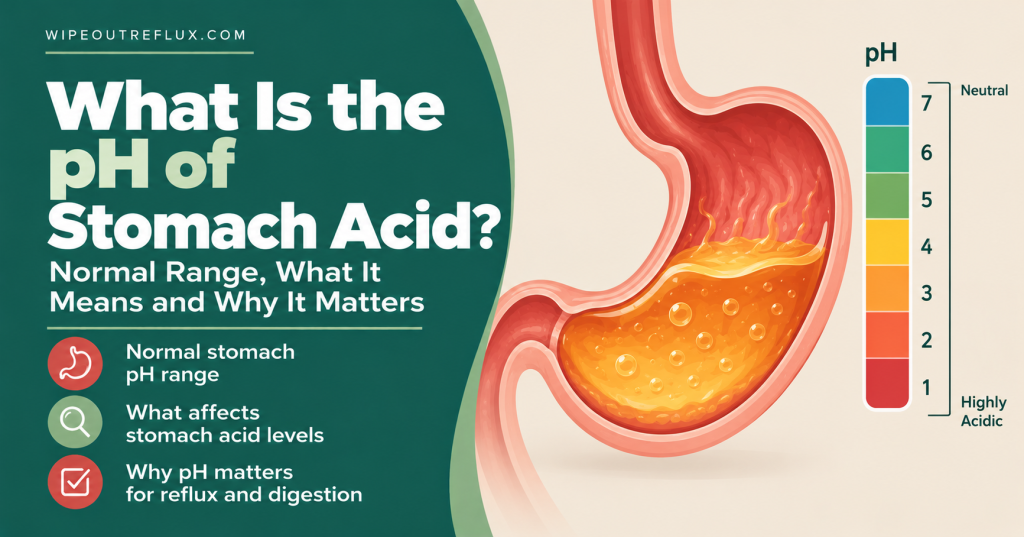
The pH of stomach acid in humans is usually between 1.5 and 3.5. On an empty stomach it sits around pH 1.5 to 2, which is strongly acidic. In a classic study of healthy adults, the median fasting pH was 1.7 [Dressman et al., Pharmaceutical Research, 1990].
Stomach pH isn’t fixed. Food buffers the acid, so pH climbs after a meal, often to 5 or higher, then falls back to fasting levels within about two hours. Age, medication and H. pylori can all push it higher.
Here’s the part most pH articles miss. If you have reflux, especially silent reflux, the pH of your stomach matters less than the pH of what reaches your throat. That’s because of pepsin, the digestive enzyme that travels up with the acid. Pepsin stays active up to around pH 6.5, far less acidic than the stomach itself.
Key Takeaways
- Normal stomach pH in humans is about 1.5 to 3.5, and around 1.5 to 2 when fasting.
- Stomach acid is hydrochloric acid, made by parietal cells in the stomach lining.
- After a meal, stomach pH briefly rises toward 5 or more, then returns to fasting levels within about two hours.
- A pocket of unbuffered acid (around pH 1.6) can sit at the top of the stomach after eating, right where reflux starts.
- Your stomach is protected by a mucus and bicarbonate layer. Your esophagus and throat have little or no such protection.
- Pepsin is active up to about pH 6.5, so reflux doesn’t need to be very acidic to irritate the throat.
- PPIs raise stomach pH above 4 for roughly 10 to 14 hours a day, but they don’t stop reflux or pepsin.
- Around one in ten healthy older adults has a fasting stomach pH above 5.
What Is Stomach Acid?
Stomach acid, or gastric acid, is mostly hydrochloric acid (HCl). It’s made by parietal cells in the upper part and main body of the stomach. These cells pump hydrogen ions into the stomach using an enzyme called the proton pump (H+/K+ ATPase). The hydrogen combines with chloride to form HCl [Engevik et al., Physiological Reviews, 2019].
The proton pump pushes acid out against a very steep gradient, which is why the inside of your stomach can be millions of times more acidic than your blood. It’s also the pump that PPIs like omeprazole switch off.
Stomach acid has three main jobs:
- Activating pepsin. The stomach releases an inactive form called pepsinogen, which only becomes active pepsin in acid [Hsu et al., StatPearls, 2023].
- Breaking down protein. Pepsin starts digesting protein, and the acid unfolds proteins so pepsin can get to work.
- Killing microbes. A pH this low destroys most bacteria and other organisms in food.
What Is the Normal pH of the Stomach?
Most sources give a normal range of about 1.5 to 3.5. Here’s how that breaks down in real life.
On an empty stomach
Fasting is when your stomach is most acidic. In healthy young adults, the median fasting pH was 1.7 [Dressman et al., Pharmaceutical Research, 1990]. A physiology review describes the lumen of the stomach as having a pH below 2 [Engevik et al., Physiological Reviews, 2019].
After you eat
Food acts as a buffer. In the same study, stomach pH rose to a median peak of 6.7 after a meal, then gradually fell back to fasting levels within about two hours [Dressman et al., Pharmaceutical Research, 1990].
You might think that means reflux after meals is less acidic. It often isn’t. Researchers found that after eating, a layer of fresh, unbuffered acid collects at the very top of the stomach, where it joins the esophagus. This “acid pocket” had a median pH of 1.6, while the main body of the stomach was at pH 4.7 [Fletcher et al., Gastroenterology, 2001]. The acid floats on top of the meal, right where it’s most likely to reflux.
This is one reason large meals cause so much trouble, and why I tell people to leave a few hours between eating and lying down. See how long before bed you should stop eating.
At night
Acid production follows a daily rhythm and tends to be higher overnight. Even on twice-daily PPIs, most people in one study had a period of night-time acid recovery, starting around 7.5 hours after the evening dose [Peghini et al., The American Journal of Gastroenterology, 1998]. Combined with lying flat, that’s why reflux at night is so common.
How Acidic Is pH 1.5? Putting It in Context
The pH scale runs from 0 to 14, with 7 as neutral. It’s logarithmic, so each step down is ten times more acidic. pH 2 is ten times more acidic than pH 3, and a hundred times more acidic than pH 4.
Approximate pH values for comparison:
- Battery acid: below 1
- Stomach acid (fasting): about 1.5 to 2
- Lemon juice: about 2 to 2.5
- Cola: about 2.5
- Orange juice: about 3.5
- Coffee: about 5
- Pepsin’s upper activity limit: about 6.5
- Water: 7
- Blood: about 7.4
Look at where everyday drinks sit. Lemon juice and cola are almost as acidic as stomach acid. That doesn’t matter much to your stomach, but it matters a lot to an irritated throat. For more foods and drinks, see my food pH chart.
Why Doesn’t Stomach Acid Burn Your Stomach?
Your stomach lining is built for this. Cells in the lining secrete a thick mucus layer along with bicarbonate, which neutralizes acid right at the surface. That barrier protects the stomach wall from its own acid [Hsu et al., StatPearls, 2023].
The esophagus has much weaker defenses. The throat and voice box have almost none. They rely on things like bicarbonate in saliva and an enzyme called carbonic anhydrase, and in people with LPR those defenses are often depleted [Gill et al., Annals of Otology, Rhinology and Laryngology, 2006].
So stomach acid isn’t a problem where it belongs. It becomes a problem when it ends up somewhere it doesn’t.
Why Stomach pH Matters Less Than Throat pH
This is the core of how I think about reflux, and it’s what most “pH of stomach acid” articles leave out.
In the esophagus: acid is measured
Reflux testing in the esophagus measures acid exposure time, meaning the percentage of the day the esophagus spends in acid. Under the latest Lyon consensus, under 4% is normal and over 6% confirms GERD [Gyawali et al., Gut, 2024]. For classic heartburn, acid is the main driver of symptoms. That’s why acid blockers work well for many people with GERD. If you want to know more about testing, see the Bravo pH test.
In the throat: pepsin does the damage
In the throat, the story changes. When researchers exposed laryngeal tissue to acid at pH 4 on its own, it held up well. Add pepsin at the same pH, and the tissue was significantly damaged [Bulmer et al., The Laryngoscope, 2010]. Acid alone isn’t the main problem in the throat. Pepsin is.
Pepsin’s relationship with pH is what makes LPR so stubborn:
- pH 1.5 to 2: pepsin is at its most active.
- Up to about pH 6.5: pepsin is still active.
- pH 6.5 to 7.5: pepsin is inactive but stable, and can be reactivated by fresh acid.
- pH 8 and above: pepsin is permanently destroyed.
Those figures come from a study of human pepsin across the pH range [Johnston et al., The Laryngoscope, 2007]. Pepsin can also be taken up by throat cells at a near-neutral pH of 7.4 and cause damage from inside them [Johnston et al., Annals of Otology, Rhinology and Laryngology, 2009].
Put that together and you can see the problem. Reflux reaching your throat doesn’t have to be strongly acidic to cause symptoms. Pepsin that’s already sitting in throat tissue can be switched back on by acidic food and drink, which is why diet matters so much for silent reflux. I explain this in detail in how pepsin reactivates in the throat and what is pepsin.
When I was struggling with my own LPR, this was the thing that finally made sense of it. My stomach acid was normal. The problem was what kept reaching my throat, and what I was eating and drinking afterwards. A diet that keeps food and drinks above about pH 5 is the basis of the Wipeout Diet Plan. In one study, a strict low-acid diet improved symptoms in most people with silent reflux whose symptoms hadn’t responded to medication alone [Koufman, Annals of Otology, Rhinology & Laryngology, 2011].
How PPIs Change Stomach pH
PPIs block the proton pump, so less acid is made and stomach pH rises. In a crossover study of five PPIs, the number of hours a day stomach pH stayed above 4 ranged from about 10 hours with pantoprazole to 14 hours with esomeprazole [Miner et al., The American Journal of Gastroenterology, 2003].
That’s a big change, and for erosive GERD it’s often exactly what’s needed. But look at that number again. For the rest of the day, stomach pH is still below 4. And even at pH 4 to 6, pepsin is still active.
PPIs also don’t stop reflux itself. The stomach contents still travel upwards, just less acidic. That’s why acid blockers often help heartburn far more than they help a sore throat, hoarseness or throat clearing. I go through this in why PPIs don’t work for LPR. If you’re coming off one, read about acid rebound first.
What Raises Stomach pH Naturally?
Some people produce less stomach acid than normal, called hypochlorhydria. Common causes include:
- Age. In a study of 79 healthy older adults, the median fasting pH was 1.3, so most were still strongly acidic. But 11% had a median fasting pH above 5 [Russell et al., Pharmaceutical Research, 1993]. See acid reflux in older adults.
- Long-term acid-suppressing medication, such as PPIs and H2 blockers.
- H. pylori infection, which can inflame the stomach lining. See H. pylori and acid reflux.
- Autoimmune gastritis and stomach surgery.
You’ll see claims online that most reflux is caused by low stomach acid. The evidence for that is thin, and taking acid supplements with an inflamed throat can backfire. I’ve covered it in does low stomach acid cause acid reflux and betaine HCl for acid reflux.
Can You Test Your Stomach pH at Home?
Not reliably. Urine and saliva pH strips don’t tell you what’s happening in your stomach. Home “baking soda tests,” where you time how long it takes to burp, aren’t validated either.
Stomach and reflux pH can only be measured properly with medical tests: a catheter or wireless capsule in the esophagus, or a throat probe like Restech. For a broader view, see how acid reflux is diagnosed.
Conclusion
The pH of stomach acid in humans is around 1.5 to 3.5, dropping to about 1.5 to 2 on an empty stomach and rising briefly after a meal. That’s strong acid, but your stomach is built to handle it. The trouble starts when stomach contents travel upwards.
For heartburn, acid is the main driver. For silent reflux, pepsin is the bigger problem, and it stays active far above the pH of the stomach. That’s why lowering acid alone often doesn’t fix throat symptoms, and why the pH of what you eat and drink matters so much once pepsin has reached your throat.
If you want a plan built around exactly this, the Wipeout Diet Plan is where I’d point you. It’s my complete, step-by-step approach to what and when to eat so pepsin stays switched off and your throat and esophagus can heal. I designed it around LPR, the throat-based reflux that’s hardest to shift, but because it targets the same root causes it works just as well for GERD and everyday heartburn.
If you just want the numbers, the Wipeout Food Reference Guide is the essential companion. It lists the foods and drinks that are safe for acid reflux and LPR along with their pH values, so you can check what’s likely to reactivate pepsin before you eat it.
Frequently Asked Questions
Is stomach acid stronger than battery acid?
No. Battery acid is usually below pH 1, while stomach acid is about 1.5 to 3.5. Because the pH scale is logarithmic, battery acid is roughly ten to a hundred times more acidic. Stomach acid is still very strong, similar to lemon juice at its most acidic.
What is the pH of the stomach after eating?
It rises because food buffers the acid. In healthy adults, stomach pH peaked at around 6.7 after a meal and returned to fasting levels within about two hours. But a pocket of strong acid around pH 1.6 can still sit at the top of the stomach, where reflux starts.
Does drinking water change stomach pH?
Briefly. A glass of water dilutes stomach acid and can raise pH for a few minutes, but your stomach quickly makes more acid. Water can still help rinse reflux out of the esophagus. See the best water for acid reflux.
Can alkaline water neutralize stomach acid?
Not for long. Your stomach makes more acid than any glass of water can neutralize. Its possible benefit for reflux is in the throat, where alkaline water may help inactivate pepsin. I cover this in alkaline water for LPR.
At what pH is pepsin inactive?
Pepsin becomes inactive above about pH 6.5, but it stays stable and can be reactivated by fresh acid up to around pH 7.5. It’s only permanently destroyed at pH 8 or higher.
Is my stomach acid too strong if I have reflux?
Usually not. Most people with reflux have normal stomach acid. The problem is that acid and pepsin travel upwards, often because the valve at the top of the stomach relaxes too often. See the lower esophageal sphincter and acid reflux.
Is stomach pH the same in children?
Newborns start with a higher stomach pH that falls in the first days of life. By childhood, stomach pH is broadly similar to adults. Reflux in babies is common and usually different from adult reflux. See silent reflux in newborns.
Research & References
- [Dressman et al., Pharmaceutical Research, 1990] — Measured upper GI pH in healthy young adults: median fasting gastric pH was 1.7, rising to a median peak of 6.7 after a meal and returning to fasting values within about two hours.
- [Engevik et al., Physiological Reviews, 2019] — Review of parietal cell physiology describing how the H+/K+ ATPase secretes hydrogen ions that combine with chloride to form HCl, creating a gastric lumen pH below 2.
- [Hsu et al., StatPearls, 2023] — Overview of stomach physiology covering HCl secretion by parietal cells, acid activation of pepsinogen, and the protective mucus and bicarbonate barrier.
- [Fletcher et al., Gastroenterology, 2001] — Identified an unbuffered “acid pocket” at the gastroesophageal junction after meals, with a median pH of 1.6 compared with 4.7 in the body of the stomach.
- [Peghini et al., The American Journal of Gastroenterology, 1998] — Found night-time acid recovery in most subjects on twice-daily PPI dosing, at a median of around 7.5 hours after the evening dose.
- [Gill et al., Annals of Otology, Rhinology and Laryngology, 2006] — Detected pepsin inside laryngeal cells in LPR patients but not controls, along with reduced levels of protective proteins in the larynx.
- [Gyawali et al., Gut, 2024] — Lyon Consensus 2.0: esophageal acid exposure time below 4% excludes GERD, while above 6% on at least two days is diagnostic.
- [Bulmer et al., The Laryngoscope, 2010] — Laryngeal tissue was largely resistant to acid at pH 4 alone but was significantly damaged when pepsin was present at the same pH.
- [Johnston et al., The Laryngoscope, 2007] — Human pepsin is active up to about pH 6.5, inactive but recoverable up to pH 7.5, and irreversibly inactivated at pH 8.
- [Johnston et al., Annals of Otology, Rhinology and Laryngology, 2009] — Showed pepsin at pH 7.4 is taken up by throat cells and causes cell damage, demonstrating harm under non-acidic reflux conditions.
- [Koufman, Annals of Otology, Rhinology & Laryngology, 2011] — A strict low-acid diet improved symptoms in most people with silent reflux that hadn’t responded to medication alone.
- [Miner et al., The American Journal of Gastroenterology, 2003] — Five-way crossover study: hours per day with stomach pH above 4 ranged from 10.1 (pantoprazole 40 mg) to 14.0 (esomeprazole 40 mg).
- [Russell et al., Pharmaceutical Research, 1993] — In 79 healthy older adults, median fasting gastric pH was 1.3, but 11% had a median fasting pH above 5.

David Gray
12 years living with LPR · Consultant & researcher
I've lived with LPR for twelve years — the misdiagnoses, the PPI courses that did nothing, the slow work of figuring out what actually helps. Wipeout Reflux is where I translate the research into plain terms for people stuck in the same place. Every claim here is sourced to peer-reviewed work, and I consult one-to-one with LPR sufferers.