
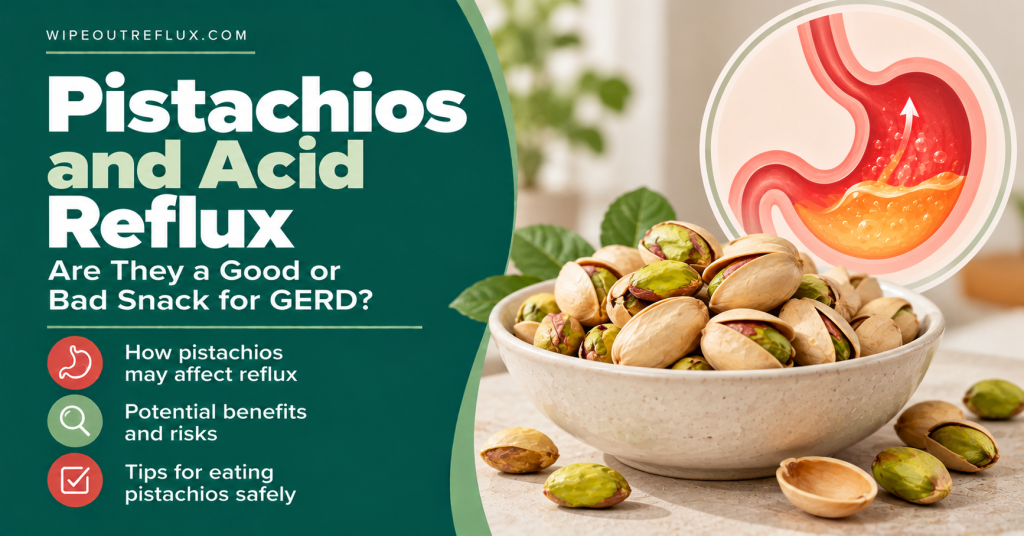
Yes, pistachios are one of the better nuts for acid reflux, as long as you keep the portion small and choose unsalted ones. Like all nuts, they aren’t really an acid problem. The issue with nuts is fat, and how easy it is to eat a lot of them at once.
Pistachios do well on both counts. They’re at the lower-fat end of the nut range, with about 45 g of fat per 100 g, compared with over 70 g in pecans and macadamias [USDA FoodData Central, Pistachio Nuts, Raw]. And if you buy them in the shell, cracking each one slows you down, which naturally keeps the portion in check.
The version to watch is heavily salted or flavored pistachios. Those are where most of the trouble comes from.
Key Takeaways
- Pistachios are generally reflux-friendly in small portions.
- With nuts, the main reflux concern is fat and portion size, not acidity.
- Pistachios have about 45 g of fat per 100 g, less than almonds, walnuts, pecans or macadamias.
- Shelling pistachios slows you down. In one study, people offered in-shell pistachios ate 41% fewer calories than those offered shelled ones.
- Salted pistachios carry a lot of sodium, and heavy salt use is linked to more reflux symptoms.
- Flavored pistachios (chili, lime, garlic, BBQ) add spice and acid that can trigger symptoms.
- A sensible serving is a small handful, about 1 oz (28 g), ideally with or after a meal.
- Pistachios are generally fine for LPR too, since the problem isn’t their pH.
Are Pistachios Acidic?
Not in the way that matters for reflux. Nuts don’t contain the fruit acids, like citric or malic acid, that make foods such as oranges or tomatoes a problem. Pistachios taste mild and aren’t sour, and they’re not the kind of food that reactivates pepsin in the throat.
That’s an important point if you have silent reflux. With LPR, I spend a lot of time steering people away from acidic foods and drinks, but nuts generally aren’t on that list. Their risk comes from somewhere else.
Why Fat Is the Real Issue With Nuts
All nuts are high in fat. Even healthy unsaturated fat affects reflux in a few ways:
- It slows stomach emptying. Fatty food sits in the stomach longer, giving it more time to reflux.
- It can relax the lower esophageal sphincter, the valve that’s meant to keep stomach contents down.
- It adds up quickly. A big handful of nuts can contain as much fat as a fried meal.
Research on diet and reflux points to fat intake and meal size, not just acidity, as independent contributors to symptoms [Heidarzadeh-Esfahani et al., Preventive Nutrition and Food Science, 2021]. So with nuts, the question is really which ones are lowest in fat and how many you eat.
How Pistachios Compare With Other Nuts
Here’s the approximate fat content per 100 g of common nuts, using USDA data:
- Cashews: about 44 g
- Pistachios: about 45 g
- Almonds: about 50 g
- Walnuts: about 65 g
- Pecans: about 72 g
- Macadamias: about 76 g
Pistachios and cashews sit at the bottom of the range. Pecans and macadamias carry roughly 60 to 70% more fat for the same weight. Pistachios are also high in fiber, at about 10.6 g per 100 g, and in protein, at about 20 g [USDA FoodData Central, Pistachio Nuts, Raw].
For a full comparison, see what nuts are good for acid reflux. I also cover cashews and acid reflux separately.
The Shell Advantage
This is the part I find genuinely useful for reflux. Because you have to crack pistachios open one at a time, you eat them more slowly, and the pile of empty shells gives you a visual reminder of how many you’ve had.
In a study of 140 students, those given in-shell pistachios ate about 125 calories’ worth, compared with about 211 for those given shelled ones. That’s 41% fewer calories, and the two groups felt equally full and satisfied [Honselman et al., Appetite, 2011].
For reflux, a smaller portion means less fat landing in the stomach at once, and eating slowly gives your stomach time to signal that it’s full. Both help. If you’re going to snack on nuts, in-shell pistachios are one of the easiest ways to keep it sensible.
Salted and Flavored Pistachios Are the Real Problem
Most pistachios in shops are roasted and salted. Raw pistachios have almost no sodium, about 1 mg per 100 g. Dry-roasted salted pistachios have around 428 mg per 100 g [USDA FoodData Central, Pistachio Nuts, Dry Roasted, With Salt Added]. Many brands are saltier still, with salt coating the shells too.
That matters because salt is linked to reflux. In a Norwegian study of more than 43,000 people, those who always added extra salt to their food were 70% more likely to have reflux symptoms than those who never did [Nilsson et al., Gut, 2004]. Salty snacks also make you thirsty, and if you reach for a soda or beer to wash them down, that’s a second trigger.
Flavored pistachios add another layer. Chili, sweet chili, salt and vinegar, lemon, lime, garlic and BBQ flavors all bring in spice, acid or both. If you have LPR, the acidic coatings are the ones to avoid, since they can irritate your throat directly. See spicy food and acid reflux.
My advice: buy unsalted or lightly salted pistachios in the shell, and skip the flavored bags.
Pistachios and Silent Reflux (LPR)
Pistachios generally fit well into a low-acid diet for silent reflux. They aren’t acidic, they’re filling, and they give you protein and fiber between meals. Plain pistachios are a snack I’m happy to recommend once the main healing phase is under way.
Two cautions for LPR:
- Dry, crumbly bits can catch in a sensitive throat. If you already feel a lump or tickle, chew well and drink some water.
- Don’t eat them late. Even a small portion of fat close to bedtime can make night-time reflux worse.
Choosing snacks that don’t undo your progress is a big part of the Wipeout Diet Plan. For more ideas, see my list of snacks for the LPR diet.
How to Eat Pistachios With Acid Reflux
- Stick to about 1 oz (28 g). That’s a small handful.
- Buy them in the shell. It slows you down and limits the portion naturally.
- Choose unsalted or lightly salted. Avoid flavored versions.
- Eat them with or after a meal, not as a big snack on an empty stomach.
- Not within three hours of bed.
- Drink water with them, not soda, beer or juice.
- Try pistachio butter in a thin layer if whole nuts bother your throat. As with almond butter, the portion is what counts.
Conclusion
Pistachios are one of the best nuts to choose if you have acid reflux. They’re not acidic, they’re at the lower-fat end of the nut range, and buying them in the shell slows you down and keeps portions sensible. The real problems are big handfuls, late-night snacking, and heavily salted or flavored varieties.
Snacks are just one part of the picture, though. The Wipeout Diet Plan is my complete, step-by-step plan for what to eat, when to eat it and how much, so you can calm reflux down without guessing. It was designed around LPR, the throat-based reflux that’s hardest to treat, but because it targets the same underlying causes, it works equally well for GERD and heartburn.
If you want a quick way to check foods as you go, the Wipeout Food Reference Guide is the essential companion. It lists the foods and drinks that are safe for acid reflux and LPR, along with their pH values.
Frequently Asked Questions
Can pistachios cause heartburn?
They can if you eat a lot of them at once, because of their fat content. Salted and spicy flavored pistachios are more likely to cause heartburn than plain ones. A small handful of unsalted pistachios rarely causes problems.
How many pistachios can I eat with acid reflux?
About 1 oz (28 g), or a small handful, is a good limit. Buying them in the shell makes it easier to stick to that.
Are pistachios better than almonds for acid reflux?
Slightly, if fat is your trigger. Pistachios have about 45 g of fat per 100 g, compared with about 50 g for almonds. Both are good choices in small portions.
Are salted pistachios bad for acid reflux?
They can be. Roasted salted pistachios contain far more sodium than raw ones, and heavy salt use is linked to reflux symptoms. Unsalted or lightly salted versions are better.
Are pistachios OK for silent reflux?
Yes, plain pistachios are generally fine for LPR because they aren’t acidic. Avoid flavored versions with lemon, lime, vinegar or chili, and keep portions small.
Is pistachio ice cream OK for acid reflux?
Usually not. Ice cream is high in fat and sugar, which are bigger triggers than the pistachio itself. See is ice cream bad for acid reflux.
Do pistachios cause bloating?
They can in some people. Pistachios are high in fiber and contain fermentable carbohydrates, which can cause gas if you eat a lot. Bloating can push up on the stomach valve and make reflux worse, so keep portions small.
Research & References
- [USDA FoodData Central, Pistachio Nuts, Raw] — Per 100 g, raw pistachios contain 45.3 g of fat, 560 kcal, 20.2 g of protein, 10.6 g of fiber and 1 mg of sodium.
- [USDA FoodData Central, Pistachio Nuts, Dry Roasted, With Salt Added] — Per 100 g, dry-roasted salted pistachios contain 45.8 g of fat and 428 mg of sodium.
- [Heidarzadeh-Esfahani et al., Preventive Nutrition and Food Science, 2021] — Systematic review of diet and reflux risk, covering fat intake, meal size and eating patterns alongside acidity as independent contributors to symptoms.
- [Honselman et al., Appetite, 2011] — In 140 students, those offered in-shell pistachios ate 41% fewer calories than those offered shelled pistachios, with no difference in fullness or satisfaction.
- [Nilsson et al., Gut, 2004] — In a Norwegian population study of 3,153 people with reflux symptoms and 40,210 controls, always using extra table salt was associated with reflux (odds ratio 1.7).

David Gray
12 years living with LPR · Consultant & researcher
I've lived with LPR for twelve years — the misdiagnoses, the PPI courses that did nothing, the slow work of figuring out what actually helps. Wipeout Reflux is where I translate the research into plain terms for people stuck in the same place. Every claim here is sourced to peer-reviewed work, and I consult one-to-one with LPR sufferers.