
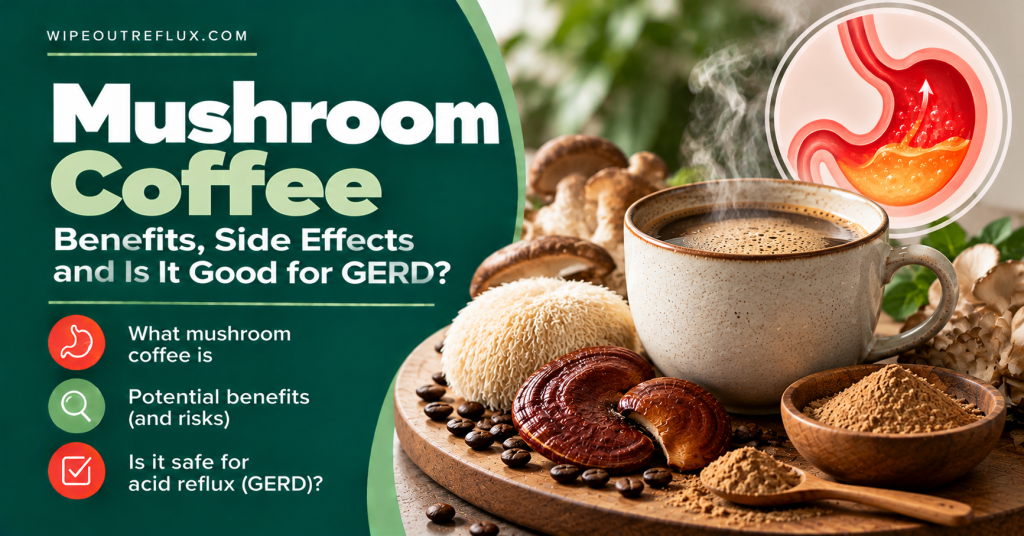
Mushroom coffee isn’t a reflux fix, but some people find it a bit gentler than regular coffee. The main reason is caffeine. A serving of Ryze, the best-known brand, has about 48 mg, roughly half a typical cup of brewed coffee. The catch is that most mushroom coffees are still made with real coffee, and research suggests the parts of coffee that drive reflux aren’t mainly the caffeine. So if regular coffee triggers your reflux, there’s a good chance mushroom coffee will too, just less so.
As for the mushrooms, nobody has studied lion’s mane, reishi, cordyceps or chaga in people with acid reflux. They don’t seem to help or harm it. If you want to try mushroom coffee, the smart move is to test it properly rather than assume it’s safe.
Key Takeaways
- Most mushroom coffees, including Ryze and Four Sigmatic, are real coffee blended with powdered mushroom extracts.
- Ryze lists about 48 mg of caffeine per serving, around half a typical brewed coffee.
- Less caffeine may help, but in a pH-monitoring study, caffeine on its own didn’t increase reflux. Coffee’s other components did.
- Coffee also stimulates stomach acid and is acidic itself, which matters for silent reflux (LPR) because acid reactivates pepsin in the throat.
- There are no studies of mushroom coffee or medicinal mushrooms in people with reflux. The gut-protection research on lion’s mane is in animals.
- Some “mushroom coffees”, such as MUD\WTR, contain no coffee at all, but they use cacao and spices, which can trigger reflux in their own right.
- The amounts of mushroom in a single serving are small compared with the doses used in studies.
- If you want to try it, cut coffee out for two weeks, then test mushroom coffee on its own with food, in the morning.
What Is Mushroom Coffee?
Mushroom coffee is a powdered drink mix that combines coffee, or a coffee substitute, with extracts of so-called functional mushrooms. These are mushrooms used in traditional medicine and sold today for focus, energy or immune support. The most common are lion’s mane, reishi, cordyceps, chaga, shiitake and turkey tail.
Despite the name, it doesn’t taste of mushrooms. Most brands taste like a mild instant coffee. Here’s what the three best-known products contain, according to their labels:
- Ryze: organic arabica coffee, MCT oil, coconut milk and a blend of six mushrooms (cordyceps, lion’s mane, reishi, shiitake, turkey tail and king trumpet). About 48 mg of caffeine per 6 g scoop, with 2 g of the scoop being the mushroom blend.
- Four Sigmatic Think: organic instant coffee with 250 mg each of lion’s mane and chaga, plus rhodiola.
- MUD\WTR :rise: no coffee. It’s black tea, cacao, a spice blend (cinnamon, turmeric, ginger, cardamom, black pepper, nutmeg and cloves) and four mushrooms, with about 35 mg of caffeine.
Formulas change, so check the current label before you buy. But the key split is clear: some mushroom coffees are coffee with extras, and some are coffee-free blends. For reflux, those two groups behave quite differently.
Why Regular Coffee Triggers Reflux
To judge mushroom coffee, you need to know what it is about coffee that causes reflux in the first place. It’s not as simple as “caffeine”.
Coffee promotes reflux, but caffeine may not be the main reason
A review of coffee and digestion concluded that coffee clearly promotes gastroesophageal reflux and stimulates gastric acid, while studies of its effect on the lower esophageal sphincter have conflicting results [Boekema et al., Scandinavian Journal of Gastroenterology Supplement, 1999].
The most revealing experiment measured reflux after people drank regular coffee, decaf, tea and plain water with or without added caffeine. Regular coffee caused significant reflux. Decaf caused less, but adding caffeine to water had no effect. Coffee with its caffeine reduced to the level of tea still increased reflux. The authors concluded that caffeine didn’t seem to be responsible and that other components of coffee were to blame [Wendl et al., Alimentary Pharmacology & Therapeutics, 1994].
That’s the single most important finding for anyone considering mushroom coffee. Its main selling point for reflux is lower caffeine, and caffeine may not be the main problem.
Coffee stimulates acid
Coffee increases stomach acid production, and decaf does too, which again points to compounds other than caffeine. Roast matters as well. A dark roast blend, which contains more of a compound produced during roasting called N-methylpyridinium, stimulated less acid than a medium roast [Rubach et al., Molecular Nutrition & Food Research, 2014]. Most mushroom coffee brands don’t tell you the roast level.
Coffee is acidic
Coffee typically sits around pH 5. That isn’t very acidic for the stomach, but it matters for silent reflux. Pepsin, the digestive enzyme that does much of the damage in LPR, can lodge in throat tissue and become active again when it meets acid. See is coffee acid or alkaline and how pepsin reactivates in the throat.
But coffee isn’t a trigger for everyone
This is worth keeping in perspective. A 2026 meta-analysis of 40 studies and more than 122,000 people found GERD was only slightly more common in coffee drinkers (34.9% vs 30.7%). The authors said the clinical significance was unclear, and that avoiding coffee shouldn’t be a universal rule [Muftah et al., Clinical and Translational Gastroenterology, 2026]. In practice, coffee is a strong trigger for some people and barely matters for others. I go through all of this in is coffee bad for acid reflux.
Is Mushroom Coffee Better for Acid Reflux?
Putting that together, here’s how coffee-based mushroom coffee compares with a regular cup.
What may be better
- Less caffeine. At around 48 mg, Ryze has roughly half the caffeine of a typical brewed coffee. Even if caffeine isn’t the main reflux driver, it still matters for some people, especially those who get jittery, anxious or acidic after a strong mug. See caffeine and acid reflux.
- Less coffee overall. Part of each serving is mushroom powder, MCT oil and coconut milk, so there’s simply less coffee in the cup than in a full-strength mug. That may mean fewer of the coffee components that drive reflux, though no one has measured it.
- A smaller habit. Many people drink one mushroom coffee instead of two or three regular ones. Less coffee is usually less reflux.
What doesn’t change
- It’s still coffee. The acid-stimulating and reflux-promoting compounds that aren’t caffeine are still there.
- It’s still acidic, which matters if you have LPR.
- The added fat is small but real. Ryze contains MCT oil and coconut milk. In one cup that’s unlikely to matter much, but a recent review found digestive side effects were the most common problem with MCT oil, especially at higher doses [Scheller et al., Frontiers in Nutrition, 2026]. If fat is one of your triggers, keep it in mind.
My verdict: coffee-based mushroom coffee is best thought of as a weaker coffee, not a reflux-friendly drink. If caffeine is your main issue, it may help. If coffee itself is the problem, it probably won’t solve it.
What About the Mushrooms?
This is where marketing gets ahead of the evidence.
Lion’s mane has the most gut-related research. In animal studies, extracts protected the stomach lining against alcohol-induced injury [Bei et al., Food Science & Nutrition, 2026]. That’s interesting, but it’s stomach injury in animals, not reflux in people, and these studies use concentrated extracts. The human trials of lion’s mane have looked at things like cognition and stress, using doses around 1.8 g a day [Docherty et al., Nutrients, 2023]. A sachet of Four Sigmatic contains 250 mg.
Reishi, cordyceps, shiitake, turkey tail and king trumpet have no reflux research at all.
So the honest answer is that the mushrooms are probably neutral for reflux. They’re unlikely to cause it, and there’s no good evidence they’ll calm it. Don’t choose mushroom coffee expecting the mushrooms to protect your esophagus or throat.
Coffee-Free Mushroom Blends: Are They Safer?
Blends like MUD\WTR swap coffee for black tea, cacao and spices. On paper that removes coffee’s specific reflux-promoting effect, and in the decaffeination study mentioned above, tea didn’t increase reflux the way coffee did. But two of the other ingredients are well-known triggers:
- Cacao. In people with esophagitis, chocolate increased acid exposure in the esophagus in the hour after eating [Murphy and Castell, American Journal of Gastroenterology, 1988]. See does chocolate cause heartburn or acid reflux.
- Warming spices like black pepper, cinnamon and cloves bother some people. See spicy food and acid reflux.
For some people, a coffee-free blend will be easier than coffee. For others, the cacao will cause just as much trouble. It’s another one to test rather than assume.
Is Mushroom Coffee OK for Silent Reflux (LPR)?
For LPR, I’d be more cautious. Throat tissue is far more sensitive to acid than the esophagus, and any coffee-based drink is acidic enough to reactivate pepsin. During the healing phase of an LPR diet, I’d leave mushroom coffee out along with regular coffee. Once your throat has settled, you can test it like any other food.
If you need something warm in the morning in the meantime, chamomile tea or a chicory-based drink are better options. See coffee alternatives for acid reflux and is chamomile tea good for acid reflux.
Other Things Worth Knowing Before You Switch
- Chaga and oxalate. Chaga is very high in oxalate. There are case reports of kidney damage in people taking large amounts of chaga powder, for example 10 to 15 g a day for months [Kwon et al., Medicine, 2022]. A sachet contains far less than that, but if you’ve had kidney stones, check with your doctor before drinking chaga blends daily.
- Medications. Medicinal mushrooms are sold as supplements, and their interactions aren’t well studied. If you take blood thinners, diabetes medication or immunosuppressants, it’s worth asking your pharmacist.
- Cost. Mushroom coffee costs several times more per cup than regular coffee. Decaf or a dark roast may give you most of the same reflux benefit for much less. See is decaf coffee bad for acid reflux and the best low-acid coffee brands.
How to Test Mushroom Coffee Without Guessing
Because coffee affects people so differently, the only way to know is to test it properly:
- Cut out all coffee for two weeks, including mushroom coffee and decaf, so you have a clean baseline.
- Reintroduce mushroom coffee on its own. Don’t change anything else that week.
- Drink it with breakfast, not on an empty stomach, and only in the morning.
- Start with half a serving for a day or two, then a full serving.
- Watch for symptoms over 24 to 48 hours. Throat symptoms from LPR are often delayed until the next day.
This is the same approach I use for any trigger. I explain it in full in my guide to the elimination diet for acid reflux. The Wipeout Diet Plan builds it into a complete program, with a stricter healing phase, a two-week meal plan including what to drink, and a guided way to bring foods and drinks like coffee back.
Conclusion
Mushroom coffee is a weaker coffee, not a reflux-friendly drink. Its lower caffeine may help people who are sensitive to caffeine, but research suggests coffee’s other components drive most of its reflux effect, and they’re still in the cup. The mushrooms themselves are probably neutral. There’s no evidence in people that they protect the esophagus or throat. Coffee-free blends avoid coffee but swap in cacao, which is a trigger in its own right. If you have LPR, leave it out until your throat has healed. Otherwise, test it properly against a clean baseline and let your own symptoms decide.
If you want the bigger picture of what to drink and eat, the Wipeout Diet Plan is my complete, step-by-step guide. It covers trigger foods and drinks, safe swaps, a full two-week meal plan, and how to reintroduce favorites like coffee without undoing your progress. I built it first for silent reflux, the stubborn throat-based kind, but it works on the same root mechanisms, so it helps GERD and everyday heartburn just as well.
For a quick reference, the Wipeout Food Reference Guide is the essential companion. It lists reflux- and LPR-friendly foods and drinks with their pH values, so you can check what’s in your cup at a glance.
Frequently Asked Questions
Is mushroom coffee good for acid reflux?
It isn’t good for reflux, but it may be gentler than regular coffee for some people because it usually contains less caffeine. Most brands still contain real coffee, which stimulates stomach acid and promotes reflux through components other than caffeine.
Is Ryze mushroom coffee OK for acid reflux?
Ryze contains arabica coffee with about 48 mg of caffeine per serving, roughly half a typical brewed coffee, plus MCT oil and coconut milk. Some people with reflux tolerate it better than regular coffee, but it’s still coffee. Test it on its own after a coffee-free break.
Does mushroom coffee have less acid than regular coffee?
Brands don’t usually publish pH data. Because each serving contains less coffee than a full-strength mug, it may contain less of coffee’s acids, but coffee-based blends are still acidic.
Is mushroom coffee OK for silent reflux (LPR)?
I’d avoid it during the healing phase. Any coffee-based drink is acidic enough to reactivate pepsin in the throat. Once symptoms have settled, test it carefully.
Does lion’s mane help acid reflux?
There’s no evidence in people. Lion’s mane extracts have protected the stomach lining in animal studies, but nobody has tested it for reflux, and mushroom coffees contain small amounts.
Is MUD\WTR better for acid reflux than coffee?
It contains no coffee, which may help if coffee is your trigger. But it contains cacao and spices, and chocolate is a well-documented reflux trigger, so it isn’t automatically safer.
What’s the best coffee substitute for acid reflux?
For most people, caffeine-free, low-acid drinks like chamomile, rooibos or roasted chicory are the safest options. If you want to keep drinking coffee, decaf or a dark roast with breakfast is usually better tolerated than a strong regular cup.
Research & References
- Wendl et al., Alimentary Pharmacology & Therapeutics, 1994. Regular coffee increased reflux, while decaf caused less. Caffeine added to water had no effect, and coffee reduced to tea’s caffeine level still increased reflux, pointing to components other than caffeine.
- Boekema et al., Scandinavian Journal of Gastroenterology Supplement, 1999. A review concluding that coffee promotes gastroesophageal reflux and stimulates gastric acid secretion, with conflicting evidence on LES pressure.
- Rubach et al., Molecular Nutrition & Food Research, 2014. A dark roast blend rich in N-methylpyridinium stimulated less gastric acid than a medium roast in healthy volunteers.
- Muftah et al., Clinical and Translational Gastroenterology, 2026. In 40 studies and 122,074 people, GERD was slightly more common in coffee drinkers (OR 1.18), with unclear clinical significance and no link to Barrett’s esophagus.
- Murphy and Castell, American Journal of Gastroenterology, 1988. Chocolate significantly increased esophageal acid exposure in the first hour after eating in patients with esophagitis.
- Bei et al., Food Science & Nutrition, 2026. Lion’s mane (Hericium erinaceus) extracts reduced ethanol-induced acute gastric injury in an animal model, partly through effects on gut bacteria.
- Docherty et al., Nutrients, 2023. A 28-day trial of 1.8 g lion’s mane in 41 healthy adults suggested possible effects on processing speed and stress, with mixed results.
- Scheller et al., Frontiers in Nutrition, 2026. A systematic review found gastrointestinal side effects were the most common problem with MCT oil, particularly at higher doses.
- Kwon et al., Medicine, 2022. A case report of acute oxalate nephropathy in a man taking 10 to 15 g of chaga powder daily for three months.

David Gray
12 years living with LPR · Consultant & researcher
I've lived with LPR for twelve years — the misdiagnoses, the PPI courses that did nothing, the slow work of figuring out what actually helps. Wipeout Reflux is where I translate the research into plain terms for people stuck in the same place. Every claim here is sourced to peer-reviewed work, and I consult one-to-one with LPR sufferers.