
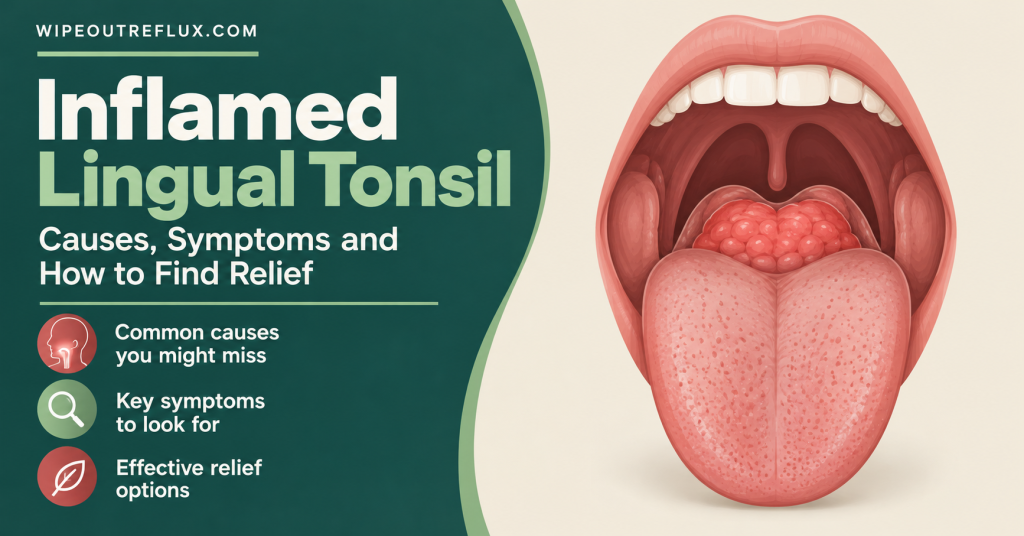
An inflamed or enlarged lingual tonsil is swelling of the lymph tissue at the very back of your tongue, low down where the tongue curves into the throat. It’s usually harmless, and the most common causes are infection, reflux, carrying extra weight and, in some people, a previous tonsillectomy. It typically feels like a lump or fullness at the base of the tongue, food catching there, a sore spot low in the throat, or a constant urge to clear your throat.
Reflux is one of the most consistent links in the research, and it’s the one almost nobody explains to patients. Studies have found that people with more reflux reaching the throat tend to have larger lingual tonsils. That matters because if reflux is driving the swelling, calming the reflux is the most practical thing you can do about it.
If you’ve been told your scans and biopsy are clear but the lump feeling is still there, this article is for you.
Key Takeaways
- The lingual tonsil is a patch of bumpy lymph tissue at the back of the tongue. Everyone has one, and its bumpy surface is normal.
- When it becomes inflamed or enlarged, it can cause a lump feeling, food sticking, throat clearing, a sore throat low down, and sometimes snoring.
- The main causes of enlargement are reflux, infection, obesity and, in some people, compensatory growth after the main tonsils are removed.
- Several studies link reflux reaching the throat to larger lingual tonsils, and to more inflamed tonsil crypts on close inspection.
- Many people with an enlarged lingual tonsil have silent reflux without any heartburn.
- Reflux-related swelling often eases with dietary changes, an alginate and night-time reflux control, though it can take a few months.
- A lump on one side only, a persistent one-sided sore throat, ear pain, a neck lump, bleeding or weight loss should always be examined by an ENT doctor.
Where Is the Lingual Tonsil?
Most people only know about the two tonsils you can see at the sides of the throat. Those are the palatine tonsils. You actually have a ring of tonsil tissue guarding the entrance to your airway and food pipe, and the lingual tonsil is the bottom part of that ring.
It sits on the base of your tongue, the back third that you can’t see in a mirror. It starts just behind a V-shaped row of large bumps on your tongue (the circumvallate papillae) and runs down towards the epiglottis, the flap that covers your windpipe when you swallow. You can’t normally see it without a mirror or a camera, but you can sometimes feel it with your tongue or notice it when you swallow.
Are the bumps at the back of my tongue normal?
Yes, in most cases. The back of the tongue is naturally bumpy. The large bumps in a V shape are taste papillae, and the lingual tonsil behind them has a cobbled surface made of lots of small rounded mounds of lymph tissue. It’s very common for people to spot these bumps for the first time, especially when their throat already feels odd, and worry. Symmetrical bumps on both sides of the back of the tongue are almost always normal anatomy.
If you can see redness or swelling on the back of the tongue, it’s worth reading my guide to what silent reflux does to the tongue.
Symptoms of an Inflamed or Enlarged Lingual Tonsil
A lingual tonsil can be acutely inflamed, as in an infection, or slowly enlarged over months or years. The symptoms overlap:
- A lump or fullness at the base of the tongue, often described as something stuck that won’t swallow away
- Food catching at the back of the tongue, especially bread, meat and dry food
- Frequent throat clearing and a feeling of mucus sitting low in the throat
- A sore throat felt low down, sometimes more on one side, and sometimes with ear pain
- A change in voice, which can sound muffled or “thick”
- Snoring or disturbed sleep, because a large lingual tonsil can narrow the airway at night
- A chronic cough or tickle
Enlarged lingual tonsils are a recognised cause of the lump-in-throat feeling (globus) and of swallowing difficulty, and they can also contribute to obstructive sleep apnea [Harris et al., Journal of Otolaryngology–Head & Neck Surgery, 2017]. If the lump feeling is your main symptom, my guide to the lump in throat from reflux goes into the mechanism in detail, and the food stuck in throat feeling covers the swallowing side.
What Causes Lingual Tonsil Inflammation and Swelling?
1. Infection (lingual tonsillitis)
Like any tonsil, the lingual tonsil can become infected. Lingual tonsillitis usually comes on over a day or two with a sore throat felt low down, pain on swallowing, sometimes a fever and swollen neck glands. It’s more common in people who have had their palatine tonsils removed, because the lingual tonsil is then doing more of the work. Most cases are viral and settle within a week or so. Severe swelling with drooling, a muffled voice or any trouble breathing needs urgent attention.
2. Reflux reaching the throat
This is the cause I want to spend the most time on, because it’s the one most people with a long-term enlarged lingual tonsil are never told about. It has its own section below.
3. Weight
Carrying more weight is linked to larger lingual tonsils. In a Canadian study of 102 adults, people with a BMI over 30 had significantly more lingual tonsil tissue [Harris et al., Journal of Otolaryngology–Head & Neck Surgery, 2017]. Weight and reflux also travel together, so it’s hard to fully separate the two.
4. After a tonsillectomy
Some people find their lingual tonsil grows after their main tonsils have been removed, as the remaining tissue compensates. It’s a recognised pattern, though not everyone shows it. In the Canadian study above, a childhood tonsillectomy wasn’t linked to larger lingual tonsils in adulthood.
5. Other contributors
Smoking, frequent throat infections and chronic post-nasal drip have all been suggested. Allergy has been studied but the link isn’t clear. Very rarely, swelling at the base of the tongue is caused by something other than tonsil tissue, which is why one-sided or unusual swelling should always be examined (more on that below).
The Reflux Link: Why Your Lingual Tonsil May Be Swollen
The lingual tonsil sits right in the path of anything that comes up from the stomach. When reflux travels past the upper esophageal sphincter, the base of the tongue and the area just above the voice box are among the first surfaces it touches. Tonsil tissue is immune tissue, and its job is to react to whatever lands on it. Repeated contact with refluxed material is a plausible reason for it to stay inflamed and slowly enlarge.
What the research shows
- More reflux, bigger tonsil. Researchers who measured reflux high in the throat with pH probes found that the severity of lingual tonsil enlargement increased with the amount of reflux reaching the upper throat [DelGaudio et al., Otolaryngology–Head and Neck Surgery, 2008].
- Reflux signs on examination go with enlargement. In the Canadian study, people with a positive Reflux Finding Score (visible signs of reflux on a throat scope) had significantly larger lingual tonsils [Harris et al., Journal of Otolaryngology–Head & Neck Surgery, 2017].
- Reflux and weight as joint risk factors. In adults with snoring and sleep-disordered breathing, obesity and laryngopharyngeal reflux were both identified as risk factors for lingual tonsil enlargement [Sung et al., JAMA Otolaryngology–Head & Neck Surgery, 2013].
- Inflamed crypts. Using a special light filter to look closely at the tissue, Italian researchers found that people with LPR had larger lingual tonsils and more inflammation inside the tonsil crypts than people without reflux [Galli et al., European Archives of Oto-Rhino-Laryngology, 2020].
I want to be honest about the limits here. These studies show a consistent association, not proof that reflux causes every enlarged lingual tonsil, and nobody has yet run a large trial showing that treating reflux shrinks it. But the pattern is consistent across different countries and methods, and it fits what I hear from readers: the lump feeling at the base of the tongue often eases as their reflux comes under control.
Why you might not have heartburn
Most people with throat-level reflux (laryngopharyngeal reflux, or LPR) don’t get heartburn. In the original research defining LPR, nearly all patients came in with throat and voice symptoms, and only a minority had heartburn [Koufman, The Laryngoscope, 1991]. So “but I don’t have reflux, I never get heartburn” doesn’t rule it out.
The throat is also far more sensitive than the esophagus. The main troublemaker is pepsin, the stomach’s protein-digesting enzyme. It can stick to throat tissue and be switched back on by later acid exposure, whether that’s another reflux episode or an acidic drink [Johnston et al., The Laryngoscope, 2007]. That helps explain why throat tissue can stay irritated for months. I explain this in more depth in how to neutralize pepsin in the throat.
Signs your lingual tonsil swelling may be reflux-related
- It’s on both sides, and has built up gradually over weeks or months
- Your scans or biopsy came back clear, but the lump feeling remains
- You clear your throat a lot, or feel mucus sitting low in the throat
- You have hoarseness, a cough after eating or lying down, or a sour taste in the morning
- It’s worse after large or late meals, coffee, alcohol, fizzy drinks or acidic food
- Your doctor mentioned redness or swelling around the voice box
If several of these fit, score yourself on the Reflux Symptom Index. A score above 13 suggests reflux is likely to be involved [Belafsky et al., Journal of Voice, 2002].
Lingual Tonsil Pain on One Side
It’s common for a swollen lingual tonsil to feel worse on one side, in the same way that reflux and mucus can irritate one side of the throat more, often the side you sleep on. Lingual tonsillitis can also start on one side. And because the throat and ear share nerves, one-sided pain at the tongue base can be felt in the ear too.
For more on why throat pain can be one-sided, see sore throat on one side.
That said, a lump or pain that stays on one side only for more than three weeks should be examined by an ENT doctor, even if you’re fairly sure it’s reflux. The check is quick and it’s the right thing to do.
How Is an Enlarged Lingual Tonsil Diagnosed?
Your GP won’t usually be able to see the lingual tonsil by looking in your mouth. An ENT doctor will look with a mirror or, more often, a thin flexible camera passed through the nose. This takes a few minutes in clinic and gives a clear view of the tongue base and voice box.
During the same look, they can check for signs of reflux on the larynx, often recorded as a Reflux Finding Score [Belafsky et al., The Laryngoscope, 2001]. If anything looks asymmetrical or unusual, they may arrange a scan or a biopsy. If you’ve already been through that and everything came back clear, that’s genuinely good news: it means you’re dealing with tonsil tissue that is irritated, and that’s something you can work on.
For more on what an ENT appointment involves, see when to see a doctor for LPR.
How to Calm an Inflamed Lingual Tonsil
If it’s an infection
- Rest, fluids and simple pain relief such as paracetamol (acetaminophen) or ibuprofen if they suit you
- Warm salt water gargles two or three times a day
- See a doctor if it isn’t improving after a few days, or sooner if you have a high fever or swallowing is very painful. Bacterial lingual tonsillitis may need antibiotics
If reflux is likely
Throat tissue heals slowly, so give these changes at least eight to twelve weeks before you judge them.
- Take the acid out of your diet. This is where I’d focus first. Acidic food and drink can reactivate pepsin already sitting in the throat. A strict low-acid diet clearly improved symptoms in people with stubborn LPR [Koufman, Annals of Otology, Rhinology & Laryngology, 2011], and a plant-based Mediterranean-style diet with alkaline water worked as well as acid-reducing medication [Zalvan et al., JAMA Otolaryngology–Head and Neck Surgery, 2017]. My Wipeout Diet Plan takes you through this step by step, so you know exactly what to eat and drink while the tissue settles. The list of LPR foods to avoid is a good place to begin.
- Use an alginate after meals and at bedtime. It forms a protective raft on top of the stomach contents. In a trial of 49 people with LPR, Gaviscon Advance improved symptoms and throat appearance compared with no treatment [McGlashan et al., European Archives of Oto-Rhino-Laryngology, 2009]. See alginates for acid reflux.
- Protect the night. Stop eating three hours before bed, raise the head of the bed, and sleep on your left side. Night-time reflux sits on the throat for longer because you swallow less while asleep.
- Cut down on throat clearing. Every hard clear knocks the tissue at the base of the tongue and voice box. Swap it for a sip of water and a firm swallow. See how to stop constant throat clearing.
- Work on weight if it applies. Even modest weight loss reduces pressure on the stomach and is linked to smaller lingual tonsils in the research above.
- Stop smoking and go easy on alcohol, both of which irritate the throat directly and worsen reflux.
When the tonsil itself needs treating
If an enlarged lingual tonsil is causing significant swallowing problems or contributing to sleep apnea, and conservative measures haven’t helped, an ENT surgeon can reduce it (lingual tonsillectomy, often done with coblation or laser). This is a bigger step with a sore recovery, so it’s usually reserved for clear-cut cases after reflux and other causes have been addressed. If snoring or sleep apnea is part of your picture, see sleep apnea and acid reflux.
When to See a Doctor
Most lingual tonsil swelling is benign, and if you’ve already had scans and a biopsy that came back clear, you can take real reassurance from that. For anyone who hasn’t been examined, book an ENT or GP appointment if:
- The lump, swelling or soreness is on one side only and has lasted more than three weeks
- You have ear pain on the same side that won’t go away
- You notice a lump in your neck that hasn’t gone down after two to three weeks
- Your voice has been hoarse for more than three weeks
- Swallowing is getting harder, or you’ve lost weight without trying
- You’ve noticed blood in your saliva
Get urgent help if swelling comes on quickly with drooling, a muffled voice, difficulty breathing or inability to swallow your own saliva.
Conclusion
An inflamed lingual tonsil can be a frustrating, slightly mysterious problem: a lump at the base of your tongue that you can feel but not see, food catching, and constant clearing, often with clear scans and no real explanation. In many people the missing piece is reflux. The lingual tonsil sits right where refluxed material lands, and studies from several countries link more reflux in the throat to bigger, more inflamed lingual tonsils, often in people who never get heartburn.
If that’s your picture, the most useful thing you can do is reduce what reaches your throat and stop feeding the irritation, and that mostly comes down to diet, meal timing and night-time habits. The Wipeout Diet Plan is where I’d start. It’s my complete plan for taking the acid out of your meals and drinks so pepsin stops irritating your throat tissue, built from twelve years of managing reflux myself. It was designed first for silent reflux, the throat-based type behind most lingual tonsil swelling, though because it targets the same root causes, it works just as well for classic heartburn and GERD.
If you’d like something lighter to begin with, the Wipeout Food Reference Guide is the essential companion. It lists the foods and drinks that are safe for acid reflux and LPR with their pH values, so you can quickly check what you’re eating.
Frequently Asked Questions
What does an inflamed lingual tonsil feel like?
Usually a lump, fullness or “something stuck” feeling at the base of the tongue, often with food catching there, frequent throat clearing and a sore spot low in the throat. Some people notice a thicker-sounding voice or more snoring.
Can acid reflux cause lingual tonsil hypertrophy?
Reflux is one of the most consistent associations. Studies have found that more reflux reaching the upper throat goes with larger lingual tonsils, and that people with LPR have more inflamed tonsil crypts. It hasn’t been proven that reflux causes every case, but treating reflux is a sensible, low-risk step.
Where is the lingual tonsil located?
On the back third of the tongue, behind the V-shaped row of large taste bumps and in front of the epiglottis. You can’t see it in a normal mirror, which is why ENT doctors use a small camera to examine it.
Are bumps on the back of my tongue normal?
Usually, yes. The back of the tongue has large taste papillae and the cobbled surface of the lingual tonsil, and both look bumpy. Symmetrical bumps on both sides are normal. A single lump, an ulcer or anything on one side that persists for three weeks should be checked.
How long does a swollen lingual tonsil take to go down?
An infection usually settles within one to two weeks. Reflux-related enlargement takes longer, often two to three months of consistent changes, because throat tissue heals slowly and pepsin needs time to clear.
Can a lingual tonsil grow back after tonsillectomy?
Your palatine tonsils don’t grow back, but the lingual tonsil is separate tissue that isn’t removed in a normal tonsillectomy. Some people find it enlarges afterwards, possibly to compensate, though studies don’t agree on how often this happens.
Should I worry about an enlarged lingual tonsil?
Most enlarged lingual tonsils are benign. If it’s on both sides and you’ve been examined, it’s very likely irritated lymph tissue. Swelling on one side only, a neck lump, ongoing ear pain, bleeding or weight loss should be seen by an ENT doctor.
Research & References
- [Harris et al., Journal of Otolaryngology–Head & Neck Surgery, 2017] — Cross-sectional study of 102 Canadian adults finding that a positive Reflux Finding Score and a BMI over 30 were associated with lingual tonsil hypertrophy, while symptom scores, allergy and childhood tonsillectomy were not; notes enlarged lingual tonsils can cause globus, dysphagia and contribute to sleep apnea.
- [DelGaudio et al., Otolaryngology–Head and Neck Surgery, 2008] — pH monitoring study reporting that reflux reaching the upper pharynx correlated with increasing severity of lingual tonsil hypertrophy.
- [Sung et al., JAMA Otolaryngology–Head & Neck Surgery, 2013] — Study of adults with sleep-disordered breathing identifying obesity and laryngopharyngeal reflux as factors associated with lingual tonsil hypertrophy.
- [Galli et al., European Archives of Oto-Rhino-Laryngology, 2020] — Case-control study of 82 LPR patients and 80 controls using narrow band imaging, finding larger lingual tonsils and more tonsil crypt inflammation in people with reflux.
- [Koufman, The Laryngoscope, 1991] — Landmark study establishing laryngopharyngeal reflux, in which most patients had throat and voice symptoms while only a minority reported heartburn.
- [Johnston et al., The Laryngoscope, 2007] — Showed pepsin remains stable at throat pH and is reactivated by acid, explaining ongoing throat irritation between reflux episodes.
- [Belafsky et al., Journal of Voice, 2002] — Developed and validated the Reflux Symptom Index, a nine-item LPR questionnaire, with scores above 13 considered abnormal.
- [Belafsky et al., The Laryngoscope, 2001] — Developed the Reflux Finding Score, an eight-item scale for grading visible signs of reflux on laryngoscopy.
- [Koufman, Annals of Otology, Rhinology & Laryngology, 2011] — Reported marked symptom improvement in patients with stubborn LPR after a strict low-acid diet.
- [Zalvan et al., JAMA Otolaryngology–Head and Neck Surgery, 2017] — Found a plant-based Mediterranean-style diet with alkaline water improved LPR symptoms at least as well as proton pump inhibitors.
- [McGlashan et al., European Archives of Oto-Rhino-Laryngology, 2009] — Randomized trial of Gaviscon Advance in 49 people with LPR, showing significantly better symptom and throat examination scores than no treatment.

David Gray
12 years living with LPR · Consultant & researcher
I've lived with LPR for twelve years — the misdiagnoses, the PPI courses that did nothing, the slow work of figuring out what actually helps. Wipeout Reflux is where I translate the research into plain terms for people stuck in the same place. Every claim here is sourced to peer-reviewed work, and I consult one-to-one with LPR sufferers.