
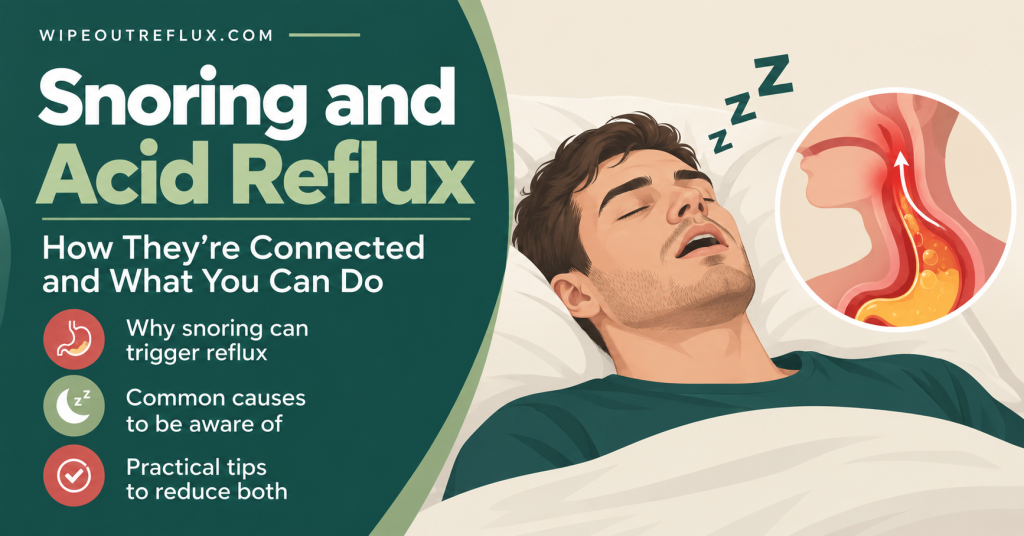
Snoring and acid reflux are linked, and the link works both ways. Snoring makes reflux more likely because every partly blocked breath creates a stronger suction in your chest that can pull stomach contents upwards. Reflux in turn makes snoring more likely by inflaming and swelling the tissues of the throat, which narrows the airway further. Both are also made worse by the same habits: late meals, alcohol, extra weight and sleeping on your back.
Large population studies back this up. Snoring is one of the strongest predictors of heartburn at night, and people who both snore and have night-time reflux report more throat and chest symptoms than people with either one alone.
This article is about ordinary snoring, not sleep apnea. If you stop breathing in your sleep, wake gasping or feel exhausted every day, read sleep apnea and acid reflux as well, because that’s a different and more serious problem.
Key Takeaways
- Snoring is the sound of soft tissue in the throat vibrating as air squeezes through a narrowed airway during sleep.
- In a study of over 15,000 adults, snoring was one of the strongest predictors of heartburn during sleep.
- Snoring increases the suction in your chest on each breath, which can draw stomach contents up past a weak valve.
- Reflux, especially silent reflux, can swell the throat lining and lingual tonsil, narrowing the airway and making snoring worse.
- Heavy snoring vibrates and can injure the same soft palate tissue that reflux irritates, so the two can compound each other.
- Late meals, alcohol, extra weight and back sleeping drive both problems, which is why fixing them often helps both at once.
- Pauses in breathing, gasping, choking or daytime exhaustion point to sleep apnea, which needs a sleep study.
How Snoring and Reflux Are Connected
When you sleep, the muscles that hold your throat open relax. In some people the airway narrows enough that the soft palate, uvula and tongue base start to flutter as air rushes past. That’s snoring. Reflux happens when the valve at the bottom of the esophagus lets stomach contents travel up, and at night those contents can reach all the way to the throat.
These two problems happen in the same place, at the same time of night, in the same tissues. That’s why I think the connection is so interesting, and why treating one often helps the other.
What the research shows
- Snoring predicts night-time heartburn. In the Sleep Heart Health Study, which questioned 15,314 adults, about a quarter reported heartburn during sleep, and snoring was one of the strongest predictors of it, alongside daytime sleepiness, a higher BMI and carbonated drinks [Fass et al., Chest, 2005].
- Together, they add up. In a European study of 5,715 adults, 16% were habitual snorers and 7% had night-time reflux. People with both had markedly more breathlessness at night and morning phlegm than people with neither, and more than people with only one [Emilsson et al., ERJ Open Research, 2019].
Neither study can prove which comes first, and most of the detailed mechanism research has been done in sleep apnea rather than simple snoring. But the direction of the evidence is consistent, and the mechanisms make sense in both directions.
How Snoring Can Cause Reflux
1. Stronger suction in the chest
When your airway narrows, your diaphragm and chest muscles have to work harder to pull air in. That creates a stronger negative pressure inside your chest. Your esophagus runs through your chest, and your stomach sits just below the diaphragm, so a stronger suction above and the normal pressure below both pull in the same direction: upwards. If the valve at the bottom of your esophagus is already a little weak, those repeated hard breaths make it easier for stomach contents to leak through.
The clearest evidence for this comes from sleep apnea, the extreme end of snoring. When people with apnea are given CPAP, which keeps the airway open with air pressure, their night-time reflux drops dramatically [Kerr et al., Chest, 1992]. Snoring creates a smaller version of the same effort, so it’s reasonable to expect a smaller version of the same effect. I cover the CPAP side in CPAP and acid reflux.
2. Mouth breathing and a dry throat
Most snorers breathe through their mouth for part of the night. That dries out the throat and reduces the protective film of saliva, which normally helps wash refluxed material back down. You swallow far less once you’re asleep anyway [Orr et al., Digestive Diseases and Sciences, 1981], so any reflux that reaches a dry throat stays in contact for longer. See dry throat at night.
3. Disturbed sleep
Snoring fragments sleep, even if you don’t fully wake. Brief arousals are often when reflux episodes happen, and lighter, broken sleep can leave you more aware of symptoms. Poor sleep and reflux feed each other, which I go into in can silent reflux cause insomnia.
How Reflux Can Cause Snoring
1. Swelling of the throat lining
When reflux reaches the throat, the tissue responds with inflammation and swelling. ENT doctors grade this on a camera exam using the Reflux Finding Score, which includes swelling of the vocal cords and the tissue around the voice box [Belafsky et al., The Laryngoscope, 2001]. Swollen tissue takes up space, and in a throat that’s already prone to narrowing at night, a little extra swelling can be the difference between quiet breathing and snoring.
Most people with throat-level reflux (LPR) never get heartburn [Koufman, The Laryngoscope, 1991], so many snorers with reflux-swollen throats have no idea reflux is involved.
2. An enlarged lingual tonsil
The lingual tonsil sits at the base of the tongue, right where refluxed material lands. Reflux is one of the factors linked to it enlarging, and in adults with snoring and sleep-disordered breathing, laryngopharyngeal reflux and obesity were both associated with larger lingual tonsils [Sung et al., JAMA Otolaryngology–Head & Neck Surgery, 2013]. A bigger lingual tonsil narrows the airway behind the tongue, which is a classic snoring site. I explain this in inflamed lingual tonsil.
3. Swollen uvula and nasal congestion
Reflux can also contribute to a swollen uvula, which is the dangly tissue that vibrates when you snore, and to post-nasal drip and nasal congestion that push you into mouth breathing. See uvula enlargement and acid reflux.
The Vibration Problem: Why They Feed Each Other
This is the part I find most interesting. Snoring doesn’t just make noise. Every snore is a vibration running through the soft palate and the tissues around it, hundreds of times a night, for years.
Researchers at Umeå University in Sweden looked at soft palate tissue from snorers, people with sleep apnea and non-snorers. They found signs of nerve and muscle injury in the soft palate of snorers and apnea patients, with the body’s attempts at repair seemingly disrupted. They suggest that the repeated vibration of snoring causes the damage and then keeps it from healing [Shah et al., Respiratory Research, 2019].
Now put that next to reflux. Reflux irritates the same soft palate, throat and voice box tissue chemically, through acid and pepsin. Pepsin can stick to throat tissue and be reactivated by later acid exposure [Johnston et al., The Laryngoscope, 2007]. So a snorer with reflux has tissue that’s being shaken mechanically and irritated chemically at the same time, every night. Inflamed tissue swells, swollen tissue snores more, and more snoring may mean more reflux. That’s the loop.
I want to be clear that nobody has directly studied this combined effect yet. But it’s a very plausible reason why some people with LPR find their throat is always worst first thing in the morning, and why their partner says the snoring got worse around the same time their throat symptoms began.
Shared Triggers That Drive Both
Even without any direct link, snoring and reflux share so many triggers that they often turn up together:
- Alcohol in the evening. It relaxes the throat muscles, making snoring more likely, and relaxes the valve at the bottom of the esophagus, making reflux more likely.
- Late, large meals. A full stomach at bedtime means more to reflux, and lying down soon after eating makes it easier for it to travel up.
- Extra weight. Fat around the neck narrows the airway, and fat around the middle pushes on the stomach.
- Sleeping on your back. The tongue and soft palate fall backwards, and reflux clears more slowly than on your left side.
- Smoking. It irritates and swells the throat lining and weakens the reflux valve.
- Sedatives and sleeping tablets. They relax the throat and reduce swallowing.
Snoring or Sleep Apnea? How to Tell
Ordinary snoring is noisy but your breathing carries on. Sleep apnea means your airway closes for ten seconds or more, repeatedly, starving you of oxygen and waking your brain each time. It’s linked with high blood pressure and heart problems, so it shouldn’t be ignored.
Signs that it may be apnea rather than simple snoring:
- Someone has seen you stop breathing, then gasp or snort
- You wake choking or gasping for air
- You feel exhausted in the daytime, or nod off easily
- You wake with headaches or a very dry mouth
- You get up to pass urine several times a night
- You have high blood pressure that’s hard to control
If any of these fit, ask your doctor about a sleep study. Be aware that reflux can cause its own night-time choking episodes that feel similar. I explain the difference in reflux laryngospasm at night vs sleep apnea.
How to Reduce Snoring and Reflux Together
The good news is that most of what helps one helps the other. Here’s where I’d start.
- Finish eating three hours before bed. This is the most effective single change for night-time reflux, and a lighter stomach also means less pressure under the diaphragm. See how long before bed you should stop eating.
- Raise the head of your bed. A 15 to 20 cm incline using risers or a wedge helps keep reflux down and can reduce snoring by stopping the tongue falling back as easily. Stacking pillows doesn’t work as well because it bends you at the waist. See how to raise the head of your bed or my roundup of the best wedge pillows.
- Sleep on your left side. Side sleeping reduces snoring for many people, and the left side specifically has been linked to less acid exposure and faster clearing than lying on your back or right side [Schuitenmaker et al., American Journal of Gastroenterology, 2022]. More in the best sleeping position for silent reflux.
- Cut alcohol in the evening, or at least stop drinking three to four hours before bed.
- Take an alginate at bedtime. It forms a raft on top of the stomach contents that physically blocks reflux. In a trial of 49 people with LPR, Gaviscon Advance improved symptoms and throat appearance compared with no treatment [McGlashan et al., European Archives of Oto-Rhino-Laryngology, 2009]. See alginates for acid reflux.
- Calm the throat with diet. If reflux has swollen your throat, taking the acid out of your diet for a few weeks helps the tissue settle, which may reduce snoring as well as throat symptoms. My Wipeout Diet Plan sets this out meal by meal.
- Clear your nose. Saline rinses, a steroid spray for allergies or nasal strips can reduce mouth breathing. Some people try mouth taping, but if you have reflux, read is mouth taping safe for acid reflux first.
- Lose a little weight if it applies. Even a modest loss reduces neck and abdominal pressure and helps both problems.
Give these a few weeks. If your partner notices quieter nights and your mornings feel less rough, you’ll know you’re on the right track.
When to See a Doctor
See your doctor if:
- You have any of the sleep apnea signs above
- Your snoring has suddenly got much louder or started recently
- You’ve been hoarse for more than three weeks
- You wake regularly with a sour taste, coughing or choking
- You have trouble swallowing or have lost weight without trying
- Reflux symptoms continue despite the changes above
An ENT doctor can look at your throat, tongue base and soft palate with a thin camera in a few minutes, which is a good way to see whether reflux swelling is part of your snoring.
Conclusion
Snoring and acid reflux are closer partners than most people realise. Snoring pulls on the reflux valve with every strained breath, and reflux swells the throat tissue that makes you snore. On top of that, the vibration of snoring and the chemical irritation of reflux land on the same tissue every night. Both are driven by the same habits, so fixing those habits is one of the most effective ways to help both at once.
If reflux is part of your picture, the biggest lever you have is what and when you eat. The Wipeout Diet Plan is where I’d start. It’s my complete approach to calming reflux and taking away the acid that keeps throat tissue inflamed and swollen, built from twelve years of managing this myself. I originally built it around silent reflux, the throat-based form most likely to be tangled up with snoring, but because it works on the same root causes, it helps just as well with heartburn and GERD.
For a lighter place to begin, the Wipeout Food Reference Guide is the essential companion. It lists the foods and drinks that are safe for acid reflux and LPR, with their pH values, so you can plan evening meals that won’t come back to haunt you at night.
Frequently Asked Questions
Can acid reflux cause snoring?
It can contribute. Reflux that reaches the throat inflames and swells the lining, and can enlarge the lingual tonsil at the base of the tongue. Both narrow the airway, which makes snoring more likely. This is especially likely with silent reflux, which often has no heartburn.
Can snoring cause acid reflux?
Yes, it can make it more likely. A narrowed airway makes you breathe in harder, which increases the suction in your chest and can pull stomach contents up past a weak valve. In a large US study, snoring was one of the strongest predictors of heartburn during sleep.
Can you have snoring and reflux without sleep apnea?
Yes. Plenty of people snore without ever stopping breathing, and the link with reflux still applies. If you have pauses in breathing, gasping or daytime exhaustion, though, it’s worth a sleep study to rule out apnea.
Does sleeping on your left side help snoring and reflux?
For many people, yes. Side sleeping often reduces snoring, and the left side is linked to less acid exposure than lying on your back or right side. A wedge or raised bed head helps if you tend to roll onto your back.
Why is my throat sore in the morning when I snore?
Mouth breathing dries the throat, the vibration of snoring irritates the soft palate, and night-time reflux sits on the throat for longer because you swallow less while asleep. Any one of these can leave you with a sore, rough throat on waking, and many people have all three.
Can treating reflux stop snoring?
It may reduce it if reflux swelling is part of the cause, but it won’t fix snoring caused by your anatomy or weight alone. Large trials on this specific question are lacking. Because the same changes help both, it’s well worth trying.
Does alcohol make snoring and reflux worse?
Yes, both. Alcohol relaxes the throat muscles that keep the airway open and relaxes the valve that keeps stomach contents down. Stopping drinking at least three to four hours before bed is one of the simplest changes you can make.
Research & References
- [Fass et al., Chest, 2005] — Sleep Heart Health Study analysis of 15,314 adults in which 24.9% reported heartburn during sleep, with snoring and daytime sleepiness among the strongest predictors.
- [Emilsson et al., ERJ Open Research, 2019] — European study of 5,715 adults finding habitual snoring in 16% and night-time reflux in 7%, with people who had both reporting markedly more nocturnal breathlessness and morning phlegm.
- [Kerr et al., Chest, 1992] — In sleep apnea patients, nasal CPAP dramatically reduced overnight reflux, showing that relieving airway obstruction reduces reflux.
- [Orr et al., Digestive Diseases and Sciences, 1981] — Showed swallowing falls sharply during sleep and acid takes much longer to clear, so refluxed material lingers at night.
- [Belafsky et al., The Laryngoscope, 2001] — Developed the Reflux Finding Score, an eight-item scale grading visible reflux changes on laryngoscopy, including swelling of the vocal cords and surrounding tissue.
- [Koufman, The Laryngoscope, 1991] — Landmark study establishing laryngopharyngeal reflux, in which most patients had throat and voice symptoms while only a minority reported heartburn.
- [Sung et al., JAMA Otolaryngology–Head & Neck Surgery, 2013] — Study of adults with sleep-disordered breathing identifying obesity and laryngopharyngeal reflux as factors associated with lingual tonsil hypertrophy.
- [Shah et al., Respiratory Research, 2019] — Umeå University study of soft palate tissue finding nerve and muscle injury with disrupted repair in snorers and sleep apnea patients compared with non-snoring controls, attributed to repeated snoring vibration.
- [Johnston et al., The Laryngoscope, 2007] — Showed pepsin remains stable at throat pH and is reactivated by acid, explaining ongoing throat irritation between reflux episodes.
- [Schuitenmaker et al., American Journal of Gastroenterology, 2022] — Sleep-position and reflux monitoring study finding left-side sleeping was associated with less esophageal acid exposure and faster clearance than back or right-side sleeping.
- [McGlashan et al., European Archives of Oto-Rhino-Laryngology, 2009] — Randomized trial of Gaviscon Advance in 49 people with LPR, showing significantly better symptom and throat examination scores than no treatment.

David Gray
12 years living with LPR · Consultant & researcher
I've lived with LPR for twelve years — the misdiagnoses, the PPI courses that did nothing, the slow work of figuring out what actually helps. Wipeout Reflux is where I translate the research into plain terms for people stuck in the same place. Every claim here is sourced to peer-reviewed work, and I consult one-to-one with LPR sufferers.