
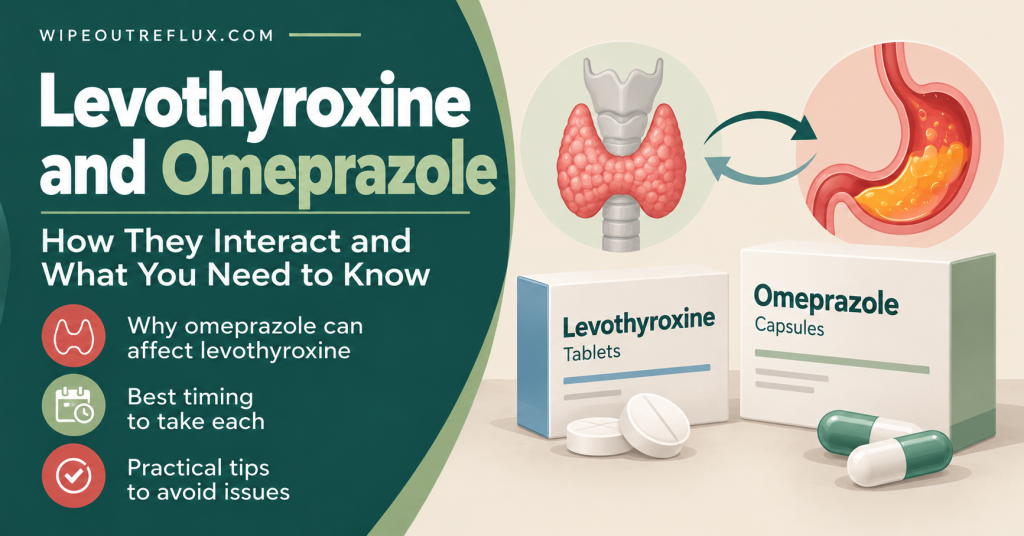
Yes, you can take levothyroxine and omeprazole together, and huge numbers of people do. But they do interact. Levothyroxine tablets need stomach acid to dissolve properly, and omeprazole switches much of that acid off. As a result, some people absorb less levothyroxine once they start a PPI, and their TSH level creeps up.
The practical answer is simple: take your levothyroxine on an empty stomach, keep the routine the same every day, and ask for a thyroid blood test about six to eight weeks after you start, stop or change the dose of omeprazole. If your levels keep drifting, a liquid or softgel form of levothyroxine is much less affected by stomach acid.
I hear about this a lot. Thyroid problems and reflux overlap heavily among my readers, and many people are never told that their acid medication can quietly change how well their thyroid medication works. This article explains why it happens and what to do about it.
This is general information, not personal medical advice. Never change your levothyroxine dose without speaking to your doctor.
Key Takeaways
- Levothyroxine and omeprazole can be taken together, but omeprazole may reduce how much levothyroxine you absorb.
- The reason is stomach acid. Levothyroxine tablets dissolve best in an acidic stomach, and PPIs raise stomach pH.
- Studies show TSH tends to rise after starting a PPI. In one small study, people needed 37% more levothyroxine while on omeprazole.
- The effect varies a lot. Most people see a small change, but around 1 in 20 see a large one.
- Stopping a PPI can have the opposite effect, so your levothyroxine dose may become too high.
- Get your TSH checked about six to eight weeks after starting, stopping or changing a PPI.
- Liquid and softgel levothyroxine are much less dependent on stomach acid and are an option if your levels won’t settle.
- Keep calcium-based antacids such as Tums, and alginates such as Gaviscon, at least four hours away from your levothyroxine.
Can You Take Levothyroxine and Omeprazole Together?
Yes. There’s no rule against taking them together, and doctors prescribe the two side by side all the time. The NHS lists medicines that reduce stomach acid, such as omeprazole, among the medicines that “may not mix well” with levothyroxine. It doesn’t mean you can’t take both. It means the combination needs a little attention.
The US prescribing information for levothyroxine says the same thing: gastric acidity is essential for adequate absorption, PPIs may reduce absorption, and patients should be monitored [Levoxyl Prescribing Information, Pfizer]. In practice, “monitor” means a blood test to check your thyroid levels after a change.
Why Omeprazole Affects Levothyroxine
This is the part that’s rarely explained, and once you understand it, the rest makes sense.
Levothyroxine is absorbed mainly in the small intestine, not the stomach. But before it can be absorbed, the tablet has to break apart and dissolve, and that happens in the stomach. Levothyroxine dissolves much better at a low, acidic pH. The European Thyroid Association’s 2025 guidelines explain that an acidic stomach allows levothyroxine tablets to break down and dissolve, which improves absorption further down the gut [Centanni et al., European Thyroid Journal, 2025].
Omeprazole works by shutting down the proton pumps that make stomach acid. That raises the pH in your stomach, which is what helps reflux. But a less acidic stomach also means the levothyroxine tablet dissolves less completely, so less of it reaches your blood.
The strongest evidence that acid matters comes from people whose stomachs naturally make less acid. In an Italian study published in the New England Journal of Medicine, people with H. pylori gastritis or atrophic gastritis (both reduce stomach acid) needed 22% to 34% more levothyroxine than people with healthy stomachs [Centanni et al., New England Journal of Medicine, 2006]. If you’ve had H. pylori, my article on H. pylori and acid reflux explains how it changes stomach acid.
What the Research Shows
Several studies have looked at what happens to thyroid levels when people on levothyroxine start a PPI:
- Omeprazole needed a 37% higher dose. In the same NEJM study, 10 people on levothyroxine who had reflux were started on omeprazole. TSH rose in all 10, and it took a 37% increase in their levothyroxine dose to bring it back to target [Centanni et al., New England Journal of Medicine, 2006].
- TSH rose after starting lansoprazole. In a US study of people with stable thyroid levels, TSH rose significantly in the two months after they started a PPI, while it stayed steady in a comparison group [Sachmechi et al., Endocrine Practice, 2007].
- A large Scottish study confirmed the effect. Looking at nearly 11,000 people on levothyroxine, starting a PPI raised TSH by a small amount on average, but 5.6% of people saw a large jump of more than 5 mU/L. Interestingly, H2 blockers such as famotidine had no effect [Irving et al., Clinical Endocrinology, 2015].
- Pantoprazole raised TSH whatever time it was taken. In a 2023 crossover study, taking pantoprazole for just six weeks raised TSH in people on levothyroxine, whether they took it in the morning or the evening [Awasthi et al., Thyroid Research, 2023].
To be fair, not every study agrees. A small study in healthy volunteers found that one week of esomeprazole didn’t change levothyroxine absorption from a single large test dose [Ananthakrishnan et al., Thyroid, 2008]. That’s quite a different situation from long-term daily use, though, and the larger real-world studies point in the same direction. Long-term PPI use carries a greater risk of needing a higher dose [Centanni et al., European Thyroid Journal, 2025].
The bottom line: for most people the change is modest, but it’s unpredictable, and for a minority it’s big enough to bring back hypothyroid symptoms. That’s why the test matters more than the averages.
Starting or Stopping a PPI: Watch Your Thyroid Levels
This is the most practical point in the whole article.
When you start omeprazole
If your levothyroxine absorption drops, your TSH rises and you may slowly drift towards being under-replaced. Symptoms can creep back over weeks: tiredness, feeling cold, weight gain, constipation, low mood, dry skin and brain fog. Because many of these overlap with how reflux makes you feel, it’s easy to miss.
When you stop or taper omeprazole
The opposite can happen. If your levothyroxine dose was increased to make up for the PPI, coming off the PPI means you absorb more again, and that dose may now be too high. Signs of over-replacement include a racing or pounding heart, anxiety, shakiness, poor sleep, sweating and weight loss. In the NEJM study, the rise in TSH caused by H. pylori largely reversed once the infection was treated, which shows how quickly absorption can bounce back once stomach acid returns [Centanni et al., New England Journal of Medicine, 2006].
If you’re planning to come off omeprazole, tell your doctor you’re on levothyroxine so they can plan a blood test. My PPI taper schedule and guide to getting off PPIs and acid rebound take you through the process.
When to get tested
Levothyroxine has a half-life of around seven days, so your levels take several weeks to settle after any change. A sensible approach is to ask for a TSH test about six to eight weeks after you:
- Start a PPI
- Stop or taper a PPI
- Change your PPI dose (for example, going from 20 mg to 40 mg)
- Switch from one PPI to another, or from a PPI to famotidine
And at any point if symptoms of under- or over-replacement appear.
How to Take Levothyroxine and Omeprazole
Here’s a routine that works for most people. Check it with your doctor or pharmacist, as your circumstances may be different.
- Take levothyroxine first, on an empty stomach, with a glass of water. The NHS advises taking it 30 to 60 minutes before breakfast, caffeinated drinks or any other medicine. The European Thyroid Association recommends either 60 minutes before breakfast or at bedtime, at least three hours after your evening meal [Centanni et al., European Thyroid Journal, 2025].
- Take omeprazole after that, typically 30 to 60 minutes before breakfast, which is when it works best. In practice, many people take levothyroxine as soon as they wake up, then omeprazole a little later, then breakfast. See the best time of day to take omeprazole.
- Alternatively, split them. Some people find it easier to take levothyroxine at bedtime and omeprazole in the morning. Spacing them doesn’t stop the PPI lowering stomach acid (its effect lasts all day), but it keeps both routines clean.
- Be consistent. Whatever routine you choose, stick to it every day. Consistency matters more than the exact timing, because your dose is adjusted to your usual routine.
- Delay coffee. Coffee can significantly cut levothyroxine absorption, so wait an hour after your tablet [Centanni et al., European Thyroid Journal, 2025]. That’s also kinder to your reflux, as I cover in is coffee bad for acid reflux.
Watch your antacids and alginates
This catches a lot of reflux sufferers out. Calcium carbonate (the main ingredient in Tums and found in some Gaviscon products) binds to levothyroxine in the gut. The prescribing information advises taking levothyroxine at least four hours apart from calcium carbonate and iron [Levoxyl Prescribing Information, Pfizer]. Aluminum and magnesium antacids can interfere too.
Alginates are one of the most useful tools for LPR, so you don’t need to give them up. Just time them carefully: after meals and at bedtime works well if you take levothyroxine first thing in the morning. If you take levothyroxine at bedtime, use your night-time alginate earlier in the evening or check timings with your pharmacist. See alginates for acid reflux and are Tums safe for acid reflux.
Liquid and Softgel Levothyroxine
If your TSH keeps drifting on a PPI despite a good routine, it’s worth asking about a different form of levothyroxine.
Standard tablets have to break down in stomach acid. Liquid levothyroxine is already dissolved, and softgel capsules contain levothyroxine dissolved in a gel that only needs its shell to melt. The European Thyroid Association notes that switching from tablets to liquid or softgel at the same dose can be considered when TSH stays above range [Centanni et al., European Thyroid Journal, 2025].
- A review found that liquid levothyroxine appears to get around the absorption problem caused by PPIs, calcium, iron, antacids and alginate [Gatta et al., Frontiers in Endocrinology, 2022].
- In people with low stomach acid, switching from tablets to softgel allowed nearly all of them to lower their dose by more than 20%, while people with normal stomach acid saw no change, suggesting softgel absorption doesn’t depend on stomach pH [Virili et al., Frontiers in Endocrinology, 2022].
- A meta-analysis found that people with poorly controlled TSH on tablets saw a significant improvement after switching to liquid at the same dose [Virili et al., Frontiers in Endocrinology, 2018].
Availability and cost vary. In the UK, liquid levothyroxine is available on prescription, and in the US, softgel capsules (Tirosint) and liquid forms are available, though often at a higher cost than generic tablets. Never switch forms without your doctor. The dose can need adjusting and your levels will need checking.
Is Famotidine a Better Option?
If you only need occasional or milder acid control, an H2 blocker such as famotidine may interfere less. In the large Scottish study, starting an H2 blocker had no effect on TSH, unlike PPIs [Irving et al., Clinical Endocrinology, 2015]. Famotidine is a weaker acid reducer, so it isn’t a like-for-like swap for everyone, and the evidence is limited. But it’s worth discussing with your doctor. See famotidine vs omeprazole for the trade-offs.
Newer acid blockers such as vonoprazan suppress acid even more strongly. They haven’t been studied with levothyroxine, but given the mechanism, I’d assume a similar or bigger effect and get tested after starting one.
The Bigger Picture: Thyroid, Reflux and PPIs
The levothyroxine interaction is one more reason to make sure a PPI is genuinely earning its place. Long-term PPI use can also lower your absorption of nutrients that matter for thyroid health and energy, including iron, vitamin B12 and magnesium. My article on what nutrients PPIs deplete covers the details, and iron deficiency in particular can make fatigue worse in people with hypothyroidism.
There’s also a two-way link between an underactive thyroid and reflux itself. Low thyroid hormone may slow down gut movement and the muscles of the esophagus, which can make reflux worse. I explain this in thyroid problems and acid reflux. So keeping your thyroid levels well controlled can help your reflux, and that’s another reason not to let a PPI quietly push your TSH up.
And if you have LPR (silent reflux) rather than classic heartburn, it’s worth knowing that PPIs often don’t work as well for throat symptoms, because the problem there is pepsin as much as acid. See why PPIs don’t work for LPR.
Conclusion
Levothyroxine and omeprazole can be taken together, but they’re not completely independent. Omeprazole lowers stomach acid, levothyroxine tablets need that acid to dissolve, and so starting, stopping or changing a PPI can shift your thyroid levels. The fix is straightforward: take levothyroxine on an empty stomach in a consistent routine, keep antacids and alginates four hours away from it, get a TSH test six to eight weeks after any PPI change, and ask about liquid or softgel levothyroxine if your levels won’t settle.
The other side of the equation is reducing how much acid suppression you need in the first place, and for many people that comes down to diet. The Wipeout Diet Plan is the most complete way I know to do that. It’s my step-by-step plan for calming reflux through what you eat and drink, which is the foundation if you’re hoping to rely less on acid medication, with your doctor’s guidance. It was built with LPR in mind, the stubborn throat-based kind, but because it targets the same underlying triggers, it works just as well for everyday heartburn and GERD.
If you’d like a lighter place to start, the Wipeout Food Reference Guide is the essential companion. It lists the foods and drinks that are safe for acid reflux and LPR along with their pH values, so you can make better choices at every meal.
Frequently Asked Questions
Is there an interaction between levothyroxine and omeprazole?
Yes, a moderate one. Omeprazole reduces stomach acid, which levothyroxine tablets need to dissolve properly. This can lower absorption and raise your TSH. It’s usually managed with a blood test and, if needed, a dose adjustment.
How far apart should I take levothyroxine and omeprazole?
Take levothyroxine first on an empty stomach, then omeprazole, then breakfast 30 to 60 minutes later. Spacing them doesn’t fully prevent the interaction, because omeprazole lowers acid all day, so a consistent routine and a TSH check matter more than the exact gap.
Can I take levothyroxine and omeprazole at the same time?
Many people do, and it’s generally acceptable. The NHS advises taking levothyroxine 30 to 60 minutes before other medicines, so taking omeprazole a little later is the tidier option. Talk to your pharmacist if you’re unsure.
Does omeprazole make levothyroxine less effective?
It can. Studies show TSH tends to rise after starting a PPI, and some people need a higher levothyroxine dose. The effect is small for most people but large for a minority, so get tested six to eight weeks after starting.
Should I take levothyroxine at night if I’m on omeprazole?
Bedtime dosing is a reasonable option as long as it’s at least three hours after your last meal. It won’t cancel out the PPI’s effect on stomach acid, but it can make your morning routine simpler. Talk to your doctor before switching, and get a TSH check afterwards.
Is liquid levothyroxine better if I take a PPI?
It can be. Liquid and softgel forms don’t need stomach acid to dissolve, so they’re much less affected by PPIs. They’re usually reserved for people whose TSH won’t stay in range on tablets, and they may cost more.
Do other PPIs like pantoprazole and lansoprazole affect levothyroxine?
Yes. The effect comes from lowering stomach acid, which all PPIs do. Studies have shown TSH rises with omeprazole, lansoprazole and pantoprazole, so the same advice applies to any PPI.
Research & References
- [Centanni et al., European Thyroid Journal, 2025] — European Thyroid Association guidelines on levothyroxine, explaining that an acidic stomach is needed for tablets to dissolve, that PPI users may need higher doses (especially long term), recommending dosing 60 minutes before breakfast or at bedtime, and supporting a switch to liquid or softgel when TSH stays high.
- [Centanni et al., New England Journal of Medicine, 2006] — People with reduced stomach acid from H. pylori or atrophic gastritis needed 22% to 34% more levothyroxine; omeprazole raised TSH in all 10 treated patients, reversed by a 37% dose increase.
- [Sachmechi et al., Endocrine Practice, 2007] — Retrospective study showing TSH rose significantly in patients on stable levothyroxine after starting lansoprazole, but not in controls.
- [Irving et al., Clinical Endocrinology, 2015] — Population study of nearly 11,000 levothyroxine users in Scotland; starting a PPI raised TSH, with 5.6% seeing a rise of over 5 mU/L, while H2 receptor antagonists had no effect.
- [Awasthi et al., Thyroid Research, 2023] — Crossover study showing six weeks of pantoprazole significantly raised TSH in levothyroxine-treated patients regardless of whether it was taken in the morning or evening.
- [Ananthakrishnan et al., Thyroid, 2008] — In 30 healthy volunteers, one week of famotidine or esomeprazole did not change absorption of a single large levothyroxine test dose.
- [Gatta et al., Frontiers in Endocrinology, 2022] — Review concluding that liquid levothyroxine circumvents absorption problems caused by PPIs, calcium, iron, antacids and sodium alginate.
- [Virili et al., Frontiers in Endocrinology, 2022] — In 28 hypothyroid patients, switching to softgel levothyroxine allowed a dose reduction of over 20% in nearly all patients with low stomach acid but not in those with normal acid, showing softgel absorption is independent of gastric pH.
- [Virili et al., Frontiers in Endocrinology, 2018] — Meta-analysis of six studies showing patients with suboptimal TSH on tablets had significantly improved TSH after switching to liquid levothyroxine at the same dose.
- [Levoxyl Prescribing Information, Pfizer] — US prescribing information stating that gastric acidity is essential for levothyroxine absorption, that PPIs and antacids may reduce it, and that levothyroxine should be taken at least four hours apart from calcium carbonate and iron.

David Gray
12 years living with LPR · Consultant & researcher
I've lived with LPR for twelve years — the misdiagnoses, the PPI courses that did nothing, the slow work of figuring out what actually helps. Wipeout Reflux is where I translate the research into plain terms for people stuck in the same place. Every claim here is sourced to peer-reviewed work, and I consult one-to-one with LPR sufferers.