
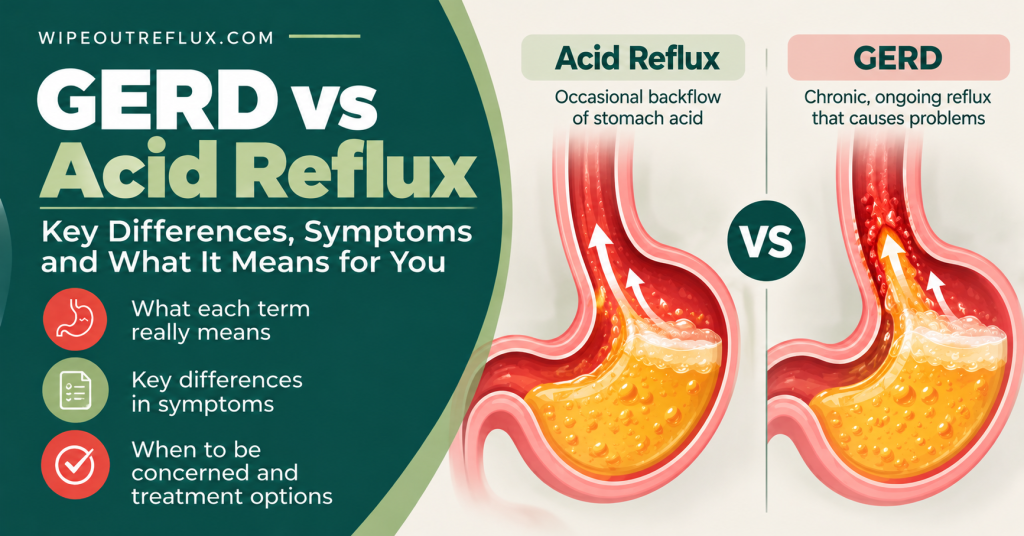
Acid reflux is the event: stomach contents flowing back up into the esophagus. Almost everyone has it now and then, usually after a big or late meal, and it often causes heartburn. GERD (gastroesophageal reflux disease) is what doctors call it when that reflux happens often enough, or does enough damage, to become a chronic problem.
The simplest way to put it: all GERD involves acid reflux, but not all acid reflux is GERD. Occasional heartburn after a curry is acid reflux. Heartburn or regurgitation two or more times a week, symptoms that disrupt your sleep or your day, or reflux that has inflamed the esophagus, is GERD.
Heartburn is different again. It isn’t a disease at all, it’s a symptom: the burning feeling behind the breastbone that reflux often causes. You can have heartburn without GERD, and you can have GERD (or its throat-based cousin, silent reflux) with little or no heartburn.
Key Takeaways
- Acid reflux is the backflow of stomach contents into the esophagus. It’s normal in small amounts and happens to most people occasionally.
- GERD is chronic, troublesome reflux. A common rule of thumb is reflux symptoms at least twice a week, or reflux that has caused damage such as esophagitis.
- Heartburn is a symptom, not a condition. It’s the burning chest sensation that reflux can cause.
- Roughly 1 in 5 adults in North America has GERD, so it’s very common.
- GERD symptoms and acid reflux symptoms are the same; what separates them is how often, how severe and how long they go on.
- You don’t need damage on a scope to have GERD. Most people with GERD have a normal-looking esophagus.
- Silent reflux (LPR) is reflux that reaches the throat, often without heartburn, and is easily missed.
- Occasional reflux usually responds to simple habit changes; GERD usually needs a more structured plan.
What Is Acid Reflux?
At the bottom of your esophagus sits a ring of muscle called the lower esophageal sphincter (LES). It’s meant to open to let food into your stomach and then close tightly so stomach contents stay where they belong. Acid reflux happens when that valve relaxes or opens at the wrong time and some of what’s in your stomach (acid, the digestive enzyme pepsin, and sometimes bile) washes back up.
Some reflux is completely normal. Everyone has brief reflux episodes each day, especially after eating, and most go unnoticed because the esophagus clears them quickly with gravity, swallowing and saliva. It’s only when the amount, frequency or sensitivity crosses a threshold that people start to feel it. I explain how this valve works in more depth in my guide to the lower esophageal sphincter and acid reflux.
Common triggers for an occasional bout include large meals, eating close to bedtime, alcohol, fatty or fried food, chocolate, coffee and lying down soon after eating. If it happens once or twice a month after an obvious trigger, that’s acid reflux, not a disease.
What Is GERD?
GERD is acid reflux that has become a chronic condition. The international definition most gastroenterologists use, known as the Montreal definition, describes GERD as a condition that develops when reflux of stomach contents causes troublesome symptoms and/or complications [Vakil et al., American Journal of Gastroenterology, 2006].
Two parts of that definition matter:
- “Troublesome” is defined by you, the patient, not by a scope. If reflux is affecting how you eat, sleep or feel, it counts.
- “Complications” covers damage such as esophagitis (inflammation of the esophagus), strictures and Barrett’s esophagus.
The same consensus also recognized that GERD isn’t only a chest problem. It includes “extraesophageal” syndromes such as chronic cough, laryngitis, asthma and dental erosion [Vakil et al., American Journal of Gastroenterology, 2006]. That’s why people with a hoarse voice or a nagging cough are sometimes told they have reflux even though they’ve never had heartburn.
In population studies, GERD is usually defined as heartburn and/or regurgitation on at least one day a week. By that measure it affects about 10 to 20% of adults in the Western world [Dent et al., Gut, 2005], and an updated review put North American prevalence at 18 to 28% [El-Serag et al., Gut, 2014]. In other words, if you have it, you’re in very large company.
GERD vs Acid Reflux: The Key Differences
The symptoms of acid reflux and GERD are identical. A burning chest feels the same whether it’s your first episode this year or your fourth this week. What separates them is the pattern.
- Frequency. Acid reflux is occasional. GERD is regular, typically twice a week or more.
- Duration. Acid reflux comes and goes with obvious triggers. GERD persists for weeks, months or years.
- Impact. Acid reflux is a nuisance. GERD affects sleep, eating, work or quality of life.
- Damage. Occasional reflux rarely harms the esophagus. GERD can cause inflammation and, over time, complications.
- Treatment. Acid reflux usually settles with an antacid and avoiding the trigger. GERD usually needs consistent diet and lifestyle changes, and often medication.
If you’re not sure where you sit, my free Do I Have GERD? quiz takes about a minute and gives you a sense of whether your pattern sounds more like occasional reflux or ongoing GERD.
Heartburn vs GERD: Where Heartburn Fits In
This is where most of the confusion comes from, because the three terms get used interchangeably in adverts and on medicine boxes.
Heartburn is a symptom. It’s a burning feeling behind the breastbone, often rising toward the throat, that usually comes on after eating or when lying down. It has nothing to do with the heart, despite the name. Acid reflux is the most common cause of heartburn, and GERD is the condition where that reflux-driven heartburn keeps coming back.
So the relationship looks like this:
- Heartburn = the sensation
- Acid reflux = the event that usually causes the sensation
- GERD = the chronic condition where reflux keeps happening and causes ongoing trouble
Two twists are worth knowing. First, not everyone with GERD gets heartburn. Some people mainly regurgitate sour fluid, some mainly cough, and some feel it in their throat instead. Second, not all heartburn comes from reflux. When people have heartburn but testing shows normal acid levels and no link between reflux episodes and symptoms, doctors call it functional heartburn, which is thought to come from an oversensitive esophagus rather than excess reflux [Aziz et al., Gastroenterology, 2016].
Because chest burning can occasionally be cardiac, it’s worth reading my guide on heartburn or heart attack so you know the warning signs that mean getting help straight away.
GERD vs Acid Reflux Symptoms
Because the symptoms overlap completely, it helps to look at the full list and then ask how often you’re getting them.
Classic symptoms
- Heartburn: burning behind the breastbone, often after meals or at night
- Regurgitation: sour or bitter fluid coming up into the throat or mouth
- A sour or acid taste, especially in the morning
- Chest discomfort after eating
Less obvious symptoms
- Burping and bloating
- Nausea, especially in the morning
- Difficulty swallowing or a sensation of food sticking
- Waking at night coughing or choking
- Upper stomach discomfort that’s easily confused with indigestion. See indigestion vs acid reflux
Throat and airway symptoms
- Constant throat clearing
- Hoarseness or a voice that tires easily
- A lump-in-the-throat feeling
- Chronic cough
- Excess mucus or post-nasal drip
Have one or two classic symptoms after an obvious trigger a few times a month? That’s typical acid reflux. Symptoms most weeks, symptoms that wake you up, or a mix of chest and throat symptoms that never quite go away? That pattern points toward GERD.
Do You Need an Endoscopy to Have GERD?
No. This surprises a lot of people who are told their scope was “normal” and assume that means they don’t have reflux disease.
Most people with GERD have no visible damage at all. This is called non-erosive reflux disease (NERD). Only a minority have erosive esophagitis, where the lining is visibly inflamed or broken, and doctors grade that damage from A (mild) to D (severe) using the Los Angeles classification [Lundell et al., Gut, 1999].
A large Swedish study that scoped a random sample of ordinary adults found reflux symptoms in 40% and erosive esophagitis in 15.5%. Strikingly, more than a third of the people with esophagitis had no reflux symptoms at all [Ronkainen et al., Scandinavian Journal of Gastroenterology, 2005]. Symptoms and damage don’t always line up.
When the picture is unclear, gastroenterologists use pH or pH-impedance monitoring to measure how much acid actually reaches the esophagus. Under the latest Lyon Consensus, acid exposure below 4% of the day rules GERD out, and above 6% confirms it [Gyawali et al., Gut, 2024]. I cover the full testing pathway in how acid reflux is diagnosed, and what the scope involves in endoscopy for acid reflux.
Where Silent Reflux (LPR) Fits In
There’s a third term you’ll see on this site a lot: LPR, or laryngopharyngeal reflux, often called silent reflux. It’s reflux that travels all the way up into the throat and voice box.
The throat has far less protection than the esophagus, so small amounts of reflux that the esophagus would shrug off can irritate it. In the study that first defined the condition, most patients had throat and voice symptoms and many never experienced heartburn [Koufman, The Laryngoscope, 1991]. That’s why it’s called “silent”: the chest stays quiet while the throat takes the hit.
The main culprit in the throat is pepsin, the stomach’s protein-digesting enzyme. It can lodge in throat tissue and reactivate whenever something acidic arrives, including acidic food and drink, which is why diet matters so much for LPR. If your symptoms are mostly in your throat, my comparison of GERD vs LPR and my full list of LPR symptoms are the places to start.
Why the Difference Matters
The label isn’t just semantics. It changes what you should do.
Occasional acid reflux is usually best handled by spotting your triggers and using an antacid or alginate when it flares. There’s no need for daily medication.
GERD deserves a proper plan, for two reasons. First, untreated chronic reflux can inflame the esophagus and, in a small number of people, lead to complications such as strictures or Barrett’s esophagus. The absolute risk of cancer from Barrett’s is low, around 0.12% a year in a large Danish study [Hvid-Jensen et al., New England Journal of Medicine, 2011], but it’s a reason not to ignore years of symptoms. Second, GERD rarely fixes itself without changes. My guide on whether acid reflux can cause cancer puts the real risk in perspective without the scare stories.
How Treatment Differs
For occasional acid reflux
- Identify and avoid the meals or drinks that set it off
- Don’t lie down for 2 to 3 hours after eating
- Use an antacid or an alginate such as Gaviscon Advance when it flares. See alginates for acid reflux
- An occasional H2 blocker such as famotidine before a known trigger meal can help
For GERD
Lifestyle change is the foundation. A systematic review found the strongest evidence for weight loss (if you’re carrying extra weight), stopping smoking, avoiding late evening meals and raising the head of the bed for night-time symptoms [Ness-Jensen et al., Clinical Gastroenterology and Hepatology, 2016]. An earlier evidence review reached a similar conclusion, and found that blanket food bans were less well supported than identifying your own triggers [Kaltenbach et al., Archives of Internal Medicine, 2006].
That’s exactly why I think a structured, personalized diet works better than a generic “avoid spicy food” list. My Wipeout Diet Plan takes you through a calming phase and then a careful reintroduction so you find your own triggers instead of cutting out everything forever.
Medication also has its place. US guidelines recommend an 8-week course of a proton pump inhibitor (PPI) for typical GERD symptoms, taken 30 to 60 minutes before a meal, and then stepping down to the lowest effective dose [Katz et al., American Journal of Gastroenterology, 2022]. If you’re already on a PPI and want to come off, read getting off PPIs and acid rebound first, because stopping suddenly often triggers a temporary flare.
For a full overview of every treatment option, my ultimate guide to acid reflux pulls it all together.
When to See a Doctor
Occasional reflux doesn’t need a doctor. Book an appointment if:
- You have reflux symptoms twice a week or more for several weeks
- Over-the-counter remedies aren’t controlling it, or you’ve needed them for more than two weeks at a time
- Symptoms wake you at night regularly
- You have persistent hoarseness, cough or throat symptoms
- You’re over 50 and have had reflux for years without ever being assessed
Get seen promptly if you have difficulty swallowing that’s getting worse, food sticking, unintentional weight loss, vomiting blood or black stools. And seek emergency help for chest pain with breathlessness, sweating, or pain spreading to the arm, jaw or back.
Conclusion
The difference between GERD and acid reflux comes down to pattern. Acid reflux is the event, and almost everyone has it occasionally. GERD is when that event keeps happening, causes troublesome symptoms, or starts to damage the esophagus. Heartburn is simply the most common symptom of both. Once you know which one you’re dealing with, it’s much easier to choose the right response: trigger-spotting and the odd antacid for occasional reflux, or a proper, consistent plan for GERD.
If your reflux has crossed into GERD territory, the Wipeout Diet Plan is where I’d point you first. It’s the complete, step-by-step approach I built from twelve years of managing reflux myself: what to eat, what to drink, when to eat it, and how to reintroduce foods so you find your own triggers. I originally designed it around silent reflux, the stubborn throat-based form, but because it targets the same root causes it works just as well for classic GERD and everyday heartburn.
Frequently Asked Questions
Is GERD the same as acid reflux?
Not quite. Acid reflux is stomach contents flowing back into the esophagus, which happens to most people occasionally. GERD is the chronic condition where that reflux happens often (usually twice a week or more), causes troublesome symptoms, or damages the esophagus.
What’s the difference between heartburn and GERD?
Heartburn is a symptom: a burning feeling behind the breastbone. GERD is a disease. Heartburn is the most common symptom of GERD, but you can have occasional heartburn without GERD, and some people with GERD have little or no heartburn.
How often do you need reflux to have GERD?
A common rule of thumb is symptoms at least twice a week, or once a week if they’re moderate to severe. But the official definition is based on symptoms being “troublesome” to you, so even less frequent reflux can count if it’s significantly affecting your life or has caused damage.
Can acid reflux turn into GERD?
Yes. Occasional reflux can become more frequent over time, often with weight gain, pregnancy, a hiatal hernia, aging, smoking or changes in eating habits. Catching it early and adjusting your diet and routine can stop it progressing.
Can you have GERD without heartburn?
Yes. Some people mainly experience regurgitation, nausea, chest discomfort, cough or throat symptoms. When reflux mainly affects the throat and voice box with little heartburn, it’s often called silent reflux or LPR.
Is GERD worse than acid reflux?
GERD is more significant because it’s ongoing. Occasional acid reflux rarely causes lasting harm, while years of untreated GERD can inflame the esophagus and, in a small number of people, lead to complications. The good news is that GERD usually responds well to consistent diet and lifestyle changes.
Do I need medication for GERD?
Not always. Many people control GERD with diet, meal timing, weight management and sleeping position, sometimes with an alginate after meals. PPIs are effective for healing esophagitis and controlling heavy acid reflux, but they work best alongside lifestyle changes rather than instead of them.
Research & References
- [Vakil et al., American Journal of Gastroenterology, 2006] — The Montreal global consensus defining GERD as reflux of stomach contents causing troublesome symptoms and/or complications, independent of endoscopic findings, and recognizing laryngitis, cough, asthma and dental erosion as possible GERD syndromes.
- [Dent et al., Gut, 2005] — Systematic review estimating GERD prevalence (at least weekly heartburn and/or regurgitation) at around 10–20% in the Western world and under 5% in Asia.
- [El-Serag et al., Gut, 2014] — Updated systematic review reporting GERD prevalence of 18.1–27.8% in North America and 8.8–25.9% in Europe, with evidence of rising prevalence since 1995.
- [Aziz et al., Gastroenterology, 2016] — Rome IV review of functional esophageal disorders, including functional heartburn, describing esophageal symptoms not explained by reflux disease and driven largely by visceral hypersensitivity and hypervigilance.
- [Lundell et al., Gut, 1999] — Validation of the Los Angeles classification for grading reflux esophagitis, showing grade correlated with acid exposure, heartburn severity and treatment response.
- [Ronkainen et al., Scandinavian Journal of Gastroenterology, 2005] — Population-based endoscopic study (Kalixanda) finding reflux symptoms in 40% of adults and erosive esophagitis in 15.5%, with 36.8% of those with esophagitis reporting no reflux symptoms.
- [Gyawali et al., Gut, 2024] — Lyon Consensus 2.0: esophageal acid exposure time below 4% excludes GERD, while above 6% on at least two days is diagnostic.
- [Koufman, The Laryngoscope, 1991] — Landmark study of 225 ear, nose and throat patients using 24-hour pH monitoring that established reflux as a common cause of laryngeal and voice disorders, often without heartburn.
- [Hvid-Jensen et al., New England Journal of Medicine, 2011] — Danish nationwide cohort of more than 11,000 Barrett’s patients showing an annual adenocarcinoma risk of 0.12%, about 11 times the general population risk but low in absolute terms.
- [Ness-Jensen et al., Clinical Gastroenterology and Hepatology, 2016] — Systematic review finding weight loss, smoking cessation, avoiding late evening meals and head-of-bed elevation were the lifestyle measures with the best evidence in GERD.
- [Kaltenbach et al., Archives of Internal Medicine, 2006] — Evidence-based review finding good support for weight loss and head-of-bed elevation in GERD, but little evidence that blanket dietary restrictions improve outcomes, supporting individualized trigger identification.
- [Katz et al., American Journal of Gastroenterology, 2022] — ACG clinical guideline for GERD, covering an 8-week PPI trial taken before meals, step-down to the lowest effective dose and management of persistent symptoms.

David Gray
12 years living with LPR · Consultant & researcher
I've lived with LPR for twelve years — the misdiagnoses, the PPI courses that did nothing, the slow work of figuring out what actually helps. Wipeout Reflux is where I translate the research into plain terms for people stuck in the same place. Every claim here is sourced to peer-reviewed work, and I consult one-to-one with LPR sufferers.