
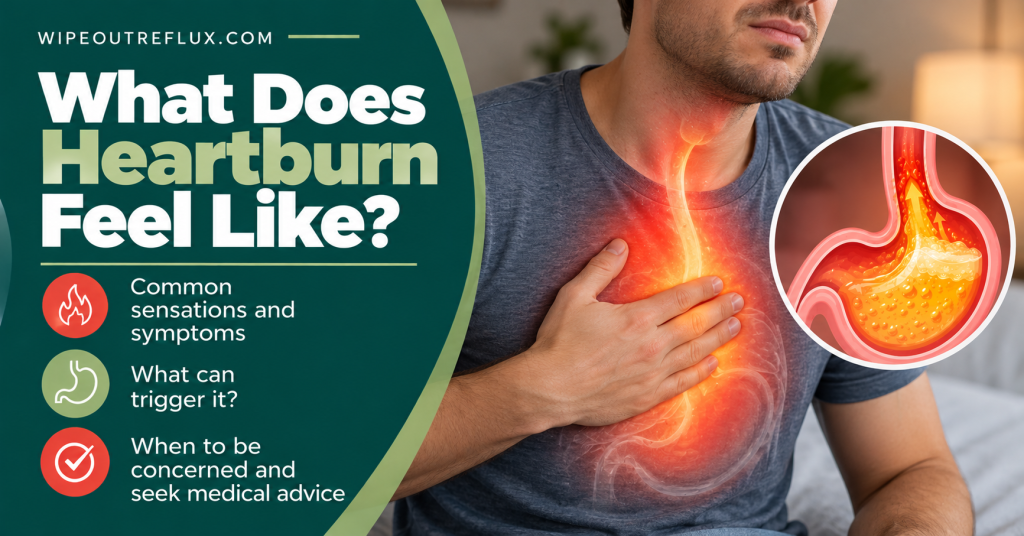
Heartburn feels like a burning or hot sensation behind your breastbone, usually in the middle of your chest. It often starts low, just above the top of your stomach, and can rise up toward your throat. Many people describe it as a fire, an acidic heat or a raw, scalded feeling in the chest.
It typically comes on within an hour of eating, especially after a large, rich or late meal, and it often gets worse when you lie down or bend over. It can last a few minutes or several hours, and it’s often accompanied by a sour or bitter taste in the mouth, burping or a feeling of food or fluid coming back up.
Despite the name, heartburn has nothing to do with your heart. It’s caused by stomach contents flowing back up into the esophagus, the tube that connects your mouth and stomach. That said, heart pain can occasionally feel similar, so it’s important to know the differences, which I cover below.
Key Takeaways
- Heartburn is a burning sensation behind the breastbone that can rise toward the throat.
- It usually starts after meals, at night, or when lying down or bending over.
- It often comes with a sour taste, burping, regurgitation or a hot feeling in the throat.
- Episodes can last from a few minutes to a few hours.
- Some people feel it more as pressure, tightness or an ache than as burning.
- Heartburn usually eases with an antacid or alginate, or by sitting upright.
- Chest pain with breathlessness, sweating, nausea or pain spreading to the arm, jaw or back needs urgent medical help.
- Heartburn more than twice a week may be a sign of GERD and is worth addressing properly.
What Heartburn Feels Like, in Detail
The international definition doctors use describes heartburn as a burning sensation in the retrosternal area, meaning behind the breastbone [Vakil et al., American Journal of Gastroenterology, 2006]. In everyday language, people describe it in lots of different ways:
- “A fire in my chest”
- “Hot acid creeping up my throat”
- “Like I’ve swallowed something scalding”
- “A raw, sore feeling behind my breastbone”
- “Indigestion, but burning”
- “Pressure that turns into burning when I lie down”
Where you feel it
Most people feel heartburn in the center of the chest, behind the breastbone. It can start just below the ribs, in the upper stomach area, and travel upward. In stronger episodes it can reach the base of the throat, and some people feel it between the shoulder blades too.
How it moves
A distinctive feature of heartburn is that it tends to rise. It often begins as warmth low in the chest and moves upward in waves. That upward movement follows the path of refluxed stomach contents traveling up the esophagus.
How long it lasts
A typical episode lasts anywhere from a few minutes to a couple of hours. It often eases as your stomach empties, when you sit upright, or after an antacid. After a very large or late meal, it can linger for much of the evening or wake you up during the night. For more on timing, see how long acid reflux lasts.
What usually comes with it
- A sour or bitter taste at the back of the mouth
- Regurgitation: fluid or food coming back up into the throat or mouth
- Water brash: a sudden rush of salty saliva. See water brash and regurgitation
- Burping and bloating. More in acid reflux and burping
- A hot or sore throat, especially in the morning
- A cough or hoarse voice after an episode
What Does Acid Reflux Feel Like?
Heartburn is the most familiar feeling of acid reflux, but it’s not the only one. Reflux simply means stomach contents moving back up into the esophagus, and depending on how high they travel and how sensitive you are, it can feel quite different from person to person.
- In the chest: burning, warmth, pressure or a dull ache behind the breastbone
- In the throat: a burning or raw throat, a lump sensation, constant throat clearing or a sour taste
- In the upper stomach: fullness, gnawing or burning just below the ribs
- In the mouth: acid or bile taste, extra saliva, or bad breath
- As a cough: particularly after meals or when lying down
Some people with reflux get very little heartburn at all. When reflux reaches the throat and voice box, it often causes throat symptoms instead of chest burning. In the study that first defined this “silent” form, most patients had throat and voice symptoms while only a minority reported heartburn [Koufman, The Laryngoscope, 1991]. If your symptoms are mainly in your throat, see my full list of LPR symptoms.
Why Heartburn Burns: The Mechanism
Your stomach is built to handle acid. It has a thick protective layer of mucus and bicarbonate. The esophagus doesn’t have that protection. Its lining is closer to the skin inside your mouth, and it’s packed with nerve endings that sense chemical irritation.
Normally a ring of muscle at the bottom of the esophagus, the lower esophageal sphincter, stays closed except when you swallow. When it relaxes at the wrong time, acid and the digestive enzyme pepsin wash up into the esophagus. The sensory nerves in the lining detect the acid and send a burning signal, and because the esophagus runs right behind your breastbone, your brain registers it as chest pain. More on this valve in the lower esophageal sphincter and acid reflux.
Interestingly, how much you feel doesn’t always match how much reflux you have. Some people have plenty of reflux and hardly feel it. In a Swedish population study, more than a third of people with visible esophageal inflammation had no reflux symptoms at all [Ronkainen et al., Scandinavian Journal of Gastroenterology, 2005]. Others feel intense burning with normal amounts of acid, because their esophagus is oversensitive. When testing shows normal reflux levels with no link between reflux and symptoms, doctors call this functional heartburn [Aziz et al., Gastroenterology, 2016].
When Heartburn Usually Strikes
After meals
Heartburn is most common in the first hour or two after eating. A full stomach pushes upward on the sphincter, and fatty or large meals keep the stomach full for longer. Some foods and drinks also relax the sphincter or irritate the esophagus directly, and in a study of nearly 400 people, more acidic foods and drinks were linked to more reported heartburn [Feldman & Barnett, Gastroenterology, 1995]. Coffee is a classic trigger: regular coffee caused significantly more reflux than water in one study, while tea did not [Wendl et al., Alimentary Pharmacology & Therapeutics, 1994].
At night
Night-time heartburn is extremely common. In a study of more than 15,000 adults, a quarter reported heartburn during sleep [Fass et al., Chest, 2005]. Lying flat removes gravity’s help, and you swallow far less while asleep, so acid stays in the esophagus longer [Orr et al., Digestive Diseases and Sciences, 1981]. Eating late makes it much worse: going to bed within three hours of dinner was linked to markedly higher odds of reflux [Fujiwara et al., American Journal of Gastroenterology, 2005]. If this is your pattern, read acid reflux at night.
When bending or lifting
Bending over, lifting something heavy or wearing tight waistbands squeezes the stomach and can push contents up. Heartburn that appears when you tie your shoes or garden after a meal is very typical.
On an empty stomach
Heartburn can happen even when you haven’t eaten, which confuses many people. I explain why in why do I get heartburn when I haven’t eaten.
Heartburn vs Heart Attack: How to Tell the Difference
This is the most important section of this article. Heartburn and heart pain can overlap, and heart pain doesn’t always feel the way people expect. US cardiology guidelines note that heart-related chest pain may be felt as pressure, tightness, squeezing, heaviness or burning, and can spread to the shoulders, arms, neck or jaw [Gulati et al., Journal of the American College of Cardiology, 2021].
Heartburn is more likely if:
- It’s a burning feeling that rises from the upper stomach toward the throat
- It started after eating, lying down or bending over
- You have a sour taste, burping or regurgitation
- It eases with an antacid, alginate or sitting upright
- It follows a familiar pattern you’ve had before
Call emergency services straight away if:
- You have chest pain, pressure or tightness with shortness of breath, sweating, nausea, lightheadedness or a sense of doom
- The pain spreads to your arm, shoulder, neck, jaw or back
- It comes on with exertion and eases with rest
- It feels different from your usual heartburn, or you’re not sure
When in doubt, get checked. It’s always better to have a heart problem ruled out than to assume. I go through this in much more depth in heartburn or heart attack.
Heartburn That Doesn’t Feel Like Burning
Not everyone experiences heartburn as a classic burn. Reflux is the most common esophageal cause of chest pain that turns out not to be heart-related, a problem that affects around a quarter of people at some point [Fass and Achem, Journal of Neurogastroenterology and Motility, 2011]. That kind of reflux chest pain can feel like:
- A squeezing or tight band across the chest. See acid reflux chest tightness
- A dull ache or heaviness behind the breastbone
- A sharp, stabbing pain that comes and goes
- Pain that feels like food is stuck in the chest
Because these overlap with heart symptoms, chest pain that isn’t clearly heartburn should always be assessed by a doctor first. Once the heart has been checked, reflux is a very common explanation. If your chest discomfort is mostly linked to eating, my guide to chest pain after eating covers the other causes too.
Other Conditions That Can Feel Like Heartburn
- Indigestion (dyspepsia): more of a fullness, gnawing or discomfort in the upper stomach than a rising burn. See indigestion vs acid reflux
- Stomach ulcers: a gnawing or burning pain in the upper stomach, sometimes eased by food. See stomach ulcer or acid reflux
- Gastritis: burning or aching in the upper stomach with nausea
- Esophageal spasm: sudden, intense squeezing chest pain, often with swallowing. See esophageal spasm vs acid reflux
- Gallbladder pain: usually in the upper right abdomen, often after fatty meals, sometimes spreading to the right shoulder
- Heart problems: as above, always rule these out first if in doubt
How to Relieve Heartburn Fast
- Sit or stand upright. Let gravity help keep stomach contents down.
- Take an alginate or antacid. Antacids neutralize acid quickly. Alginates such as Gaviscon Advance go a step further and form a raft that sits on top of the stomach contents, and one study found an alginate raft displaced the acid pocket away from the esophagus in 71% of GERD patients, compared with 21% on an antacid alone [Rohof et al., Clinical Gastroenterology and Hepatology, 2013]. See Tums vs Gaviscon.
- Loosen tight clothing around your waist.
- Sip some water to help wash acid back down.
- Avoid lying flat. If it’s bedtime, raise your head and upper body, and try lying on your left side, which has been linked to less acid exposure than lying on your back or right side [Schuitenmaker et al., American Journal of Gastroenterology, 2022].
For a full rundown of the options, see the best over-the-counter medicine for acid reflux.
How to Stop Heartburn Coming Back
Quick fixes help in the moment, but if you get heartburn regularly, it’s worth working on the cause. The changes with the best track record are:
- Finish eating at least three hours before bed. See how long before bed you should stop eating
- Eat smaller meals rather than one big one
- Raise the head of your bed if you get night-time heartburn
- Work out your personal trigger foods instead of following generic lists
- Cut back on alcohol and stop smoking
- Lose weight if you’re carrying extra around your middle
The trigger-food piece is where most people get stuck, because the usual lists are long and contradictory. That’s why I built my Wipeout Diet Plan around a short calming phase followed by careful reintroduction, so you end up knowing exactly which foods set you off.
When to See a Doctor About Heartburn
Occasional heartburn after an obvious trigger is very common and doesn’t need a doctor. Make an appointment if:
- You have heartburn more than twice a week
- You’ve needed antacids or over-the-counter medicine for more than two weeks
- Your symptoms are getting worse or changing
- Heartburn regularly wakes you at night
- You’re over 50 and have had heartburn for years without being assessed
See a doctor promptly if you have difficulty or pain when swallowing, food sticking, unexplained weight loss, vomiting, vomiting blood, or black, tarry stools. And as above, get emergency help for any chest pain that could be your heart.
Conclusion
Heartburn feels like a burning, rising heat behind the breastbone, usually after meals, at night or when you bend over, and often with a sour taste or burping. It’s caused by stomach contents washing back into the esophagus, not by your heart. But because heart pain can sometimes feel similar, any chest pain with breathlessness, sweating, or pain spreading to your arm or jaw needs urgent attention. Once you know what your heartburn feels like and what sets it off, it becomes far easier to control.
If heartburn has become a regular part of your life, the Wipeout Diet Plan is the most complete way I know to get on top of it. It walks you through what to eat, what to drink, when to eat and how to find your personal triggers, based on twelve years of managing reflux myself. I originally designed it around silent reflux, the throat-based kind, but because it tackles the same root causes, it works equally well for classic heartburn and GERD.
Frequently Asked Questions
What does heartburn feel like?
Heartburn feels like a burning or hot sensation behind the breastbone that often rises toward the throat. It usually comes on after eating or when lying down, and it can come with a sour taste, burping or fluid coming back up.
Where do you feel heartburn?
Most people feel it in the center of the chest, behind the breastbone. It can start in the upper stomach just below the ribs and move upward toward the throat, and some people also feel it between the shoulder blades.
How long does heartburn last?
Usually from a few minutes to a couple of hours. It often eases as the stomach empties, when you sit upright or after an antacid. After a large or late meal it can last longer or come back during the night.
Can heartburn feel like pressure instead of burning?
Yes. Some people feel reflux as pressure, tightness or a dull ache in the chest rather than burning. Because heart pain can feel this way too, new or unexplained chest pressure should always be checked by a doctor first.
How do I know if it’s heartburn or my heart?
Heartburn usually burns, rises toward the throat, follows meals or lying down, and eases with antacids. Heart pain is more likely with exertion, breathlessness, sweating, nausea, or pain spreading to the arm, neck, jaw or back. If you’re unsure, treat it as a possible heart problem and get help immediately.
Can you feel heartburn in your throat?
Yes. Stronger episodes can reach the base of the throat, causing a burning or acidic feeling there. When reflux regularly reaches the throat, it can cause hoarseness, throat clearing, a lump sensation or a sore throat, often with little chest burning. This is known as silent reflux or LPR.
Why does heartburn get worse when I lie down?
Lying flat removes the help of gravity, so stomach contents can flow back into the esophagus more easily. You also swallow less while lying still or asleep, so acid stays in the esophagus longer. Avoiding food for three hours before bed and raising the head of your bed both help.
Research & References
- [Vakil et al., American Journal of Gastroenterology, 2006] — The Montreal global consensus on GERD, defining heartburn as a burning retrosternal sensation and GERD as reflux causing troublesome symptoms and/or complications.
- [Koufman, The Laryngoscope, 1991] — Landmark study of 225 ear, nose and throat patients using 24-hour pH monitoring that established reflux as a common cause of laryngeal and voice disorders, often without heartburn.
- [Ronkainen et al., Scandinavian Journal of Gastroenterology, 2005] — Population-based endoscopic study finding reflux symptoms in 40% of adults and erosive esophagitis in 15.5%, with 36.8% of those with esophagitis reporting no reflux symptoms.
- [Aziz et al., Gastroenterology, 2016] — Rome IV review of functional esophageal disorders, including functional heartburn, describing symptoms not explained by reflux disease and driven largely by visceral hypersensitivity and hypervigilance.
- [Feldman & Barnett, Gastroenterology, 1995] — In nearly 400 people, more acidic foods and drinks were associated with more reported heartburn.
- [Wendl et al., Alimentary Pharmacology & Therapeutics, 1994] — Regular coffee caused significantly more reflux than water, while regular tea did not differ from water; decaffeinating coffee reduced reflux.
- [Fass et al., Chest, 2005] — Sleep Heart Health Study analysis of 15,314 adults in which 24.9% reported heartburn during sleep.
- [Orr et al., Digestive Diseases and Sciences, 1981] — Showed swallowing falls sharply during sleep and acid takes much longer to clear, so refluxed material lingers at night.
- [Fujiwara et al., American Journal of Gastroenterology, 2005] — Case-control study finding that going to bed within three hours of dinner was associated with roughly 7.5 times the odds of gastroesophageal reflux compared with a gap of four hours or more.
- [Gulati et al., Journal of the American College of Cardiology, 2021] — The 2021 AHA/ACC chest pain guideline notes that heart-related chest pain may be felt as pressure, tightness, squeezing, heaviness or burning, can spread to the shoulders, arms, neck or jaw, and advises calling emergency services for acute chest pain.
- [Fass and Achem, Journal of Neurogastroenterology and Motility, 2011] — Review of noncardiac chest pain finding it affects around a quarter of the population, with GERD the most common esophageal cause.
- [Rohof et al., Clinical Gastroenterology and Hepatology, 2013] — An alginate-antacid raft displaced the post-meal acid pocket below the diaphragm in 71% of GERD patients versus 21% on antacid alone, and reduced acid reflux episodes.
- [Schuitenmaker et al., American Journal of Gastroenterology, 2022] — Combined sleep-position and reflux monitoring study finding that sleeping on the left side was associated with less esophageal acid exposure and faster clearance than lying on the back or right side.

David Gray
12 years living with LPR · Consultant & researcher
I've lived with LPR for twelve years — the misdiagnoses, the PPI courses that did nothing, the slow work of figuring out what actually helps. Wipeout Reflux is where I translate the research into plain terms for people stuck in the same place. Every claim here is sourced to peer-reviewed work, and I consult one-to-one with LPR sufferers.