
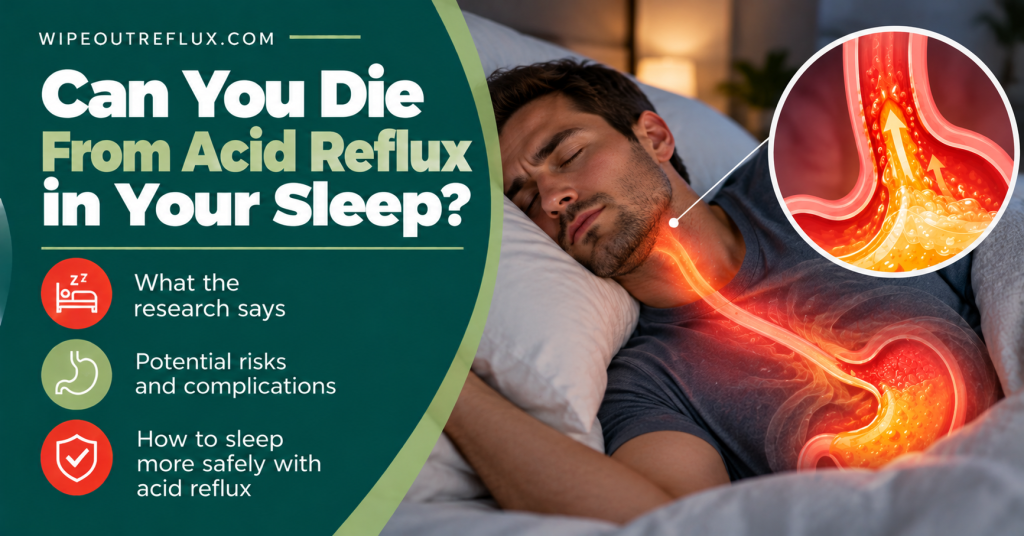
For a healthy adult, the honest answer is that it’s extremely unlikely to die from acid reflux in your sleep. Night-time reflux can wake you up coughing, choking or gasping, and that can be genuinely frightening, but your body has strong protective reflexes that kick in to clear your airway. Those episodes almost always pass within seconds to a minute.
The real risks of night-time reflux are different from what most people fear. Over years, untreated reflux can damage the esophagus, and in a small number of people that leads to complications such as Barrett’s esophagus. Reflux at night can also worsen asthma, chronic cough and sleep quality. And occasionally, chest pain that someone assumes is heartburn is actually their heart.
So while you’re very unlikely to die from reflux in your sleep, it’s still worth taking night-time symptoms seriously and getting them under control.
Key Takeaways
- Dying from acid reflux during sleep is extremely rare in healthy adults.
- Waking up choking or gasping from reflux is usually caused by laryngospasm, a brief, protective closing of the vocal cords that resolves on its own.
- Night-time reflux is more damaging than daytime reflux because you swallow less and acid stays in the esophagus longer.
- The serious long-term risks are esophageal damage, Barrett’s esophagus and, rarely, esophageal cancer.
- Heavy drinking, sedatives or sleeping pills can blunt the reflexes that normally protect your airway.
- Chest pain at night should never be assumed to be heartburn if it comes with breathlessness, sweating or pain spreading to the arm or jaw.
- Simple changes such as eating earlier, raising the head of the bed and sleeping on your left side reduce night-time reflux significantly.
- Babies with reflux should still always be placed on their back to sleep.
Why People Worry About Reflux at Night
If you’ve ever woken up unable to breathe, with acid burning your throat, it’s natural to wonder how close you came to something serious. It’s one of the most common fears I hear from readers, and it’s completely understandable. Waking in a panic, gasping, with your heart pounding, doesn’t feel like a minor digestive problem.
Night-time reflux is also very common. In a study of more than 15,000 adults, a quarter reported heartburn during sleep [Fass et al., Chest, 2005]. So lots of people experience these episodes, and the reassuring news is that the overwhelming majority come through them completely unharmed.
What Happens When You Reflux in Your Sleep
During the day, gravity and frequent swallowing keep most reflux in check. Anything that comes up is washed back down within seconds by saliva, which also helps neutralize acid.
At night, two things change. First, lying flat removes the help of gravity, so stomach contents can travel up more easily. Second, you swallow far less while you’re asleep, so acid that reaches the esophagus stays there much longer [Orr et al., Digestive Diseases and Sciences, 1981]. That’s why night-time reflux tends to cause more damage than daytime reflux, and why it’s more likely to reach the throat.
When reflux reaches the top of the esophagus and touches the voice box, your body responds with a set of protective reflexes: you cough, you swallow, and often you wake up. Those reflexes are uncomfortable, but they’re exactly what keeps you safe. I explain night-time reflux in more detail in acid reflux at night.
Waking Up Choking: What’s Actually Happening
The most frightening night-time reflux symptom is waking up feeling like you can’t breathe. This is usually caused by laryngospasm: a sudden, involuntary closing of the vocal cords when acid or pepsin touches them. It’s a protective reflex designed to stop anything going down into your lungs.
During an episode you may wake gasping, with a tight throat and noisy, high-pitched breathing (called stridor). It feels terrifying, but it typically lasts from a few seconds to under a minute, and the vocal cords relax on their own as your body takes over. In a study of adults with recurrent laryngospasm, reflux was confirmed in nearly all of them, most didn’t have heartburn, and every patient’s laryngospasm stopped completely once their reflux was treated [Loughlin and Koufman, The Laryngoscope, 1996].
If this happens to you, the most helpful thing is to stay as calm as you can, sit upright and breathe slowly in through your nose. Small sips of water once you can swallow help clear any remaining acid. My guides on waking up choking from acid reflux and laryngospasm and silent reflux cover what to do in the moment and how to stop it recurring.
Is it reflux or sleep apnea?
Waking up gasping can also be a sign of obstructive sleep apnea, where the airway repeatedly collapses during sleep. The two often go together: in the large study above, snoring and daytime sleepiness were among the strongest predictors of night-time heartburn [Fass et al., Chest, 2005]. Sleep apnea matters because, unlike laryngospasm, it’s linked to long-term heart and blood pressure problems. If you snore loudly, someone has noticed you stop breathing, or you’re exhausted during the day, ask your doctor about a sleep study. See reflux laryngospasm vs sleep apnea and snoring and acid reflux.
Can You Choke on Reflux and Stop Breathing?
In a healthy adult who is simply asleep, it’s very unlikely. The cough reflex, laryngospasm and waking up are all powerful, automatic defenses. Even when you breathe a little refluxed fluid toward your windpipe, your body usually forces it out before it goes further.
The situations where those defenses can be weakened are worth knowing about:
- Heavy drinking before bed. Alcohol both increases reflux and blunts the protective reflexes, and it makes you sleep more deeply.
- Sedatives, sleeping pills or opioid painkillers. These can dampen arousal and the cough reflex.
- Conditions affecting swallowing or consciousness, such as a previous stroke, advanced Parkinson’s or dementia.
- Very large meals right before lying down, which raise the volume of what can come up.
In these circumstances, regular aspiration of stomach contents can contribute to lung problems such as aspiration pneumonia, particularly in frail older people. That’s a different risk profile from an otherwise healthy person with reflux, but it’s one reason it’s never a good idea to combine a big late meal with alcohol or sleeping tablets.
The Real Long-Term Risks of Night-Time Reflux
Rather than sudden death in your sleep, the risks of untreated night-time reflux play out slowly over years.
Damage to the esophagus
Because acid lingers longer at night, nocturnal reflux is particularly good at inflaming the esophagus (esophagitis). Over time that can lead to scarring and narrowing. See erosive esophagitis.
Barrett’s esophagus and cancer
In some people with long-standing reflux, the lining of the lower esophagus changes to a different type of cell, a condition called Barrett’s esophagus. It’s the main known precursor to esophageal adenocarcinoma. In a large Swedish study, people with recurrent reflux symptoms had about 7.7 times the odds of this cancer, and those with long-standing, severe symptoms had a far higher risk [Lagergren et al., New England Journal of Medicine, 1999]. The more frequent, severe and long-lasting the symptoms, the greater the risk.
The absolute risk is still low. Among more than 11,000 people with Barrett’s in Denmark, the annual risk of cancer was around 0.12% [Hvid-Jensen et al., New England Journal of Medicine, 2011]. My guide on whether acid reflux can cause cancer puts this in perspective.
Breathing and lung problems
Night-time reflux can trigger or worsen chronic cough, asthma and hoarseness, sometimes in people who never feel heartburn. If you have asthma that’s worse at night, reflux is worth considering. See reflux cough and acid reflux misdiagnosed as asthma.
Poor sleep
Reflux and poor sleep feed each other. In a large population study, persistent reflux predicted new sleep problems, and persistent sleep problems more than doubled the risk of developing reflux [Lindam et al., Sleep, 2016]. Broken sleep affects mood, concentration and overall health. More in can silent reflux cause insomnia.
When Night-Time “Heartburn” Is Actually Your Heart
This is the scenario that genuinely can be fatal, and it’s why I’d never tell anyone to ignore chest pain at night. Heart pain doesn’t always feel like crushing pressure. US cardiology guidelines note it may be felt as pressure, tightness, squeezing, heaviness or even burning, and it can spread to the shoulders, arms, neck or jaw [Gulati et al., Journal of the American College of Cardiology, 2021].
Call emergency services straight away if night-time chest pain comes with:
- Shortness of breath, sweating, nausea or lightheadedness
- Pain spreading to the arm, shoulder, neck, jaw or back
- A feeling that something is badly wrong, or pain that’s different from your usual heartburn
- No relief from an antacid or sitting up
If in doubt, get checked. It’s far better to have your heart ruled out than to sleep through a heart attack thinking it’s indigestion. My guide on heartburn or heart attack covers the differences in detail.
What About Babies With Reflux?
Reflux and spitting up are very common in healthy babies and usually settle by their first birthday. Parents sometimes worry that a baby with reflux might choke if laid on their back. The American Academy of Pediatrics is clear: babies should always be placed on their back to sleep, on a firm, flat surface that isn’t inclined, without soft bedding [Moon et al., Pediatrics, 2022]. Healthy babies have protective reflexes that clear spit-up, and side or stomach sleeping and inclined sleepers carry their own serious risks.
If your baby has reflux with poor weight gain, breathing pauses, blood in spit-up or forceful vomiting, see your pediatrician. More in silent reflux in newborns.
How to Make Night-Time Reflux Safer and Less Frequent
The good news is that night-time reflux responds well to a handful of practical changes.
- Stop eating three hours before bed. Going to bed within three hours of dinner was associated with roughly seven times the odds of reflux compared with waiting four hours or more [Fujiwara et al., American Journal of Gastroenterology, 2005]. See how long before bed you should stop eating.
- Raise the head of your bed. Risers or a wedge (not stacked pillows) reduce night-time acid exposure. In trials, head-of-bed elevation cut the time the esophagus spent exposed to acid while lying down from about 21% to 15% [Ness-Jensen et al., Clinical Gastroenterology and Hepatology, 2016]. See how to raise the head of your bed.
- Sleep on your left side. Left-side sleeping was linked to less acid exposure and faster clearance than lying on your back or right side [Schuitenmaker et al., American Journal of Gastroenterology, 2022]. More in the best sleeping position for reflux.
- Take an alginate at bedtime. An alginate such as Gaviscon Advance forms a raft on top of stomach contents that helps block reflux. See alginates for acid reflux.
- Avoid alcohol in the evening, and talk to your doctor if you take sedatives or sleeping pills and have night-time reflux.
- Keep dinner light and low in fat, and avoid your personal trigger foods in the evening.
What you eat during the day matters too, especially if your reflux reaches your throat at night. My Wipeout Diet Plan covers exactly what to eat, when to stop eating and how to find your personal triggers, so your evenings stop being a gamble.
When to See a Doctor
Make an appointment if:
- You regularly wake up coughing, choking or with acid in your throat
- You have reflux symptoms more than twice a week
- You snore loudly, stop breathing in your sleep or feel exhausted during the day
- You have asthma or a chronic cough that’s worse at night
- You’ve had reflux for many years, especially if you’re over 50, male, a current or former smoker, or carry weight around your middle
Seek urgent help if you have difficulty breathing that doesn’t settle, chest pain with any of the warning signs above, vomiting blood, black stools, or difficulty swallowing that’s getting worse.
Conclusion
Waking up choking on reflux is frightening, but for a healthy adult it’s very unlikely to be fatal. Your body’s protective reflexes are strong, and the gasping episodes that feel so alarming usually pass within a minute. The genuine risks of night-time reflux are slower and quieter: damage to the esophagus, worse breathing problems, poor sleep and, rarely, Barrett’s esophagus. And any chest pain that might be your heart deserves urgent attention. The encouraging part is that night-time reflux usually improves dramatically with earlier meals, a raised bed and left-side sleeping.
If you want a complete plan to get night-time reflux under control, the Wipeout Diet Plan is where I’d start. It brings together everything I’ve learned from twelve years of managing reflux myself, from meal timing and evening routines to what to eat and how to find your triggers. I built it originally for silent reflux, the throat-based kind behind most night-time choking episodes, though because it targets the same root causes it works just as well for GERD and classic heartburn.
For a lighter starting point, the Wipeout Food Reference Guide is the essential companion. It lists the foods and drinks that are safe for acid reflux and LPR, along with their pH values, so you can plan evening meals that won’t come back to haunt you at 3am.
Frequently Asked Questions
Can you die from acid reflux in your sleep?
For a healthy adult, it’s extremely unlikely. Your cough reflex, protective vocal cord closure and waking up all clear the airway. The risk is higher in people whose reflexes are blunted by heavy alcohol, sedatives or conditions affecting swallowing, which is why those situations need extra care.
Why do I wake up choking from acid reflux?
Usually because acid or pepsin touched your vocal cords and triggered laryngospasm, a brief protective closing of the airway. It feels like you can’t breathe, but it typically resolves within seconds to a minute. Treating the underlying reflux usually stops these episodes.
Can acid reflux stop you breathing at night?
Laryngospasm can make breathing feel blocked for a few seconds, but it relaxes on its own. If you regularly stop breathing during sleep, snore loudly or wake unrefreshed, obstructive sleep apnea is more likely, and it’s worth asking your doctor about a sleep study.
Is night-time acid reflux more dangerous than daytime reflux?
It tends to cause more damage because you swallow less while asleep, so acid stays in the esophagus longer and is more likely to reach the throat and airway. That’s why controlling night-time reflux is particularly important for preventing long-term complications.
Can you aspirate stomach acid while sleeping?
Small amounts can reach the airway, which is what triggers coughing and choking. In healthy people this is usually cleared quickly. Repeated aspiration is more of a concern in frail older people, after a stroke, or with heavy alcohol or sedative use, where it can contribute to lung infections.
What position should I sleep in with acid reflux?
Sleeping on your left side with the head of your bed raised by 6 to 8 inches is the best combination. Left-side sleeping is linked to less acid exposure, and a raised bed lets gravity keep stomach contents down. Avoid stacking pillows, which can bend you at the waist and make reflux worse.
Should a baby with reflux sleep on their side or stomach?
No. Babies with reflux should still always sleep on their back, on a firm, flat, non-inclined surface without soft bedding. This is the American Academy of Pediatrics recommendation. Healthy babies can clear spit-up while on their back.
Research & References
- [Fass et al., Chest, 2005] — Sleep Heart Health Study analysis of 15,314 adults in which 24.9% reported heartburn during sleep, with snoring and daytime sleepiness among the strongest predictors.
- [Orr et al., Digestive Diseases and Sciences, 1981] — Showed swallowing falls sharply during sleep and acid takes much longer to clear, so refluxed material lingers at night.
- [Loughlin and Koufman, The Laryngoscope, 1996] — Prospective study of 12 adults with paroxysmal laryngospasm; reflux was found in 11 (only a third had heartburn), and all patients had complete cessation of laryngospasm with antireflux treatment.
- [Lagergren et al., New England Journal of Medicine, 1999] — Swedish population-based case-control study finding recurrent reflux symptoms associated with 7.7 times the odds of esophageal adenocarcinoma, rising to 43.5 with long-standing, severe symptoms.
- [Hvid-Jensen et al., New England Journal of Medicine, 2011] — Danish nationwide cohort of more than 11,000 Barrett’s patients showing an annual adenocarcinoma risk of 0.12%, about 11 times the general population risk but low in absolute terms.
- [Lindam et al., Sleep, 2016] — HUNT cohort study of 25,844 people finding persistent sleep disturbances associated with new-onset reflux symptoms (risk ratio 2.70), and persistent reflux with new-onset sleep disturbances (1.41).
- [Gulati et al., Journal of the American College of Cardiology, 2021] — The 2021 AHA/ACC chest pain guideline notes that heart-related chest pain may be felt as pressure, tightness, squeezing, heaviness or burning, can spread to the shoulders, arms, neck or jaw, and advises calling emergency services for acute chest pain.
- [Moon et al., Pediatrics, 2022] — American Academy of Pediatrics policy statement recommending supine (back) sleeping on a firm, noninclined surface, room sharing without bed sharing and avoidance of soft bedding to reduce sleep-related infant deaths.
- [Fujiwara et al., American Journal of Gastroenterology, 2005] — Case-control study finding that going to bed within three hours of dinner was associated with roughly 7.5 times the odds of gastroesophageal reflux compared with a gap of four hours or more.
- [Ness-Jensen et al., Clinical Gastroenterology and Hepatology, 2016] — Systematic review finding head-of-bed elevation reduced supine esophageal acid exposure from 21% to 15%, and avoiding late evening meals reduced supine acid exposure.
- [Schuitenmaker et al., American Journal of Gastroenterology, 2022] — Combined sleep-position and reflux monitoring study finding that sleeping on the left side was associated with less esophageal acid exposure and faster clearance than lying on the back or right side.

David Gray
12 years living with LPR · Consultant & researcher
I've lived with LPR for twelve years — the misdiagnoses, the PPI courses that did nothing, the slow work of figuring out what actually helps. Wipeout Reflux is where I translate the research into plain terms for people stuck in the same place. Every claim here is sourced to peer-reviewed work, and I consult one-to-one with LPR sufferers.