
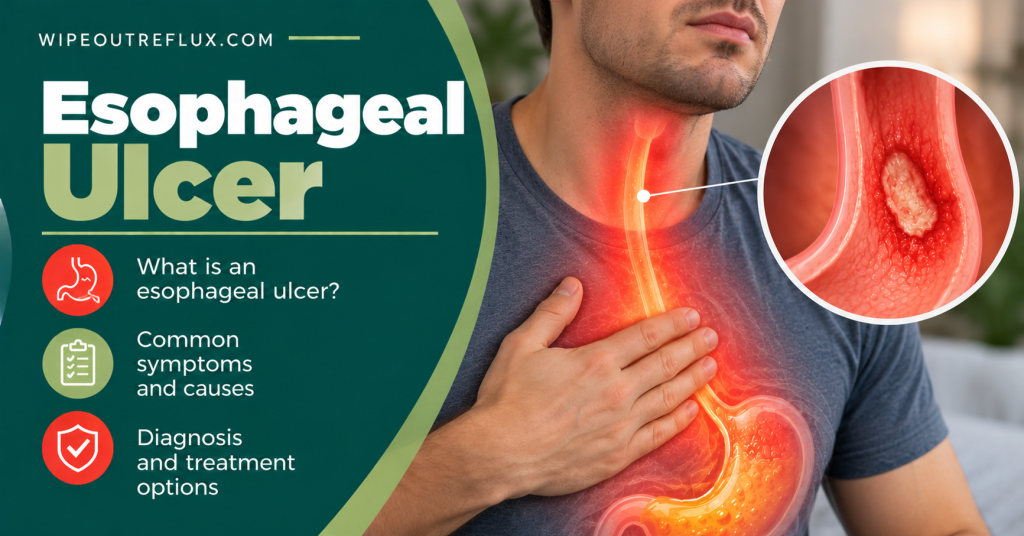
An esophageal ulcer is an open sore in the lining of the esophagus, the tube that carries food from your mouth to your stomach. The most common cause by far is acid reflux (GERD), where repeated exposure to stomach acid wears through the lining. The next most common cause is medication: tablets such as anti-inflammatory painkillers, certain antibiotics, iron and potassium can burn the lining if they lodge on the way down. Infections, vomiting and radiation treatment are less common causes.
Typical symptoms are pain behind the breastbone, pain when swallowing, heartburn and sometimes difficulty swallowing. Some ulcers bleed, which can show up as vomiting blood or black, tarry stools.
The good news is that most ulcers on the esophagus heal well within a few weeks once the cause is removed, usually with acid-suppressing medication for reflux ulcers or by stopping the offending tablet.
Key Takeaways
- An esophageal ulcer is a break in the lining of the esophagus with a clearly defined edge.
- Acid reflux causes roughly 6 in 10 esophageal ulcers; medications cause most of the rest.
- Common symptoms include chest pain behind the breastbone, painful swallowing, heartburn and difficulty swallowing.
- Bleeding is the most common complication, causing black stools or vomiting blood.
- Diagnosis is made by endoscopy, sometimes with biopsies to check for infection or other causes.
- Reflux ulcers usually heal with an 8-week course of a proton pump inhibitor; pill ulcers often heal within 1 to 2 weeks of stopping the tablet.
- Taking tablets upright with a full glass of water is the simplest way to prevent pill ulcers.
- Vomiting blood, black stools, severe chest pain or being unable to swallow need urgent medical attention.
What Is an Esophageal Ulcer?
The esophagus is lined with layers of flat cells that protect it from food, drink and the occasional splash of stomach contents. Unlike the stomach, it has no thick protective mucus layer, so it’s vulnerable to anything that sits against it for too long.
When the lining is damaged repeatedly, it first becomes inflamed (esophagitis). If the damage continues, it can break through the surface layers to form an ulcer: a distinct crater with a clearly defined edge. Ulcers are a more severe form of injury than the shallow erosions seen in milder esophagitis, which doctors grade from A to D using the Los Angeles classification [Lundell et al., Gut, 1999].
Esophageal ulcers are relatively uncommon. In one hospital’s 11-year review, they were found in about 0.5% of all upper endoscopies [Cohen et al., Acta Gastro-Enterologica Belgica, 2021]. But they’re worth understanding, because they can cause significant symptoms and, occasionally, bleeding.
Esophageal ulcer vs stomach ulcer
People often confuse the two. A stomach (peptic) ulcer forms in the stomach or the first part of the small intestine and is usually caused by H. pylori infection or anti-inflammatory painkillers, with upper stomach pain as the main symptom. An esophageal ulcer forms higher up, in the food pipe, and is usually caused by reflux or tablets, with pain behind the breastbone and pain on swallowing. My guide on stomach ulcer or acid reflux covers how to tell stomach ulcers and reflux apart.
What Causes Ulcers on the Esophagus?
Two large hospital series give a clear picture. In one, of 88 patients with esophageal ulcers, 66% were caused by reflux, 23% by medications, 3% by candida (thrush) and the rest by rarer causes such as caustic injury and herpes [Higuchi et al., Journal of Gastrointestinal Surgery, 2003]. In another, of 100 patients, reflux accounted for 57%, followed by anti-inflammatory painkillers, cancer, vomiting, caustic ingestion, pill injury and radiation [Cohen et al., Acta Gastro-Enterologica Belgica, 2021].
1. Acid reflux (GERD)
This is the most common cause. When stomach contents wash up into the esophagus often, especially at night when you swallow less and acid lingers, the lower esophagus takes repeated chemical damage. Reflux ulcers are usually found low down, near where the esophagus joins the stomach. Having a hiatal hernia makes this more likely. More in erosive esophagitis and hiatal hernia and reflux.
2. Pill-induced ulcers
When a tablet or capsule sticks in the esophagus instead of passing straight into the stomach, it can dissolve against the lining and cause a concentrated chemical burn. A review of nearly 1,000 cases identified close to 100 different medications as culprits [Kikendall, Journal of Clinical Gastroenterology, 1999]. The most common include:
- Antibiotics, especially doxycycline and tetracycline. See can antibiotics cause heartburn
- Anti-inflammatory painkillers such as ibuprofen, naproxen and aspirin. See does ibuprofen cause acid reflux
- Bisphosphonates for osteoporosis, such as alendronate
- Potassium chloride tablets
- Iron supplements. See do iron supplements cause heartburn
- Vitamin C and some other supplements
Pill ulcers are more likely if you take tablets with little or no water, swallow them just before lying down, are older, or have a narrowing in the esophagus. Anti-inflammatory painkillers deserve special mention: in a study of bleeding esophageal ulcers, half of the patients had been taking them [Wolfsen and Wang, Journal of Clinical Gastroenterology, 1992].
3. Infections
Infections of the esophagus are mainly seen in people with weakened immunity, for example from HIV, chemotherapy, organ transplant medication or long-term steroids, though they can occasionally affect healthy people. Candida (thrush) is the most common, followed by cytomegalovirus (CMV) and herpes simplex virus, and they typically cause sudden pain or difficulty swallowing [Rosołowski and Kierzkiewicz, Przeglad Gastroenterologiczny, 2013]. Viral infections tend to cause discrete ulcers, while thrush more often causes white plaques.
4. Other causes
- Repeated or forceful vomiting
- Radiation therapy to the chest
- Swallowing caustic substances such as household cleaners
- Esophageal cancer, which can appear as an ulcer and is one reason biopsies are taken
- Crohn’s disease and other rare inflammatory conditions
Esophageal Ulcer Symptoms
Symptoms depend partly on the cause and size of the ulcer, but the most common are:
- Pain behind the breastbone, often burning or aching, which may be constant or worse after eating
- Pain when swallowing (odynophagia): food or drink hurts as it passes the ulcer, especially hot, spicy, acidic or rough foods
- Heartburn and regurgitation, particularly with reflux ulcers
- Difficulty swallowing, or a feeling that food is sticking. See dysphagia
- Nausea and reduced appetite
- Signs of bleeding: black, tarry stools, vomiting blood or material like coffee grounds, tiredness or breathlessness from anemia
Pill ulcers usually come on suddenly, often within hours of a dose, with sharp pain behind the breastbone that’s worse when swallowing. In reviews of drug-induced esophagitis, chest pain is the most common symptom, followed by painful and difficult swallowing [Saleem and Sharma, StatPearls, 2023]. Reflux ulcers tend to develop more gradually, often on a background of months or years of heartburn.
Complications of Esophageal Ulcers
Most esophageal ulcers heal without lasting problems, but complications do happen:
- Bleeding. This is the most common complication. In one series, a third of patients had bleeding [Higuchi et al., Journal of Gastrointestinal Surgery, 2003], and in another, half of all patients first came to medical attention because of bleeding [Cohen et al., Acta Gastro-Enterologica Belgica, 2021].
- Stricture. As a reflux ulcer heals, scar tissue can narrow the esophagus, making swallowing difficult. Strictures complicated about 1 in 8 ulcers in one series and were linked to reflux rather than pill ulcers [Higuchi et al., Journal of Gastrointestinal Surgery, 2003]. See esophageal stricture.
- Perforation. Rarely, an ulcer can go all the way through the esophageal wall. This is an emergency.
Reassuringly, the same series concluded that esophageal ulcers rarely cause death, and the great majority were managed without surgery.
How Esophageal Ulcers Are Diagnosed
An upper endoscopy is the standard test. A thin camera passed through the mouth lets the doctor see the ulcer directly, judge its size and location, and treat any bleeding on the spot. Biopsies are often taken, particularly if the ulcer looks unusual, to look for infection, Barrett’s esophagus or cancer. The location also gives clues: reflux ulcers are usually in the lowest part of the esophagus, while pill ulcers are often higher up, where the esophagus naturally narrows.
If you’ve been booked for a scope, my guide to endoscopy for acid reflux explains what happens.
Esophageal Ulcer Treatment
Treatment targets the cause.
Reflux ulcers
Proton pump inhibitors (PPIs) such as omeprazole are the main treatment. US guidelines recommend an initial 8-week course for healing erosive esophagitis, which includes ulcers [Katz et al., American Journal of Gastroenterology, 2022]. Your doctor may arrange a repeat scope afterward for larger ulcers to confirm healing.
Alongside medication, reducing reflux helps the ulcer heal and stops it coming back: smaller meals, no food for three hours before bed, raising the head of your bed and avoiding your trigger foods. An alginate after meals and at bedtime adds a protective barrier. See alginates for acid reflux.
Pill ulcers
The key step is identifying and stopping the medication, or switching to a liquid form or a different drug with your doctor’s advice. Most pill injuries heal within one to two weeks of removing the culprit [Saleem and Sharma, StatPearls, 2023]. Doctors often prescribe a PPI or a coating agent such as sucralfate to ease symptoms while it heals. See sucralfate (Carafate).
Infectious ulcers
These are treated with antifungal or antiviral medication, depending on the organism found on biopsy.
Bleeding ulcers
Active bleeding can often be stopped during the endoscopy itself, followed by acid-suppressing medication. Surgery is rarely needed.
What to Eat With an Esophageal Ulcer
While an ulcer heals, the goal is to avoid anything that scrapes, burns or bathes it in acid:
- Choose soft, moist foods: oatmeal, scrambled eggs, mashed potato, soups, yogurt, ripe bananas, well-cooked vegetables, tender fish and chicken. My acid reflux soups are ideal here
- Let hot food and drinks cool to warm rather than scalding
- Avoid acidic foods and drinks: citrus, tomato, vinegar, fruit juice, carbonated drinks
- Avoid spicy foods, alcohol and coffee
- Skip rough, dry foods such as crusty bread, chips, crackers and nuts until it heals
- Eat smaller meals and stay upright afterward
If reflux caused your ulcer, getting your everyday diet right is what stops it coming back once the medication course ends. My Wipeout Diet Plan lays out exactly what to eat and drink in each phase, so you can let your esophagus heal and then find a long-term diet that keeps reflux under control.
How to Prevent Esophageal Ulcers
- Take tablets properly: swallow every tablet with a full glass of water while sitting or standing, and stay upright for at least 30 minutes afterward. This simple step reduces pill injury significantly [Kikendall, Journal of Clinical Gastroenterology, 1999]
- Never take tablets right before lying down for the night
- Use anti-inflammatory painkillers sparingly, and ask your doctor about alternatives if you need them regularly. See medications that make acid reflux worse
- Control reflux early rather than living with frequent heartburn for years
- Stop smoking and cut back on alcohol
When to See a Doctor
Book an appointment if you have:
- Pain behind the breastbone or pain on swallowing lasting more than a few days
- Heartburn that’s frequent or not responding to over-the-counter treatment
- Difficulty swallowing or food sticking
- Chest pain that started after taking a tablet
Get urgent help if you have:
- Vomiting blood or material that looks like coffee grounds
- Black, tarry stools
- Severe chest pain, especially with fever or breathlessness
- Inability to swallow food, liquids or saliva
- Dizziness or fainting
Remember that chest pain can also come from the heart. If you have chest pain with breathlessness, sweating or pain spreading to the arm or jaw, call emergency services. See heartburn or heart attack.
Conclusion
Esophageal ulcers sound alarming, but they’re usually very treatable. Most come from acid reflux, with tablets such as anti-inflammatory painkillers, antibiotics and iron the next most common cause. Pain behind the breastbone, painful swallowing and heartburn are the typical signs, and bleeding is the complication to watch for. With the right treatment, usually an 8-week course of acid-suppressing medication for reflux ulcers or stopping the culprit tablet for pill ulcers, most heal within weeks. Preventing the next one comes down to controlling reflux and taking tablets upright with plenty of water.
If reflux was behind your ulcer, the Wipeout Diet Plan is the long-term plan I’d recommend. It’s the step-by-step approach I’ve built over twelve years of managing reflux myself, covering what to eat, what to drink, meal timing and how to find your triggers so the damage doesn’t keep repeating. It was designed with silent reflux in mind first, but because it addresses the same root causes it works equally well for GERD and erosive reflux.
If you’d like a lighter starting point, the Wipeout Food Reference Guide is the essential companion. It lists the foods and drinks that are safe for acid reflux and LPR, with their pH values, so you can choose meals that are gentle on a healing esophagus.
Frequently Asked Questions
What causes an esophageal ulcer?
Acid reflux is the most common cause, responsible for roughly 6 in 10 cases. Medications are next, particularly anti-inflammatory painkillers, doxycycline and other antibiotics, bisphosphonates, potassium and iron tablets. Infections, vomiting, radiation and swallowed caustic substances are less common causes.
What does an esophageal ulcer feel like?
Most people feel a burning or aching pain behind the breastbone, pain when swallowing, and often heartburn. Food may feel like it sticks. Pill ulcers usually cause sudden, sharp chest pain within hours of taking a tablet.
How long does an esophageal ulcer take to heal?
Pill ulcers often heal within one to two weeks of stopping the medication. Reflux ulcers are usually treated with an 8-week course of a proton pump inhibitor, and most heal within that time. Larger ulcers may take longer and may need a follow-up scope.
Can an esophageal ulcer heal on its own?
Small pill ulcers can heal on their own once the tablet is stopped. Reflux ulcers usually need acid-suppressing medication and lifestyle changes, because ongoing reflux keeps damaging the lining. Any suspected ulcer should be assessed by a doctor.
Are esophageal ulcers dangerous?
Most heal without lasting problems, but they can bleed, cause narrowing as they heal, or rarely perforate. Vomiting blood, black stools or severe chest pain need urgent medical attention. Deaths from esophageal ulcers are rare.
What should I eat with an esophageal ulcer?
Soft, moist, lukewarm foods such as oatmeal, eggs, mashed potato, soups, yogurt, bananas and tender fish or chicken. Avoid acidic, spicy, very hot or rough foods, and skip alcohol, coffee and carbonated drinks until it heals.
Is an esophageal ulcer the same as a stomach ulcer?
No. Stomach ulcers form in the stomach or duodenum and are mainly caused by H. pylori or anti-inflammatory painkillers. Esophageal ulcers form in the food pipe and are mainly caused by reflux or tablets lodging on the way down.
Research & References
- [Lundell et al., Gut, 1999] — Validation of the Los Angeles classification for grading reflux esophagitis, showing grade correlated with acid exposure, heartburn severity and treatment response.
- [Cohen et al., Acta Gastro-Enterologica Belgica, 2021] — Retrospective review of 100 patients with esophageal ulcers (0.49% of upper endoscopies); half presented with bleeding, most ulcers were in the lower esophagus, and reflux was the most common cause (57%), followed by anti-inflammatory painkillers, malignancy, vomiting, caustic ingestion, pill esophagitis and radiation.
- [Higuchi et al., Journal of Gastrointestinal Surgery, 2003] — Ten-year series of 88 patients with esophageal ulcers: causes were reflux (65.9%), drugs (22.7%), candida (3.4%) and rarer causes; complications included bleeding (34%), stricture (12.5%) and perforation (3.4%), and 92% were managed without surgery.
- [Kikendall, Journal of Clinical Gastroenterology, 1999] — Review of 979 cases of pill esophagitis due to nearly 100 medications, noting most cause self-limited pain but hemorrhage, stricture and perforation can occur, and that taking pills upright with plenty of fluid reduces risk.
- [Wolfsen and Wang, Journal of Clinical Gastroenterology, 1992] — Esophageal ulcers accounted for 2% of acute gastrointestinal bleeding; half of affected patients were taking anti-inflammatory painkillers, and 90% of ulcers were in the distal esophagus.
- [Rosołowski and Kierzkiewicz, Przeglad Gastroenterologiczny, 2013] — Review of infectious esophagitis identifying Candida as the predominant cause, followed by cytomegalovirus and herpes simplex, with risk factors including antibiotics, steroids, chemotherapy and immunodeficiency.
- [Saleem and Sharma, StatPearls, 2023] — Review of drug-induced esophagitis reporting retrosternal pain, odynophagia and dysphagia as the main presenting symptoms, with resolution within one to two weeks of stopping the culprit drug.
- [Katz et al., American Journal of Gastroenterology, 2022] — ACG clinical guideline for GERD, including an 8-week course of PPI therapy for healing erosive esophagitis.

David Gray
12 years living with LPR · Consultant & researcher
I've lived with LPR for twelve years — the misdiagnoses, the PPI courses that did nothing, the slow work of figuring out what actually helps. Wipeout Reflux is where I translate the research into plain terms for people stuck in the same place. Every claim here is sourced to peer-reviewed work, and I consult one-to-one with LPR sufferers.