
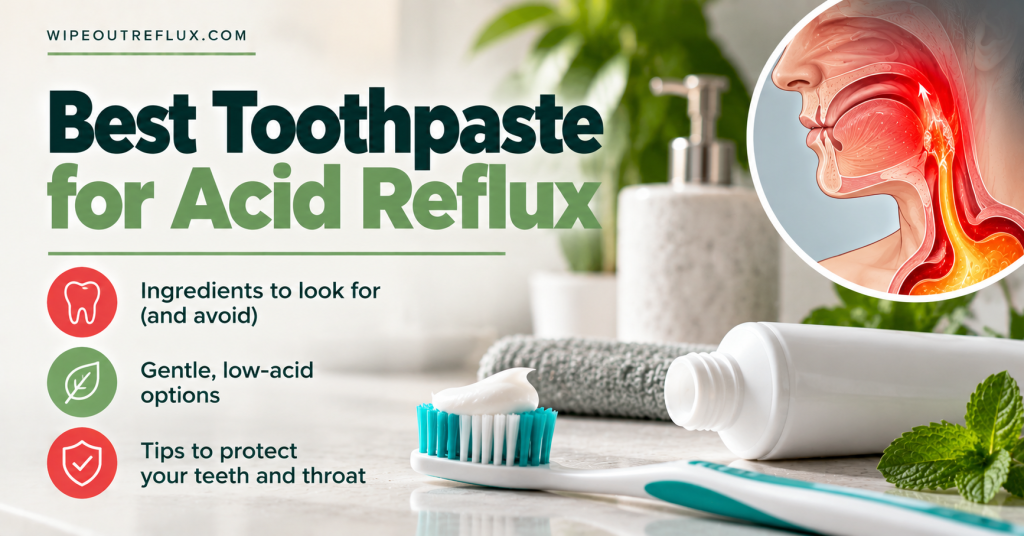
The best toothpaste for acid reflux, GERD and LPR is a gentle, SLS-free fluoride toothpaste with little or no mint flavor, ideally one that contains baking soda. Baking soda neutralizes acid in your mouth, fluoride protects enamel that reflux has already weakened, and skipping strong mint and harsh detergents means less irritation for a mouth and throat that are already inflamed.
My go-to recommendation is a baking soda toothpaste from Arm & Hammer, ideally the SLS-free Essentials range. If even a mild mint bothers you, a truly unflavored SLS-free fluoride paste is the best swap, and you can still get the baking soda benefit by dipping your brush in a pinch of plain baking soda.
How you brush matters too. Don’t brush straight after a reflux episode or an acidic meal, because softened enamel wears away more easily. Rinse with water or a mild baking soda solution first, and brush later.
Key Takeaways
- Strong mint toothpaste is a common complaint among people with reflux, but the research suggests mint mostly irritates sensitive tissue rather than causing more reflux.
- In a controlled study, a flavoring-sized dose of spearmint didn’t change sphincter pressure or reflux, while a high dose caused symptoms through direct irritation.
- Menthol caused noticeably more esophageal discomfort in GERD patients than in healthy people, which fits with reflux leaving tissue sensitized.
- Sodium lauryl sulfate (SLS), the foaming detergent in most toothpastes, is linked to more mouth ulcers. SLS-free toothpaste reduced ulcer number, duration and pain in a meta-analysis.
- Baking soda rapidly neutralizes acid in the mouth, and at a high enough pH it also inactivates pepsin, the enzyme behind much of the damage in LPR.
- Around 1 in 4 people with GERD have dental erosion, and both GERD and LPR are linked to it, so fluoride matters.
- Arm & Hammer Essentials (SLS-free baking soda), Dr. Bob Unflavored (no mint, no SLS, with fluoride) and Sensodyne Pronamel (SLS-free enamel protection) are my top picks.
- Wait 30 to 60 minutes after reflux or acidic food before brushing, and rinse with water or a baking soda solution in the meantime.
Can Toothpaste Cause Acid Reflux?
If you’ve ever brushed your teeth and felt a burning in your chest or a tightness and tickle in your throat straight afterward, you’re not imagining it. A popular thread in the GERD community on Reddit is literally titled “It was the toothpaste all along.” For a lot of people with reflux, toothpaste is an overlooked daily trigger.
The usual explanation is that mint relaxes the lower esophageal sphincter (LES), the valve that keeps stomach contents down. It’s the same reason peppermint is on most reflux “avoid” lists, and why I steer people away from it in my article on whether peppermint tea is good for acid reflux.
But when you look at the research on mint and the LES specifically, the picture is more interesting, and it actually matters more for LPR than for GERD.
What the mint research actually shows
In a double-blind crossover study, healthy volunteers were given spearmint at either a flavoring dose or a high dose. Neither changed LES pressure or the number of reflux episodes. The flavoring dose didn’t cause more symptoms than placebo, but the high dose did, and the researchers put this down to direct irritation of the lining rather than reflux [Bulat et al., Alimentary Pharmacology & Therapeutics, 1999].
A more recent study infused menthol, the main active compound in mint, directly into the esophagus of healthy volunteers and GERD patients. Again, it didn’t meaningfully change LES pressure or esophageal movement in either group. But the GERD patients felt significantly more intense discomfort from the menthol than the healthy volunteers did, and the authors concluded that other mechanisms must explain menthol-related heartburn [Bánovčin et al., Dysphagia, 2024].
So here’s how I read it. Mint probably isn’t flooding your esophagus with acid. What it seems to do is irritate tissue that reflux has already made sensitive. Menthol acts on cold and pain-sensing nerve receptors, and in an inflamed esophagus or throat those nerves are already on high alert. That’s why a strong mint toothpaste can feel like it’s setting off your reflux even if it isn’t causing extra reflux at all.
Why it matters even more with LPR
With classic GERD, toothpaste only reaches your esophagus if you swallow some. With silent reflux (LPR), the irritated tissue is right there in your throat, voice box and the back of your mouth, the exact area that strong mint, foaming detergent and toothpaste froth come into contact with twice a day.
If your throat is already raw from pepsin and acid, adding a burning mint flavor and a detergent on top is a bit like putting aftershave on a graze. It won’t cause the underlying problem, but it can keep it flared up and make throat clearing, tickles and that lump-in-the-throat feeling worse. If you’re not sure which type of reflux you’re dealing with, my GERD vs LPR guide explains the difference.
Toothpaste Ingredients to Avoid With Acid Reflux
When I’m checking a toothpaste for someone with reflux, these are the ingredients I look for on the label.
Strong mint flavors (peppermint, spearmint, menthol)
Words like “Extra Fresh,” “Icy Mint,” “Cool Mint” or “Arctic” usually mean a high menthol content. Based on the research above, flavoring-level mint is tolerable for many people, but the strong versions are the ones most likely to cause trouble. If you’re sensitive, go mild or go unflavored.
Sodium lauryl sulfate (SLS)
SLS is the detergent that makes toothpaste foam. It’s also a known irritant of the delicate lining of the mouth. A systematic review and meta-analysis of controlled trials found that switching to SLS-free toothpaste reduced the number of mouth ulcers, how long they lasted, how often they came back and how painful they were [Alli et al., Journal of Oral Pathology & Medicine, 2019]. A broader review noted that SLS can irritate oral tissue more generally, though most of that evidence comes from lab and animal work [Sabri et al., Journal of Dentistry (Shiraz), 2023].
To be honest, nobody has studied SLS in people with LPR specifically. But if a detergent is irritating enough to make mouth ulcers worse, I’d rather not foam it around a throat that’s already inflamed, especially as SLS-free toothpaste is easy to find. If you get ulcers alongside your reflux, I cover that link in acid reflux and mouth ulcers.
Other common irritants
- Cinnamon flavors. Cinnamon toothpastes and gums are a well-known cause of mouth irritation and contact reactions.
- Peroxide whitening formulas. These can sting sensitive gums and soft tissue. Gentle baking soda whitening is a kinder option.
- “Extreme” tartar control and whitening pastes. These tend to combine strong flavors, SLS and extra active ingredients, so they’re often the harshest pastes on the shelf.
- Alcohol and strong mint mouthwashes. These sting and dry out the mouth. Dry mouth means less saliva, and saliva is one of your natural defenses against acid (more on that in acid reflux and dry mouth).
If you also find that a burning mouth or tongue goes along with your reflux, toothpaste irritants are worth ruling out first. See my guide to burning mouth syndrome.
Why Baking Soda Toothpaste Is Good for Acid Reflux
This is why baking soda toothpaste is my first recommendation for anyone with reflux. Baking soda (sodium bicarbonate) is the same alkaline compound your body uses to buffer acid. In your saliva, your pancreas and your throat tissue, bicarbonate is your natural acid neutralizer. I go into the chemistry in baking soda for heartburn.
In your mouth, baking soda has two benefits for people with reflux.
1. It neutralizes acid on your teeth
A review in The Journal of the American Dental Association found that baking soda can rapidly reverse the drop in pH on teeth after an acid challenge, and that its effect depends on concentration. Marketed toothpastes range from about 10% to 65% baking soda. The review also noted that people with low saliva may benefit most from a fluoride toothpaste that contains baking soda [Zero, The Journal of the American Dental Association, 2017].
That matters if reflux regularly bathes your teeth in acid, particularly overnight when saliva flow drops.
2. It works against pepsin, the real problem in LPR
In silent reflux, the main troublemaker isn’t just acid, it’s pepsin, the stomach’s protein-digesting enzyme. Pepsin lodges in throat tissue, stays stable at neutral pH, and switches back on whenever something acidic arrives [Johnston et al., The Laryngoscope, 2007]. I explain that cycle in how pepsin reactivates in the throat.
Pepsin is only permanently inactivated at a pH of around 8 or higher. Alkaline water at pH 8.8 has been shown to irreversibly inactivate human pepsin in the lab [Koufman & Johnston, Annals of Otology, Rhinology & Laryngology, 2012]. A baking soda solution sits at around pH 8 to 8.4, right in that range.
I want to be careful here. Brushing your teeth isn’t going to clear pepsin out of your voice box, and no study has tested baking soda toothpaste for LPR. But choosing a toothpaste that’s alkaline rather than one that’s minty and foamy means your twice-daily routine is at least working with your throat rather than against it. If you want to take the pepsin-clearing idea further, my article on gargling and throat rinses for pepsin covers it in more depth, and alkaline water for LPR covers the research behind the pH 8.8 finding.
Protecting Your Teeth From Reflux Damage
Reflux doesn’t just affect your throat. Stomach acid reaching the mouth dissolves enamel, and unlike a cavity, that damage (dental erosion) can’t grow back.
A systematic review found a median of 24% of GERD patients had dental erosion, and around a third of adults with dental erosion had GERD. The authors concluded there’s a strong association between the two and that dentists should routinely check GERD patients for erosion [Pace et al., Alimentary Pharmacology & Therapeutics, 2008]. A 2025 systematic review confirmed the link for LPR as well as GERD [Wang et al., Digestive Diseases and Sciences, 2025].
That’s why I don’t recommend simply ditching toothpaste or going fluoride-free if you have reflux. Fluoride hardens enamel and helps it resist acid, and teeth exposed to reflux need all the help they can get. My full guide to acid reflux and teeth erosion covers the warning signs.
A few habits make a big difference:
- Don’t brush straight after reflux or acidic food. Acid temporarily softens enamel, and brushing it right away can scrub away the softened surface. Most dentists suggest waiting 30 to 60 minutes.
- Rinse instead. After a reflux episode, swish with plain water or half a teaspoon of baking soda dissolved in a cup of water. This neutralizes the acid without any scrubbing.
- Use a soft brush and gentle pressure. Erosion and hard brushing together wear enamel down much faster.
- Brush before bed, then nothing but water. Night is when saliva drops and reflux does the most damage, so going to bed with fluoride on clean teeth is your best protection.
- Tell your dentist you have reflux. They can look for early erosion and may suggest a higher-fluoride prescription paste if needed.
Best Toothpaste for Acid Reflux: My Picks
Here’s what I recommend, depending on how sensitive you are.
1. Arm & Hammer Essentials (best baking soda toothpaste)
Arm & Hammer is the obvious choice for baking soda toothpaste. Baking soda is its signature ingredient, and its pastes contain much more of it than most brands. For reflux, I’d pick the Arm & Hammer Essentials range over the classic tubes, because it’s SLS-free and also free from peroxide, dyes and artificial sweeteners.
Two things to know. First, the Essentials paste on Amazon is fluoride-free. If you can find the Essentials Whiten & Strengthen version with fluoride in stores, that’s the better choice for enamel. Otherwise, use it alongside a fluoride paste (see the tip below). Second, it’s flavored with natural peppermint oil. It’s a mild, flavoring-level mint rather than an “icy” blast, which most people with reflux tolerate fine, but if mint of any kind sets you off, go for option 2.
The classic Arm & Hammer Dental Care and Complete Care pastes contain fluoride and plenty of baking soda, but they also contain SLS and a stronger mint flavor, so I’d only use them if you’ve tried them and know they don’t bother you.
2. Dr. Bob Unflavored (best mint-free toothpaste)
If you want to remove mint completely, Dr. Bob Unflavored Toothpaste is a genuinely flavorless fluoride gel: no mint, no fruit, no SLS, and it contains xylitol. It was designed for people with sensory and taste sensitivities, which makes it ideal for a sensitive, reflux-irritated mouth and throat.
UK readers can get a similar product, OraNurse Unflavoured, which is SLS-free and contains standard-strength fluoride.
3. Sensodyne Pronamel (best for enamel erosion)
If your dentist has already spotted erosion, Sensodyne Pronamel Intensive Enamel Repair is designed specifically to protect against acid erosion. It’s SLS-free, contains fluoride and is low in abrasiveness. The downside is that it’s mint flavored, so it suits people who can tolerate a fresh mint taste.
My tip: combine an unflavored paste with baking soda
If you have LPR and a sensitive throat, this is the approach I like most. Put a pea-sized amount of an unflavored, SLS-free fluoride toothpaste on your brush, then dip it lightly in a pinch of plain baking soda. You get fluoride for your enamel, baking soda to neutralize acid, and no mint or detergent to irritate your throat.
Plain baking soda is mildly abrasive, so use a soft brush and a light touch, and don’t use baking soda on its own instead of fluoride toothpaste long term.
A cheap option for sensitive mouths
Children’s fluoride toothpastes in fruit flavors are another way to avoid mint. Many are SLS-free and gentler overall. Just check the fluoride level on the label, since some contain less than adult pastes.
Don’t Forget Gum, Mints and Mouthwash
Toothpaste is only one source of mint in most people’s day. If you brush with a mint-free paste and then chew mint gum or suck on mints, you’re back where you started. Chewing gum can actually help reflux by increasing saliva, but the flavor matters. I cover which types are best in chewing gum and acid reflux, and there are better sweet options in the best candy for acid reflux.
For mouthwash, choose an alcohol-free, mild or unflavored rinse, or just use a homemade baking soda rinse (half a teaspoon in a cup of water). It’s cheap, alkaline and won’t sting.
Toothpaste is a small piece of the puzzle, though. The bigger lever for most people is what they eat and drink every day, which is exactly what the Wipeout Diet Plan is built around.
Conclusion
Switching your toothpaste won’t cure acid reflux, but it’s one of the easiest changes you can make, and for some people it removes a trigger they’ve been hitting twice a day for years. The research suggests mint mostly irritates tissue that reflux has already sensitized rather than causing more reflux, and that matters most with LPR, where the irritated tissue sits right in the path of toothpaste froth.
The ideal toothpaste for reflux is gentle, SLS-free, low in mint or unflavored, contains fluoride to protect enamel and ideally contains baking soda to neutralize acid. Arm & Hammer Essentials is my pick for baking soda, Dr. Bob Unflavored for going mint-free, and Sensodyne Pronamel if erosion is already a concern. Pair whichever you choose with smart habits: wait before brushing after reflux, rinse with a baking soda solution, and use a soft brush.
Toothpaste only reduces irritation, though. To calm reflux at its source, you need to take control of the foods and drinks that keep pepsin active and your throat inflamed. That’s exactly what the Wipeout Diet Plan is designed to do. It was built first and foremost for LPR, the stubborn throat-based kind, but because it targets the same underlying reflux mechanisms, it works just as well for GERD and everyday heartburn. It walks you step by step through what to eat, what to avoid and how to reintroduce foods without triggering a flare.
If you’d rather start with something lighter, the Wipeout Food Reference Guide is the essential companion, listing the foods and drinks that are safe for acid reflux and LPR along with their pH values, so you can check anything at a glance.
Frequently Asked Questions
Can toothpaste cause acid reflux?
Toothpaste doesn’t usually cause reflux itself, but it can trigger symptoms. Research suggests strong mint mainly irritates tissue that reflux has already sensitized, rather than relaxing the valve at the top of the stomach. Strong mint flavors and SLS are the most common culprits.
Is mint toothpaste bad for acid reflux?
Strong mint toothpaste can be a problem, especially with LPR. A flavoring-level amount of mint didn’t increase reflux or symptoms in a controlled study, but higher doses caused irritation. If mint toothpaste leaves your chest or throat burning, switch to a mild or unflavored paste.
Is baking soda toothpaste good for acid reflux?
Yes. Baking soda is alkaline, so it quickly neutralizes acid in your mouth and on your teeth. A baking soda solution also sits around the pH needed to inactivate pepsin, which makes it a good fit for silent reflux. Choose one that also contains fluoride where possible.
What is the best toothpaste for GERD?
The best toothpaste for GERD is an SLS-free fluoride toothpaste with mild or no mint, ideally with baking soda. Arm & Hammer Essentials, Dr. Bob Unflavored and Sensodyne Pronamel are good options, depending on how sensitive you are to mint and whether you have enamel erosion.
Is SLS-free toothpaste better for LPR?
It’s a sensible choice. SLS is a detergent that irritates the lining of the mouth, and SLS-free toothpaste reduced mouth ulcers in clinical trials. It hasn’t been studied in LPR specifically, but avoiding a foaming detergent around an inflamed throat makes sense, and SLS-free pastes are easy to find.
Should I brush my teeth after acid reflux?
Not straight away. Acid softens enamel, and brushing immediately can wear it away. Rinse with water or a baking soda solution, then wait 30 to 60 minutes before brushing.
Can I brush my teeth with plain baking soda?
You can use a pinch of baking soda alongside your normal toothpaste, but don’t replace fluoride toothpaste with plain baking soda long term. Reflux puts your enamel at risk of erosion, and fluoride is your best protection.
Research & References
- [Bulat et al., Alimentary Pharmacology & Therapeutics, 1999] — Double-blind crossover study in healthy volunteers finding spearmint, at either flavoring or high dose, didn’t change lower esophageal sphincter pressure or reflux. High doses caused symptoms, likely through direct mucosal irritation.
- [Bánovčin et al., Dysphagia, 2024] — Esophageal menthol infusion didn’t affect LES pressure or esophageal motility in healthy volunteers or GERD patients, but caused significantly more intense discomfort in GERD patients.
- [Alli et al., Journal of Oral Pathology & Medicine, 2019] — Systematic review and meta-analysis of four crossover trials finding SLS-free toothpaste reduced ulcer number, duration, episodes and pain in people with recurrent mouth ulcers.
- [Sabri et al., Journal of Dentistry (Shiraz), 2023] — Literature review of the benefits and side effects of SLS in oral care, including mucosal irritation, noting that most evidence comes from lab and animal studies.
- [Zero, The Journal of the American Dental Association, 2017] — Review showing baking soda rapidly reverses the pH drop in dental plaque after an acid challenge, with effects depending on concentration (10% to 65% in marketed pastes).
- [Johnston et al., The Laryngoscope, 2007] — Showed pepsin stays stable at throat pH and can be reactivated by acid, explaining why ongoing exposure keeps damaging laryngeal tissue in LPR.
- [Koufman & Johnston, Annals of Otology, Rhinology & Laryngology, 2012] — Found pH 8.8 alkaline water irreversibly inactivated human pepsin in the lab and had good acid-buffering capacity.
- [Pace et al., Alimentary Pharmacology & Therapeutics, 2008] — Systematic review of 17 studies finding a median 24% prevalence of dental erosion in GERD patients and a strong association between GERD and erosion.
- [Wang et al., Digestive Diseases and Sciences, 2025] — Systematic review of 22 studies finding adults with GERD or LPR had a significantly higher prevalence of dental erosion than healthy controls.

David Gray
12 years living with LPR · Consultant & researcher
I've lived with LPR for twelve years — the misdiagnoses, the PPI courses that did nothing, the slow work of figuring out what actually helps. Wipeout Reflux is where I translate the research into plain terms for people stuck in the same place. Every claim here is sourced to peer-reviewed work, and I consult one-to-one with LPR sufferers.