
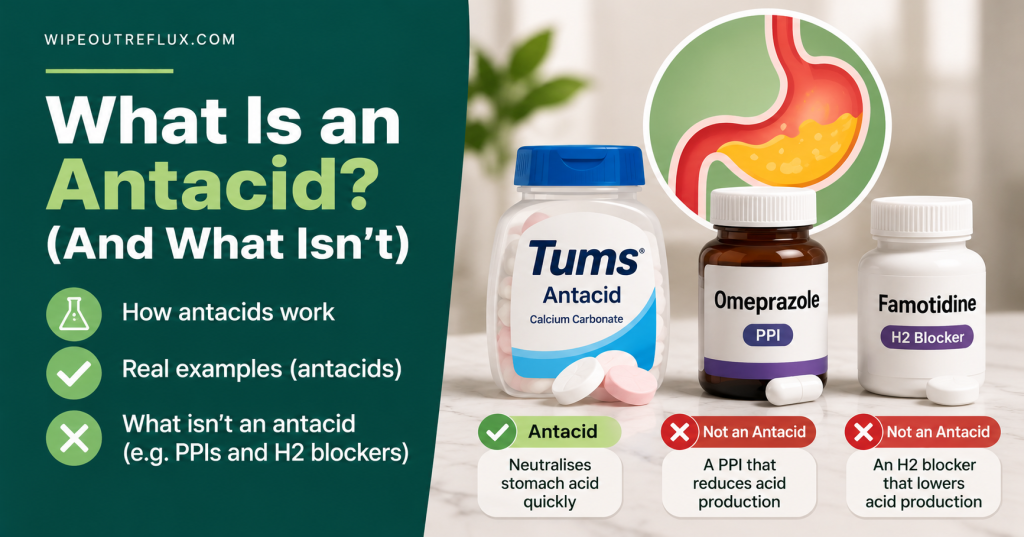
An antacid is a medicine that neutralizes acid that’s already in your stomach. It’s an alkaline compound, usually a calcium, magnesium, aluminum or sodium salt, that reacts with stomach acid and cancels it out. That’s why antacids like Tums, Rolaids, Maalox and Mylanta work within minutes to ease heartburn and indigestion.
What an antacid doesn’t do is stop your stomach making acid. That’s where a lot of confusion comes from. Omeprazole (Prilosec) and Pepcid (famotidine) are often called antacids, but they aren’t. They’re acid reducers that turn down acid production at the source, so they work much more slowly but last much longer. Pepto-Bismol isn’t a true antacid either.
Knowing the difference matters, because picking the wrong one for your symptoms is one of the most common reasons people feel their reflux medicine “isn’t working.”
Key Takeaways
- An antacid is an alkaline compound that chemically neutralizes stomach acid that’s already there.
- The main antacid ingredients are calcium carbonate, magnesium hydroxide, aluminum hydroxide and sodium bicarbonate.
- Antacids work within minutes but usually only last 30 to 60 minutes.
- Omeprazole is not an antacid. It’s a proton pump inhibitor (PPI) that blocks acid production.
- Pepcid (famotidine) is not an antacid. It’s an H2 blocker, although Pepcid Complete also contains antacids.
- Pepto-Bismol is not a true antacid. Its active ingredient, bismuth subsalicylate, works mainly by coating and soothing.
- Gaviscon is an alginate, which forms a raft to block reflux, often combined with an antacid.
How Do Antacids Work?
Your stomach produces hydrochloric acid to help digest food. Normally it stays put, but when the valve at the top of your stomach relaxes or gets overwhelmed, acid escapes upward and you feel heartburn.
Antacids work by basic chemistry. They contain a weak base that reacts with the acid to form water and a salt, raising the pH of your stomach contents so they’re less irritating if they reflux. Antacids are a mix of calcium, magnesium and aluminum salts, and they act by neutralizing stomach acid and inhibiting pepsin, the digestive enzyme that damages tissue during reflux [Salisbury & Terrell, StatPearls, 2023].
That pepsin point is more important than it sounds. Pepsin is the enzyme behind much of the damage in reflux, especially in the throat, and it’s only active in acidic conditions. I explain why in my guide to what pepsin is.
What legally counts as an antacid
In the US, a product can only be labeled an “antacid” if its active ingredients come from an FDA-approved list and the dose can neutralize at least 5 milliequivalents (mEq) of acid. This is called its acid-neutralizing capacity [US Code of Federal Regulations, 21 CFR 331.10]. That’s a useful definition, because it rules out a lot of products people assume are antacids.
The Main Types of Antacid
Almost every antacid on the shelf uses one or more of these four ingredients:
Calcium carbonate
Found in Tums, Rolaids and many store brands. It’s strong, fast and cheap, and the calcium counts toward your daily intake. The downsides are constipation and gas, because neutralizing acid with calcium carbonate releases carbon dioxide. Very high doses over long periods can push your blood calcium too high. More in are Tums safe for acid reflux.
Magnesium hydroxide or carbonate
Found in Milk of Magnesia, Rolaids and combination products like Mylanta and Maalox. Magnesium works quickly but tends to loosen stools, which is why it’s often paired with aluminum.
Aluminum hydroxide
Slower and gentler, and it tends to cause constipation. Combining aluminum with magnesium balances those effects out. A 2022 review confirmed the classic pattern: magnesium antacids cause dose-related diarrhea and aluminum antacids cause constipation [Garg et al., Journal of International Medical Research, 2022]. See my guides to Maalox and Mylanta for how these combinations compare.
Sodium bicarbonate
Baking soda and Alka-Seltzer. It’s the fastest acting but also the most absorbed, and it’s high in sodium. It produces a lot of gas and isn’t recommended for regular use, during pregnancy, or if you have high blood pressure, heart or kidney problems. Original Alka-Seltzer also contains aspirin. More in baking soda for heartburn.
What Isn’t an Antacid
This is where most of the confusion lies. Several of the most popular heartburn medicines aren’t antacids at all.
Is omeprazole an antacid?
No. Omeprazole (Prilosec) is a proton pump inhibitor (PPI). Instead of neutralizing acid, it switches off the proton pumps in your stomach lining that produce acid in the first place. It’s actually a prodrug: it has to be activated by acid, and then it binds permanently to the acid pump to shut it down [Shin & Kim, Journal of Neurogastroenterology and Motility, 2013].
That’s why omeprazole doesn’t help much if you take it when heartburn hits. It takes 1 to 4 days to reach its full effect, which I cover in how long omeprazole takes to work. The same goes for esomeprazole (Nexium), lansoprazole (Prevacid) and pantoprazole (Protonix). Packets of these are labeled “acid reducer,” not “antacid.”
Is Pepcid an antacid?
Plain Pepcid (Pepcid AC) is not. It contains famotidine, an H2 blocker that blocks one of the signals telling your stomach to make acid. Like omeprazole, it’s an acid reducer.
The exception is Pepcid Complete, which combines famotidine with calcium carbonate and magnesium hydroxide. So it’s part antacid for quick relief and part H2 blocker for longer relief. My guide to Pepcid for silent reflux goes into more detail.
Is Pepto-Bismol an antacid?
Not really. Pepto-Bismol’s active ingredient is bismuth subsalicylate, which is related to aspirin. It works mainly by coating and soothing the stomach and has mild anti-inflammatory and antibacterial effects. It’s useful for upset stomach and diarrhea, but it’s a weak option for heartburn. I explain why in does Pepto-Bismol help acid reflux.
Is Gaviscon an antacid?
Partly. Gaviscon is built around an alginate, a seaweed extract that forms a gel raft on top of your stomach contents when it meets acid. The raft physically blocks reflux, and because it can sit in the stomach for hours, it lasts longer than a regular antacid [Mandel et al., Alimentary Pharmacology & Therapeutics, 2000]. Most Gaviscon products also contain antacid ingredients. More in alginates for acid reflux.
Is Gas-X an antacid?
No. Gas-X contains simethicone, which breaks up gas bubbles. It doesn’t touch acid. Some antacids include simethicone too, which is why products like Mylanta are labeled “antacid/anti-gas.” See does Gas-X help acid reflux.
Antacids vs Acid Reducers: Speed vs Staying Power
The clearest way to see the difference is a classic study that compared Tums with Pepcid AC after a meal. Calcium carbonate started neutralizing acid within the first 30 minutes but its effect lasted only about 60 minutes. Famotidine didn’t kick in until about 90 minutes, but then lasted at least 9 hours. At their peak, the two were similarly strong [Feldman, JAMA, 1996].
Here’s how the three main options compare:
- Antacids (Tums, Rolaids, Maalox): work in minutes, last 30 to 60 minutes, best for occasional heartburn.
- H2 blockers (Pepcid, Tagamet): work in about 1 to 2 hours, last up to 12 hours, best taken before a meal or bed you know will cause trouble.
- PPIs (omeprazole, Nexium): take 1 to 4 days for full effect, give the strongest acid suppression, best for frequent heartburn or healing esophagitis.
For a direct comparison of the two acid reducers, see famotidine vs omeprazole, and for a full rundown of what’s on the shelf, see my guide to the best OTC medicine for acid reflux.
Side Effects and Limits of Antacids
Antacids are safe for occasional use, but they aren’t meant for daily, long-term reliance. US labels say not to use the maximum dose for more than two weeks without a doctor’s advice. Common issues include:
- Constipation with calcium and aluminum.
- Diarrhea with magnesium.
- Gas and burping with calcium carbonate and sodium bicarbonate, as they release carbon dioxide. I cover this in do antacids cause burping and gas.
- Acid rebound, where high doses and frequent use can prompt your stomach to make more acid [Garg et al., Journal of International Medical Research, 2022].
- Drug interactions. Antacids can block absorption of iron, thyroid medication and some antibiotics, so space them a couple of hours apart.
- Mineral build-up if you have kidney disease, as your body can’t clear magnesium, aluminum or calcium as easily.
If you’re pregnant, the rules are a little different. I’ve covered which options are safe in which antacids are safe in pregnancy.
Do Antacids Help Silent Reflux?
This is where I see a lot of people get stuck. With LPR, or silent reflux, the damage happens in the throat, not the stomach. Pepsin is carried up in tiny droplets, sticks to the throat tissue, and is reactivated whenever it meets acid again, including acid from food and drinks.
A standard antacid only neutralizes what’s in your stomach for an hour or so. It doesn’t stop reflux happening, and it doesn’t do anything about pepsin already sitting in your throat. That’s why antacids on their own rarely make much difference to LPR symptoms like throat clearing, hoarseness or a lump in the throat. Alginates are a better fit, because the raft physically blocks reflux from reaching your throat, and the real long-term work is done by changing what you eat, which is exactly what my Wipeout Diet Plan is built around. It’s also why PPIs often disappoint, as I explain in why PPIs don’t work for LPR.
When to See a Doctor
Antacids are for occasional symptoms. Talk to a doctor if you need them most days for more than two weeks, if your symptoms keep coming back after you stop, or if you notice difficulty swallowing, unexplained weight loss, vomiting, black stools or chest pain that’s different from your usual heartburn.
Conclusion
An antacid is an alkaline compound that neutralizes the acid already in your stomach. The main types are calcium carbonate (Tums), magnesium and aluminum combinations (Maalox, Mylanta) and sodium bicarbonate (baking soda, Alka-Seltzer). They work within minutes but only last about an hour. Omeprazole and plain Pepcid are not antacids. They’re acid reducers that work more slowly but last much longer. Pepto-Bismol isn’t a true antacid, and Gaviscon is an alginate raft that’s usually combined with one.
The bigger lesson is that every one of these medicines is dealing with acid after the fact. If you’re reaching for antacids every day, the most effective thing you can do is cut down how much reflux happens in the first place, and that starts with what and when you eat.
That’s what the Wipeout Diet Plan is designed to do. It started life as a plan for silent reflux, the stubborn throat-based kind, but because it targets the same root causes, it works equally well if your symptoms are classic heartburn. It shows you exactly which low-acid foods to build your meals around, which triggers to cut, and how to time your eating, so you rely far less on tablets to put the fire out.
Frequently Asked Questions
What is an antacid?
An antacid is a medicine that neutralizes stomach acid using an alkaline ingredient such as calcium carbonate, magnesium hydroxide, aluminum hydroxide or sodium bicarbonate. It gives fast relief from heartburn and indigestion but doesn’t reduce how much acid your stomach makes.
Is omeprazole an antacid?
No. Omeprazole is a proton pump inhibitor that blocks acid production. It takes 1 to 4 days to reach full effect, so it won’t give instant relief like an antacid. It’s labeled as an “acid reducer.”
Is Pepcid an antacid?
Pepcid AC isn’t. It contains famotidine, an H2 blocker that reduces acid production. Pepcid Complete is different because it combines famotidine with calcium carbonate and magnesium hydroxide, which are antacids.
Is Pepto-Bismol an antacid?
Not in the traditional sense. Its active ingredient, bismuth subsalicylate, coats and soothes the stomach rather than neutralizing acid.
What is the strongest antacid?
It depends on the dose rather than the brand. Products with higher acid-neutralizing capacity per dose, such as extra or ultra strength calcium carbonate or liquid aluminum and magnesium combinations, neutralize more acid. None of them last longer than a couple of hours.
Can you take an antacid with omeprazole?
Yes, an antacid can be used for breakthrough heartburn while you’re taking omeprazole. Many doctors suggest it. Just space antacids away from other medications, such as iron or thyroid tablets, by a few hours.
Is milk an antacid?
Milk may feel soothing at first, but it isn’t an effective antacid. Its fat and protein can trigger more acid production afterward. More in does milk help acid reflux.
Research & References
- [Salisbury & Terrell, StatPearls, 2023] — Clinical overview explaining that antacids are combinations of calcium, magnesium and aluminum salts that neutralize stomach acid and inhibit pepsin, along with their side effects and interactions.
- [US Code of Federal Regulations, 21 CFR 331.10] — FDA rule defining an over-the-counter antacid as a product using approved ingredients with an acid-neutralizing capacity of at least 5 mEq.
- [Garg et al., Journal of International Medical Research, 2022] — Review of antacid types and their place in self-care, confirming magnesium-related diarrhea, aluminum-related constipation and the risk of acid rebound with high, frequent doses.
- [Shin & Kim, Journal of Neurogastroenterology and Motility, 2013] — Review of how proton pump inhibitors work as acid-activated prodrugs that bind covalently to the gastric acid pump.
- [Mandel et al., Alimentary Pharmacology & Therapeutics, 2000] — Review explaining how alginate-raft products like Gaviscon form a floating gel barrier that differs from traditional antacids and gives longer-lasting relief.
- [Feldman, JAMA, 1996] — Randomized trial showing calcium carbonate acted within 30 minutes but lasted only 60 minutes, while famotidine started after 90 minutes and lasted at least 540 minutes.

David Gray
12 years living with LPR · Consultant & researcher
I've lived with LPR for twelve years — the misdiagnoses, the PPI courses that did nothing, the slow work of figuring out what actually helps. Wipeout Reflux is where I translate the research into plain terms for people stuck in the same place. Every claim here is sourced to peer-reviewed work, and I consult one-to-one with LPR sufferers.