
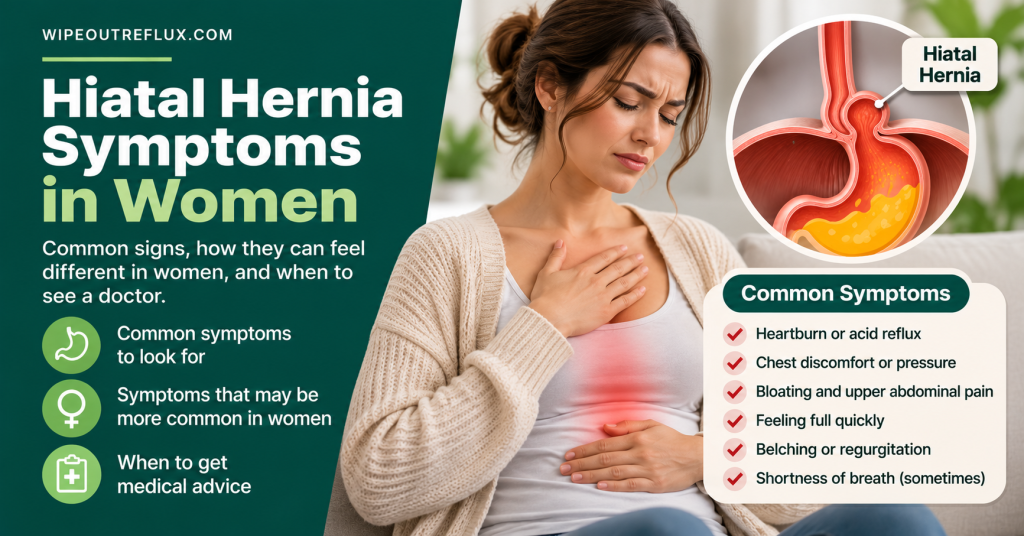
The most common hiatal hernia symptoms in women are heartburn, regurgitation, chest pain or pressure, bloating and feeling full quickly, burping, and trouble swallowing. Many women also get throat symptoms like hoarseness, a cough or a lump-in-the-throat feeling. These are the same symptoms men get, but women are more likely to have a hiatal hernia in the first place, more likely to have the larger paraesophageal type, and more likely to have symptoms that get mistaken for something else.
Some of the most easily missed signs in women aren’t digestive at all. Unexplained tiredness from slow blood loss, breathlessness, and chest discomfort that could equally be the heart all deserve a closer look.
Key Takeaways
- Hiatal hernias are more common in women than men, and become more common with age.
- Large paraesophageal hernias occur mostly in older women.
- Typical symptoms are heartburn, regurgitation, chest pain, bloating, early fullness, burping and trouble swallowing.
- Yes, a hiatal hernia can cause bloating, particularly after meals and with larger hernias.
- Large hernias can cause iron deficiency anemia through slow bleeding, which shows up as fatigue.
- Large hernias can also cause shortness of breath by crowding the lungs.
- Women’s heart attack symptoms often look like indigestion, so new chest symptoms should always be checked.
Are Hiatal Hernias More Common in Women?
Yes. In a large study that looked at chest CT scans of more than 3,000 adults aged 53 to 94, hiatal hernias were found in 12.7% of women compared with 7.0% of men. They also became more common with every decade of age, rising from 2.4% in people in their 50s to 16.6% in people in their 80s [Kim et al., BMJ Open Gastroenterology, 2021].
The difference is even more striking with paraesophageal hernias, the less common type where part of the stomach pushes up beside the esophagus. These are found more often in older women. In a registry of more than 3,000 people having paraesophageal hernia repair, about two thirds of patients under 80 were women, rising to over three quarters in those aged 80 and older [Staerkle et al., Surgical Endoscopy, 2019].
If you’re not sure how hiatal hernias work, my guide to hiatal hernia and reflux explains the two types and why they cause reflux.
Common Hiatal Hernia Symptoms in Women
Small sliding hernias often cause no symptoms at all. When they do, the symptoms are mostly those of reflux. Larger hernias, especially paraesophageal ones, add mechanical symptoms caused by part of the stomach sitting in the chest.
Heartburn and regurgitation
A hernia weakens the barrier between your stomach and esophagus, so acid escapes more easily. That means burning behind the breastbone, a sour or bitter taste, and food or liquid coming back up, especially after meals, when bending over or when lying down. If you’re not sure what you’re feeling, see what does heartburn feel like.
Women with reflux are more likely than men to have the non-erosive form, where symptoms are troublesome but the esophagus looks normal on endoscopy. Women also tend to report more frequent symptoms [Kim et al., Journal of Neurogastroenterology and Motility, 2016]. That can mean being told “everything looks fine” when you clearly don’t feel fine.
Chest pain or pressure
A hernia can cause a burning, squeezing or full feeling in the chest, often after eating. Paraesophageal hernias in particular are linked to pain behind the breastbone along with trouble swallowing, vomiting and regurgitation [Staerkle et al., Surgical Endoscopy, 2019]. More on this in acid reflux and chest tightness and chest pain after eating.
Bloating and feeling full quickly
Many women notice upper abdominal bloating, pressure or feeling full after just a few bites. I cover this in more detail below.
Burping and hiccups
Frequent burping is common with a hernia, as is a feeling of trapped air in the chest. See acid reflux and burping and trapped gas in the chest.
Trouble swallowing
Food may feel like it sticks low in the chest, especially with larger hernias where the esophagus gets kinked. See food feels stuck in chest. New or worsening difficulty swallowing should always be checked by a doctor.
Throat and voice symptoms
When reflux reaches the throat, it causes LPR, or silent reflux. Symptoms include hoarseness, constant throat clearing, a chronic cough, post-nasal drip and a lump-in-the-throat feeling, often without much heartburn. These are easy to put down to allergies or a lingering cold. My guide to LPR symptoms covers the full list.
Will a Hiatal Hernia Cause Bloating?
It can. There are a few ways a hiatal hernia leads to bloating:
- Less room for your stomach. With part of the stomach above the diaphragm, there’s less space for food below it. That can make you feel full and swollen after small meals, and it’s more noticeable with larger hernias.
- Trapped gas. Air can get caught in the herniated pouch, causing pressure in the upper abdomen or chest that eases when you burp.
- Swallowing more air. People with reflux often swallow more air, whether through frequent swallowing to clear the throat or a burping habit, which adds to the bloated feeling.
- Slower emptying. Big or fatty meals sit in the stomach for longer, pushing up on the hernia and keeping you uncomfortable.
Bloating isn’t specific to hiatal hernias, though. Lower abdominal bloating, especially if it changes with your cycle or comes with changes in your bowel habits, is more likely to be related to IBS, constipation or hormones. See IBS and acid reflux and acid reflux and your period. Persistent bloating in women over 50, particularly with feeling full quickly or pelvic pain, should be checked by a doctor to rule out other causes.
Symptoms Women Often Miss
Fatigue from iron deficiency anemia
This is one of the most overlooked hernia symptoms. Large hiatal hernias can develop small erosions or ulcers where the stomach is squeezed by the diaphragm, called Cameron lesions. They bleed slowly, often for months, and the first sign is usually tiredness, breathlessness on exertion, or pale skin from iron deficiency. Cameron lesions are more common with large hernias and with use of anti-inflammatory painkillers like ibuprofen [Gray et al., Diseases of the Esophagus, 2015].
In women, low iron is very easy to put down to periods or diet, especially before menopause. If your iron stays low despite supplements, or you have anemia after menopause, it’s worth asking whether a hiatal hernia could be involved.
Shortness of breath
A large hernia takes up space in the chest and can press on the lungs. Women may notice breathlessness when walking, after meals or when lying down. A meta-analysis found that surgical repair of hiatal hernias significantly improved lung function [Wang et al., Hernia, 2023]. Reflux itself can also cause breathing symptoms. See silent reflux and shortness of breath.
Palpitations
Some women notice a fluttering heartbeat after large meals. Reflux and a full stomach can irritate the nerves around the heart, and a large hernia can sit right behind it. More in acid reflux and heart palpitations. Palpitations still need checking by a doctor, as they can have many other causes.
Nausea and vomiting
Larger hernias can cause nausea or vomiting after meals, especially if part of the stomach gets twisted or partially blocked. See silent reflux and nausea.
Why Women May Be More Prone
The exact reasons aren’t fully understood, but several factors are thought to play a part:
- Age. The tissues anchoring the esophagus to the diaphragm loosen with age, and women live longer on average.
- Pregnancy. Each pregnancy puts months of upward pressure on the stomach and diaphragm. See acid reflux and pregnancy.
- Weight. Extra weight around the middle increases abdominal pressure, and in the CT study, hernias that grew over 10 years were in people with a higher BMI [Kim et al., BMJ Open Gastroenterology, 2021].
- Chronic constipation. Regular straining puts repeated pressure on the hiatus, and constipation is more common in women.
- Menopause. Hormonal changes may affect connective tissue and reflux symptoms. See menopause and acid reflux.
- Connective tissue conditions like hypermobile Ehlers-Danlos syndrome, which are more common in women. See EDS, POTS and acid reflux.
Is It a Hiatal Hernia or Your Heart?
This matters more for women than men. Women’s heart attack symptoms are often less “classic.” In a study of 515 women who’d had a heart attack, only 57% reported any chest discomfort during the attack itself, while shortness of breath, weakness and unusual fatigue were common. In the weeks beforehand, 39% had noticed indigestion [McSweeney et al., Circulation, 2003].
That overlap means you should never assume new chest pressure, breathlessness or “indigestion” is just your hernia. Call emergency services if chest discomfort comes with shortness of breath, sweating, nausea, dizziness, or pain spreading to your arm, jaw, neck or back, or if it comes on with exertion. I go through the differences in heartburn or heart attack.
Gallbladder problems, which are also more common in women, can cause upper abdominal pain and bloating after fatty meals too, so it’s worth mentioning to your doctor if your pain sits under your right ribs.
When to Get Urgent Help
Rarely, part of the stomach can get trapped or twisted in the chest. Seek emergency care if you have:
- Sudden, severe chest or upper abdominal pain
- Retching or trying to vomit without being able to bring anything up
- Being completely unable to swallow, even liquids
- Vomiting blood, or black, tarry stools
How a Hiatal Hernia Is Diagnosed
Hiatal hernias are usually confirmed with a barium swallow or an upper endoscopy, and sometimes picked up by chance on a CT scan. Esophageal manometry can help measure the size and how well your esophagus is working. If you have anemia, your doctor may also check your iron levels and look for Cameron lesions during endoscopy.
What Helps
Most women with a hiatal hernia manage it without surgery by tackling the reflux: eating smaller meals, stopping eating 3 hours before bed, raising the head of the bed, losing weight if needed, avoiding tight waistbands and treating constipation. Alginates like Gaviscon, H2 blockers and PPIs can help too. Surgery is mainly for large paraesophageal hernias that cause symptoms, complications like anemia, or reflux that won’t respond to treatment.
I go through every option step by step in my guide on how to treat a hiatal hernia. If diet is where you want to start, the Wipeout Diet Plan lays out exactly what to eat to take the pressure off.
Conclusion
Hiatal hernia symptoms in women include heartburn, regurgitation, chest pain or pressure, bloating, feeling full quickly, burping, trouble swallowing and throat symptoms like hoarseness and cough. Women are more likely than men to have a hiatal hernia, and large paraesophageal hernias mostly affect older women. Some of the most important signs, like fatigue from iron deficiency anemia and shortness of breath, are easy to put down to something else. Because women’s heart symptoms can look like indigestion, any new chest symptom should be checked.
For most women, the hernia itself isn’t the problem day to day. The reflux it allows is, and that’s very treatable. Smaller, gentler, low-acid meals put less pressure on the hiatus and leave less to reflux, and many women notice the bloating and chest pressure ease within a few weeks.
That’s why I’d recommend the Wipeout Diet Plan. I built it first and foremost for LPR, the stubborn throat-based kind of reflux that so many women live with, but because it targets the same underlying causes, it works just as well for the heartburn, bloating and regurgitation a hiatal hernia brings. It shows you what to eat, what to avoid and how to time your meals, so you can feel better without guessing.
Frequently Asked Questions
What are the symptoms of a hiatal hernia in women?
The most common are heartburn, regurgitation, chest pain or pressure, bloating, feeling full quickly, burping and trouble swallowing. Throat symptoms like hoarseness and cough, fatigue from anemia and shortness of breath can also occur, especially with larger hernias.
Will a hiatal hernia cause bloating?
Yes, it can. A hernia can trap gas, reduce the space your stomach has below the diaphragm, and make you feel full and swollen after small meals. Bloating is usually in the upper abdomen and worse after eating.
Are hiatal hernias more common in women?
Yes. A large CT study found hiatal hernias in 12.7% of women compared with 7.0% of men, and paraesophageal hernias in particular are more common in older women.
Can a hiatal hernia cause tiredness?
It can. Large hernias can develop small ulcers called Cameron lesions that bleed slowly and cause iron deficiency anemia, leading to fatigue and breathlessness. Poor sleep from nighttime reflux can also leave you tired.
Can a hiatal hernia cause back pain?
Some people feel hernia or reflux discomfort between the shoulder blades or in the upper back. New back pain with chest symptoms should be checked to rule out a heart problem. See acid reflux and back pain.
Can pregnancy cause a hiatal hernia?
Pregnancy increases pressure on the stomach and diaphragm, and it’s thought to be one of the factors that may contribute to hiatal hernias in women. Reflux in pregnancy is very common and usually settles after birth.
How do I know if it’s a hiatal hernia or a heart problem?
You can’t always tell from symptoms alone, especially as women’s heart attacks often cause indigestion-like symptoms. Get urgent help if chest discomfort comes with breathlessness, sweating, nausea, dizziness or pain spreading to your arm, jaw or back.
Research & References
- [Kim et al., BMJ Open Gastroenterology, 2021] — CT study of 3,200 adults finding hiatal hernias in 12.7% of women versus 7.0% of men, increasing with age, with hernia growth over 10 years linked to higher BMI.
- [Staerkle et al., Surgical Endoscopy, 2019] — Registry analysis of over 3,000 paraesophageal hernia repairs noting these hernias are found more often in elderly women, with women making up the majority of patients.
- [Kim et al., Journal of Neurogastroenterology and Motility, 2016] — Review of sex and gender differences in GERD showing non-erosive reflux disease affects more women than men and is associated with more frequent symptoms.
- [Gray et al., Diseases of the Esophagus, 2015] — Study of Cameron lesions in hiatal hernia patients, finding them more common with large hernias and NSAID use, and associated with gastrointestinal bleeding.
- [Wang et al., Hernia, 2023] — Systematic review and meta-analysis showing surgical repair of hiatal hernia significantly improves lung function measures.
- [McSweeney et al., Circulation, 2003] — Study of 515 women after a heart attack finding only 57% had chest discomfort during the attack, with indigestion, fatigue and breathlessness common warning symptoms.

David Gray
12 years living with LPR · Consultant & researcher
I've lived with LPR for twelve years — the misdiagnoses, the PPI courses that did nothing, the slow work of figuring out what actually helps. Wipeout Reflux is where I translate the research into plain terms for people stuck in the same place. Every claim here is sourced to peer-reviewed work, and I consult one-to-one with LPR sufferers.