
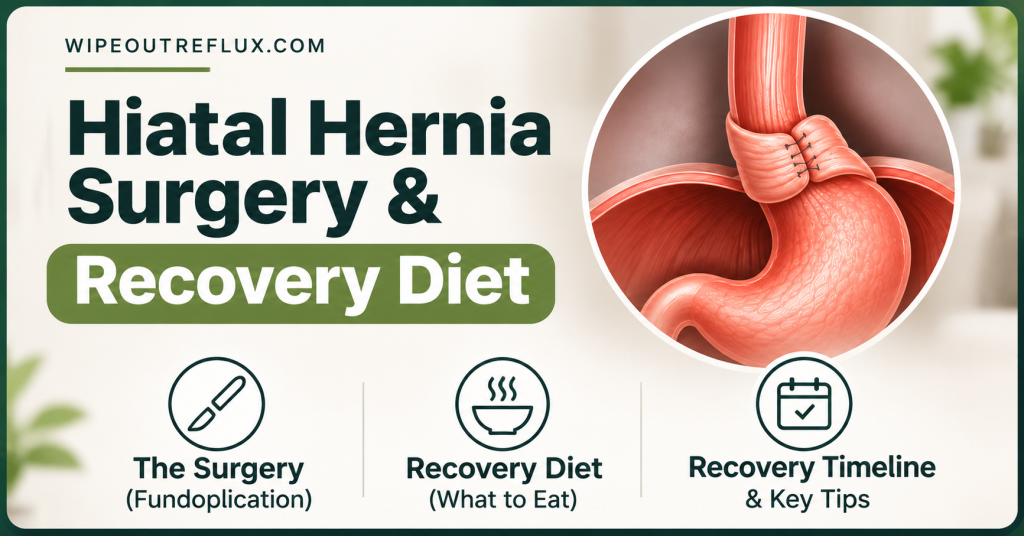
Hiatal hernia surgery is usually done laparoscopically, through five or six small cuts in the abdomen. The surgeon pulls the stomach back down below the diaphragm, stitches the stretched opening (the hiatus) tighter, and in most cases wraps the top of the stomach around the lower esophagus to rebuild the anti-reflux valve. Most people go home after 1 to 2 days and are back to light activities within a couple of weeks.
The recovery diet is what catches most people out. For around 6 weeks, you’ll move gradually from liquids to soft foods to normal meals, because the repair is swollen and the stitches are new. Eat too much, too fast, and food can get stuck or strain the repair. Below I’ll walk through the operation, recovery, and exactly how the diet works.
Key Takeaways
- Laparoscopic (keyhole) repair is the standard approach and has better short-term outcomes than open surgery.
- The operation involves reducing the hernia, tightening the hiatus and usually adding a fundoplication.
- Most people stay in hospital for 1 to 2 days.
- Expect to avoid heavy lifting for several weeks, with full recovery taking around 6 to 12 weeks.
- The diet progresses in stages: clear liquids, full liquids, pureed and very soft food, soft solids, then normal food at around 6 weeks.
- Temporary trouble swallowing, bloating and difficulty burping are common early on.
- Hernias can come back on imaging after repair, but most people keep their symptom relief.
Who Needs Hiatal Hernia Surgery?
Most hiatal hernias never need an operation. Small sliding hernias that cause no symptoms don’t need repairing, and most reflux from a hernia can be managed with lifestyle changes, diet and medication. Surgery is generally recommended for [Kohn et al., Surgical Endoscopy, 2013]:
- Paraesophageal hernias that are causing symptoms
- Reflux that doesn’t respond well to medication, or if you’d rather not take medication for life
- Complications such as severe esophagitis, strictures, bleeding or anemia
- Emergencies, where the stomach becomes twisted or trapped
For symptomatic paraesophageal hernias, there’s a strong case for planned surgery rather than waiting. Emergency repairs carry a much higher risk: one large registry review noted mortality is around seven times higher after emergency repair than after planned repair [Staerkle et al., Surgical Endoscopy, 2019].
If you’re still weighing up your options, my guide on how to treat a hiatal hernia covers everything short of surgery.
What Happens During Laparoscopic Hiatal Hernia Repair
The operation is done under general anesthetic and usually takes around 1 to 3 hours, depending on the size of the hernia. Laparoscopic repair has become the standard because it has better outcomes than open surgery [Howell et al., Scientific Reports, 2020]. Many centers also use robotic-assisted keyhole surgery, which works in the same way.
The main steps are:
- Reducing the hernia. The surgeon gently pulls the stomach back down from the chest into the abdomen.
- Removing the hernia sac. The lining that has stretched up into the chest is freed and removed so the hernia is less likely to slide back.
- Freeing the esophagus. The lower esophagus is mobilized so a few centimeters sit comfortably below the diaphragm without tension.
- Tightening the hiatus. The two muscle bands of the diaphragm (the crura) are stitched closer together around the esophagus. Some surgeons reinforce this with mesh, particularly for large hernias.
- Adding a fundoplication. The top of the stomach is wrapped around the lower esophagus to recreate a valve. Guidelines suggest this be done routinely during hernia repair [Daly et al., Surgical Endoscopy, 2024]. A full 360-degree wrap is a Nissen, and a partial wrap is a Toupet or Dor. I compare them in Nissen vs Toupet fundoplication.
For frail patients or very large hernias, the surgeon may instead stitch the stomach to the abdominal wall (a gastropexy) to stop it moving back up.
Mesh or no mesh?
This is still debated. Mesh reduces the chance of the hernia coming back in the short term, but the benefit appears to fade over time, and the latest guidelines found the evidence too mixed to recommend it routinely [Daly et al., Surgical Endoscopy, 2024]. Your surgeon will decide based on the size of the opening and how much tension the stitches are under.
Risks and Results
Common short-term effects
- Trouble swallowing (dysphagia). Swelling around the wrap makes food feel like it sticks. It’s very common for the first few weeks and usually settles as the swelling goes down.
- Gas bloat and difficulty burping. The new valve makes it harder to let air out, so trapped gas, bloating and passing more wind are common early on.
- Shoulder tip pain. Gas used to inflate the abdomen during surgery can irritate the diaphragm for a day or two.
- Early fullness. Most people feel full quickly and lose some weight in the first few weeks.
Less common complications
As with any operation, there’s a small risk of bleeding, infection, injury to nearby organs, or a lung complication. Rarely, swallowing problems persist and need treatment such as stretching (see esophageal dilation). Overall, hiatal hernia repair can be performed safely with a low rate of complications [Howell et al., Scientific Reports, 2020].
Can the hernia come back?
Yes, and it’s worth knowing this going in. In a multicenter trial following people for around 5 years after laparoscopic paraesophageal hernia repair, imaging showed some degree of recurrence in more than half of patients. Despite that, relief of symptoms and quality of life remained good and durable for most [Oelschlager et al., Journal of the American College of Surgeons, 2011]. Most recurrences are small and don’t cause symptoms. Keeping your weight down and avoiding straining after surgery helps protect the repair.
Benefits beyond reflux
Large hernias can press on the lungs. A meta-analysis found hiatal hernia repair significantly improved lung function measures, which is why some people notice they can breathe more easily afterward [Wang et al., Hernia, 2023].
Recovery Timeline
Everyone recovers differently, and your surgeon’s instructions always come first, but this is a typical picture:
- In hospital (1 to 2 days): You’ll be up and walking the same day or the next, starting on sips of clear fluids.
- Week 1: Tired and sore, with some swallowing difficulty and bloating. Walk several times a day. Pain is usually controlled with simple painkillers, often in liquid form.
- Weeks 2 to 3: Energy returns. Many people with desk jobs go back to work. Still no heavy lifting.
- Weeks 4 to 6: Swallowing improves noticeably and you’ll be moving onto more normal textures.
- 6 weeks onward: Most people are eating a near-normal diet and gradually returning to exercise. Full recovery, including heavier lifting and core exercise, often takes 6 to 12 weeks.
Lifting limits vary between surgeons, but avoiding anything heavy and avoiding straining in the early weeks is standard advice, because pressure inside your abdomen pushes against the fresh repair. Treat constipation early with fluids, fiber and a gentle laxative if needed. Coughing, vomiting and heavy retching also strain the repair, so let your team know if you’re feeling sick.
The Diet After Hiatal Hernia Surgery
The staged diet exists for two reasons. First, the wrap and hiatus are swollen, so the passage into your stomach is temporarily narrower. Large or dry pieces of food can get stuck. Second, the stitches are new, and a stretched, overfull stomach or forceful vomiting puts strain on them.
Your hospital will give you its own plan, and you should follow that. Most look broadly like this:
Stage 1: Clear liquids (first 1 to 2 days)
Water, clear broth, diluted non-citrus juice, weak decaf tea, gelatin and ice pops. Take small sips throughout the day rather than large gulps.
Stage 2: Full liquids (roughly days 3 to 7)
Smooth soups, milk or plant milk, protein shakes, smooth yogurt, thin oatmeal or cream of wheat, and blended smoothies without seeds. Focus on getting enough protein and fluid.
Stage 3: Pureed and very soft food (roughly weeks 2 to 3)
Mashed potatoes, scrambled eggs, cottage cheese, pureed vegetables, well-cooked oatmeal, hummus, flaked soft fish, and mashed banana or avocado. Everything should be soft enough to mash with a fork.
Stage 4: Soft solids (roughly weeks 4 to 6)
Tender, moist foods like soft-cooked chicken or fish, well-cooked vegetables, soft pasta and pancakes. Cut food into small pieces and chew thoroughly.
Stage 5: Back to normal (from around 6 weeks)
Gradually reintroduce firmer textures one at a time. Keep chewing well and eating slowly.
I’ve written a detailed week-by-week plan with meal ideas and the evidence behind each stage in my fundoplication recovery diet guide. It applies to hiatal hernia repair too, since most repairs include a fundoplication.
Foods that commonly cause trouble early on
- Bread, rolls and doughy foods, which form a sticky lump that’s hard to swallow
- Dry or tough meat, like steak, pork chops or dry chicken breast
- Rice, which can clump and stick
- Raw vegetables, nuts, seeds and popcorn
- Fizzy drinks and beer, because you can’t easily burp the gas out
- Gas-producing foods like beans, broccoli and cabbage, which add to bloating
Eating habits that help
- Eat 5 to 6 small meals a day rather than 3 large ones.
- Take small bites, chew thoroughly and put your fork down between mouthfuls.
- Sit upright to eat and stay upright for at least 30 minutes afterward.
- Sip drinks between meals rather than with large mouthfuls of food.
- Avoid chewing gum and drinking through straws, which make you swallow more air.
- Ask your pharmacist whether any tablets need to be crushed or swapped for liquids in the early weeks.
If food gets stuck, stop eating, stay upright and take small sips of warm water. If you can’t swallow your own saliva or keep fluids down, contact your surgical team straight away.
Longer term
Once you’re fully healed, many people can eat a much wider range of foods than before. But the habits that protect the repair, like smaller meals, not eating late, and keeping your weight down, are worth keeping for good. For many people the surgery fixes the mechanics, while diet keeps things calm, especially if you had throat symptoms. A low-acid way of eating like the Wipeout Diet Plan is a good long-term base.
When to Call Your Surgical Team
Contact your team or seek urgent help if you have:
- Inability to swallow liquids or your own saliva
- Persistent vomiting or retching
- Severe or worsening chest or abdominal pain
- Fever, or redness and discharge from the wounds
- Shortness of breath or chest pain
- Black stools or vomiting blood
- Severe bloating with an inability to burp or pass gas
Alternatives to a Full Repair
For people with reflux and only a small hernia, there are other procedures, such as the LINX device or the TIF procedure, though these usually still involve repairing the hiatus if a hernia is present. If you have LPR rather than classic heartburn, see my guide to LPR surgery for what to consider first.
Conclusion
Laparoscopic hiatal hernia repair involves pulling the stomach back below the diaphragm, tightening the hiatus, and usually adding a fundoplication to rebuild the anti-reflux valve. Most people go home within 1 to 2 days and are back to light activities in a couple of weeks, though full recovery takes around 6 to 12 weeks. The diet after a hiatal hernia operation moves in stages from clear liquids to full liquids, pureed and soft foods, and then normal meals at around 6 weeks, to protect the swollen repair. Temporary swallowing difficulty and bloating are common, and while hernias can recur on imaging, most people keep their symptom relief.
Surgery fixes the mechanics, but what you eat still matters, both during recovery and for years afterward. Gentle, low-acid meals help the repair settle and keep any remaining reflux in check.
Once you’re through the early stages, the Wipeout Diet Plan is a great way to build your long-term eating around. It was built first and foremost for LPR, the stubborn throat-based kind of reflux, but because it targets the same underlying causes, it works just as well for anyone with GERD, heartburn or a history of hiatal hernia. It shows you what to eat, what to avoid and how to time your meals, so you can protect your repair and keep reflux from creeping back.
Frequently Asked Questions
How long does it take to recover from laparoscopic hiatal hernia repair?
Most people leave hospital after 1 to 2 days, return to light activities and desk work within 1 to 3 weeks, and are back to a normal diet around 6 weeks. Full recovery, including heavy lifting and core exercise, usually takes 6 to 12 weeks.
What can I eat after hiatal hernia surgery?
You’ll start with clear liquids, then full liquids, then pureed and very soft foods, then soft solids, before returning to normal food at around 6 weeks. Always follow your own surgeon’s plan, as timings vary.
Why can’t I eat bread after hiatal hernia surgery?
Bread forms a soft, sticky lump when chewed that can easily get stuck in the swollen area around the repair. Most surgeons advise avoiding it for the first several weeks.
Is it normal to have trouble swallowing after surgery?
Yes. Swelling around the wrap commonly causes difficulty swallowing for the first few weeks. It usually improves steadily. Contact your team if you can’t swallow liquids or saliva.
Will I be able to burp after hiatal hernia surgery?
Burping is often harder at first, especially after a full Nissen wrap, which can cause bloating. This usually improves over the following months. Avoid fizzy drinks and gulping air in the meantime.
Can a hiatal hernia come back after surgery?
Yes. Long-term studies show many repairs show some recurrence on imaging after several years, but most are small and don’t cause symptoms. Only a small proportion of people need another operation.
Will I still need reflux medication after surgery?
Many people are able to stop their reflux medication after surgery, although some need it again over time. Your surgeon will advise you on when to stop. For tapering, see getting off PPIs.
Research & References
- [Kohn et al., Surgical Endoscopy, 2013] — SAGES guidelines setting out when hiatal hernia repair is indicated, including symptomatic paraesophageal hernias and refractory reflux.
- [Daly et al., Surgical Endoscopy, 2024] — Updated SAGES guidelines suggesting a fundoplication be routinely performed during hiatal hernia repair, with evidence for routine mesh use found to be equivocal.
- [Staerkle et al., Surgical Endoscopy, 2019] — Registry analysis of paraesophageal hernia repair noting a sevenfold higher mortality rate for emergency repairs compared with elective repairs.
- [Howell et al., Scientific Reports, 2020] — Review of 128 hiatal hernia repairs reporting a median hospital stay of 1 day for laparoscopic repair and a low complication rate.
- [Oelschlager et al., Journal of the American College of Surgeons, 2011] — Long-term follow-up of a randomized trial finding radiological recurrence in more than half of patients at around 5 years, with durable symptom relief and quality of life.
- [Wang et al., Hernia, 2023] — Systematic review and meta-analysis showing hiatal hernia repair significantly improves lung function measures.

David Gray
12 years living with LPR · Consultant & researcher
I've lived with LPR for twelve years — the misdiagnoses, the PPI courses that did nothing, the slow work of figuring out what actually helps. Wipeout Reflux is where I translate the research into plain terms for people stuck in the same place. Every claim here is sourced to peer-reviewed work, and I consult one-to-one with LPR sufferers.