
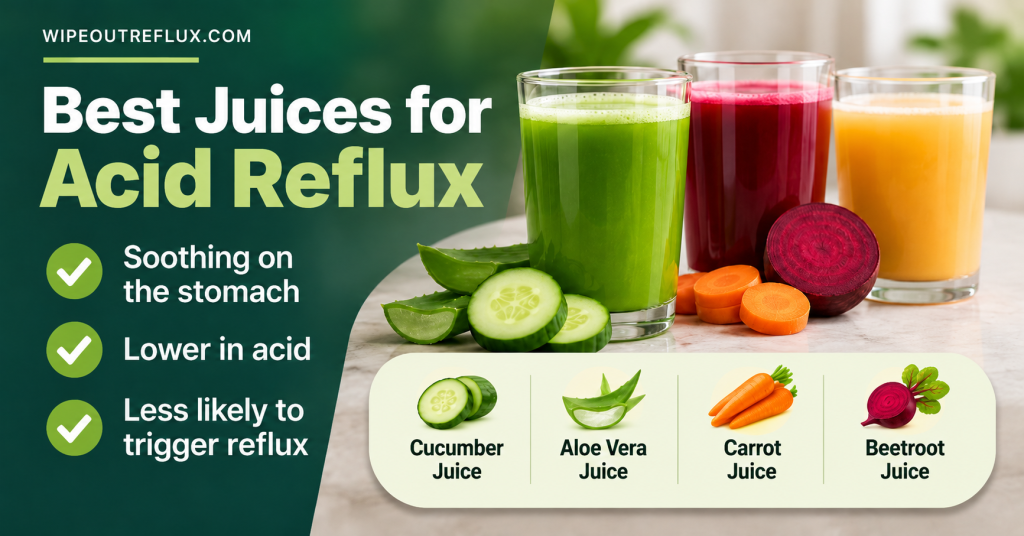
The best juices for acid reflux are low-acid vegetable and melon juices: carrot juice, aloe vera juice, cucumber and celery juice, cantaloupe or honeydew juice, watermelon juice, papaya juice, and mild green juices made without lemon. These are far less acidic than typical fruit juices, so they’re much gentler on an irritated esophagus or throat.
The juices most likely to cause trouble are citrus and high-acid fruit juices: orange, grapefruit, lemon, lime, cranberry, pineapple, tomato and, for many people, apple and grape. Most of these sit around pH 2 to 4, which is acidic enough to irritate inflamed tissue and reactivate pepsin, the enzyme behind a lot of reflux damage.
Key Takeaways
- Carrot juice is one of the best options, with a near-neutral pH of roughly 6.2 to 7.0 when fresh.
- In one study of 35 beverages, carrot juice had one of the lowest heartburn scores of all.
- Aloe vera, cucumber, celery, melon, papaya and watermelon juices are also good low-acid choices.
- Citrus, cranberry, pineapple, tomato and grape juices are the most common juice triggers.
- Bottled juices often contain added citric or ascorbic acid, which lowers their pH, so check the label.
- If you have silent reflux (LPR), aim for drinks above pH 5, as pepsin can stay active up to pH 6.5.
- Drink juice in small amounts with food, not on an empty stomach or close to bedtime.
Why Some Juices Trigger Reflux and Others Don’t
It mostly comes down to acid. When you have reflux, the lining of your esophagus, and sometimes your throat, is already irritated. Drinking something acidic on top of that can sting, burn or make symptoms flare.
There’s a second, less obvious reason that matters a lot for throat symptoms. When stomach contents reflux, they carry pepsin, a digestive enzyme that can stick to the tissue in your throat. Pepsin is activated by acid, and human pepsin can stay partly active right up to pH 6.5. That’s why a low-acid diet that cut out all foods and drinks below pH 5 helped 19 out of 20 people with stubborn silent reflux that hadn’t responded to PPIs [Koufman, Annals of Otology, Rhinology & Laryngology, 2011]. I explain the mechanism in what is pepsin.
pH isn’t the whole story, though. How much total acid a drink contains, known as its titratable acidity, also seems to matter. In a study comparing 35 popular beverages, the titratable acidity of citrus juices correlated with how much heartburn they caused. Orange juice had the highest titratable acidity and was one of the worst for heartburn, while carrot juice had one of the lowest heartburn scores of any drink tested [Kim et al., The Korean Journal of Gastroenterology, 2010].
Does juice actually cause reflux?
Interestingly, a large study of more than 48,000 women found that drinking juice wasn’t linked to developing new reflux symptoms, while coffee, tea and soda were [Mehta et al., Clinical Gastroenterology and Hepatology, 2020]. So juice doesn’t seem to cause reflux in people who don’t already have it. But if you already have reflux, especially with throat symptoms, acidic juice is one of the most common things that makes it flare. That’s the situation this guide is for.
The Best Juices for Acid Reflux
1. Carrot juice
Carrot juice is my top pick. Fresh carrot juice measured between about pH 6.2 and 7.0 in one analysis, which is close to neutral [Petek et al., Scientific Papers Series B Horticulture, 2021]. It also scored among the lowest for heartburn in the beverage study above. It’s naturally sweet, so it works well on its own or blended with cucumber or a little ginger. More in are carrots good for acid reflux.
One thing to watch: many shop-bought carrot juices are blended with orange or apple, or have acid added to extend shelf life. Pure, unblended carrot juice is the one you want.
2. Aloe vera juice
Aloe vera juice has a reputation for soothing the gut, and in the beverage study it had by far the lowest titratable acidity of the juices tested [Kim et al., The Korean Journal of Gastroenterology, 2010]. Choose an inner-leaf, decolorized product made for drinking, as whole-leaf aloe contains latex compounds with a strong laxative effect. Many brands also add citric acid, so check the label. I cover the research in is aloe vera juice good for acid reflux.
3. Cucumber and celery juice
Cucumber and celery are both low-acid, high-water vegetables, at roughly pH 5.1 to 5.8 and 5.7 to 6.0 respectively, and their juices are mild and refreshing [Clemson Cooperative Extension, pH Values of Common Foods and Ingredients]. They make a great base for a green juice. See do cucumbers cause acid reflux and is celery good for acid reflux.
4. Melon juice (cantaloupe and honeydew)
Cantaloupe and honeydew are among the least acidic fruits, at roughly pH 6.1 to 6.6 and 6.0 to 6.7 [Clemson Cooperative Extension, pH Values of Common Foods and Ingredients]. Blended melon makes a sweet, gentle juice. More in is cantaloupe good for acid reflux.
5. Watermelon juice
Watermelon is low in acid (around pH 5.2 to 5.6) and very high in water, which makes it one of the more reflux-friendly fruit juices. Some people find large amounts bloating, so start small. See is watermelon good for acid reflux.
6. Papaya juice
Fresh papaya has a pH of around 5.2 to 6.0, making it one of the gentler tropical fruits [Clemson Cooperative Extension, pH Values of Common Foods and Ingredients]. Many bottled papaya nectars are mixed with other fruits or acids, so fresh or pure is best. See is papaya good for acid reflux.
7. Mild green juices
Juices made from spinach, kale, cucumber and celery are low in acid and packed with nutrients. The catch is that most recipes and shop-bought green juices add lemon, lime, pineapple or green apple to improve the taste, which brings the acid right back. Make your own, or check the ingredients. See is spinach good for acid reflux.
Worth mentioning: coconut water
Coconut water isn’t technically a juice, but it’s a popular alternative and much less acidic than fruit juice. More in is coconut water good for acid reflux.
Juices to Avoid With Acid Reflux
These are the juices that most often trigger symptoms. US government testing puts lemon juice at around pH 2.2, cranberry juice at about 3.4, apple juice at roughly 3.5 to 3.7, and orange juice at about 3.5 to 4.2 [USDA Agricultural Research Service, pH of Selected Foods]. A survey of bottled drinks in US stores found juices ranged from pH 2.56 for cranberry to 4.19 for V8, all well below the pH 5 threshold that matters for silent reflux [Reddy et al., The Journal of the American Dental Association, 2016].
- Orange juice: high in both acid and total acidity, and one of the most common juice triggers. See is orange juice bad for acid reflux.
- Grapefruit, lemon and lime juice: the most acidic juices of all. See is lemonade bad for acid reflux.
- Cranberry juice: very acidic, especially bottled cocktails. See is cranberry juice bad for acid reflux.
- Pineapple juice: acidic despite its sweetness. See is pineapple good for acid reflux.
- Tomato and V8 juice: acidic, and tomatoes are a classic reflux trigger. See are tomatoes bad for acid reflux.
- Grape juice: very acidic and high in sugar.
- Apple juice: some people tolerate it in small amounts, but it’s still acidic. See is apple juice bad for acid reflux.
You might also see pickle juice recommended for heartburn. I looked at whether that holds up in pickle juice for heartburn.
How to Drink Juice Without Triggering Reflux
- Check for added acid. Citric acid and ascorbic acid (vitamin C) are added to many bottled juices to preserve them, and they lower the pH. I explain why in is citric acid bad for acid reflux.
- Make it fresh when you can, so you control exactly what goes in.
- Keep portions small. A small glass (4 to 6 ounces) is plenty. Large volumes stretch the stomach and make reflux more likely.
- Drink it with food, not on an empty stomach.
- Avoid juice within 3 hours of bed, when reflux is most likely to reach your throat.
- Dilute it with water if you’re easing back in, or if a juice is borderline for you.
- Skip fizzy versions, as carbonation adds gas and pressure.
- Watch the sugar. Even low-acid juices are concentrated sugar without the fiber, so they’re best as an occasional drink rather than an all-day one.
If you’d prefer something more filling, a low-acid smoothie keeps the fiber and is often easier on the stomach. Try my acid reflux smoothie recipes, and for other ideas see what to drink with acid reflux and the best morning drinks for acid reflux.
A Simple Reflux-Friendly Juice
Here’s one I keep coming back to. Juice 3 medium carrots, half a cucumber and 2 celery sticks, then add a small slice of fresh ginger if you tolerate it. It’s mild, naturally sweet and has no citrus at all. If you want it sweeter, add a handful of cantaloupe or honeydew rather than apple or orange. Low-acid drinks and recipes like this are built into my Wipeout Diet Plan, so you always have something safe to reach for.
Conclusion
The best juices for acid reflux are the low-acid ones: carrot juice, aloe vera juice, cucumber and celery juice, cantaloupe and honeydew, watermelon, papaya and mild green juices made without lemon or pineapple. Carrot juice stands out, with a near-neutral pH and one of the lowest heartburn scores in beverage testing. The juices most likely to cause trouble are citrus, cranberry, pineapple, tomato and grape, which mostly sit between pH 2 and 4. Check bottled juices for added citric acid, keep portions small, drink them with food, and avoid them close to bedtime.
Choosing the right juice helps, but it’s only one small piece of the picture. Reflux usually responds best when your whole diet is working with you, not just what’s in your glass.
That’s what the Wipeout Diet Plan is for. It was built first and foremost for LPR, the stubborn throat-based kind of reflux where acidic drinks cause the most trouble, but because it targets the same underlying causes, it works just as well for GERD and everyday heartburn. It gives you a complete low-acid way of eating, with meal plans, the foods and drinks to build around, and how to time your meals, so you’re not guessing every time you open the fridge. If you just want a quick way to check whether a drink is safe, the Wipeout Food Reference Guide is the lighter option, with food and drink pH values only.
Frequently Asked Questions
What juice is good for acid reflux?
Low-acid juices are best, especially carrot juice, aloe vera juice, cucumber and celery juice, melon juice, watermelon juice and papaya juice. Avoid citrus, cranberry, pineapple, tomato and grape juices.
Is carrot juice good for acid reflux?
Yes. Fresh carrot juice has a pH of roughly 6.2 to 7.0, which is close to neutral, and it had one of the lowest heartburn scores in a study comparing 35 popular beverages. Choose pure carrot juice without added orange or apple.
Is apple juice OK for acid reflux?
Apple juice is acidic, at roughly pH 3.5 to 3.7, so it can trigger symptoms, especially throat symptoms. Some people tolerate a small amount with food. Low-acid juices like carrot or melon are safer choices.
Is orange juice bad for acid reflux?
For most people with reflux, yes. Orange juice is acidic and has high total acidity, and it’s one of the most commonly reported juice triggers for heartburn.
What fruit juice is good for acid reflux?
Melon juices like cantaloupe and honeydew, watermelon juice and papaya juice are the gentlest fruit juices. Most other fruit juices are too acidic for people with active reflux.
Is aloe vera juice good for acid reflux?
Aloe vera juice is low in acid and is often well tolerated. Choose an inner-leaf, decolorized product without added citric acid, and avoid whole-leaf aloe, which can have a strong laxative effect.
When is the best time to drink juice if I have reflux?
With or after a meal, in a small glass, and not within 3 hours of lying down. Avoid drinking juice on an empty stomach first thing in the morning if it tends to cause symptoms.
Research & References
- [Koufman, Annals of Otology, Rhinology & Laryngology, 2011] — Study showing a strict low-acid diet eliminating foods and drinks below pH 5 improved symptoms in 19 of 20 PPI-resistant LPR patients, noting human pepsin retains activity up to pH 6.5.
- [Kim et al., The Korean Journal of Gastroenterology, 2010] — Study of 35 beverages in 382 patients finding titratable acidity of citrus juices correlated with heartburn, with carrot juice among the lowest heartburn scores and aloe juice the lowest titratable acidity.
- [Mehta et al., Clinical Gastroenterology and Hepatology, 2020] — Prospective study of more than 48,000 women finding coffee, tea and soda were associated with new reflux symptoms, while water, milk and juice were not.
- [Petek et al., Scientific Papers Series B Horticulture, 2021] — Analysis of carrot juice from different retail sources reporting near-neutral pH values of 6.17 to 7.02.
- [Clemson Cooperative Extension, pH Values of Common Foods and Ingredients] — Reference table of food pH values, including cantaloupe (6.13 to 6.58), honeydew (6.00 to 6.67), papaya (5.20 to 6.00), celery (5.70 to 6.00), cucumber (5.12 to 5.78) and watermelon (5.18 to 5.60).
- [USDA Agricultural Research Service, pH of Selected Foods] — Government reference listing pH values for foods and juices, including lemon, cranberry, apple, orange and tomato juice.
- [Reddy et al., The Journal of the American Dental Association, 2016] — Measurement of 380 commercial US beverages finding juices ranged from pH 2.56 (cranberry) to 4.19 (V8).

David Gray
12 years living with LPR · Consultant & researcher
I've lived with LPR for twelve years — the misdiagnoses, the PPI courses that did nothing, the slow work of figuring out what actually helps. Wipeout Reflux is where I translate the research into plain terms for people stuck in the same place. Every claim here is sourced to peer-reviewed work, and I consult one-to-one with LPR sufferers.