
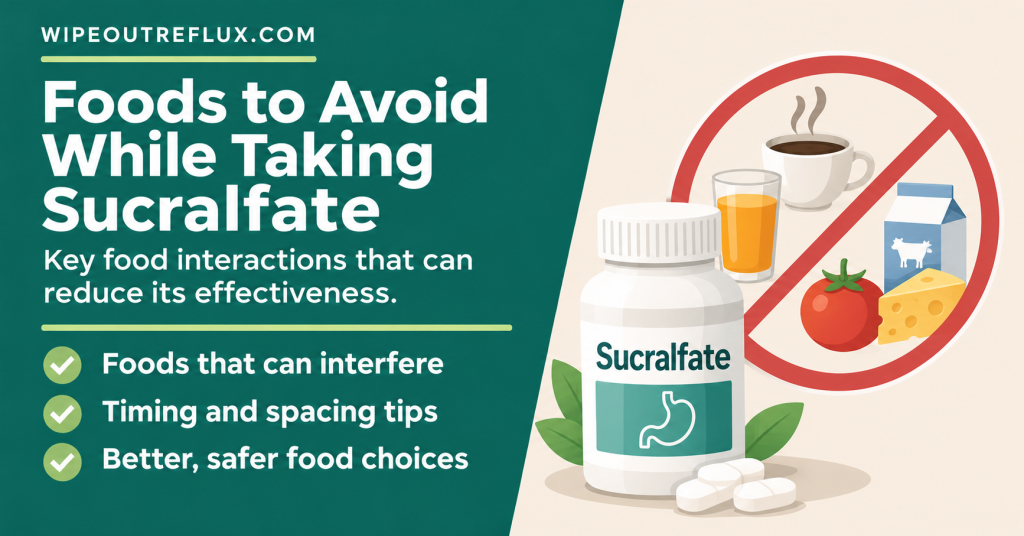
There’s no strict list of banned foods with sucralfate (Carafate). What matters more is when you eat. Sucralfate should be taken on an empty stomach, usually an hour before meals and at bedtime, so it can coat the damaged lining before food arrives. Beyond timing, the main things to avoid are antacids within 30 minutes of a dose, calcium citrate and other citrate supplements (which increase aluminum absorption), alcohol while you’re healing, and other medications taken too close to a dose. If you have diabetes, kidney disease or slow stomach emptying, there are a few extra cautions.
Sucralfate is one of the medicines I get asked about most, especially by people with silent reflux who’ve been prescribed the liquid as a throat-coating “slurry”. The instructions that come with it are short, and most of the confusion comes from what they don’t say. Below I go through what to avoid, how to time your meals and other medicines around it, and what to eat while you’re taking it.
Key Takeaways
- Take sucralfate on an empty stomach, typically 1 hour before meals and at bedtime. Food reduces its ability to coat damaged tissue.
- No specific foods are banned on the US label, but timing your meals around doses matters.
- Don’t take antacids within 30 minutes before or after a sucralfate dose.
- Avoid calcium citrate and other citrate supplements. Citrate markedly increases how much aluminum the body absorbs, and sucralfate contains aluminum.
- Take other medications at least 2 hours before sucralfate. Sucralfate binds many drugs, including levothyroxine, ciprofloxacin, digoxin and phenytoin.
- Avoid alcohol while you’re healing an ulcer or inflamed lining.
- If you have diabetes, monitor your blood sugar, as hyperglycemia has been reported. If you have kidney disease, sucralfate needs extra caution because of aluminum build-up.
- Constipation is the most common side effect. Fluids and gentle soluble fiber help.
How Sucralfate Works (and Why Timing Matters)
Sucralfate is a combination of sucrose sulfate and aluminum hydroxide. In an acidic environment it forms a sticky, paste-like layer that clings to damaged or ulcerated tissue, creating a physical barrier against acid, pepsin and bile. It also boosts the lining’s own defenses: blood flow, mucus and bicarbonate secretion, and growth factors that help tissue repair [Szabo, Scandinavian Journal of Gastroenterology Supplement, 1991].
It’s not an acid reducer. It’s barely absorbed into the bloodstream and works mainly where it touches. That’s why timing matters so much. Taken on an empty stomach, it can reach and coat the damaged lining. Taken with or straight after a meal, it gets mixed into the food and much of its coating effect is lost. The US prescribing information says sucralfate should be taken on an empty stomach [Carafate prescribing information, FDA, 2023].
Why it’s used for silent reflux
For LPR, sucralfate liquid is sometimes prescribed off-label, gargled or swallowed slowly, to coat the throat. In lab studies, suspended sucralfate strongly adsorbs pepsin [Yoshida et al., Arzneimittel-Forschung, 1980]. That’s interesting for LPR, where pepsin is the main driver of throat damage. I cover how it’s used in sucralfate (Carafate) for LPR.
Foods and Drinks to Avoid While Taking Sucralfate
1. Food within an hour before a dose (and straight after)
This is the most important rule. Take sucralfate about 1 hour before meals and at bedtime, and don’t eat for at least 30 to 60 minutes afterward. A practical four-times-daily schedule looks like this:
- 7:00 am: sucralfate. 8:00 am: breakfast.
- 12:00 pm: sucralfate. 1:00 pm: lunch.
- 5:00 pm: sucralfate. 6:00 pm: dinner.
- Bedtime (at least 2 to 3 hours after dinner): sucralfate.
Your prescriber may give you a different schedule, especially for LPR use, so follow theirs.
2. Calcium citrate and citrate-containing products
This is the one dietary-supplement interaction most people have never heard of. Sucralfate contains aluminum. Citrate binds aluminum and greatly increases how much is absorbed from the gut. In a study of healthy men taking an aluminum-containing antacid, adding calcium citrate raised urinary aluminum excretion (a marker of absorption) by roughly 5 to 11 times. The authors concluded the two should not be prescribed together [Coburn et al., American Journal of Kidney Diseases, 1991].
That study used aluminum hydroxide rather than sucralfate itself. Still, it’s a sensible precaution while you’re on sucralfate to avoid:
- Calcium citrate supplements (use calcium carbonate instead, taken at a different time)
- Potassium or sodium citrate, and effervescent tablets containing citrate
- Large amounts of concentrated citrus juice taken at the same time as a dose
This matters most if you have reduced kidney function.
3. Antacids within 30 minutes
Antacids raise stomach pH, and sucralfate needs acid to form its protective paste. The label says antacids shouldn’t be taken within half an hour before or after sucralfate [Carafate prescribing information, FDA, 2023]. Many antacids also contain aluminum, which adds to the aluminum load. See what is an antacid? If you use an alginate such as Gaviscon Advance after meals, keep it well apart from your sucralfate doses too.
4. Alcohol
Alcohol directly irritates the stomach lining and slows the healing sucralfate is trying to support. It’s best avoided completely while you’re treating an ulcer, gastritis or esophagitis. See does quitting alcohol help reflux?
5. Large or hard-to-digest meals if your stomach empties slowly
Sucralfate can rarely form a bezoar, a hardened mass of medication, sometimes with food, in the stomach or esophagus [Algozzine et al., New England Journal of Medicine, 1983]. According to the label, most reported cases involved people with delayed stomach emptying or those on tube feeding [Carafate prescribing information, FDA, 2023]. If you have gastroparesis, diabetes-related slow emptying, or you’re on a GLP-1 drug, tell your doctor. Favor smaller, softer, lower-fiber meals and avoid large amounts of tough, stringy or very fibrous foods.
6. Sugary foods (if you have diabetes)
The label notes that episodes of hyperglycemia have been reported in people with diabetes taking sucralfate, and it recommends close blood-sugar monitoring [Carafate prescribing information, FDA, 2023]. If you’re diabetic, keep an eye on your readings, and be wary of extra sugary snacks and drinks while you’re on it. See diabetes and acid reflux.
Medications to Keep Apart From Sucralfate
This is where most real interactions happen. Sucralfate binds to many medicines in the gut and reduces how much is absorbed. The label lists reduced absorption with fluoroquinolone antibiotics (such as ciprofloxacin), ketoconazole, levothyroxine, phenytoin, quinidine, digoxin, cimetidine, ranitidine, tetracycline and theophylline. It notes that taking the other drug 2 hours before sucralfate eliminated the interaction in studies [Carafate prescribing information, FDA, 2023].
The size of the effect can be dramatic. In healthy volunteers, taking sucralfate with ciprofloxacin cut ciprofloxacin blood levels by roughly 87% (from 8.8 to 1.1 µg·h/ml) [Garrelts et al., Antimicrobial Agents and Chemotherapy, 1990]. Sucralfate has also been shown to bind levothyroxine, which can lower thyroid hormone levels if the two are taken together [Havrankova & Lahaie, Annals of Internal Medicine, 1992].
Simple rule: take your other medicines at least 2 hours before sucralfate. If you take thyroid medication, see levothyroxine and omeprazole for how acid-reducing drugs affect it too, and my wider guide to omeprazole drug interactions if you’re on a PPI alongside sucralfate. If you take warfarin, your INR may need closer monitoring.
What to Eat While Taking Sucralfate
Sucralfate doesn’t require a special diet, but it’s usually prescribed for an ulcer, gastritis, esophagitis or reflux, so the diet that helps those conditions is the one to follow:
- Small, regular, low-fat meals timed around your doses
- Gentle starches: oatmeal, rice, potatoes, plain bread or crackers
- Lean proteins: skinless chicken, white fish, eggs, tofu
- Low-acid fruit and cooked vegetables: banana, melon, pear, carrots, zucchini, green beans
- Plenty of water and non-mint herbal teas such as chamomile
See my gastritis diet for a fuller list. If you’re taking sucralfate for silent reflux, follow a low-acid approach (foods above pH 5) to avoid reactivating pepsin in the throat. See the LPR diet.
Managing constipation
Constipation is the most frequently reported side effect, at about 2% in the label data [Carafate prescribing information, FDA, 2023]. It’s caused by the aluminum. Helpful steps:
- Drink more water through the day
- Add gentle soluble fiber, such as oats, banana or psyllium (taken well apart from doses). See fiber and acid reflux.
- Take a daily walk
- If you’re also on a PPI, see do acid reducers cause constipation?
Who Needs Extra Caution
- Kidney disease: aluminum can build up and cause toxicity in people with chronic kidney failure. The label advises caution [Carafate prescribing information, FDA, 2023].
- Diabetes: monitor blood sugar.
- Swallowing difficulties: the tablets are large. Ask whether the liquid suits you better.
- Slow stomach emptying or tube feeding: higher bezoar risk.
- Pregnancy and breastfeeding: discuss with your prescriber.
Conclusion
The real rules for eating on sucralfate are mostly about timing, not forbidden foods. Take it on an empty stomach about an hour before meals and at bedtime. Keep antacids 30 minutes away and other medicines at least 2 hours before. Avoid citrate supplements and alcohol, and take extra care if you have diabetes, kidney disease or slow stomach emptying. Around that, a gentle, low-fat, low-acid diet supports the healing sucralfate is there to help with.
Sucralfate protects tissue while it heals. It doesn’t stop reflux from happening. The food you eat every day decides how much acid and pepsin keep reaching that tissue, especially in the throat. If you want a complete plan to follow, the Wipeout Diet Plan gives you low-acid meals and a step-by-step approach. I built it around LPR, the hardest form of reflux to control, and it works just as well for GERD and stomach irritation.
Frequently Asked Questions
Can I eat right after taking sucralfate?
It’s best to wait about an hour. Sucralfate works by coating damaged tissue on an empty stomach, and eating too soon reduces that effect.
Can I drink coffee while taking sucralfate?
There’s no direct interaction, but coffee increases acid and commonly irritates ulcers, gastritis and reflux. If you drink it, keep it away from your doses and consider cutting back while you heal.
Can I drink milk with sucralfate?
There’s no known direct interaction, but don’t take your dose with milk or food. Take sucralfate with water on an empty stomach.
Can I take sucralfate with omeprazole?
They’re often prescribed together. Sucralfate works best in an acidic environment, so prescribers usually space them out. A common approach is the PPI 30 to 60 minutes before breakfast and sucralfate at other times. Follow your prescriber’s schedule.
Can I drink alcohol while taking sucralfate?
It’s best to avoid it. Alcohol irritates the stomach lining and works against the healing sucralfate is supporting.
What happens if I take sucralfate with food?
It isn’t dangerous, but the medicine is less effective, because it mixes with the food instead of coating the damaged lining. Go back to taking it on an empty stomach at the next dose.
Does sucralfate interact with calcium supplements?
Avoid calcium citrate, which increases aluminum absorption. Calcium carbonate is a better choice, but take it at a different time from sucralfate, since it acts as an antacid.
Research & References
- The US prescribing information for Carafate (sucralfate), covering empty-stomach dosing, separation from antacids, drug interactions and the 2-hour spacing rule, hyperglycemia in diabetes, bezoars, aluminum accumulation in kidney failure, and constipation as the most common side effect [Carafate prescribing information, FDA, 2023].
- A review of how sucralfate works, including maintenance of mucosal blood flow, increased bicarbonate and mucus secretion, and binding of growth factors that support ulcer healing [Szabo, Scandinavian Journal of Gastroenterology Supplement, 1991].
- A laboratory study showing that suspended sucralfate strongly adsorbs the enzyme pepsin [Yoshida et al., Arzneimittel-Forschung, 1980].
- A crossover study in healthy men showing that calcium citrate increased urinary aluminum excretion from aluminum hydroxide roughly 5- to 11-fold, concluding the two should not be prescribed together [Coburn et al., American Journal of Kidney Diseases, 1991].
- A randomized crossover study finding that sucralfate reduced ciprofloxacin exposure (AUC) from 8.8 to 1.1 µg·h/ml [Garrelts et al., Antimicrobial Agents and Chemotherapy, 1990].
- A report of levothyroxine binding by sucralfate [Havrankova & Lahaie, Annals of Internal Medicine, 1992].
- A report of a sucralfate bezoar [Algozzine et al., New England Journal of Medicine, 1983].

David Gray
12 years living with LPR · Consultant & researcher
I've lived with LPR for twelve years — the misdiagnoses, the PPI courses that did nothing, the slow work of figuring out what actually helps. Wipeout Reflux is where I translate the research into plain terms for people stuck in the same place. Every claim here is sourced to peer-reviewed work, and I consult one-to-one with LPR sufferers.