
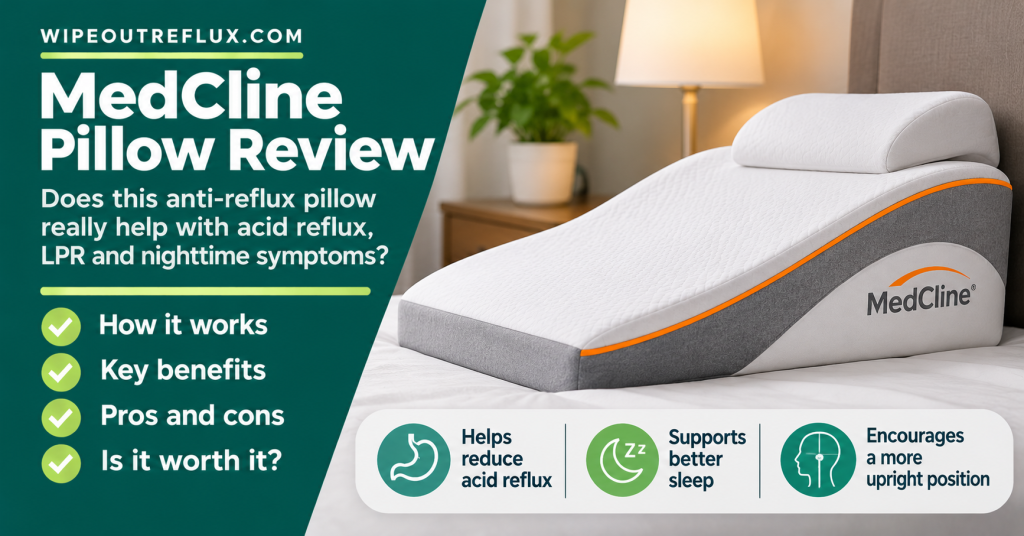
The MedCline Reflux Relief System is a wedge and body pillow designed to keep you sleeping on your left side with your upper body raised, the two positions that reduce night-time reflux most. A small industry-funded trial found that using it left-side down cut esophageal acid exposure dramatically compared with a standard wedge or lying flat, and a follow-up study in people with ongoing night-time symptoms despite medication found large symptom improvements. It’s well designed and backed by more evidence than most reflux pillows. It’s also expensive (around $300) and bulky, and it suits side sleepers far better than back or stomach sleepers.
Night-time reflux is one of the hardest parts of reflux to control, and positioning matters more than most people realize. I’ve covered standard wedges in my best wedge pillows guide. MedCline is a different approach, so it deserves its own look. Below is what it is, what the research shows, who it suits, and the cheaper ways to get similar benefits.
Key Takeaways
- MedCline combines an inclined wedge (about 15 to 20 degrees), a body pillow and an arm pocket. Together they hold you on your side with your torso elevated.
- Sleeping on your left side reduces night-time reflux compared with the right side, and elevation reduces it further.
- In a randomized crossover trial of 20 healthy volunteers, using MedCline left-side down produced 0.46% esophageal acid exposure, compared with 3.59% on a standard wedge, 3.46% flat and 4.59% on MedCline right-side down.
- In 27 patients with night-time reflux despite medication, two weeks on the device cut nocturnal symptom scores from 57.7 to 18.2.
- Both studies were small, and the first was funded by the manufacturer with an employee as an author.
- It costs roughly $290 to $330 depending on the retailer and size, is FSA/HSA eligible, and comes in three sizes based on height.
- It works best for people who already sleep on their side, and less well for back or stomach sleepers and couples short on bed space.
- Cheaper alternatives (bed risers, a standard wedge, left-side habits) give some of the benefit, especially when combined with not eating late.
What Is the MedCline Reflux Relief System?
MedCline (made by Amenity Health) is a two-part positioning system:
- A wedge that raises your torso at roughly 15 to 20 degrees
- A body pillow with an arm pocket, which lets your lower arm slide through so you can lie on your side without your shoulder taking the weight
- An insert pillow and removable, washable covers
It comes in Small (4’8″ to 5’4″), Medium (5’5″ to 5’11”) and Large (6’0″ and up), with the wedge height increasing with size. It’s made from gel-infused memory foam and, according to retailers, is FSA and HSA eligible [Vitality Medical product listing].
The key design difference from a standard wedge is the arm pocket and body pillow. These make it far more comfortable to stay on your side all night on an incline, which is where most wedges fall down. People tend to slide down or roll onto their back.
Why Left Side and Elevated?
Two positional effects reduce night-time reflux:
- Elevation: raising the upper body lets gravity help keep stomach contents down. See how to raise the head of your bed.
- Left-side sleeping: because of how the stomach and esophagus are angled, lying on your left side puts the junction between them above the pool of stomach contents. Lying on the right side does the opposite.
In a study tracking people’s natural sleep positions, lying on the right side was associated with more reflux than lying on the left. The authors concluded the left side is preferred for nocturnal reflux and that ways to help people stay there should be developed [Khoury et al., American Journal of Gastroenterology, 1999].
That last point matters. In a separate, independent trial, a wearable device that vibrated when people rolled onto their right side doubled the rate of meaningful improvement in night-time reflux symptoms compared with a sham device (44% vs 24%) [Schuitenmaker et al., Clinical Gastroenterology and Hepatology, 2022]. Staying on your left side genuinely helps, and the hard part is staying there. That’s what MedCline is designed to solve. See best sleeping position for silent reflux.
What the Research on MedCline Shows
Healthy volunteers: acid exposure
In a randomized crossover trial, 20 healthy volunteers wore reflux monitors for four 6-hour periods after a high-fat meal. They spent each period either on MedCline left-side down, on MedCline right-side down, on a standard wedge, or flat. Esophageal acid exposure was:
- MedCline, left side: 0.46%
- Standard wedge: 3.59%
- Flat: 3.46%
- MedCline, right side: 4.59%
Reflux episodes were also lower on the left side than the right (5.55 vs 13.23) [Person et al., Journal of Clinical Gastroenterology, 2015].
Notably, the device used right-side down was no better, and possibly worse, than lying flat. The benefit depends on using it on your left side.
Patients with night-time symptoms despite medication
In a follow-up study, 27 patients who still had night-time heartburn and regurgitation despite acid-reducing medication used the positioning device for at least 6 hours a night for two weeks. Nocturnal symptom scores fell from 57.7 to 18.2, and reflux quality-of-life scores improved from 29.8 to 16.7, with no adverse events reported [Allampati et al., Diseases of the Esophagus, 2017].
The caveats
- Both studies were small. The first was in healthy volunteers, and the second had no control group, so some improvement may be placebo or other factors.
- The first study was funded by the manufacturer, and one author was an employee.
- Neither study specifically looked at silent reflux (LPR) or throat symptoms.
Even so, that’s more direct evidence than almost any other reflux pillow has, and it fits well with independent research on left-side sleeping.
Pros and Cons
Pros
- Combines the two best-supported sleep positions for reflux
- The arm pocket makes side-sleeping on an incline far more comfortable than a standard wedge
- Has a published randomized trial and a patient study behind it
- Three sizes, washable covers, and quiet with no motors
- FSA/HSA eligible
Cons
- Expensive at roughly $290 to $330, versus $40 to $80 for a typical wedge
- Bulky. It takes up a lot of bed space, which matters for couples.
- Designed for side sleeping, so it’s less useful if you sleep mainly on your back or stomach
- Takes some nights to get used to
- Only helps if you use it left-side down
- Some medical retailers list it as prescription-only, which can complicate buying from them
Is MedCline Worth It?
It’s likely worth considering if:
- Night-time reflux, regurgitation or waking up with reflux symptoms is your main problem
- You’re a natural side sleeper
- You’ve tried a standard wedge but kept sliding down or rolling onto your back
- You can use FSA/HSA funds to offset the cost
It’s probably not the best first step if:
- Your reflux is mostly daytime or after meals
- You sleep on your back or stomach and don’t want to change
- Budget is tight. Try the cheaper options below first.
Cheaper Alternatives
- Bed risers or raising the head of the bed by 6 to 8 inches, which elevates your whole torso without bending you at the waist. See adjustable beds vs bed risers.
- A standard wedge pillow plus a body pillow behind your back to stop you rolling. See my best wedge pillows guide.
- Training yourself to sleep on your left side. A pillow wedged behind your back helps.
- Stopping eating 3 hours before bed. This is free and highly effective. See how long before bed to stop eating.
- An alginate at bedtime, such as Gaviscon Advance, to form a raft that blocks reflux overnight
My Verdict
On paper, MedCline is one of the most thoughtfully designed reflux sleep products available, and it’s one of the few with a randomized trial behind it. It does something a standard wedge doesn’t: it keeps you on your left side, elevated, all night. For dedicated side sleepers with stubborn night-time reflux, it’s a genuinely reasonable investment, especially with FSA/HSA funds.
It isn’t magic, and it isn’t cheap. Positioning works best alongside not eating late and a reflux-friendly diet. If cost is a barrier, bed risers, a standard wedge and left-side habits get you part of the way.
Conclusion
The MedCline Reflux Relief System combines elevation with left-side sleeping, and a small randomized trial showed a large drop in acid exposure when it’s used left-side down. A patient study found big improvements in night-time symptoms. The evidence is limited and partly manufacturer-funded, the price is high, and it suits side sleepers best, but for night-time reflux it’s one of the better-designed options available.
Positioning reduces how much reflux happens overnight, but what you eat during the day, and when, decides how much is there to reflux in the first place. The Wipeout Diet Plan gives you a step-by-step, low-acid way to eat that works hand in hand with better sleep positioning. I built it around LPR, the hardest form of reflux to control, and it works just as well for GERD and everyday heartburn.
Frequently Asked Questions
Does the MedCline pillow work for acid reflux?
Evidence suggests it can. In a small randomized trial, using it left-side down greatly reduced acid exposure compared with a standard wedge or lying flat, and patients with night-time symptoms improved significantly after two weeks.
How much does MedCline cost?
Typically around $290 to $330 depending on size and retailer. It’s often FSA/HSA eligible.
Can I use MedCline on my right side?
You can, but research found right-side use didn’t reduce reflux and may increase it. For reflux, use it left-side down.
Is MedCline good for back sleepers?
Not really. It’s designed for side sleeping. Back sleepers may do better with bed risers or a wedge.
What size MedCline do I need?
Sizes are based on height: Small for 4’8″ to 5’4″, Medium for 5’5″ to 5’11”, and Large for 6’0″ and up.
Is MedCline better than a wedge pillow?
In the trial, MedCline used left-side down reduced acid exposure far more than a standard wedge. The difference comes from keeping you on your left side, which a basic wedge doesn’t do.
Does MedCline help silent reflux (LPR)?
It hasn’t been studied specifically for LPR, but reducing night-time reflux is helpful for throat symptoms, which are often worse in the morning. Combine it with a low-acid diet for the best results.
Research & References
- A randomized crossover trial in 20 healthy volunteers finding esophageal acid exposure of 0.46% with the sleep positioning device left-side down, compared with 3.59% on a wedge, 3.46% flat and 4.59% on the device right-side down. The study was industry-funded [Person et al., Journal of Clinical Gastroenterology, 2015].
- A prospective study of 27 patients with PPI-refractory nocturnal GERD symptoms finding that two weeks of positional therapy device use improved nocturnal symptom scores from 57.7 to 18.2 and GERD-HRQL from 29.8 to 16.7 [Allampati et al., Diseases of the Esophagus, 2017].
- A study of spontaneous sleep positions in GERD patients finding that right-side sleeping was associated with more recumbent reflux than left-side sleeping [Khoury et al., American Journal of Gastroenterology, 1999].
- A double-blind, randomized, sham-controlled trial of 100 patients finding that a wearable sleep positional therapy device produced treatment success in 44% vs 24% with sham [Schuitenmaker et al., Clinical Gastroenterology and Hepatology, 2022].

David Gray
12 years living with LPR · Consultant & researcher
I've lived with LPR for twelve years — the misdiagnoses, the PPI courses that did nothing, the slow work of figuring out what actually helps. Wipeout Reflux is where I translate the research into plain terms for people stuck in the same place. Every claim here is sourced to peer-reviewed work, and I consult one-to-one with LPR sufferers.