
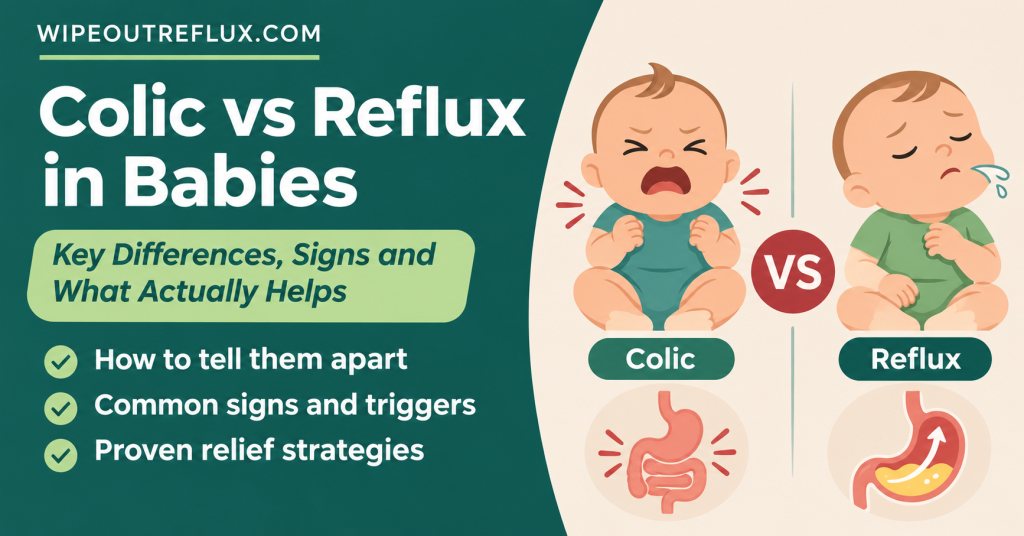
The quickest way to tell colic from reflux is to look at when your baby cries and what else is going on. Colic is long bouts of crying, often in the late afternoon or evening, in a baby who is otherwise healthy, feeding well and growing. It usually peaks around six weeks and fades by three to four months. Reflux is linked to feeds: spit-up, discomfort during or just after feeding, back arching, coughing or gulping, and fussiness when laid flat. It tends to peak around four months and settle by the first birthday.
The catch is that most crying babies with spit-up don’t actually have reflux disease. Spitting up is normal in young babies, and research shows crying on its own is a poor sign of reflux. That’s why acid-reducing medicine rarely helps a colicky baby. Telling the two apart matters, because what helps colic and what helps reflux are not the same.
Here’s how to read the signs, what’s going on underneath each one, and what to try.
Key Takeaways
- Colic is unexplained, hard-to-soothe crying in an otherwise healthy, growing baby under five months. It isn’t tied to feeds and often clusters in the evening.
- Reflux is stomach contents coming back up. Spitting up is normal in babies and peaks around four months. It only becomes a problem (GERD) when it causes real complications, like poor weight gain or feeding refusal.
- Colic is very common in the first six weeks, affecting roughly 17% to 25% of babies, but drops to under 1% by 10 to 12 weeks.
- Crying and irritability alone are unlikely to be caused by reflux, according to international pediatric reflux guidelines.
- Acid-reducing medicines don’t reduce crying in infants. In a major trial, babies did exactly as well on placebo as on a PPI, and had more chest infections on the drug.
- Cow’s milk protein allergy can look like both colic and reflux, and is worth considering when symptoms are severe or come with eczema, blood in stools or diarrhea.
- See your pediatrician urgently for forceful or green vomiting, blood, fever, breathing problems, poor weight gain, feeding refusal or a high-pitched, unusual cry.
What Is Colic?
Colic is a description, not a disease. It means a baby who cries, fusses or is irritable for long stretches without an obvious cause and can’t be settled, while otherwise being healthy, feeding and gaining weight normally.
The old “rule of threes” (crying more than three hours a day, three days a week, for three weeks) has been dropped for everyday use. Under the current Rome IV criteria, a doctor would diagnose infant colic when symptoms start and stop before five months of age, the crying or fussiness is recurrent and prolonged with no obvious cause, caregivers can’t prevent or stop it, and there’s no failure to thrive, fever or illness [Zeevenhooven et al., Pediatric Gastroenterology, Hepatology and Nutrition, 2017].
Nobody knows exactly what causes colic. The leading theories involve an immature nervous system that struggles to regulate itself, gut bacteria and gas, sensitivity to feeding, and simple temperament. It’s very likely a mix that varies from baby to baby.
What we do know is how common it is and how predictable its timeline is. A meta-analysis of 28 diary studies covering 8,690 babies found that babies fuss and cry for an average of about two hours a day in the first six weeks. Colic affected 17% to 25% of babies in that window, fell to 11% by eight to nine weeks, and to just 0.6% by 10 to 12 weeks [Wolke et al., Journal of Pediatrics, 2017].
That drop-off is one of the most useful clues. Colic is something babies grow out of quickly.
What Is Reflux in Babies?
Reflux (gastroesophageal reflux, or GER) is milk and stomach contents flowing back up from the stomach into the esophagus, and sometimes out of the mouth. In babies, it happens because the valve at the bottom of the esophagus, the lower esophageal sphincter, is still immature, their diet is all liquid, and they spend most of their time lying down.
Spitting up is extremely common. Regurgitation affects around two-thirds or more of babies at its peak at two to four months, and it resolves on its own without long-term effects [Zeevenhooven et al., Pediatric Gastroenterology, Hepatology and Nutrition, 2017]. Pediatricians call these babies “happy spitters”: lots of laundry, but a content, growing baby.
Reflux becomes GERD (gastroesophageal reflux disease) when it causes troublesome symptoms or complications, such as poor weight gain, feeding refusal, esophagitis or breathing problems. GERD is far less common than simple reflux.
There’s also silent reflux in newborns, where the milk comes up but is swallowed back down instead of spat out. That’s the version most often confused with colic, because there’s no spit-up to point you toward the stomach.
Why reflux can hurt
When stomach contents come up, they carry acid and pepsin, a digestive enzyme. In the stomach, these are harmless because the stomach lining is built for them. The esophagus and throat aren’t. That’s the same mechanism I deal with in adult LPR. In babies, though, most reflux episodes are buffered by milk and are only mildly acidic, which is one reason many refluxing babies are perfectly comfortable.
Colic vs Reflux: The Key Differences
These are the patterns that help separate the two. No single sign settles it, so look at the overall picture.
Timing of the crying
- Colic: Crying comes in long bouts that aren’t linked to feeds. It often clusters in the late afternoon and evening, sometimes called the “witching hour.”
- Reflux: Discomfort is linked to feeding. It happens during a feed, in the hour afterward, or when your baby is laid flat soon after eating.
Feeding behavior
- Colic: Feeds usually go normally. Babies may even settle briefly while feeding.
- Reflux: Pulling off the breast or bottle, gulping, coughing, choking, or refusing to finish feeds. Some babies want small, frequent “comfort” feeds.
Spit-up and vomiting
- Colic: Spit-up is normal or minimal and doesn’t match the crying.
- Reflux: Frequent spit-up, wet burps, hiccups or swallowing sounds after feeds. With silent reflux, you may hear it more than see it.
Body language
- Colic: Clenched fists, red face, legs drawn up to the tummy, and a tight, gassy belly. These are common in all crying babies.
- Reflux: Back arching and stiffening during or after feeds, and turning the head away.
Position
- Colic: Position doesn’t make much difference. Motion, rocking and white noise often help more.
- Reflux: Worse when lying flat after feeds, and better when held upright.
Age pattern
- Colic: Starts in the first few weeks, peaks around six weeks, and is usually gone by three to four months.
- Reflux: Peaks around four months and usually settles by 12 months, as babies sit up and start solids.
Growth
- Colic: Normal weight gain by definition.
- Reflux: Normal in simple reflux. Slow weight gain points to GERD or another problem and needs a doctor’s review.
Some babies have both. A baby can be a happy spitter who also has colicky evenings. And a reflux-prone baby who is overtired and overstimulated can cry far more than the reflux alone would explain.
Why Crying Is a Poor Sign of Reflux
This is the part most parents are never told, and it’s why so many colicky babies end up on reflux medicine that doesn’t work.
The joint North American and European pediatric reflux guidelines state that when excessive irritability and pain are a baby’s only symptoms, they are unlikely to be caused by reflux. Irritability shows up in babies with and without GERD, and a fussy baby who is growing and developing well generally doesn’t need testing or acid suppression [Rosen et al., Journal of Pediatric Gastroenterology and Nutrition, 2018].
The medication trials back this up. In a large randomized trial of 162 babies with crying and fussing attributed to reflux, 54% improved on the PPI lansoprazole and exactly 54% improved on placebo. The babies on the drug also had more serious side effects, mainly chest infections [Orenstein et al., Journal of Pediatrics, 2009]. A systematic review of all the placebo-controlled trials reached the same conclusion: PPIs don’t reduce crying or irritability in infants [Gieruszczak-Białek et al., Journal of Pediatrics, 2015].
Part of the reason is the same one I see constantly in adults with LPR. Acid suppression changes the acidity of what comes up, but it doesn’t stop it coming up. In babies, much of the refluxate is milk-buffered and only weakly acidic anyway, so turning down acid doesn’t change much.
None of this means reflux never hurts babies. It means crying alone isn’t enough to call it reflux, and medication shouldn’t be the first step.
The Third Possibility: Cow’s Milk Protein Allergy
Cow’s milk protein allergy (CMPA) can cause both colic-like crying and reflux-like spit-up, which is why it often gets missed. It’s an immune reaction to the proteins in cow’s milk, either from formula or passed through breast milk from the mother’s diet.
Signs that point toward CMPA rather than plain colic or reflux include:
- Eczema or other rashes
- Diarrhea, mucus or streaks of blood in the stools
- Vomiting that’s more than ordinary spit-up
- A family history of allergies, eczema or asthma
- Symptoms that are severe or don’t follow the normal colic timeline
For formula-fed babies whose reflux symptoms continue despite feeding changes, the pediatric guidelines suggest considering a two- to four-week trial of an extensively hydrolyzed or amino acid formula before trying acid suppression [Rosen et al., Journal of Pediatric Gastroenterology and Nutrition, 2018]. If you’re breastfeeding, the equivalent is a trial of cutting dairy from your own diet. Both should be done with your pediatrician’s guidance.
What Helps Colic
Colic doesn’t have a cure, but it does end. The goal is to get you and your baby through it. Reassurance and support for parents are the cornerstone of management [Zeevenhooven et al., Pediatric Gastroenterology, Hepatology and Nutrition, 2017].
- Soothing techniques: Rocking, gentle bouncing, walking, car rides, white noise, swaddling (with hips loose) and skin-to-skin contact. What works changes from day to day, so rotate.
- Reduce stimulation: Dim lights and quiet rooms in the evening, especially if your baby gets more wound-up as the day goes on.
- Probiotic drops (breastfed babies): The probiotic Lactobacillus reuteri DSM 17938 reduced crying time in breastfed babies with colic in a pooled analysis of four trials. There wasn’t enough evidence to show the same in formula-fed babies [Sung et al., Pediatrics, 2018]. Ask your pediatrician before starting.
- Check feeding: Make sure your baby isn’t getting too much air or being overfed, both of which can add to discomfort.
What Helps Reflux
For reflux, the first line is always feeding and positioning changes, not medication. I go into these in full in my guide to silent reflux in newborns, but the main ones are:
- Avoid overfeeding: Offer smaller, more frequent feeds, keeping the total daily amount appropriate for your baby’s age and weight. The guidelines specifically recommend this [Rosen et al., Journal of Pediatric Gastroenterology and Nutrition, 2018].
- Hold upright after feeds: Keep your baby upright for 20 to 30 minutes after feeding.
- Burp during feeds: Not just at the end.
- Thickened feeds: Thickened or anti-regurgitation formulas can reduce visible spit-up. Only use them on your pediatrician’s advice.
- Safe sleep comes first: Always lay your baby flat on their back to sleep. Don’t raise the crib mattress, use wedges or put your baby to sleep on their side or front for reflux.
Medication is reserved for babies with true GERD who haven’t responded to these changes, and that’s a decision for your pediatrician.
When to See a Doctor
Colic and simple reflux are common and harmless, but these signs need a prompt medical review:
- Forceful or projectile vomiting, especially in a baby aged two to eight weeks
- Green or yellow vomit, or blood in vomit or stools
- Fever, lethargy, floppiness or a bulging soft spot
- A high-pitched, weak or unusual cry that’s different from your baby’s normal cry
- Breathing pauses, turning blue, wheezing or noisy breathing
- Poor weight gain, weight loss or refusing feeds
- Fewer wet diapers than usual
- Crying that starts after five months, or that’s getting worse rather than better
And trust your gut. If something feels wrong, get your baby checked.
Looking After Yourself Through It
Hours of crying you can’t fix is one of the hardest parts of early parenthood, whether it’s colic or reflux. It’s normal to feel frustrated, exhausted or even angry.
If you feel overwhelmed, it’s OK to put your baby down safely on their back in the crib, step out of the room and take a few minutes to calm down. Never shake a baby. Ask a partner, family member or friend to take a shift, and tell your pediatrician or health visitor how you’re coping. They’d much rather hear it early.
Conclusion
Colic and reflux overlap, but they’re not the same thing. Colic is long, hard-to-settle crying that isn’t linked to feeds, in a healthy, growing baby, and it’s usually over by three to four months. Reflux is tied to feeding, with spit-up, arching or discomfort when laid flat, and it usually settles by the first birthday. Crying alone is a poor sign of reflux, which is why acid-reducing medicine so rarely helps a colicky baby.
The most useful things you can do are track when the crying happens, watch for the feeding-linked signs that point to reflux, keep cow’s milk allergy in mind if symptoms are severe, and get any red flags checked straight away. For most families, time does most of the work.
If reflux runs in your house, and it often does, especially after pregnancy, the same mechanisms that cause discomfort in babies affect adults too. If you’re dealing with your own heartburn, throat clearing or silent reflux, the Wipeout Diet Plan is my complete, step-by-step guide to getting it under control through diet. It was built first for LPR, the throat-based kind, but because it targets the same root causes it works just as well for GERD and classic heartburn. It’s designed for adults, not babies, so it’s something for you rather than your little one.
Frequently Asked Questions
How can I tell if my baby has colic or reflux?
Look at when the crying happens. Colic crying comes in long bouts, often in the evening, and isn’t linked to feeds. Reflux discomfort happens during or soon after feeds, with spit-up, back arching, gulping or coughing, and is worse when your baby is laid flat. Colic also peaks earlier, around six weeks, and is usually gone by three to four months.
Can a baby have colic and reflux at the same time?
Yes. Many babies spit up a lot and also have colicky evenings. Spit-up is normal in young babies, so having it doesn’t mean reflux is the cause of the crying. If symptoms are severe, consider cow’s milk protein allergy, which can cause both.
What does reflux crying sound like compared with colic crying?
Colic crying is often intense, high-energy and hard to stop, with clenched fists and legs pulled up. Reflux crying is more often linked to feeds and may come with a hoarse or raspy cry, coughing, wet burps or swallowing sounds. A weak, high-pitched or unusual cry isn’t typical of either and should be checked by a doctor.
Does reflux medicine help colic?
No. Trials show PPIs don’t reduce crying or irritability in babies. In one large trial, babies did exactly as well on placebo as on the PPI, and had more chest infections on the medicine. Medication is only considered for babies with confirmed GERD.
At what age do colic and reflux go away?
Colic usually improves after six weeks and is gone by three to four months. Reflux peaks around four months and usually resolves by 12 months, as babies spend more time upright and start eating solid food.
Is silent reflux mistaken for colic?
Often. With silent reflux, milk comes up but is swallowed back down, so there’s no spit-up to point to the stomach. The clues are feeding-linked discomfort, back arching, hiccups, a hoarse cry, congestion without a cold, and poor sleep when laid flat.
Can gripe water or gas drops help colic?
There’s little good evidence that gripe water or simethicone gas drops reduce colic crying. They’re widely used, but soothing techniques, reducing stimulation and, for breastfed babies, the probiotic L. reuteri DSM 17938 have better support. Check with your pediatrician before giving any remedy.
Research & References
- [Zeevenhooven et al., Pediatric Gastroenterology, Hepatology and Nutrition, 2017] — Review of the Rome IV criteria for infant colic and regurgitation, describing regurgitation as peaking at two to four months and resolving without long-term effects, with reassurance as the cornerstone of colic management.
- [Wolke et al., Journal of Pediatrics, 2017] — Meta-analysis of 28 diary studies (8,690 infants) finding colic in 17% to 25% of babies in the first six weeks, falling to 0.6% by 10 to 12 weeks.
- [Rosen et al., Journal of Pediatric Gastroenterology and Nutrition, 2018] — Joint NASPGHAN/ESPGHAN guidelines stating irritability alone is unlikely to be due to reflux, recommending against overfeeding, and suggesting a two- to four-week hydrolyzed or amino acid formula trial before acid suppression.
- [Orenstein et al., Journal of Pediatrics, 2009] — Randomized trial of 162 infants; 54% responded to both lansoprazole and placebo, with more serious adverse events, mainly lower respiratory infections, on lansoprazole.
- [Gieruszczak-Białek et al., Journal of Pediatrics, 2015] — Systematic review of randomized trials finding PPIs did not reduce crying or irritability in infants.
- [Sung et al., Pediatrics, 2018] — Individual participant data meta-analysis of four trials (345 infants) showing L. reuteri DSM 17938 reduced crying in breastfed infants with colic, with insufficient evidence for formula-fed infants.

David Gray
12 years living with LPR · Consultant & researcher
I've lived with LPR for twelve years — the misdiagnoses, the PPI courses that did nothing, the slow work of figuring out what actually helps. Wipeout Reflux is where I translate the research into plain terms for people stuck in the same place. Every claim here is sourced to peer-reviewed work, and I consult one-to-one with LPR sufferers.