
If you have chest pain right now that feels like pressure, squeezing or heaviness, spreads to your arm, jaw, neck or back, or comes with shortness of breath, sweating, nausea or lightheadedness, call 911 (or your local emergency number) now. Don’t try to work it out from an article.
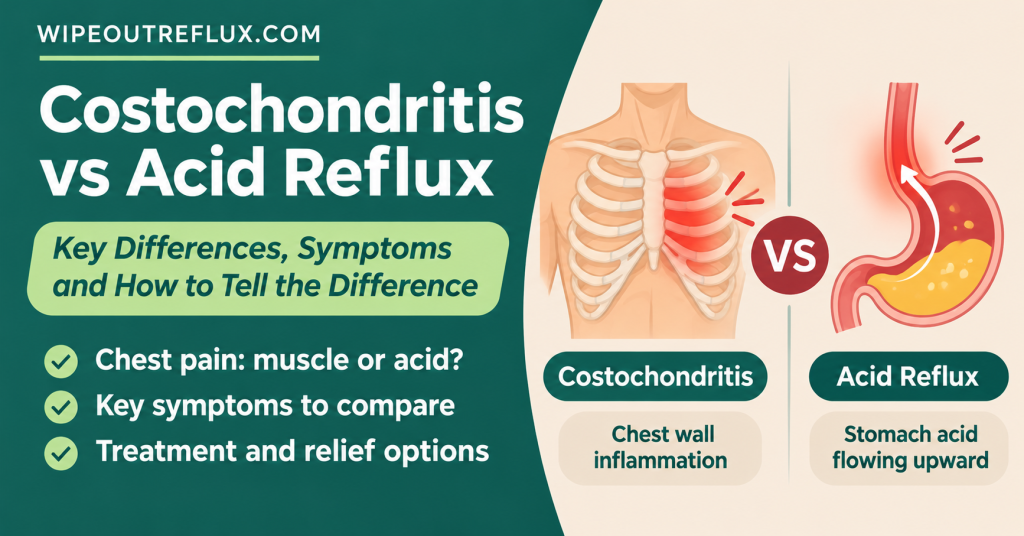
Costochondritis and acid reflux can both cause pain in the front of the chest, but they behave differently. Costochondritis is inflammation of the cartilage where your ribs join your breastbone. It causes sharp, aching or pressure-like pain on the chest wall, usually to one side of the sternum, that gets worse when you press on the spot, breathe deeply, cough, twist or lift your arms. Acid reflux causes a burning pain behind the breastbone that rises toward the throat, often after meals or when lying down, and usually comes with a sour taste, burping or regurgitation. It isn’t tender to the touch.
Heart pain is different again. It’s typically a pressure or tightness brought on by exertion or stress, and it can’t be pressed or moved into being worse. The three can overlap, though, which is why any new or unexplained chest pain should be checked by a doctor.
Key Takeaways
- Costochondritis pain is on the chest wall. Pressing on the sore rib joints reproduces it, and movement, deep breaths and coughing make it worse.
- It most often affects the second to fifth rib joints, especially the third and fourth, usually on one side and at more than one level.
- Reflux pain is a burning feeling behind the breastbone. It’s linked to meals, lying down and bending over, and often comes with a sour taste, burping or a cough.
- Heart pain is more often a pressure or heaviness triggered by exertion or stress that may spread to the arm, jaw or back.
- Costochondritis is common. In one emergency department study it accounted for 30% of chest pain cases, and 69% of those patients were women.
- Tenderness doesn’t fully rule out the heart. About 3% to 6% of adults with chest pain and chest wall tenderness turn out to have coronary artery disease.
- GERD is the most common cause of chest pain that isn’t from the heart.
- NSAIDs used for costochondritis can irritate the stomach and worsen reflux, so be careful if you have both.
What Is Costochondritis?
Each of your upper ribs connects to your breastbone (sternum) through a strip of cartilage. Costochondritis is inflammation of the joints where the rib meets that cartilage, or where the cartilage meets the sternum. It’s also called costosternal syndrome or anterior chest wall syndrome.
It’s usually harmless and settles on its own, but it can be painful enough to send people to the emergency room convinced something is wrong with their heart. Common triggers include a recent bout of heavy coughing (after a cold or chest infection), unaccustomed exercise, lifting, or repetitive arm and upper body movements. Often there’s no clear trigger at all.
It’s far more common than most people realize. In a prospective study of 122 people who came to an emergency department with chest pain, 30% had costochondritis. Women made up 69% of the costochondritis cases, and most cases had resolved on their own by one year [Disla et al., Archives of Internal Medicine, 1994].
Where Is Costochondritis Pain Located?
Location is one of the most useful clues. Costochondritis pain sits on the front of the chest wall, at the joints along the edge of the breastbone.
- Which ribs: The second to fifth rib joints are most often affected, especially the third and fourth, though any of the upper seven can be involved [Proulx and Zryd, American Family Physician, 2009].
- One side: It’s usually on one side of the breastbone, and the left is common, which is why it gets confused with the heart.
- More than one spot: In about 90% of people, more than one rib joint is tender [Proulx and Zryd, American Family Physician, 2009].
- Spread: The pain can radiate across the chest wall, and sometimes toward the shoulder, upper arm or back.
- No swelling: The area is tender but not visibly swollen, red or hot.
If one rib joint, usually the second or third, is visibly swollen as well as painful, that points to Tietze syndrome, a rarer cousin of costochondritis that tends to affect people under 40.
Costochondritis pain areas in women
Women are affected more often than men, and the pain areas can be especially confusing. Because the third to fifth rib joints sit just inside the breast tissue, costochondritis is frequently felt as pain in or around the breast, under the breast, or along the inner edge of the breast next to the sternum, most often on the left. It can be mistaken for breast pain, a heart problem or, for women who know they get reflux, a bad bout of heartburn.
The giveaway is that the pain is in the chest wall, not deep inside. Pressing on the rib joints at the edge of the breastbone reproduces it, and it changes with arm movement, carrying bags or children, deep breaths and lying on that side. Any new breast lump, skin change or nipple discharge should be checked separately by a doctor.
It’s also worth knowing that heart attack symptoms in women are more often “atypical”: tightness, breathlessness, nausea, unusual fatigue, or pain in the back, jaw or upper stomach rather than classic crushing chest pain. That’s another reason not to self-diagnose costochondritis if anything about the pain feels different.
What Does Costochondritis Feel Like?
People describe costochondritis pain as:
- Sharp, stabbing or aching
- A pressure or tightness on the chest wall
- Worse with deep breaths, coughing, sneezing or laughing
- Worse when twisting, bending, reaching overhead, lifting or pushing
- Worse when pressing on the sore spot or lying on that side
- Lasting from moments to a constant ache that can go on for weeks
The pain is mechanical. It changes with movement and position, not with meals.
What Does Acid Reflux Chest Pain Feel Like?
Reflux chest pain comes from stomach acid and pepsin irritating the lining of the esophagus, the tube that runs behind your breastbone. Because the esophagus sits right next to the heart and shares nerve pathways with it, the brain can’t always tell which one the pain is coming from.
That’s not a small issue. GERD is likely the most common cause of chest pain that isn’t from the heart, and a patient’s history and symptoms can’t reliably tell cardiac and esophageal chest pain apart [Fass and Achem, Journal of Neurogastroenterology and Motility, 2011].
Reflux chest pain typically feels like:
- A burning sensation behind the breastbone that may rise toward the throat
- Sometimes a squeezing or tight feeling in the chest, especially with esophageal spasm
- Worse after large or fatty meals, alcohol, coffee or chocolate
- Worse lying down, bending over or at night
- Accompanied by a sour or bitter taste, regurgitation, burping, a cough, hoarseness or a feeling of food stuck in the chest
- Often eased by antacids or an alginate within minutes
For a fuller picture, see my guides on what heartburn feels like and chest pain after eating.
Costochondritis vs Acid Reflux vs Heart: Side by Side
Where you feel it
- Costochondritis: On the chest wall at the edge of the breastbone. You can often point to it with one finger.
- Reflux: Deep behind the breastbone, often rising toward the throat. Harder to pinpoint.
- Heart: A diffuse pressure in the center or left of the chest that may spread to the arm, jaw, neck, back or upper stomach.
What it feels like
- Costochondritis: Sharp, aching or pressure-like, and tender to touch.
- Reflux: Burning, sometimes squeezing.
- Heart: Pressure, heaviness, tightness or squeezing.
Pressing on it
- Costochondritis: Pressing the sore spot reproduces your exact pain.
- Reflux: Pressing does nothing.
- Heart: Usually does nothing, but tenderness doesn’t rule the heart out.
What makes it worse
- Costochondritis: Movement, deep breaths, coughing, lifting and lying on that side.
- Reflux: Meals, trigger foods, lying down and bending over.
- Heart: Exertion, stress and cold.
What eases it
- Costochondritis: Rest, heat or ice, and pain relief.
- Reflux: Sitting up, antacids and alginates.
- Heart: Rest may ease angina, but a heart attack doesn’t settle with rest.
Other symptoms
- Costochondritis: Usually none. Sometimes a recent cough or strain.
- Reflux: Sour taste, regurgitation, burping, throat clearing and hoarseness.
- Heart: Breathlessness, sweating, nausea, lightheadedness and fatigue.
For more on the reflux versus heart side specifically, read my guide to heartburn or heart attack.
Heart Attack vs Costochondritis: Why Tenderness Isn’t Enough
The classic teaching is that if pressing on the chest reproduces the pain, it’s musculoskeletal and not the heart. That’s mostly true, but not always.
Chest wall tenderness makes a heart problem less likely, but coronary artery disease is still found in 3% to 6% of adults with chest pain and chest wall tenderness [Proulx and Zryd, American Family Physician, 2009]. A prospective emergency department study reached a similar conclusion: reproducible chest wall tenderness helps doctors rule out acute coronary syndrome early on, but it shouldn’t be used on its own [Gräni et al., BMJ Open, 2015].
That’s why doctors recommend an ECG, and often a chest X-ray, for adults over 35 with suspected costochondritis, or anyone with heart risk factors. A normal ECG and X-ray are expected with costochondritis.
Take chest pain seriously, and get emergency help, if it:
- Feels like pressure, squeezing or heaviness
- Spreads to your arm, jaw, neck, back or upper stomach
- Comes with shortness of breath, sweating, nausea, lightheadedness or a racing or irregular heartbeat
- Comes on with exertion and eases with rest
- Is new and you’re over 35, or you have diabetes, high blood pressure, high cholesterol, a smoking history or a family history of heart disease
Can You Have Costochondritis and Acid Reflux at the Same Time?
Yes, and it’s more common than you’d think. A few links connect them:
- Chronic coughing: Reflux, especially the throat-based kind (LPR), causes a persistent cough and throat clearing. Weeks of coughing strains the rib joints and is a classic trigger for costochondritis.
- NSAIDs: Ibuprofen and naproxen are the standard treatment for costochondritis, but they’re also among the medications that make acid reflux worse. A short course with food is usually fine, but if you already have reflux, ask your doctor whether a topical NSAID gel, acetaminophen or heat would be a better option.
- Anxiety and hypervigilance: Chest pain from any source is frightening, and anxiety raises muscle tension and sensitivity to pain. It also makes you more aware of reflux sensations. If this cycle sounds familiar, see my article on health anxiety and acid reflux.
A useful way to separate them when both are present: notice which pain changes with movement and pressing (costochondritis) and which changes with meals and lying down (reflux).
What to Do Next
If it looks like costochondritis
- Get it checked at least once, especially if you’re over 35 or have heart risk factors.
- Rest from the activities that set it off, like heavy lifting, push-ups and reaching overhead.
- Use heat or ice on the sore area.
- Use pain relief as your doctor advises. Think twice about oral NSAIDs if you get reflux.
- Gentle stretching can help once the acute pain settles.
- Expect it to improve over weeks. For some people it lingers for months, but it’s not dangerous.
If it looks like reflux
- Avoid eating within three hours of bed, and raise the head of your bed.
- Eat smaller meals and cut common triggers like alcohol, coffee, chocolate, fatty food, citrus and fizzy drinks.
- Try an alginate after meals and at bedtime. It forms a raft that physically blocks reflux.
- Track whether the chest pain follows meals and positions, and share that with your doctor.
- If you want a structured plan rather than trial and error, the Wipeout Diet Plan walks you through exactly which foods to cut and what to eat instead.
If reflux chest pain doesn’t respond to treatment, or comes with difficulty swallowing, weight loss, vomiting or black stools, see your doctor for further tests.
Conclusion
Costochondritis and acid reflux can both make your chest hurt, but they leave different fingerprints. Costochondritis is on the chest wall, at the rib joints beside the breastbone, and pressing on it, moving or breathing deeply makes it worse. Reflux is a burning pain behind the breastbone that follows meals and lying down, and comes with a sour taste, burping or throat symptoms. Heart pain is a pressure or heaviness, often brought on by exertion, and it can sometimes coexist with chest wall tenderness. That’s why any new chest pain deserves a proper check first.
Once your heart has been ruled out, the reflux side is very treatable, and it’s where most people find lasting relief. Getting your diet, meal timing and triggers right takes away the acid and pepsin that irritate the esophagus and set off chest pain in the first place. The Wipeout Diet Plan is my complete, in-depth guide to doing that. It was designed first for LPR, the stubborn throat-based form of reflux, but because it goes after the same root causes it works just as well for GERD, heartburn and reflux-related chest pain. It gives you a full food list with pH values, a meal plan and a clear step-by-step approach, so you’re not guessing.
Frequently Asked Questions
How can I tell if it’s costochondritis or acid reflux?
Press on the sore area. If pressing on the rib joints beside your breastbone reproduces the exact pain, and it’s worse with movement and deep breaths, costochondritis is likely. If the pain is a burning feeling behind the breastbone that follows meals or lying down, with a sour taste or burping, reflux is more likely. Get any new chest pain checked by a doctor first.
Where is costochondritis pain located?
On the front of the chest wall, at the joints where the ribs meet the breastbone. The second to fifth rib joints are most often affected, especially the third and fourth. It’s usually on one side, often the left, and in most people more than one joint is tender.
Where do women feel costochondritis pain?
Women often feel it in or around the breast, under the breast, or along the inner edge of the breast beside the breastbone, most often on the left. It’s tender when pressed and worse with arm movement, lifting and deep breaths.
Can costochondritis feel like a heart attack?
Yes. It can cause sharp or pressure-like pain on the left side of the chest that frightens many people into the emergency room. But heart pain can occasionally come with chest wall tenderness too, so you can’t safely tell them apart at home. Get emergency help for chest pressure, pain spreading to the arm, jaw or back, or pain with breathlessness, sweating or nausea.
Can acid reflux cause pain when I press on my chest?
Not usually. Reflux pain comes from the esophagus, which is deep behind the breastbone, so pressing on the chest wall doesn’t change it. If pressing reproduces your pain, a chest wall cause like costochondritis is more likely, though you can have both at once.
How long does costochondritis last?
It often settles within a few weeks, but it can last for several months. In one emergency department study, most cases had resolved on their own by one year. It isn’t dangerous, but pain that’s getting worse or isn’t improving should be reviewed.
Can coughing from reflux cause costochondritis?
It can. A chronic cough from reflux, especially LPR, repeatedly strains the rib joints, and prolonged coughing is a well-known trigger for costochondritis. Treating the reflux that drives the cough helps break that cycle.
Research & References
- [Disla et al., Archives of Internal Medicine, 1994] — Prospective study of 122 emergency department chest pain patients; 30% had costochondritis, 69% of them women, with most cases resolving spontaneously by one year.
- [Proulx and Zryd, American Family Physician, 2009] — Clinical review describing costochondritis at the second to fifth rib joints, usually at multiple sites on one side, and noting coronary artery disease in 3% to 6% of adults with chest pain and chest wall tenderness.
- [Fass and Achem, Journal of Neurogastroenterology and Motility, 2011] — Review identifying GERD as the most likely cause of noncardiac chest pain and noting that symptoms can’t reliably distinguish cardiac from esophageal chest pain.
- [Gräni et al., BMJ Open, 2015] — Prospective diagnostic study finding reproducible chest wall tenderness helps rule out acute coronary syndrome early, but shouldn’t be relied on alone.

David Gray
12 years living with LPR · Consultant & researcher
I've lived with LPR for twelve years — the misdiagnoses, the PPI courses that did nothing, the slow work of figuring out what actually helps. Wipeout Reflux is where I translate the research into plain terms for people stuck in the same place. Every claim here is sourced to peer-reviewed work, and I consult one-to-one with LPR sufferers.