
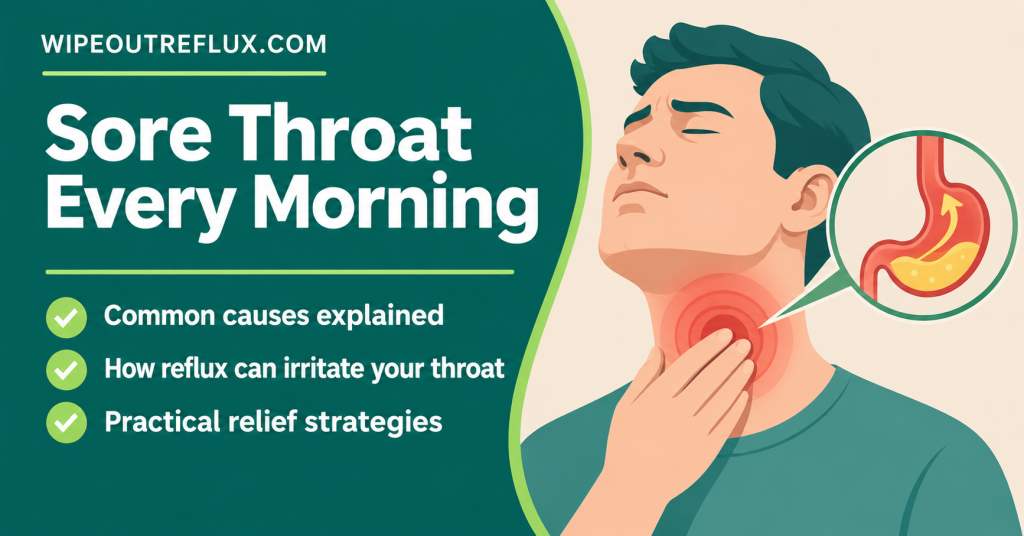
A sore throat every morning that eases by lunchtime is almost never an infection. It’s usually caused by something that happens to your throat for seven or eight hours while you sleep. The three most common causes are breathing through your mouth (often worse in dry, heated bedrooms), reflux reaching your throat at night, and post-nasal drip. Snoring and sleep apnea come close behind, and they often overlap with all three.
The good news is that the pattern itself is a clue. How fast it fades, what comes with it, and what you did the night before will usually tell you which cause you’re dealing with.
I’ve had more mornings than I can count waking up with a raw, scratchy throat during my years with LPR. Over time I learned that not every morning sore throat was reflux — and treating the wrong cause is how people stay stuck. Here’s how to work out which one is yours.
Key Takeaways
- A sore throat that’s there every morning but fades within an hour or two points to an overnight cause, not an infection.
- Mouth breathing is the most common culprit. It dries the throat lining and makes the mouth more acidic overnight.
- Dry indoor air makes it worse. Relative humidity around 40% is easier on the airways than levels below 30%.
- Snoring and sleep apnea are strongly linked to waking with a dry mouth and throat. More than half of sleep apnea patients in one study reported a dry throat daily or almost daily.
- Night-time reflux can cause morning throat pain, especially with late meals, alcohol, or excess weight. However, most throat reflux events in LPR actually happen during the day and while upright.
- If your sore throat also lasts most of the day, comes with hoarseness, throat clearing, or a lump sensation, reflux becomes much more likely.
- One-sided pain, trouble swallowing, ear pain, a lump in your neck, blood, or symptoms lasting more than three weeks need a doctor’s check.
Why mornings, specifically?
When you’re awake, your throat looks after itself constantly. You swallow hundreds of times an hour, saliva coats and buffers everything, and gravity keeps stomach contents where they belong.
Sleep switches most of that off. You swallow far less, saliva production drops, and if you’re lying flat, gravity stops working in your favor. Whatever reaches your throat overnight — dry air, mucus, or reflux — sits there longer with less to clear it.
Then you wake up, drink something, start talking and swallowing again, and your throat recovers. That’s why the classic pattern is “awful at 7am, fine by 10am.”
A quick way to narrow it down
Before going through each cause in detail, ask yourself these questions:
- Does it ease within 30–60 minutes of drinking water? Dryness is the likely cause — mouth breathing, dry air, or both.
- Is your mouth also dry, or do you wake with your mouth open? Mouth breathing.
- Do you snore, or has a partner noticed pauses in your breathing? Snoring or sleep apnea.
- Is your nose blocked, or do you wake clearing mucus down the back of your throat? Post-nasal drip, often from allergies or rhinitis.
- Is it worse after a late meal, alcohol, or a big dinner? Do you have a sour taste, hoarseness, or constant throat clearing? Night-time reflux.
- Does it last most of the day, not just the morning? Reflux, chronic irritation, or something that needs examining.
Plenty of people tick more than one box. Mouth breathing, snoring, and reflux often travel together, which is why fixing just one of them sometimes only gets you halfway.
Cause 1: mouth breathing
Your nose warms and humidifies the air before it reaches your throat. Your mouth doesn’t. Breathe through your mouth all night and you’re passing dry, unconditioned air over the back of your throat for hours.
It also changes your mouth chemistry. In a small study where healthy volunteers wore a nose clip to force mouth breathing during sleep, average intraoral pH during sleep fell from 7.0 to 6.6 [Choi et al., Journal of Oral Rehabilitation, 2016]. That’s mainly a dental concern, but it tells you how much drier and less protected the mouth and throat become when saliva isn’t doing its job.
Clues it’s mouth breathing:
- You wake with a dry mouth or cracked lips
- The soreness feels dry and scratchy rather than burning
- It eases quickly once you drink something
- Your nose is often blocked at night
The fix usually starts with the nose. If you can’t breathe comfortably through it, you’ll default to your mouth. Treating congestion, allergies, or a deviated septum often fixes the throat too. Some people try mouth taping. I’ve written about whether mouth taping is safe if you have reflux, and it’s worth reading before you try it — it’s not suitable if your nose is blocked or if you might have sleep apnea.
Cause 2: dry bedroom air
Central heating in winter and air conditioning in summer both pull moisture out of the air. A review of indoor humidity research found that relative humidity around 40% is better for the eyes and upper airways than levels below 30% [Wolkoff and Kjaergaard, Environment International, 2007].
If your morning throat is noticeably worse in winter, dry air is probably playing a part. A cheap hygrometer will tell you what your bedroom is actually sitting at. If it’s regularly below 30–35%, a humidifier is a sensible fix. I’ve covered which types work best in my guide to humidifiers for a dry, itchy throat. For the dry-not-sore version of this problem, see dry throat at night.
Cause 3: snoring and sleep apnea
Snoring means air is forcing its way through a narrowed, vibrating airway — usually with your mouth open. That’s a recipe for a sore throat.
Sleep apnea takes it further. In a study of 385 people with obstructive sleep apnea, before treatment 61% reported a dry mouth and 54% a dry throat daily or almost daily, and 52% had nasal stuffiness [Kreivi et al., Respiration, 2010]. In a community study, waking with a dry mouth was significantly associated with loud snoring and observed breathing pauses, and the authors suggested it could work as a screening symptom for sleep apnea [Ma et al., Postgraduate Medicine, 2024].
There’s a reflux link here as well. In a small study of people with sleep apnea and reflux symptoms, throat reflux was found in 28 of 30 patients, and those reflux events happened mainly at night and while lying down [Bobin and Lechien, Journal of Otolaryngology – Head & Neck Surgery, 2023]. So if you snore, wake unrefreshed, and have a sore throat most mornings, sleep apnea is worth ruling out properly — both for your throat and for your health more broadly. I go into the connection in more detail in snoring and acid reflux and sleep apnea and acid reflux.
Other signs to look for: morning headaches, daytime sleepiness, waking up gasping, or needing to urinate several times a night. If several apply, ask your doctor about a sleep study.
Cause 4: night-time reflux
This is the one most people suspect, and sometimes rightly. When stomach contents reach the throat overnight, pepsin and acid sit on tissue that has very little protection. Unlike the esophagus, the throat lining isn’t built to handle it. You can read more about how pepsin reactivates in the throat.
But I want to give you the more honest picture, because it changes what you should look for. When researchers measured throat reflux events directly in 126 people with confirmed LPR, only 5.5% of those events happened at night. Most happened during the day, and more than half the patients had no night-time throat reflux events at all. However, the patients who did have both day and night events had more severe reflux and worse symptom scores [Lechien et al., The Laryngoscope, 2021].
What that means in practice:
- If your throat is only sore in the morning and fine for the rest of the day, reflux probably isn’t the only cause. Look hard at dryness, mouth breathing, and snoring first.
- If your morning soreness comes on top of daytime throat symptoms — hoarseness, throat clearing, a lump feeling, or post-nasal mucus — reflux is much more likely to be involved, and probably more significant.
- If you snore or are carrying extra weight, night-time throat reflux becomes more likely.
Other clues that point toward reflux: a sour or bitter taste on waking, a burning rather than dry feeling, coughing when you lie down, and symptoms that are clearly worse after a late or heavy dinner, alcohol, or chocolate. If you want to score your symptoms, the Reflux Symptom Index is a good starting point.
I’ve covered the wider reasons in why acid reflux is often worse in the morning.
Cause 5: post-nasal drip
When mucus drains down the back of your throat all night, it irritates the lining and makes you clear your throat the moment you wake up. Allergies (dust mites in bedding are a classic trigger), chronic rhinitis, and sinus problems are the usual causes.
Post-nasal drip and LPR can feel almost identical, and reflux can itself cause a sensation of mucus at the back of the throat. If you’re not sure which you have, my comparison of LPR vs allergies walks through the differences, and there’s more on how to get rid of post-nasal drip.
Other things that make it worse
- Alcohol in the evening — dehydrates you, relaxes the throat muscles (more snoring), and makes night-time reflux more likely.
- Not drinking enough during the day — you start the night already on the dry side.
- Medications — antihistamines, some antidepressants, and blood pressure drugs can all dry the mouth. See acid reflux and dry mouth for more on this.
- Smoking and vaping — direct irritants to an already vulnerable throat.
- Talking or singing a lot the day before — a strained throat feels worse after a dry night.
What to do about it
Because the causes overlap, I’d start with the changes that help more than one of them at once.
Tonight
- Finish eating three hours before bed. This is the single most useful change if reflux is involved. Here’s more on how long before bed to stop eating.
- Skip alcohol in the evening for a week and see what changes.
- Drink a glass of water before bed and keep one by the bed.
- Check your nose. If it’s blocked, a saline rinse before bed can make a real difference to whether you breathe through your mouth.
This week
- Measure your bedroom humidity, and add a humidifier if it’s regularly below 30–35%.
- Raise the head of your bed — the whole bed, not just extra pillows. This helps both reflux and snoring. Here’s how to raise the head of your bed, and which sleeping position to use.
- Try an alginate after your evening meal and at bedtime if you suspect reflux. Alginates form a raft that physically blocks reflux rather than just neutralizing acid.
- Ask someone whether you snore, or record yourself overnight with a phone app.
Longer term
If reflux turns out to be part of the picture — especially if your throat is bad during the day too — diet is where you’ll make the biggest dent. Late meals, trigger foods, and acidic drinks all add up. The Wipeout Diet Plan takes you through it step by step, with an elimination phase and a structured reintroduction.
If you snore and wake unrefreshed, get checked for sleep apnea. Treating it can help your throat, your reflux, and your energy all at once.
When to see a doctor
A morning-only sore throat that fades quickly is rarely serious. But see a doctor if you have any of these:
- Pain on one side only, or pain that spreads to your ear — see sore throat on one side
- Difficulty or pain when swallowing
- A lump in your neck
- Coughing or spitting up blood
- Hoarseness lasting more than three weeks
- Unexplained weight loss
- Fever, swollen glands, or a sore throat that gets worse rather than better through the day
- A sore throat that’s lasting longer and longer — see sore throat that won’t go away
Smokers and heavy drinkers should get persistent throat symptoms checked sooner rather than later.
Conclusion
A sore throat every morning is your throat telling you about the last eight hours. When it fades quickly once you’re up and drinking, the usual causes are mouth breathing, dry air, and snoring — and those are often easy to fix with a clearer nose, a humidifier, and a check for sleep apnea.
Reflux is the other big player, but it’s worth being honest about it. Most throat reflux happens during the day, so a throat that’s only sore in the morning is rarely explained by reflux alone. When the morning soreness comes with daytime hoarseness, throat clearing, a lump feeling, or a sour taste — or it’s clearly worse after late meals and alcohol — reflux is much more likely to be driving it.
The best approach is to start with the changes that help several causes at once: stop eating three hours before bed, cut evening alcohol, raise the head of the bed, sort out your nose, and fix your bedroom humidity. Give it two weeks and see what’s left.
If reflux turns out to be part of it, the Wipeout Diet Plan is the complete guide I wish I’d had when my mornings started with a raw throat. It walks you through which foods and drinks to cut, when to eat, and how to bring foods back without setting yourself off again. It was designed first for silent reflux — the throat-based kind behind most morning soreness — and because it targets the same root causes, it works just as well for regular heartburn and GERD.
Frequently Asked Questions
Why do I wake up with a sore throat every morning but feel fine later?
Overnight, you swallow less, make less saliva, and often breathe through your mouth, so your throat dries out and anything irritating sits there longer. Once you’re up, drinking, and swallowing normally, it recovers. Mouth breathing, dry air, snoring, post-nasal drip, and night-time reflux are the usual causes.
Can acid reflux cause a sore throat in the morning?
Yes. Reflux reaching the throat overnight can leave it raw or burning on waking, especially after late meals or alcohol. But most throat reflux happens during the day, so if your throat is only sore in the morning, check for dryness and mouth breathing too.
How do I know if my morning sore throat is from mouth breathing?
Mouth breathing usually comes with a dry mouth on waking and a dry, scratchy rather than burning feeling. It eases quickly once you drink water. A blocked nose at night makes it much more likely.
Can sleep apnea cause a sore throat?
It can. Most people with sleep apnea snore and breathe through their mouths, and over half report a dry throat daily or almost daily. Sleep apnea is also linked to night-time reflux reaching the throat. Loud snoring, gasping, and daytime tiredness are reasons to ask for a sleep study.
Does a humidifier help a sore throat in the morning?
It can if your bedroom air is dry, which is common with central heating. Indoor humidity around 40% is easier on the airways than levels below 30%. It won’t fix reflux or a blocked nose, though, so it works best alongside other changes.
What should I drink for a sore throat in the morning?
Plain water first, to rehydrate. Lukewarm, non-acidic drinks such as herbal tea are gentle on the throat. If reflux is involved, avoid coffee, citrus juice, and fizzy drinks first thing.
When is a morning sore throat a sign of something serious?
See a doctor if the pain is on one side, you have trouble swallowing, a lump in your neck, blood, ear pain, unexplained weight loss, or hoarseness lasting more than three weeks. A sore throat that lasts all day and keeps getting worse also needs checking.
Research & References
- [Choi et al., Journal of Oral Rehabilitation, 2016] — Continuous monitoring in 10 healthy volunteers showed that forced mouth breathing during sleep (using a nose clip) lowered average intraoral pH from 7.0 to 6.6.
- [Wolkoff and Kjaergaard, Environment International, 2007] — A literature review on indoor humidity. It concluded that relative humidity around 40% is better for the eyes and upper airways than levels below 30%.
- [Kreivi et al., Respiration, 2010] — Among 385 patients with obstructive sleep apnea, upper airway symptoms were common before treatment: 61% had a dry mouth, 54% a dry throat, and 52% nasal stuffiness daily or almost daily.
- [Ma et al., Postgraduate Medicine, 2024] — A community cross-sectional study finding that morning dry mouth was significantly associated with loud snoring, observed sleep apnea, and daytime fatigue. The authors proposed it as a possible screening symptom for sleep apnea.
- [Bobin and Lechien, Journal of Otolaryngology – Head & Neck Surgery, 2023] — In patients with sleep apnea and reflux symptoms, oropharyngeal pH monitoring detected throat reflux in 28 of 30 cases. Reflux events occurred mainly at night and while lying down.
- [Lechien et al., The Laryngoscope, 2021] — Impedance-pH monitoring in 126 patients with LPR found that only 5.5% of throat reflux events occurred at night, and 58.7% of patients had none overnight. Patients with both daytime and night-time events had more severe reflux findings and symptoms.

David Gray
12 years living with LPR · Consultant & researcher
I've lived with LPR for twelve years — the misdiagnoses, the PPI courses that did nothing, the slow work of figuring out what actually helps. Wipeout Reflux is where I translate the research into plain terms for people stuck in the same place. Every claim here is sourced to peer-reviewed work, and I consult one-to-one with LPR sufferers.