
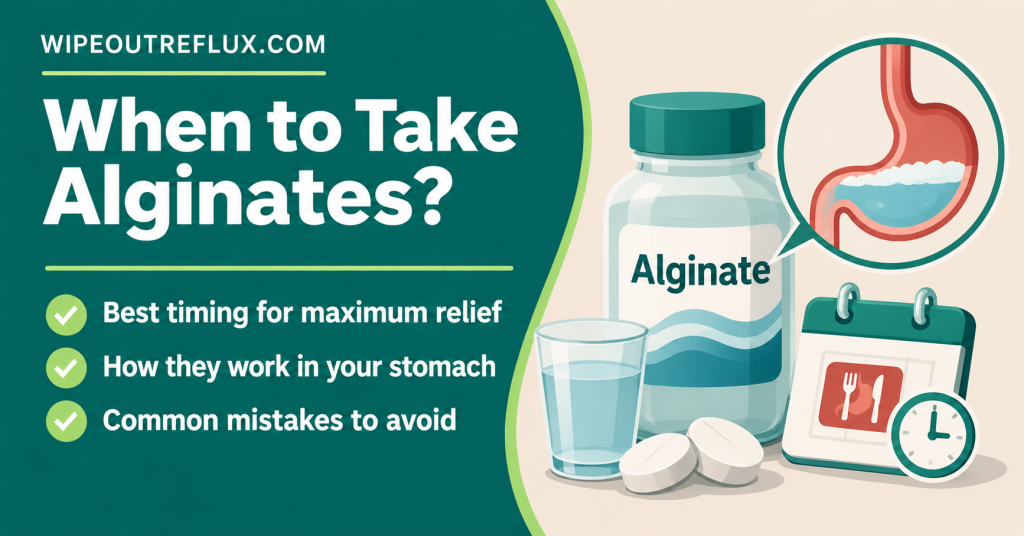
The best time to take an alginate is straight after a meal, ideally within about 30 minutes, and again last thing at night before bed. That’s when reflux is most likely, and it’s when the raft has food to float on. After each dose, don’t eat or drink for at least 30 minutes, and leave about two hours between your alginate and any other medication.
Most people who say alginates “didn’t work” for them took them at the wrong time: on an empty stomach, only once symptoms had already flared, or with a big glass of water straight afterward that washed the raft away. Timing matters more than which brand you buy.
I’ve used alginates through most of my years with LPR, and I now recommend them in almost every consult. Here’s exactly how and when to take them so they actually do their job.
Key Takeaways
- After meals: take your alginate right after eating, ideally within 30 minutes. The raft needs food in the stomach to float on.
- At bedtime: this is the most important dose for night-time reflux and throat symptoms. Take it as the very last thing before you lie down.
- The standard routine in clinical trials is after each main meal and at bedtime, up to four times a day.
- Don’t eat or drink for 30 minutes afterward, so the raft stays intact.
- Keep other medicines about two hours away from your alginate, especially thyroid medication, iron, and some antibiotics.
- For steady symptoms, take it on a schedule, not only when you feel bad.
- Alginates can be taken alongside PPIs and H2 blockers, and often work well as an add-on when a PPI alone isn’t enough.
- Check the label: US “Gaviscon” products are mostly antacid with little alginate. Alginate-dominant products such as UK Gaviscon Advance form a much stronger raft.
Why timing matters so much
To understand the timing, you need to know what the alginate is actually doing.
When an alginate meets stomach acid, it turns into a gel. Most formulas also contain bicarbonate, which releases carbon dioxide that gets trapped in the gel and makes it float. The result is a foam raft that sits on top of your stomach contents, right at the junction with the esophagus. It’s a physical barrier, not just an acid neutralizer. I go into the full mechanism in my guide to alginates for acid reflux.
Here’s the key point. After you eat, a layer of highly acidic gastric juice collects on top of the meal, just below the esophagus. It’s called the acid pocket. It forms quickly — within 10 to 15 minutes of eating — and it’s the main source of after-meal reflux [Boeckxstaens, Gastroenterology & Hepatology, 2013].
The alginate raft goes exactly where that acid pocket is. In a scintigraphy study, an alginate taken after a standard meal localized to the acid pocket and pushed it below the diaphragm in 71% of patients, against 21% with a plain antacid. It also significantly reduced acid reflux episodes [Rohof et al., Clinical Gastroenterology and Hepatology, 2013].
That’s why “after a meal” isn’t just label advice. It’s when the target exists.
When to take alginates
1. Straight after meals
This is the core dose. Take it as soon as you’ve finished eating, or within about 30 minutes. If you take it before a meal, the raft forms on an empty stomach and the food you eat afterward breaks it up. If you wait two hours, you’ve missed the window when reflux is highest.
Most people don’t need it after every snack. Focus on your main meals, especially the largest one of the day.
2. At bedtime
If you only take one dose a day, make it this one. When you lie down, gravity stops helping, and reflux can travel higher with less to clear it. For anyone with night-time reflux or throat symptoms, the bedtime dose matters most.
Take it as the very last thing you do — after brushing your teeth and after your last drink. Then go to bed.
Ideally, your last meal should have been at least three hours earlier. An alginate helps, but it doesn’t cancel out a big dinner at 10pm.
3. Before a known trigger
In my experience, a dose before something that reliably sets off your reflux can prevent a flare rather than chase it. That might be exercise after eating, a long car journey slumped in a seat, bending or lifting work, or a meal you know is going to be a problem. This is practical use rather than something trials have tested, but the logic is the same: get the barrier in place before the reflux happens.
4. On demand
Alginates work well for occasional heartburn too. Take one when symptoms start and you’ll usually feel relief quickly. But if you’re having symptoms most days, on-demand use alone usually isn’t enough. A schedule works better.
How much and how often
Always follow the label for your specific product, because strength varies a lot between brands.
For UK Gaviscon Advance, the licensed adult dose is 5–10 ml after meals and at bedtime, up to four times a day [Gaviscon Advance Summary of Product Characteristics, Reckitt Benckiser, UK]. That’s also the pattern the main trials used:
- In a trial of 278 people with moderate, episodic heartburn, alginate taken four times a day was non-inferior to omeprazole 20 mg for reaching the first 24-hour heartburn-free period [Pouchain et al., BMC Gastroenterology, 2012].
- In a trial of 49 people with LPR, 10 ml of Gaviscon Advance after meals and at bedtime significantly improved symptom scores at two and six months, and throat examination scores at six months, compared with no treatment [McGlashan et al., European Archives of Oto-Rhino-Laryngology, 2009].
Across 14 randomized trials and 2,095 people, alginate-based treatments gave more than four times the odds of reflux symptom resolution compared with placebo or antacids [Leiman et al., Diseases of the Esophagus, 2017].
A practical starting routine for daily symptoms:
- After breakfast
- After lunch
- After your evening meal
- At bedtime
If your symptoms are mostly at night or mostly after one particular meal, you can focus your doses there.
Step by step: how to take a liquid alginate
- Shake the bottle well. The alginate settles, and a thin first pour gives a weak raft.
- Measure the dose with the cup or spoon provided. Don’t guess with a swig from the bottle.
- Swallow it slowly. It coats the esophagus on the way down. Swallowed alginate stuck to the lower esophageal lining for around 10 minutes in one study, far longer than a placebo solution [Sonmez et al., Alimentary Pharmacology and Therapeutics, 2020].
- Don’t eat or drink for 30 minutes. A large drink can break the raft up and wash the coating away. If your mouth is dry, a small sip is fine.
- Stay upright after the daytime doses if you can. Slumping on the sofa straight after a meal works against you.
Liquid or tablets?
Both work, but they suit different situations.
- Liquid forms a raft quickly and coats the esophagus as it goes down. It’s my first choice at home, and especially at bedtime.
- Chewable tablets are convenient when you’re out. Chew them thoroughly — swallowing them whole or half-chewed gives a weaker raft. A drink of water afterward is usually recommended with tablets, but keep it small.
- Sachets are a good middle ground: the liquid form in a portable package.
Brand matters as well. The US version of Gaviscon is mostly antacid, with alginate as a minor ingredient, so it doesn’t behave like UK Gaviscon Advance. I compare the options in Gaviscon Advance and Reflux Gourmet vs Gaviscon.
Taking alginates with other medications
With PPIs or H2 blockers
You can take an alginate alongside a PPI or an H2 blocker such as famotidine. They do different jobs: the PPI reduces how much acid you make, and the alginate physically blocks what’s left from coming back up. In a randomized trial of people still getting symptoms on a once-daily PPI, adding an alginate improved symptoms compared with adding a placebo [Reimer et al., Alimentary Pharmacology and Therapeutics, 2016].
Take your PPI as directed, usually 30–60 minutes before breakfast, and your alginate after the meal. The timings fit together naturally.
For LPR, a PPI may not even be necessary. In one study, people taking Gaviscon Advance alone improved just as much as those taking it with a high-dose PPI [Wilkie et al., European Archives of Oto-Rhino-Laryngology, 2018]. If you’re thinking about stopping a PPI, do it gradually with your doctor — see getting off PPIs and acid rebound.
With everything else: the two-hour rule
Alginate products contain antacid salts that can interfere with how some medicines are absorbed. The UK product guidance advises leaving about two hours between an alginate and other medicines [Gaviscon Advance Summary of Product Characteristics, Reckitt Benckiser, UK]. This matters most for:
- Thyroid medication (levothyroxine)
- Iron supplements
- Some antibiotics, including tetracyclines and fluoroquinolones
- Digoxin, some beta-blockers, and steroids
- Bisphosphonates for bone health
If you take several medicines a day, ask your pharmacist to help you plan a schedule. It’s usually easy to make it work.
Alginates for LPR and silent reflux
For throat-based reflux, the routine is the same — after meals and at bedtime — but sticking to it matters even more. LPR doesn’t need much reflux to cause symptoms, so you want the barrier in place before reflux happens, not after your throat already feels raw.
Give it at least eight weeks of consistent use before you judge it. In the McGlashan trial, the improvement was measured at two months and held at six [McGlashan et al., European Archives of Oto-Rhino-Laryngology, 2009]. I cover the pepsin side in detail in does Gaviscon neutralize pepsin, and why acid suppression often falls short in why PPIs don’t work for LPR.
Alginates in pregnancy
Heartburn is very common in pregnancy, and alginates are one of the first things usually suggested because they work mostly inside the stomach rather than being absorbed into the blood. In a prospective study of 144 pregnant women with heartburn, a liquid alginate was found to be both safe and highly effective [Strugala et al., ISRN Obstetrics and Gynecology, 2012]. The same timing applies — after meals and at bedtime — but check with your midwife, doctor, or pharmacist first. See acid reflux and pregnancy for more.
Who should be careful
- People on a low-sodium diet, or with heart failure, high blood pressure, or kidney disease. Most alginate liquids contain sodium (and some contain potassium), which adds up at four doses a day. Ask your doctor.
- People with kidney problems, because of the calcium, magnesium, or aluminum salts in some products.
- People with phenylketonuria, as some flavored or sugar-free versions contain aspartame.
- Children — use only the products and doses labeled for their age, and check with a pharmacist.
If you need an alginate every day for more than a couple of weeks for heartburn, it’s worth getting checked to make sure nothing else is going on. Seek help urgently if you have difficulty swallowing, unexplained weight loss, vomiting blood, or black stools.
The most common mistakes
- Taking it before meals. The raft forms on an empty stomach and your meal breaks it up.
- Only using it when symptoms are bad. For daily symptoms, prevention beats rescue.
- Skipping the bedtime dose. It’s usually the most important one.
- Drinking straight afterward, especially coffee, juice, or fizzy drinks.
- Not shaking the bottle, or swallowing tablets half-chewed.
- Buying an antacid-heavy product and expecting a strong raft.
- Taking it at the same time as other medicines, especially thyroid tablets or iron.
- Expecting it to fix everything on its own. If you keep eating late, large, or trigger-heavy meals, the raft is fighting a losing battle.
That last one is the mistake I see most in consults. An alginate reduces how much reflux gets through, but your diet decides how much reflux is waiting to get through in the first place. The two work best together, which is why I pair an alginate routine with the Wipeout Diet Plan for most people I work with.
Conclusion
Alginates are one of the most useful and underrated tools for reflux, but only if you take them properly. The rules are simple: take them after meals, when the acid pocket is forming, and at bedtime, when reflux travels highest. Give the raft 30 minutes without food or drink, keep other medicines about two hours away, and use them on a schedule rather than only when symptoms flare.
Choose an alginate-dominant product, shake it well, and give it at least a few weeks — or eight weeks if you’re dealing with throat symptoms — before deciding whether it’s working. Alginates combine well with PPIs and H2 blockers, and they’re among the safer options in pregnancy. Check with your doctor if you’re on a salt-restricted diet or have kidney problems.
But an alginate is a barrier, not a cure. It limits how much reflux gets through; it doesn’t change why the reflux is happening. For that, you need to change what’s going into your stomach and when. The Wipeout Diet Plan is my full, step-by-step approach to that. It covers which foods to cut, how to time meals, and how to reintroduce foods without triggering a relapse. I built it first for silent reflux, the stubborn throat-based kind, but because it targets the same underlying causes, it works just as well for everyday heartburn and GERD.
Frequently Asked Questions
Should I take alginates before or after food?
After food, ideally within about 30 minutes of finishing your meal. The raft needs stomach contents to float on, and the acid pocket that drives after-meal reflux forms within 10 to 15 minutes of eating.
What is the best time to take an alginate at night?
As the very last thing before bed — after brushing your teeth and after your last drink. That gives the raft the best chance of staying intact while you’re lying down.
How long should I wait to drink after taking an alginate?
At least 30 minutes. A large drink can break up the raft and wash away the coating on your esophagus. A small sip is fine if you really need it.
Can I take an alginate with omeprazole or another PPI?
Yes. They work in different ways and are often combined. Take the PPI as directed, usually before breakfast, and the alginate after meals and at bedtime.
How many times a day can I take an alginate?
For most products it’s up to four times a day: after each main meal and at bedtime. Always follow the dose on your specific product’s label.
How long does an alginate raft last?
It varies with the product and what you’ve eaten, but it generally protects you through the after-meal reflux window. That’s why taking it after each meal and at bedtime gives the most even coverage.
Why isn’t my alginate working?
The usual reasons are taking it before meals or only on demand, drinking straight afterward, using an antacid-heavy product with little alginate, or eating late, large meals that overwhelm the raft. If you’ve fixed all of those and still have symptoms, speak to your doctor about testing.
Research & References
- [Boeckxstaens, Gastroenterology & Hepatology, 2013] — An expert overview of the gastric acid pocket. It explains that acid begins to accumulate on top of a meal within 10 to 15 minutes of eating and is a key source of after-meal reflux.
- [Rohof et al., Clinical Gastroenterology and Hepatology, 2013] — In 16 GERD patients with hiatal hernias given medication after a standard meal, an alginate-antacid raft localized to the acid pocket and displaced it below the diaphragm in 71% of patients, against 21% with antacid alone. It also reduced acid reflux episodes.
- [Gaviscon Advance Summary of Product Characteristics, Reckitt Benckiser, UK] — The official UK prescribing information. It gives a licensed adult dose of 5–10 ml after meals and at bedtime, advises leaving about two hours before or after other medicines, and covers sodium and potassium content.
- [Pouchain et al., BMC Gastroenterology, 2012] — A double-blind, randomized non-inferiority trial in 278 patients with moderate, episodic heartburn. Alginate taken four times daily was non-inferior to omeprazole 20 mg for reaching the first 24-hour heartburn-free period.
- [McGlashan et al., European Archives of Oto-Rhino-Laryngology, 2009] — In 49 patients with LPR, 10 ml of Gaviscon Advance after meals and at bedtime significantly improved symptom scores at two and six months, and throat examination scores at six months, compared with no treatment.
- [Leiman et al., Diseases of the Esophagus, 2017] — A meta-analysis of 14 randomized trials (2,095 participants). Alginate-based treatments increased the odds of reflux symptom resolution more than fourfold compared with placebo or antacids.
- [Sonmez et al., Alimentary Pharmacology and Therapeutics, 2020] — Swallowed Gaviscon Advance adhered to the lower esophageal lining for around 10 minutes in healthy volunteers and 9 minutes in heartburn patients, far longer than a placebo solution.
- [Reimer et al., Alimentary Pharmacology and Therapeutics, 2016] — A randomized, placebo-controlled trial of Gaviscon Advance as an add-on for people with persistent reflux symptoms despite a once-daily PPI.
- [Wilkie et al., European Archives of Oto-Rhino-Laryngology, 2018] — In LPR patients followed for three months, Gaviscon Advance alone reduced symptom scores as much as Gaviscon Advance combined with a high-dose PPI.
- [Strugala et al., ISRN Obstetrics and Gynecology, 2012] — A multicentre, prospective, open-label study in 144 pregnant women with heartburn, finding a liquid alginate safe and highly effective for heartburn and reflux symptoms in pregnancy.

David Gray
12 years living with LPR · Consultant & researcher
I've lived with LPR for twelve years — the misdiagnoses, the PPI courses that did nothing, the slow work of figuring out what actually helps. Wipeout Reflux is where I translate the research into plain terms for people stuck in the same place. Every claim here is sourced to peer-reviewed work, and I consult one-to-one with LPR sufferers.