
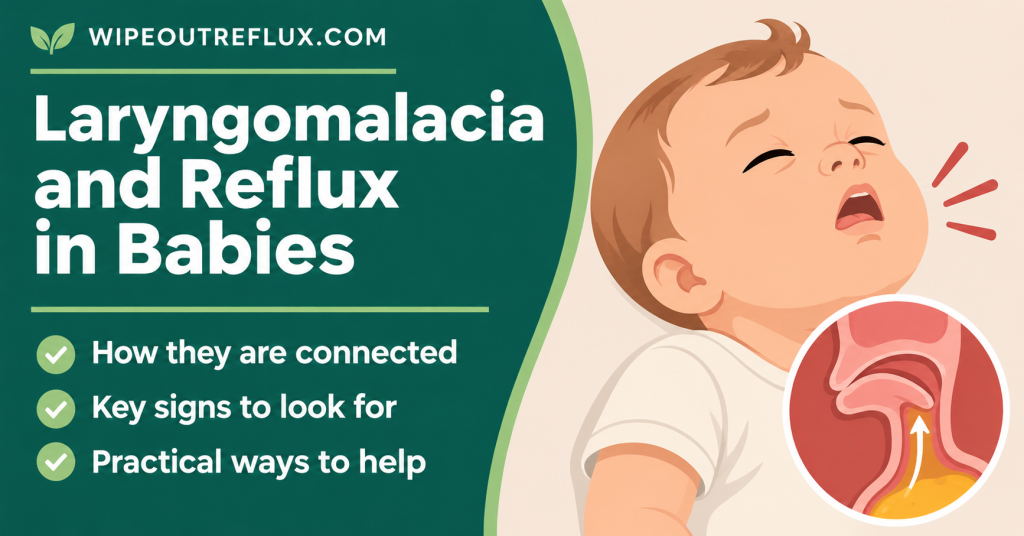
Laryngomalacia is a common condition in newborns where the soft tissue above the voice box is floppy and gets sucked inward when the baby breathes in. That causes the high-pitched, squeaky noise called stridor that’s usually worse during feeding, crying, lying on the back or when the baby is excited. It’s the most common cause of noisy breathing in infants, and in most babies it settles on its own by 12 to 18 months.
Reflux and laryngomalacia are closely linked. Around half of babies with laryngomalacia also have reflux, and reflux tends to be more common in the more severe cases. The two can feed each other: the effort of breathing through a floppy airway pulls stomach contents upward, and refluxed material reaching the larynx makes the tissue swell and collapse even more.
But here’s the part many parents don’t hear: the evidence that acid-reducing medicines actually help laryngomalacia is weak, and two recent studies even linked them to worse outcomes. Below I’ll walk through what the research shows, why that might be, and what tends to help instead.
Key Takeaways
- Laryngomalacia is a floppy upper airway that causes noisy breathing (stridor) on breathing in, usually starting in the first few weeks of life.
- Most babies have mild laryngomalacia and grow out of it, typically by 12 to 18 months, without surgery.
- Reflux is the most common condition found alongside laryngomalacia, affecting roughly half of affected babies, and is more common in moderate and severe cases.
- Reflux and laryngomalacia can create a vicious cycle: harder breathing pulls reflux up, and reflux inflames and swells the airway.
- Infant reflux is often weakly acidic or non-acidic, which may be one reason acid-reducing medicines often don’t help.
- Recent studies found babies with laryngomalacia given acid suppression were more likely to need surgery and to be hospitalized with breathing problems, though these studies can’t prove cause and effect.
- Thickened feeds and feeding therapy for swallowing problems appear more helpful than acid suppression in many babies.
- Babies should always sleep flat on their back, even with reflux and laryngomalacia.
- Blue spells, pauses in breathing, poor weight gain or struggling to feed need prompt medical attention.
What Is Laryngomalacia?
“Laryngo” means larynx (voice box), and “malacia” means softening. In laryngomalacia, the structures sitting on top of the larynx, mainly the epiglottis and the folds of tissue on either side of it, are floppy rather than firm. When the baby breathes in, the suction pulls this tissue into the airway opening and partly blocks it. Air rushing through the narrowed gap makes the characteristic noise.
Typical signs of laryngomalacia
- A high-pitched, squeaky or fluttering sound when breathing in
- Noise that starts at birth or in the first few weeks, often peaking around 4 to 8 months
- Louder breathing during feeding, crying, excitement or when lying on the back
- Quieter breathing when calm, asleep on the side, or upright
- Coughing, choking or spluttering during feeds in some babies
- Frequent spitting up or signs of reflux
The diagnosis is made by an ENT specialist, usually by passing a very thin, flexible camera through the nose to watch the larynx move while the baby breathes. It’s quick and is done awake.
Mild, moderate and severe
Laryngomalacia is a spectrum. Most babies are mild: noisy, but feeding and growing well with normal oxygen levels. Moderate cases come with feeding difficulties like coughing, choking or regurgitation. Severe cases involve breathing pauses, blue spells, poor weight gain or significant chest drawing-in, and may need surgery called supraglottoplasty, where the surgeon trims the floppy tissue.
In one large study of 201 infants followed over time, most babies’ symptoms resolved within 12 months of presenting, and reflux and feeding problems were significantly more common in those with moderate and severe disease [Thompson, The Laryngoscope, 2007].
Why Does Laryngomalacia Happen?
Nobody knows for certain, and it’s likely a mix of factors. The leading theory is neurological. That same 2007 study tested the reflexes that keep the larynx toned and protected, using small puffs of air, and found that babies with laryngomalacia had abnormal sensory and motor function in the larynx, which got worse with more severe disease [Thompson, The Laryngoscope, 2007].
In other words, the issue may not just be that the tissue is floppy. The nerve control that should hold it firm and open may be immature. That would also explain why so many of these babies have trouble coordinating sucking, swallowing and breathing, and why it improves as the nervous system matures.
How Reflux and Laryngomalacia Are Connected
Reflux shows up again and again in babies with laryngomalacia. A systematic review found an overall reflux rate of 59% across studies, and babies with severe laryngomalacia were far more likely to have reflux than babies with mild disease [Hartl & Chadha, Otolaryngology–Head and Neck Surgery, 2012]. A more recent meta-analysis found reflux disease was the single most common condition diagnosed alongside laryngomalacia, present in around 49% of children [Mills et al., International Journal of Pediatric Otorhinolaryngology, 2024].
There are two ways the relationship can run, and they can reinforce each other.
1. Laryngomalacia can make reflux worse
When a baby breathes in against a partly blocked airway, they have to suck harder. That creates strong negative pressure inside the chest. The esophagus runs through the chest, and that suction can help pull stomach contents upward past the lower esophageal sphincter, which is still immature in young babies. Crying, which is common in uncomfortable babies, adds to this.
2. Reflux can make laryngomalacia worse
When refluxed stomach contents, including pepsin, reach the larynx, they irritate and inflame the delicate tissue. Inflamed tissue swells, and swollen tissue is heavier and more likely to be sucked into the airway. Reflux may also blunt the sensory reflexes that are already weak in these babies. I explain how pepsin damages throat tissue in what is pepsin.
Put those together, and you get a cycle: floppy airway, harder breathing, more reflux, more swelling, floppier airway. That cycle is the reason doctors have reached for reflux medication for so long.
Do Reflux Medicines Help Laryngomalacia?
This is where the story gets more complicated, and it’s something I think every parent of a baby with laryngomalacia deserves to know.
For decades, acid-suppressing medicines like H2 blockers (famotidine) and PPIs (omeprazole, lansoprazole) have been prescribed almost routinely for babies with laryngomalacia. But when researchers reviewed the evidence in 2012, they found no randomized controlled trials at all. The support came from case series and reports [Hartl & Chadha, Otolaryngology–Head and Neck Surgery, 2012].
Since then, two larger studies have looked directly at outcomes:
- Boston Children’s Hospital, 2021: Of 236 infants with laryngomalacia, 55% were given acid suppression. After adjusting for severity and other conditions, babies on acid suppression had more than three times the risk of needing supraglottoplasty, needed it sooner, and had more hospital admissions for breathing problems. Thickened feeds, used to treat swallowing problems, were linked to fewer days in hospital [Duncan et al., The Journal of Pediatrics, 2021].
- Children’s National Hospital, 2025: In 395 infants with non-severe laryngomalacia, 6.7% of those treated with reflux medication went on to need surgery, compared with 3.4% of those simply observed [Zalzal et al., JAMA Otolaryngology–Head & Neck Surgery, 2025].
Both were retrospective studies, so they can’t prove the medicines caused worse outcomes. Sicker babies may simply have been more likely to be prescribed them. But they do strongly suggest that acid suppression isn’t the helpful safety net it’s often assumed to be.
Why acid suppression may fall short
I think there are a few reasons, and they line up with what I see in adults with throat reflux:
- Infant reflux is often not very acidic. Babies feed frequently, and milk buffers stomach acid, so much of their reflux is weakly acidic or non-acidic. Acid suppression doesn’t stop that reflux happening. I explain this further in non-acid reflux.
- It doesn’t stop pepsin. PPIs and H2 blockers reduce acid, but reflux still reaches the larynx, carrying pepsin with it. It’s the same reason PPIs often don’t work for LPR in adults.
- Stomach acid is protective. Acid helps kill bacteria. Lowering it may make it easier for bacteria to colonize the upper airway, and acid suppression in infants has been linked to higher rates of respiratory and gut infections.
- The symptoms may be swallowing, not reflux. Coughing and choking during feeds in laryngomalacia are often caused by trouble coordinating suck, swallow and breathe, sometimes with milk slipping into the airway. That looks like reflux but needs a different fix.
Pediatric reflux guidelines have moved in the same direction, recommending less acid suppression in infants and caution about blaming airway symptoms on reflux without good evidence [Rosen et al., Journal of Pediatric Gastroenterology and Nutrition, 2018].
That doesn’t mean medication is never appropriate. Some babies do have significant reflux disease, and your child’s doctor may decide a short trial is worthwhile. But please don’t start, stop or change a baby’s medication without speaking to their doctor.
Swallowing Problems: The Often-Missed Piece
Swallowing difficulties are very common in laryngomalacia. One study of 324 children with laryngomalacia found that swallowing dysfunction was common regardless of how severe the laryngomalacia was, and reflux disease had been diagnosed in nearly 70% of them [Simons et al., The Laryngoscope, 2016].
Signs a swallowing problem might be part of the picture include:
- Coughing, gagging or choking during feeds
- A wet, gurgly voice or breathing after feeding
- Long, stressful feeds or pulling off the bottle or breast to breathe
- Recurrent chest infections
- Poor weight gain
If you notice these, ask about a feeding assessment with a speech and language therapist. A swallow study can show whether milk is going the wrong way, and simple changes like thickening feeds, adjusting the flow rate of the bottle teat, or changing feeding position can make a big difference.
What Helps Babies With Laryngomalacia and Reflux
Always work with your child’s pediatrician, ENT or feeding team, especially before making changes to how your baby is fed.
Feeding
- Feed in a more upright position rather than lying back. It helps both breathing and swallowing.
- Offer smaller, more frequent feeds if advised, to avoid an overfull stomach.
- Pace bottle feeds. Let your baby pause to breathe, and ask about a slower-flow teat if they’re gulping or choking.
- Wind your baby gently and often. Swallowed air distends the stomach and encourages reflux.
- Hold your baby upright for 20 to 30 minutes after feeds.
- Ask about thickened feeds. Only under medical guidance, as the right thickener and amount depend on your baby’s age and needs.
- Consider cow’s milk protein allergy. It can mimic or worsen reflux in some babies. Your doctor may suggest a trial of a specialized formula or, if you’re breastfeeding, a supervised dairy-free trial.
Sleep
Laryngomalacia is often noisier when babies lie on their backs, and reflux may be too, so it’s natural to want to prop them up. But safe sleep guidance is clear: babies should always sleep flat on their back on a firm, flat mattress, with no wedges, pillows, inclined sleepers or positioners. If your baby’s breathing seems labored when lying flat, talk to their doctor rather than changing their sleep position.
Everyday care
- Keep your home smoke-free. Smoke irritates the airway and worsens reflux.
- Watch growth and feeding closely. Weight gain is one of the best signs that things are on track.
- Treat colds promptly. A cold can make laryngomalacia noticeably noisier for a while, and it’s worth keeping a closer eye on breathing during these times.
When to Seek Help
Call emergency services or get urgent care if your baby:
- Turns blue or gray around the lips
- Stops breathing, even briefly
- Has severe chest or neck drawing-in with each breath
- Is struggling to breathe or becoming floppy or unusually sleepy
See your baby’s doctor soon if they:
- Are not gaining weight well or are feeding poorly
- Cough, choke or splutter frequently during feeds
- Have repeated chest infections
- Have noisy breathing that’s getting steadily worse, or noise when breathing out as well as in
Noise on breathing out, a hoarse cry or noise that doesn’t change with position can point to a different problem in the airway, so it’s always worth having noisy breathing assessed by an ENT. If you’re also wondering whether your baby’s symptoms are reflux or something else, my guides on silent reflux in newborns and colic vs reflux in babies may help.
Will My Baby Grow Out of It?
In the large majority of cases, yes. As your baby grows, the tissues of the larynx firm up, the airway gets bigger, and the nerve control around the larynx matures. Noisy breathing usually peaks around 4 to 8 months and fades by 12 to 18 months, sometimes a little later. Infant reflux typically settles over the same period, as babies spend more time upright and move on to solid foods.
For the small number of babies with severe laryngomalacia, supraglottoplasty is generally a quick procedure with good results. If reflux symptoms carry on into childhood, my guide to silent reflux in children covers the next stage.
Conclusion
Laryngomalacia and reflux go hand in hand. A floppy airway makes babies work harder to breathe, which can pull stomach contents upward, and reflux reaching the larynx can inflame and swell the very tissue that’s already collapsing. That’s why reflux is the most common condition found alongside laryngomalacia, especially in more severe cases.
What has changed is how we think about treating it. The routine use of acid-suppressing medication isn’t well supported, and recent studies have linked it to more surgery and more breathing-related hospital admissions, not fewer. Infant reflux is often not very acidic, acid suppression doesn’t stop pepsin reaching the larynx, and many feeding symptoms turn out to be swallowing problems that respond better to feeding changes and thickened feeds. The good news is that most babies outgrow laryngomalacia completely, and careful feeding plus close monitoring gets the majority there without surgery.
A lot of parents who find their way here are dealing with reflux themselves too. If that’s you, the Wipeout Diet Plan is the in-depth guide I’d recommend for getting your own symptoms under control. I built it around silent reflux, the throat-based, pepsin-driven type this article touches on, and because it targets the same root causes it works just as well for GERD and regular heartburn. It’s designed for adults rather than babies, and walks you through exactly what to eat, what to avoid and how to time your meals.
Frequently Asked Questions
Does reflux cause laryngomalacia?
Reflux isn’t thought to be the original cause. Laryngomalacia appears to come mainly from immature nerve control and soft tissue in the larynx. But reflux is very common alongside it and can make symptoms worse by inflaming and swelling the airway tissue.
How common is reflux in babies with laryngomalacia?
Studies suggest roughly half of babies with laryngomalacia have reflux, with rates higher in moderate and severe cases. A systematic review found an overall rate of 59%.
Should babies with laryngomalacia be given reflux medicine?
Not routinely. There are no randomized trials showing it helps, and two recent studies linked acid suppression to higher rates of surgery. Some babies with significant reflux disease may still benefit from a short trial, but that decision should be made by your baby’s doctor.
What position is best for a baby with laryngomalacia and reflux?
Feeding in a more upright position and holding your baby upright for 20 to 30 minutes afterward can help. For sleep, babies should always be placed flat on their back on a firm surface, without wedges or positioners.
Do thickened feeds help laryngomalacia?
They may help, particularly when a baby has swallowing difficulties. In one large study, thickened feeds were linked to fewer days in hospital for breathing problems. Only thicken feeds with guidance from your baby’s doctor or feeding specialist.
When does laryngomalacia go away?
Most babies outgrow it by 12 to 18 months. Noisy breathing often gets louder for the first few months before gradually improving as the larynx firms up and grows.
Is laryngomalacia dangerous?
Most cases are mild and harmless apart from the noise. A small number are severe, with breathing pauses, blue spells or poor weight gain, and these need prompt medical assessment and sometimes surgery.
Research & References
- [Thompson, The Laryngoscope, 2007] — Prospective study of 201 infants with laryngomalacia showing abnormal laryngeal sensorimotor function, more reflux and feeding problems in moderate and severe disease, and symptom resolution within 12 months in most babies.
- [Hartl & Chadha, Otolaryngology–Head and Neck Surgery, 2012] — Systematic review finding an overall reflux prevalence of 59% in laryngomalacia, higher reflux rates in severe compared with mild disease, and no randomized controlled trials of antireflux treatment.
- [Mills et al., International Journal of Pediatric Otorhinolaryngology, 2024] — Meta-analysis finding stridor in around 88% of children with laryngomalacia and reflux disease as the most common comorbidity at diagnosis (48.8%).
- [Duncan et al., The Journal of Pediatrics, 2021] — In 236 infants with laryngomalacia, acid suppression was associated with a higher and earlier risk of supraglottoplasty and more respiratory hospitalizations, while thickened feeds were associated with fewer hospital days.
- [Zalzal et al., JAMA Otolaryngology–Head & Neck Surgery, 2025] — Retrospective study of 395 infants with non-severe laryngomalacia; 6.7% of those given reflux medication needed supraglottoplasty compared with 3.4% of those observed.
- [Simons et al., The Laryngoscope, 2016] — In 324 children with laryngomalacia, swallowing dysfunction was common regardless of severity, and reflux disease had been diagnosed in 69.8%.
- [Rosen et al., Journal of Pediatric Gastroenterology and Nutrition, 2018] — NASPGHAN/ESPGHAN pediatric reflux guidelines recommending reduced use of acid suppression and caution in attributing airway symptoms to reflux.

David Gray
12 years living with LPR · Consultant & researcher
I've lived with LPR for twelve years — the misdiagnoses, the PPI courses that did nothing, the slow work of figuring out what actually helps. Wipeout Reflux is where I translate the research into plain terms for people stuck in the same place. Every claim here is sourced to peer-reviewed work, and I consult one-to-one with LPR sufferers.