
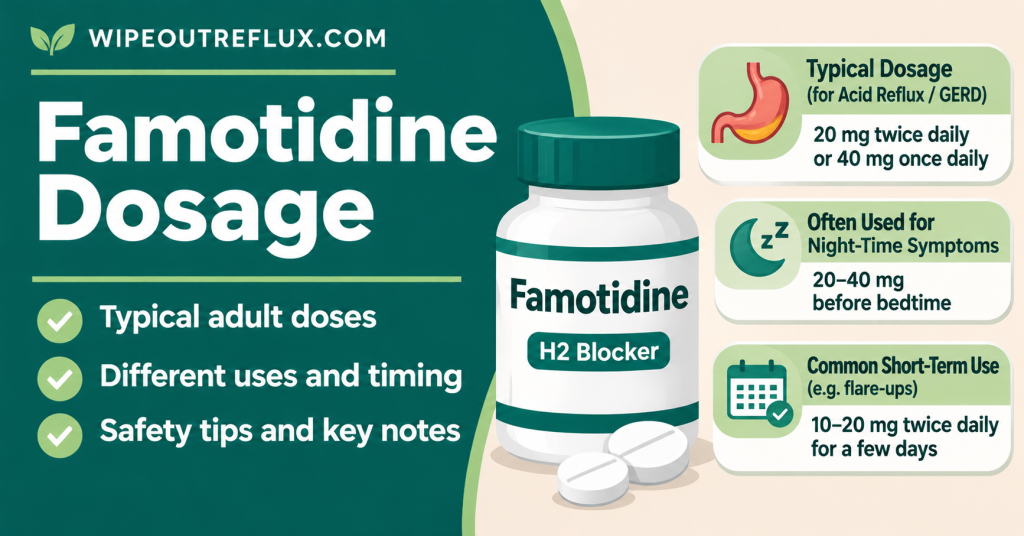
For over-the-counter heartburn relief, the usual famotidine dose is 10 mg or 20 mg, taken when symptoms start or 10 to 60 minutes before a meal you know will trigger them. Don’t take more than two tablets in 24 hours, and see a doctor if you need it for more than 14 days.
Prescription doses for reflux are higher. Symptomatic GERD is treated with 20 mg twice daily for up to 6 weeks. Erosive esophagitis is treated with 20 mg or 40 mg twice daily for up to 12 weeks. Anyone with reduced kidney function needs a lower dose, because famotidine is cleared mainly by the kidneys and builds up when they’re not working well.
Key Takeaways
- OTC famotidine (Pepcid AC) comes as 10 mg and 20 mg tablets. The maximum is two tablets in 24 hours, for no more than 14 days without seeing a doctor.
- Prescription doses: 20 mg twice daily for non-erosive GERD, and 20–40 mg twice daily for erosive esophagitis.
- Famotidine starts working within an hour and lasts 10 to 12 hours, so twice-daily dosing gives round-the-clock coverage.
- For predictable heartburn, timing matters more than dose. Taking it before the trigger meal works better than chasing symptoms afterwards.
- Below a creatinine clearance of 60 mL/min, maximum doses drop, often to 20 mg once daily or every other day.
- Tolerance develops within days of regular use, so higher or more frequent doses tend to give diminishing returns.
- A bedtime dose added to a PPI is a recognized option for nighttime breakthrough, but its benefit fades within about a week of nightly use.
How Famotidine Dosing Works
Famotidine is an H2 blocker. It stops histamine from switching on the acid-producing cells in your stomach. It doesn’t shut acid down completely the way a PPI does. It turns the volume down.
Three facts about how your body handles it explain almost every dosing rule:
- Fast onset. The acid-reducing effect starts within an hour and peaks at one to three hours.
- Medium duration. A 20 mg or 40 mg dose suppresses acid for 10 to 12 hours. That’s why prescription dosing is usually twice a day.
- Kidney clearance. About 65 to 70% of the drug leaves through the kidneys. If they work less well, famotidine lingers and blood levels climb.
All three come from the official prescribing information [Pepcid (famotidine) Prescribing Information, 2024]. Food and antacids don’t meaningfully change how much famotidine you absorb, so you can take it with or without a meal.
Over-the-Counter Famotidine Dosage
OTC famotidine is sold as Pepcid AC (10 mg), Maximum Strength Pepcid AC (20 mg), store-brand equivalents, and Zantac 360, which is now famotidine rather than ranitidine. The label directions for the 20 mg tablet are [Maximum Strength Pepcid AC Drug Facts Label]:
- To relieve symptoms: swallow one tablet with a glass of water.
- To prevent symptoms: take one tablet 10 to 60 minutes before eating food or drinking beverages that cause heartburn.
- Maximum: no more than two tablets in 24 hours.
- Children under 12: ask a doctor.
- Stop and ask a doctor if your heartburn continues or gets worse, or if you need it for more than 14 days.
So the OTC ceiling is 40 mg a day (two 20 mg tablets) or 20 mg a day (two 10 mg tablets), depending on the strength you buy.
10 mg or 20 mg?
If you only get occasional mild heartburn, 10 mg is often enough, and it’s a sensible place to start if you’re older or prone to side effects. For heavier triggers like a large, late or fatty meal, 20 mg gives a stronger and more reliable effect. I’d still rather someone take 20 mg once, at the right time, than 10 mg twice, too late.
Pepcid Complete dosing
Pepcid Complete combines 10 mg of famotidine with two antacids, so it acts in minutes rather than an hour. The antacid content changes the maximum daily amount, so follow that product’s own label. I break down the differences in Pepcid AC vs Pepcid Complete.
Prescription Famotidine Dosage for Reflux
Prescription famotidine comes in 20 mg and 40 mg tablets. The adult doses for reflux-related conditions are [Pepcid (famotidine) Prescribing Information, 2024]:
- Symptomatic non-erosive GERD: 20 mg twice daily, for up to 6 weeks.
- Erosive esophagitis (diagnosed by endoscopy): 20 mg twice daily or 40 mg twice daily, for up to 12 weeks.
- Active duodenal ulcer: 40 mg once daily or 20 mg twice daily, for up to 8 weeks.
- Active gastric ulcer: 40 mg once daily, for up to 8 weeks.
- Reducing duodenal ulcer recurrence: 20 mg once daily.
- Hypersecretory conditions (such as Zollinger-Ellison syndrome): starting at 20 mg every 6 hours and adjusted to need, sometimes far higher under specialist care.
The highest routine reflux dose, then, is 40 mg twice daily (80 mg a day) for erosive esophagitis. Anything above that is reserved for rare acid-hypersecretion conditions.
Notice the time limits, too. The approved reflux courses are weeks, not years. That fits what we know about tolerance, which I cover below.
Famotidine Dosage With Kidney Problems
This is the part of famotidine dosing that matters most for safety, and it’s often missed. Because the kidneys clear most of the drug, the label sets lower maximum doses once creatinine clearance falls below 60 mL/min [Pepcid (famotidine) Prescribing Information, 2024]:
- Non-erosive GERD: 20 mg once daily (creatinine clearance 30–60), or 20 mg every other day (below 30).
- Duodenal or gastric ulcer: 20 mg once daily or 40 mg every other day (30–60), or 20 mg every other day (below 30).
- Erosive esophagitis: reduced in the same way. Your prescriber will set the exact dose.
Without that adjustment, blood levels rise at least two-fold in moderate kidney impairment and at least five-fold in severe impairment. That’s what drives the rare but serious side effects: confusion, hallucinations and heart rhythm changes. A clinical review of H2 blocker mental status changes notes they’re more likely in older patients and those with kidney dysfunction, which is why dose adjustment is the key prevention step [Gilless et al., Consultant, 2014].
The OTC label simply says not to use it with kidney disease unless a doctor is supervising [Maximum Strength Pepcid AC Drug Facts Label]. If you’re over 65, kidney function is worth knowing before you settle into regular use, even if you feel well.
Famotidine Dosage for Children
Famotidine is used in children, but dosing is weight-based and should come from the child’s doctor or pharmacist. The prescription tablets are only for people weighing 40 kg (about 88 lb) or more. Below that, the lowest tablet strength is more than the recommended dose, and a liquid or lower-dose form is used instead [Pepcid (famotidine) Prescribing Information, 2024]. The OTC products say to ask a doctor for children under 12.
When to Take Famotidine for the Best Effect
Getting the timing right often does more than raising the dose.
Before a trigger, not after
Because famotidine takes up to an hour to work, taking it before a meal you know will cause trouble means it’s active when acid output surges. That’s the label’s own “prevent symptoms” instruction. If you take it once the burn has already started, you’ll wait a while for relief. An antacid or alginate covers that gap better.
For fast relief, antacids win on speed but not on duration. In a randomized trial of OTC famotidine against a calcium carbonate antacid, the antacid worked quickly but wore off soon, while famotidine lasted much longer [Feldman, JAMA, 1996].
At bedtime for nighttime symptoms
Famotidine is particularly good at reducing nighttime acid, which is histamine-driven. If your symptoms are worst lying down, a bedtime dose often makes the biggest difference. I explain the science in why take famotidine at night.
Twice daily for 24-hour coverage
When famotidine is prescribed for GERD, it’s typically morning and bedtime, roughly 12 hours apart, matching its 10 to 12 hour duration.
Why Higher Doses Don’t Keep Working: Tolerance
Here’s what the dosing tables don’t tell you. Taken every day, famotidine loses power fast.
Tolerance to H2 blockers is detectable from the second day of dosing, across different drugs, doses and patient groups [McRorie et al., World Journal of Gastrointestinal Pharmacology and Therapeutics, 2014]. In one direct comparison, famotidine 20 mg twice daily suppressed acid more than omeprazole 10 mg on day 1, about the same on day 8, and less by day 15 [Shimatani et al., Digestive Diseases and Sciences, 2007].
So if regular famotidine is fading, pushing the dose up tends to buy you only a little time. Better options are using it intermittently, switching to a different class, or tackling the reflux itself. I’ve covered this in detail in why famotidine stops working.
Famotidine Dosage Alongside a PPI
Some people with stubborn nighttime reflux are told to take a PPI in the morning and famotidine at bedtime. There’s a good rationale. In people on twice-daily PPIs, adding a bedtime H2 blocker raised overnight time with stomach pH above 4 from 51% to 96% [Xue et al., Alimentary Pharmacology and Therapeutics, 2001].
But tolerance shows up here too. In a separate study, the bedtime H2 blocker’s benefit had disappeared after a week of nightly use [Fackler et al., Gastroenterology, 2002]. The American College of Gastroenterology guideline accepts a bedtime H2 blocker for nighttime reflux on a PPI, while noting tachyphylaxis may develop after several weeks [Katz et al., The American Journal of Gastroenterology, 2013].
In practice, many people do best using the bedtime famotidine on bad nights rather than every night. I go through how to combine them safely in can you take omeprazole and famotidine together.
What Dose of Famotidine for Silent Reflux?
There’s no specific approved dose for LPR. When famotidine is used for silent reflux, it’s usually at standard GERD doses, often as a bedtime dose on top of a PPI.
The honest message I give anyone with throat symptoms: the dose usually isn’t the bottleneck. In LPR, small amounts of reflux carry pepsin into the throat, where it can be reactivated by acidic foods and drinks long after the reflux event. Famotidine reduces stomach acid, but it doesn’t stop reflux reaching the throat and doesn’t remove pepsin that’s already there. That’s why diet and reflux barriers matter so much more in LPR, and why the Wipeout Diet Plan focuses on cutting the acid and trigger load that keeps pepsin active. For more on where famotidine does and doesn’t help, see Pepcid for silent reflux.
What If You Miss a Dose or Take Too Much?
If you miss a dose, take it when you remember, unless your next dose is almost due. In that case, skip it. Don’t double up.
If you’ve taken more than the label allows, a one-off extra tablet is unlikely to cause harm in a healthy adult. Still, contact a pharmacist or poison control for advice, especially if the person is older, has kidney disease, or develops confusion, dizziness or palpitations.
Conclusion
Famotidine dosing is simple once you know the rules. OTC, it’s 10 or 20 mg, ideally taken before a trigger meal, no more than two tablets a day and no longer than 14 days without a doctor’s input. On prescription, GERD is typically 20 mg twice daily and erosive esophagitis up to 40 mg twice daily, for weeks rather than years. Kidney function is the one factor that should always change the dose.
Beyond that, the most important dosing lesson is that more isn’t better. Tolerance builds within days, so famotidine works best used strategically rather than escalated every time symptoms creep back. If you need it every day, it’s treating the symptom, not the cause, and that’s a good moment to step back and look at what’s actually driving your reflux. Meal size, late eating, and a handful of very common trigger foods usually explain far more than the number on the box.
That’s where the Wipeout Diet Plan comes in. It’s my complete, in-depth guide to the foods, meal patterns and habits that reduce reflux in the first place, so you need acid reducers less. I designed it around silent reflux first, but since it works on the same root causes, it’s just as effective for classic heartburn and GERD.
Frequently Asked Questions
What is the maximum dose of famotidine per day?
Over the counter, it’s two tablets in 24 hours, so 40 mg with the 20 mg strength. On prescription, the highest routine reflux dose is 40 mg twice daily for erosive esophagitis. Higher doses are only used for rare hypersecretory conditions under specialist care.
Is 40 mg of famotidine too much?
Not for most adults with healthy kidneys. 40 mg a day is within OTC limits (as two 20 mg tablets) and within prescription dosing. It may be too much if you have reduced kidney function, where maximum doses are lower.
Can I take famotidine twice a day?
Yes. Twice daily, about 12 hours apart, is the standard prescription schedule for GERD, and the OTC label allows up to two tablets in 24 hours.
How long does it take famotidine to work?
It starts working within an hour and peaks at one to three hours. For faster relief from a burn that’s already started, an antacid or alginate works more quickly.
Should I take famotidine before or after eating?
To prevent heartburn, take it 10 to 60 minutes before a meal that usually triggers symptoms. Food doesn’t affect absorption, so it’s fine to take with a meal if that’s easier to remember.
How long can I take famotidine?
OTC, no more than 14 days without seeing a doctor. Prescription courses for GERD and esophagitis run 6 to 12 weeks. Longer use should be reviewed, partly because tolerance reduces its effect.
Do I need a lower famotidine dose if I’m older?
Often, yes, because kidney function declines with age. Older adults are also more prone to confusion on H2 blockers. Ask your doctor or pharmacist to check that your dose matches your kidney function.
Research & References
- [Pepcid (famotidine) Prescribing Information, 2024] — Official prescribing information giving adult doses by indication, renal dose adjustments by creatinine clearance, the 40 kg threshold for tablets in children, onset within one hour, 10–12 hour duration, and 65–70% renal elimination.
- [Maximum Strength Pepcid AC Drug Facts Label] — OTC directions: one tablet to relieve symptoms or 10–60 minutes before trigger foods to prevent them, maximum two tablets in 24 hours, ask a doctor for children under 12, and stop and ask a doctor after 14 days.
- [Gilless et al., Consultant, 2014] — Clinical review linking H2 blocker mental status changes to older age and kidney dysfunction, emphasizing renal dose adjustment.
- [Feldman, JAMA, 1996] — Randomized, placebo-controlled trial comparing OTC famotidine with a calcium carbonate antacid, showing the antacid’s rapid onset but short duration.
- [McRorie et al., World Journal of Gastrointestinal Pharmacology and Therapeutics, 2014] — Review showing tolerance to H2 blockers is detectable from the second day of dosing, across drugs, doses and patient groups.
- [Shimatani et al., Digestive Diseases and Sciences, 2007] — Famotidine 20 mg twice daily suppressed acid more than omeprazole 10 mg on day 1, similarly on day 8, and less on day 15.
- [Xue et al., Alimentary Pharmacology and Therapeutics, 2001] — In GERD patients on twice-daily PPIs, a bedtime H2 blocker raised overnight time with stomach pH above 4 from 51% to 96%.
- [Fackler et al., Gastroenterology, 2002] — A bedtime H2 blocker added to twice-daily omeprazole reduced nighttime acid breakthrough at first, but tolerance removed the benefit after one week.
- [Katz et al., The American Journal of Gastroenterology, 2013] — ACG GERD guideline stating a bedtime H2 blocker can be added to daytime PPI therapy for nighttime reflux but may cause tachyphylaxis after several weeks.

David Gray
12 years living with LPR · Consultant & researcher
I've lived with LPR for twelve years — the misdiagnoses, the PPI courses that did nothing, the slow work of figuring out what actually helps. Wipeout Reflux is where I translate the research into plain terms for people stuck in the same place. Every claim here is sourced to peer-reviewed work, and I consult one-to-one with LPR sufferers.