
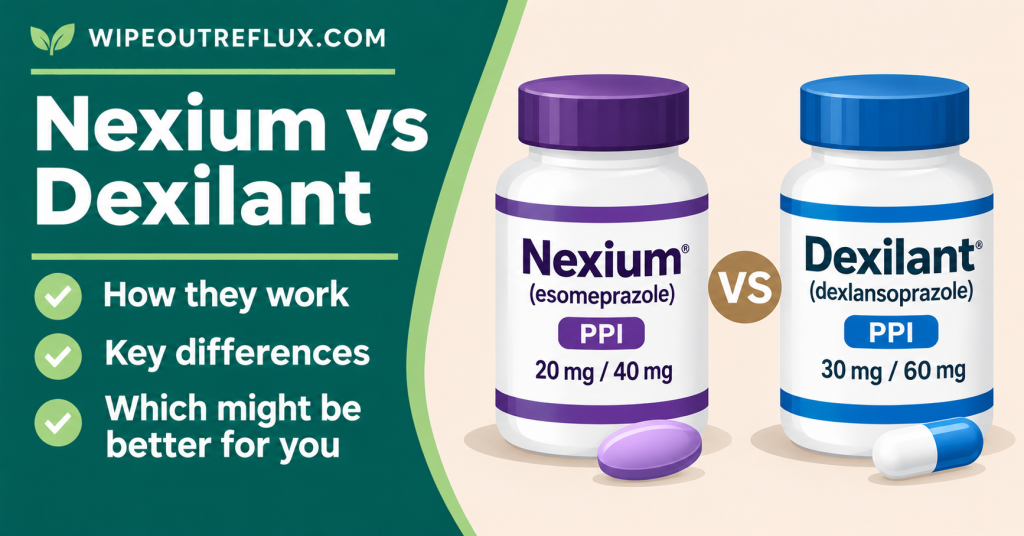
Nexium (esomeprazole) and Dexilant (dexlansoprazole) are both proton pump inhibitors, and both are among the more potent options in the class. The key difference is how long a single dose keeps working. Dexilant uses a dual delayed-release capsule that releases the drug in two waves, so one dose covers more of the day and night. It can also be taken with or without food, while Nexium should be taken at least an hour before a meal.
In head-to-head pH studies, Dexilant kept stomach pH higher in the second half of the 24 hours after a dose. But for healing esophagitis and everyday symptom control, the clinical evidence shows no clear winner. Nexium is cheaper, available over the counter, and backed by much more research. Dexilant makes most sense for people who get breakthrough symptoms late in the day or overnight, or who struggle with the before-breakfast timing rule.
Key Takeaways
- Both are PPIs. Nexium is the S-isomer of omeprazole, and Dexilant is the R-isomer of lansoprazole.
- Dexilant’s capsule releases the drug in two waves, with blood levels peaking at 1–2 hours and again at 4–5 hours.
- In a single-dose pH study, Dexilant 60 mg held stomach pH above 4 for 60% of the 12–24 hour window, versus 42% for Nexium 40 mg.
- Indirect comparisons found no significant difference in healing or maintaining healed esophagitis.
- Dexilant can be taken without regard to food. Nexium works best taken at least an hour before a meal.
- Nexium’s label says to avoid clopidogrel. Dexilant’s effect on clopidogrel was small and not considered clinically important.
- Nexium is available OTC and costs far less. Dexilant needs a prescription, and even generic versions are relatively expensive.
- Neither drug stops reflux events or removes pepsin from the throat, which limits both for silent reflux.
Nexium vs Dexilant at a Glance
- Generic name: Nexium is esomeprazole. Dexilant is dexlansoprazole.
- Related to: Nexium is the active half of omeprazole (Prilosec). Dexilant is the longer-lasting half of lansoprazole (Prevacid).
- Release: Nexium is single delayed-release. Dexilant is dual delayed-release.
- Usual GERD doses: Nexium 20 mg or 40 mg. Dexilant 30 mg or 60 mg.
- Food: Nexium at least one hour before a meal. Dexilant with or without food.
- Clopidogrel: Nexium’s label says avoid. Dexilant has a minor effect that isn’t considered clinically important.
- OTC availability: Nexium 24HR is available OTC. Dexilant is prescription only.
- Cost: Nexium is low, especially generic. Dexilant is high, even as a generic.
How Each Drug Works
All PPIs block the proton pumps that release acid into your stomach. The catch is that PPIs only last a short time in the blood, around an hour or two, and they can only block pumps that are actively working when the drug is around. Pumps that switch on later in the day escape. That’s why a once-daily PPI often leaves gaps, especially late afternoon and overnight.
Nexium: a more consistent version of omeprazole
Omeprazole is a 50:50 mix of two mirror-image molecules. Esomeprazole is just the S-isomer, which the liver clears more slowly, so more of each dose reaches the stomach [Andersson et al., Clinical Pharmacokinetics, 2001]. Its half-life is still only about 1 to 1.5 hours, which is why timing it before a meal matters so much [Nexium Prescribing Information, U.S. Food and Drug Administration, 2021].
Dexilant: two doses in one capsule
Dexilant tackles the short half-life a different way. The capsule holds two types of granules. Roughly a quarter of the dose dissolves early in the small intestine, and the rest dissolves further along, a few hours later [Frye and Peura, Therapeutics and Clinical Risk Management, 2015]. The result is two peaks in blood levels: the first at 1 to 2 hours and the second at 4 to 5 hours [DailyMed, DEXILANT Prescribing Information, 2024]. That second wave catches pumps that switch on later, stretching coverage further into the day.
I go deeper into how this works in my full guide to Dexilant (dexlansoprazole).
Which Controls Acid Better?
The head-to-head pH study
The most direct comparison is a single-dose crossover study in 44 healthy adults, who took Dexilant 60 mg and Nexium 40 mg on separate occasions, each an hour before breakfast. Over 24 hours, average stomach pH was 4.3 with Dexilant and 3.7 with Nexium. The gap came almost entirely from the second half of the day: from 12 to 24 hours after the dose, pH stayed above 4 for 60% of the time with Dexilant versus 42% with Nexium [Kukulka et al., Clinical and Experimental Gastroenterology, 2011].
Two caveats are worth knowing. It was a single dose in healthy volunteers, not repeated dosing in people with reflux. And the study was run and funded by Takeda, Dexilant’s manufacturer. The result fits the drug’s design, but it isn’t the final word.
Against other PPIs
Nexium is strong in its own right. At 40 mg, it held stomach pH above 4 longer than standard doses of omeprazole, lansoprazole, pantoprazole and rabeprazole in a five-way comparison [Miner et al., The American Journal of Gastroenterology, 2003]. For Dexilant, a review reported that 60 mg kept pH above 4 for about 17 hours a day, versus about 14 hours for lansoprazole 30 mg [Olsen and Hitzeman, Clinical Medicine Insights: Therapeutics, 2009].
What About Healing and Symptom Relief?
Better pH numbers don’t automatically mean better outcomes, and that’s what we see here.
There are no large head-to-head trials of Dexilant against Nexium for healing. An indirect comparison of randomized trials found Dexilant 30 mg better than Nexium for heartburn control in non-erosive reflux disease at four weeks, but no significant difference in healing erosive esophagitis or keeping it healed. The authors stressed the evidence was limited and should be interpreted cautiously [Wu et al., Alimentary Pharmacology and Therapeutics, 2013].
Nexium, meanwhile, has a long track record. In a large trial of 1,960 people with erosive esophagitis, esomeprazole 40 mg healed more patients, and relieved symptoms faster, than omeprazole 20 mg [Kahrilas et al., Alimentary Pharmacology and Therapeutics, 2000]. A meta-analysis found its edge over other PPIs real but modest, and most meaningful in more severe esophagitis [Gralnek et al., Clinical Gastroenterology and Hepatology, 2006].
Put simply: both are strong PPIs. Dexilant’s advantage is mostly about duration, and it shows up most for people whose symptoms break through later in the day or at night.
Dosing Compared
Nexium
- Healing erosive esophagitis: 20 mg or 40 mg once daily for 4 to 8 weeks, with another 4 to 8 weeks if needed.
- Maintaining healing: 20 mg once daily.
- Symptomatic GERD: 20 mg once daily for 4 weeks.
- Timing: at least one hour before a meal.
These come from the prescribing information [Nexium Prescribing Information, U.S. Food and Drug Administration, 2021]. Over the counter, Nexium 24HR delivers 20 mg of esomeprazole [Nexium 24HR Drug Facts Label, DailyMed, U.S. National Library of Medicine], sold for 14-day courses of frequent heartburn. I cover timing in more detail in the best time of day to take Nexium.
Dexilant
- Healing erosive esophagitis: 60 mg once daily for up to 8 weeks.
- Maintaining healing and relieving heartburn: 30 mg once daily.
- Symptomatic non-erosive GERD: 30 mg once daily for 4 weeks.
- Timing: without regard to food.
These come from the Dexilant label [DailyMed, DEXILANT Prescribing Information, 2024].
Why the food rule matters more than it sounds
Taking Nexium with food noticeably reduces how much is absorbed [Wiesner et al., International Journal of Environmental Research and Public Health, 2021]. In real life, plenty of people take their PPI with breakfast, at random times, or right before bed, and get disappointing results. If you can’t reliably take a pill an hour before eating, Dexilant’s flexibility is a genuine advantage, not just a marketing line.
Side Effects Compared
The side effect profiles are similar, as you’d expect from two drugs in the same class.
- Nexium: the most common side effects are headache, diarrhea, nausea, gas, abdominal pain, constipation and dry mouth. In placebo-controlled GERD trials, diarrhea, headache and abdominal pain each occurred in about 4% of people [Nexium Prescribing Information, U.S. Food and Drug Administration, 2021].
- Dexilant: in trials, diarrhea occurred in 4.8%, abdominal pain in 4.0%, nausea in 2.9%, upper respiratory infection in 1.9%, and vomiting and gas in 1.6% each [DailyMed, DEXILANT Prescribing Information, 2024].
Long-term considerations (B12, magnesium, bone health, gut infections, and rebound acid when stopping) apply to both. I’ve covered Nexium’s in detail in esomeprazole side effects.
Drug Interactions: The Clopidogrel Question
This is one place where the two genuinely differ. Nexium’s label says to avoid using it with clopidogrel (Plavix), because esomeprazole reduces the blood thinner’s activation [Nexium Prescribing Information, U.S. Food and Drug Administration, 2021].
With Dexilant 60 mg, levels of clopidogrel’s active metabolite fell by about 9%, which the label doesn’t consider clinically important [DailyMed, DEXILANT Prescribing Information, 2024]. Pantoprazole is still the PPI most often chosen in this situation, but if you’re on clopidogrel, Nexium isn’t the right pick.
Cost and Availability
This is often the deciding factor. Esomeprazole is cheap: it’s sold over the counter as Nexium 24HR and in generic form, and prescription generics cost little. Dexilant is prescription-only, and while generic dexlansoprazole exists, it remains much more expensive than generic esomeprazole in most situations. Insurance and discount programs change the numbers a lot, so it’s worth checking your own costs.
Practically, most doctors start with a cheaper PPI and reserve Dexilant for people who still have symptoms despite taking a standard PPI correctly.
Nexium vs Dexilant for Nighttime Reflux
If your symptoms are worst at night, Dexilant’s design makes some sense on paper. Its second release wave keeps more acid suppression going into the evening, and the pH study gap was concentrated in the later hours. Reviews have also described benefits for nighttime heartburn and reflux-related sleep problems with dexlansoprazole [Frye and Peura, Therapeutics and Clinical Risk Management, 2015].
But before switching, it’s worth trying the cheaper fixes for reflux at night: no food for three hours before bed, raising the head of the bed, and an alginate at bedtime. These help regardless of which PPI you take.
Nexium vs Dexilant for Silent Reflux
For LPR, I’d be cautious about expecting a stronger or longer-acting PPI to be the breakthrough.
A randomized trial in 132 people with LPR found no significant difference between once-daily and twice-daily dosing of a long-acting PPI at 16 weeks, with response rates of 37.3% and 32.0% respectively [Ji et al., Journal of Neurogastroenterology and Motility, 2024]. More acid suppression didn’t produce more improvement.
That makes sense once you understand LPR. Throat damage is driven largely by pepsin, which reaches the throat in even weakly acidic reflux and can be reactivated later by acidic foods and drinks. No PPI stops reflux happening or clears pepsin from throat tissue. That’s why PPIs often disappoint in LPR, and why the Wipeout Diet Plan focuses on the dietary acid and trigger load that keeps pepsin active.
So Which Should You Choose?
- You’re starting a PPI or symptoms are well controlled: Nexium (or another cheap PPI) is the sensible choice.
- You get breakthrough symptoms late in the day or overnight on a correctly timed PPI: Dexilant is a reasonable thing to ask about.
- You can’t reliably take a pill an hour before eating: Dexilant’s food flexibility is a real advantage.
- You take clopidogrel: avoid Nexium. Discuss pantoprazole or Dexilant with your doctor.
- Cost is a concern: Nexium, by a wide margin.
- Neither is working: look beyond PPIs. Consider whether reflux is truly acid-driven, a different class like vonoprazan, and the diet and lifestyle side.
For other pairings, see Prilosec vs Nexium and Prilosec vs Prevacid.
Conclusion
Nexium and Dexilant are both strong PPIs, and for most people they’ll work similarly. Dexilant’s dual-release capsule gives longer coverage from one dose and can be taken without worrying about meals, which helps if your symptoms break through later in the day or you struggle with timing. Nexium is cheaper, available over the counter, avoided with clopidogrel, and supported by a much larger body of research. For healing esophagitis, the evidence doesn’t separate them, so the choice usually comes down to timing, cost and your other medications.
What neither drug does is stop reflux from happening. If you’ve worked your way up the PPI ladder and you’re still struggling, especially with throat symptoms, the missing piece is usually not a more powerful pill, but what’s driving the reflux in the first place.
That’s what the Wipeout Diet Plan is for. It’s my complete, in-depth guide to the foods, meal timing and habits that reduce reflux at the source. I built it first for LPR, the stubborn throat-based form where PPIs struggle most, but because it targets the same root causes, it works just as well for GERD and everyday heartburn. It’s also what makes coming off a PPI realistic, whichever one you’re on.
Frequently Asked Questions
Is Dexilant stronger than Nexium?
Not exactly stronger, but longer-acting. In a single-dose pH study, Dexilant 60 mg kept stomach pH higher in the 12 to 24 hours after dosing than Nexium 40 mg. For healing esophagitis, trials don’t show a clear difference.
Can I switch from Nexium to Dexilant?
Yes, usually directly, with your doctor’s guidance. It’s most worth considering if you have late-day or nighttime breakthrough symptoms despite taking Nexium correctly.
Does Dexilant need to be taken before food?
No. The label says Dexilant can be taken without regard to food. Nexium should be taken at least an hour before a meal.
Is Dexilant available over the counter?
No, it’s prescription only. Nexium is available OTC as Nexium 24HR (20 mg) for 14-day courses.
Why is Dexilant so expensive?
It’s a specialized dual-release formulation, and even generic dexlansoprazole hasn’t dropped to the price of older generic PPIs. Insurance and discount programs can change your actual cost a lot.
Which is better for nighttime reflux, Nexium or Dexilant?
Dexilant’s longer coverage may help more if symptoms break through at night. But simple measures, like not eating late, raising the bed head and using a bedtime alginate, often matter as much as the choice of PPI.
Are Nexium and Dexilant safe long term?
Both share the same long-term PPI considerations, including lower B12 and magnesium, possible bone effects and rebound acid on stopping. Long-term use should be reviewed with your doctor, using the lowest dose that controls symptoms.
Research & References
- [Andersson et al., Clinical Pharmacokinetics, 2001] — Pharmacokinetic review of esomeprazole as the S-isomer of omeprazole, with slower clearance and higher systemic exposure per dose.
- [Nexium Prescribing Information, U.S. Food and Drug Administration, 2021] — Official labeling: GERD doses and durations, administration at least one hour before meals, half-life of about 1 to 1.5 hours, common adverse reactions, and advice to avoid concomitant use with clopidogrel.
- [Frye and Peura, Therapeutics and Clinical Risk Management, 2015] — Review of dexlansoprazole’s dual delayed-release design (about 25% of granules released early, the rest later) and its use in non-erosive reflux, nighttime heartburn and reflux-related sleep disturbance.
- [DailyMed, DEXILANT Prescribing Information, 2024] — Official labeling: plasma peaks at 1–2 and 4–5 hours, doses by indication, administration without regard to food, adverse reaction rates, and an approximately 9% reduction in clopidogrel’s active metabolite not considered clinically important.
- [Kukulka et al., Clinical and Experimental Gastroenterology, 2011] — Single-dose crossover study in 44 healthy adults (Takeda-sponsored); mean 24-hour pH was 4.3 with dexlansoprazole 60 mg vs 3.7 with esomeprazole 40 mg, and time with pH above 4 at 12–24 hours was 60% vs 42%.
- [Miner et al., The American Journal of Gastroenterology, 2003] — Five-way crossover study in which esomeprazole 40 mg maintained stomach pH above 4 longer than standard doses of four other PPIs.
- [Olsen and Hitzeman, Clinical Medicine Insights: Therapeutics, 2009] — Review reporting dexlansoprazole 60 mg kept pH above 4 for about 17 hours a day versus about 14 hours for lansoprazole 30 mg.
- [Wu et al., Alimentary Pharmacology and Therapeutics, 2013] — Indirect comparison of randomized trials: dexlansoprazole 30 mg better than esomeprazole for heartburn control in non-erosive reflux at 4 weeks, with no significant difference in healing or maintaining healed erosive esophagitis.
- [Kahrilas et al., Alimentary Pharmacology and Therapeutics, 2000] — Randomized trial in 1,960 patients with erosive esophagitis; esomeprazole 40 mg produced higher healing rates and faster symptom resolution than omeprazole 20 mg.
- [Gralnek et al., Clinical Gastroenterology and Hepatology, 2006] — Meta-analysis finding a statistically significant but modest advantage for esomeprazole over other PPIs in erosive esophagitis, greatest in more severe disease.
- [Nexium 24HR Drug Facts Label, DailyMed, U.S. National Library of Medicine] — Confirms the over-the-counter product delivers 20 mg of esomeprazole.
- [Wiesner et al., International Journal of Environmental Research and Public Health, 2021] — Review of food and dosing effects on PPI therapy, including a substantial reduction in esomeprazole absorption when taken with food.
- [Ji et al., Journal of Neurogastroenterology and Motility, 2024] — Randomized trial in 132 LPR patients finding no significant difference between twice-daily and once-daily dosing of a long-acting PPI in symptom response at 16 weeks (32.0% vs 37.3%).

David Gray
12 years living with LPR · Consultant & researcher
I've lived with LPR for twelve years — the misdiagnoses, the PPI courses that did nothing, the slow work of figuring out what actually helps. Wipeout Reflux is where I translate the research into plain terms for people stuck in the same place. Every claim here is sourced to peer-reviewed work, and I consult one-to-one with LPR sufferers.