
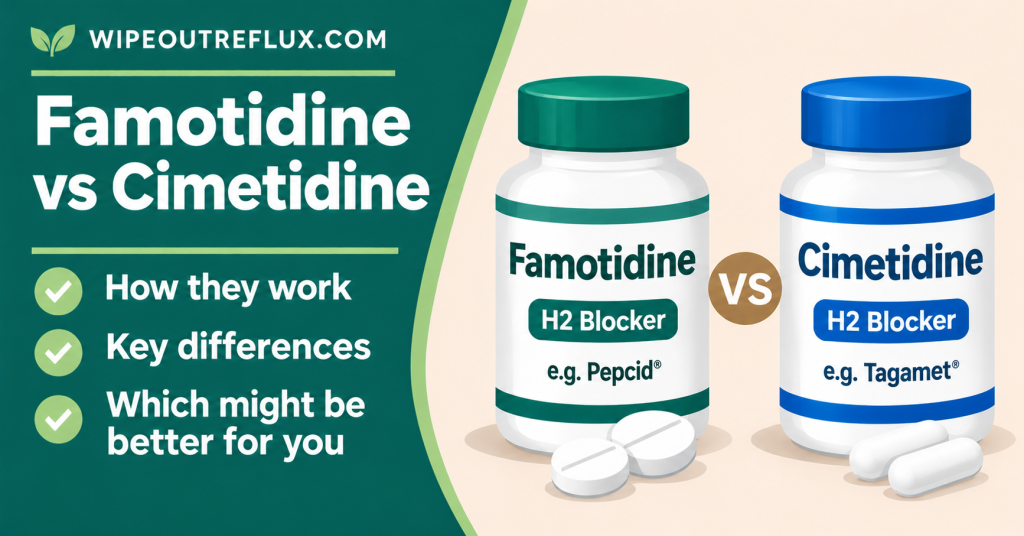
Famotidine (Pepcid) and cimetidine (Tagamet) are both H2 blockers. They reduce stomach acid the same way, by stopping histamine from switching on the cells that make it. For most people, famotidine is the better choice. It’s far more potent per milligram, lasts longer so it’s taken once or twice a day rather than up to four times, and it doesn’t interfere with how your liver processes other medicines.
Cimetidine was the first H2 blocker, and it still works. But it slows down several liver enzymes, which creates a long list of drug interactions, and it has mild hormonal effects that can occasionally cause breast tenderness or enlargement in men. Its main advantages today are price and availability. If you take no other regular medications and only need an occasional dose, it’s a reasonable fallback.
Key Takeaways
- Both are H2 blockers that reduce, but don’t eliminate, stomach acid.
- Famotidine is roughly 20 to 50 times more potent than cimetidine per milligram, so its doses are much smaller (10–40 mg vs 200–800 mg).
- Famotidine lasts 10 to 12 hours. Cimetidine is shorter-acting and may be prescribed up to four times a day for reflux.
- Cimetidine inhibits liver enzymes and interacts with many drugs, including warfarin, theophylline and phenytoin. Famotidine doesn’t.
- Cimetidine has antiandrogenic effects and can cause gynecomastia, especially at high doses. Famotidine doesn’t.
- Both can cause confusion in older adults and people with kidney impairment, and both need lower doses when kidney function is reduced.
- Both lose effectiveness within days of regular use, and both are less effective than PPIs for healing esophagitis.
Famotidine vs Cimetidine at a Glance
- Brand names: famotidine is Pepcid, Pepcid AC and Zantac 360. Cimetidine is Tagamet and Tagamet HB.
- Typical OTC dose: famotidine 10–20 mg. Cimetidine 200–400 mg.
- Prescription reflux dose: famotidine 20–40 mg twice daily. Cimetidine 1,600 mg a day in divided doses.
- Duration: famotidine 10–12 hours. Cimetidine is shorter-acting.
- Liver enzyme interactions: none to speak of with famotidine. Many with cimetidine.
- Hormonal side effects: none with famotidine. Gynecomastia is possible with cimetidine.
- Kidney dose adjustment: needed for both.
- Cost: both are cheap, and cimetidine often slightly cheaper.
How H2 Blockers Work
The cells that produce stomach acid respond to three main signals: gastrin, acetylcholine and histamine. Histamine is a powerful one, especially overnight and between meals. It binds to H2 receptors on the acid-producing cells and turns production up.
Famotidine and cimetidine both sit in that receptor and block histamine from binding. Acid output falls, but it isn’t switched off, because the other signals still work. That’s the key difference from PPIs, which block the final acid pump regardless of what switched it on.
Same mechanism, then. The differences between the two drugs come from their chemistry: how tightly they bind, how long they last, and what else they touch in the body.
Potency and How Long Each Lasts
Famotidine binds far more strongly to H2 receptors. A detailed review found it was approximately 20 to 50 times more potent than cimetidine at inhibiting acid secretion on a weight basis [Langtry et al., Drugs, 1989]. That’s why a famotidine tablet holds 10 or 20 mg, while a cimetidine tablet holds 200 mg or more.
Potency per milligram doesn’t matter much on its own, since doses are set to match. What matters more is duration. Famotidine suppresses acid for 10 to 12 hours after a 20 mg or 40 mg dose [Pepcid (famotidine) Prescribing Information, 2024]. Cimetidine wears off sooner, which is why its prescription reflux regimen is 1,600 mg a day split into several doses [DailyMed, Cimetidine Prescribing Information]. In real life, fewer doses usually means more consistent use.
Do They Work Equally Well?
At properly matched doses, the clinical results are broadly similar. In ulcer trials, famotidine 20 mg twice daily or 40 mg at bedtime produced healing rates and symptom relief similar to or better than cimetidine 800 mg a day [Langtry et al., Drugs, 1989].
For reflux specifically, the more useful comparison is with PPIs, and here both H2 blockers fall short. A recent review reported healing rates of about 52% with H2 blockers versus about 84% with PPIs in moderate-to-severe reflux disease [Shibli et al., Translational Gastroenterology and Hepatology, 2025]. If you have diagnosed erosive esophagitis, neither famotidine nor cimetidine is usually the right first tool. I compare the two classes in famotidine vs omeprazole.
The Big Difference: Drug Interactions
This is where the two drugs really part ways.
Cimetidine inhibits several of the liver’s cytochrome P450 enzymes, which break down many common medications. When those enzymes slow down, other drugs can build up to higher levels than intended. StatPearls’ review of cimetidine lists this enzyme inhibition, and the resulting interactions, as one of the main reasons for caution [Pino and Patel, StatPearls, 2026]. Drugs where this matters include:
- Warfarin: higher levels raise bleeding risk.
- Theophylline: a narrow safety margin, so small increases matter.
- Phenytoin: also narrow-margin, with a risk of toxicity.
- Several others, including tricyclic antidepressants, benzodiazepines, some beta blockers (metoprolol, propranolol), calcium channel blockers and oral diabetes drugs (sulfonylureas).
Famotidine doesn’t affect liver drug metabolism in this way [Langtry et al., Drugs, 1989]. Its notable interaction is with tizanidine, a muscle relaxant [Pepcid (famotidine) Prescribing Information, 2024]. Beyond that, the main consideration for both drugs is shared: lowering stomach acid can change how well certain acid-dependent medicines are absorbed.
If you take any regular prescription medicine, this alone is usually enough reason to choose famotidine, or at least to check with a pharmacist before taking cimetidine.
Side Effects Compared
Shared side effects
Both can cause headache, dizziness, and changes in bowel habit. On the cimetidine label, headache was reported in 3.5% of people taking 1,600 mg a day [DailyMed, Cimetidine Prescribing Information]. For famotidine, headache, dizziness and constipation are the most common reactions [Pepcid (famotidine) Prescribing Information, 2024].
Both can also cause confusion, agitation or hallucinations, mainly in older adults and people with kidney impairment, because both are cleared by the kidneys and build up when kidney function is reduced [Gilless et al., Consultant, 2014]. Lower doses are needed for both in that situation. Cimetidine carries an extra flag here: StatPearls notes the 2023 Beers criteria advise avoiding it in older adults because of the increased risk of delirium [Pino and Patel, StatPearls, 2026].
Cimetidine’s hormonal effects
Cimetidine has a weak antiandrogenic effect: it interferes with testosterone’s action. The best-known result is gynecomastia, meaning breast tenderness or enlargement in men. On the label, it occurred in about 0.3 to 1% of people in general use, rising to about 4% in people on high doses for hypersecretory conditions [DailyMed, Cimetidine Prescribing Information]. Famotidine is free of these antiandrogenic effects [Langtry et al., Drugs, 1989].
For short, occasional OTC use, this is rarely a problem. For longer-term or high-dose use, it’s another point in famotidine’s favor.
Dosing Compared
Famotidine
- OTC: 10 mg or 20 mg, up to twice in 24 hours. Take it before a trigger meal to prevent symptoms.
- Prescription GERD: 20 mg twice daily for up to 6 weeks.
- Erosive esophagitis: 20–40 mg twice daily for up to 12 weeks.
These are from the prescribing information [Pepcid (famotidine) Prescribing Information, 2024], which also sets lower maximum doses below a creatinine clearance of 60 mL/min.
Cimetidine
- OTC: 200–400 mg for heartburn [Pino and Patel, StatPearls, 2026].
- Prescription reflux esophagitis: 1,600 mg a day in divided doses for 12 weeks [DailyMed, Cimetidine Prescribing Information].
Follow the dosing on the specific product you buy, and get a pharmacist’s advice if you have kidney problems.
Tolerance Affects Both Equally
Whichever H2 blocker you choose, regular daily use brings the same problem: tolerance. A review of the evidence found tolerance to H2 blockers detectable from the second day of dosing, across different drugs, doses and patient groups. The authors recommended keeping H2 blockers for occasional heartburn [McRorie et al., World Journal of Gastrointestinal Pharmacology and Therapeutics, 2014].
So switching from famotidine to cimetidine (or the other way round) won’t restore lost effect. They act on the same receptor, and the body adapts to both. I explain what’s going on, and what to do instead, in why famotidine stops working.
Why Cimetidine Is Still Around
When ranitidine (Zantac) was withdrawn in 2020 over NDMA contamination, H2 blocker choice shrank. FDA testing found no NDMA in famotidine [FDA, Drug Safety Communication, 2020], and famotidine became the default, even taking over the Zantac 360 brand name. I tell the full story in the Zantac recall.
Cimetidine stuck around because it’s cheap, widely stocked, and useful when famotidine is in short supply. It’s also prescribed for a few things unrelated to reflux. For heartburn, though, it’s mostly a backup. I cover it in full in cimetidine (Tagamet) for heartburn.
Famotidine vs Cimetidine for Silent Reflux
For LPR, I wouldn’t expect either H2 blocker to be the answer on its own, and the choice between them makes little difference.
The problem is that both drugs reduce acid but don’t stop reflux events. In silent reflux, small amounts of refluxate carry pepsin into the throat, where it lodges in the tissue and can be reactivated by acidic foods and drinks hours later. An H2 blocker taken at bedtime can help reduce nighttime acid, and some people find it a useful add-on, which I discuss in Pepcid for silent reflux. But the core work is reducing reflux episodes and the dietary acid that keeps pepsin active. That’s the focus of the Wipeout Diet Plan, often alongside an alginate after meals and before bed.
Which Should You Choose?
- You take any regular medications: famotidine, to avoid cimetidine’s interactions.
- You’re male and need regular or high-dose use: famotidine, to avoid gynecomastia risk.
- You want fewer daily doses: famotidine.
- You need occasional heartburn relief, take no other medicines, and famotidine isn’t available: cimetidine is a reasonable stand-in.
- You’re older or have kidney problems: famotidine at a reduced dose, after checking with a pharmacist. Cimetidine is best avoided in older adults because of its delirium risk.
- You need an H2 blocker every day: neither will hold up well because of tolerance. It’s time to look at the cause, or at alternatives to famotidine.
Conclusion
Famotidine and cimetidine share a mechanism, but they’re not equals. Famotidine is more potent, longer-lasting, free of liver enzyme interactions and free of hormonal side effects, which is why it’s the H2 blocker most doctors and pharmacists recommend first. Cimetidine still works and still has a place as a cheap, widely available backup for occasional heartburn in people who aren’t taking other medicines. Both share the same limits: tolerance within days, weaker healing than PPIs, and no effect on reflux events themselves. For older adults in particular, famotidine is the clearly safer of the two.
That last point is the one I’d underline. If you’re comparing H2 blockers because you need one most days, the more useful question is why your reflux keeps coming back. A different pill on the same receptor won’t change that.
The Wipeout Diet Plan is my complete, in-depth guide to answering that question: the foods, meal timing and daily habits that calm reflux at the source. I originally built it around silent reflux, but because it targets the same underlying mechanisms, it works equally well for classic heartburn and GERD. Get those foundations right, and an H2 blocker goes back to being what it’s best at: an occasional backup.
Frequently Asked Questions
Is famotidine better than cimetidine?
For most people, yes. Famotidine is more potent, lasts longer, has very few drug interactions, and lacks cimetidine’s hormonal side effects. At matched doses, they reduce acid similarly.
Is Tagamet the same as Pepcid?
No. Tagamet is cimetidine and Pepcid is famotidine. Both are H2 blockers that work the same way, but they’re different drugs with different doses, interactions and side effects.
Can I take cimetidine instead of famotidine?
For occasional heartburn, usually yes, if you don’t take other medications that interact with it. Check with a pharmacist if you take warfarin, theophylline, phenytoin or several regular medicines.
Why does cimetidine have so many drug interactions?
Cimetidine inhibits several liver enzymes that break down other medicines. This can raise the levels of those drugs. Famotidine doesn’t affect these enzymes in the same way.
Does cimetidine cause gynecomastia?
It can. Breast tenderness or enlargement occurs in a small percentage of men, more often at high doses. It usually resolves after stopping. Famotidine doesn’t have this effect.
Can I take famotidine and cimetidine together?
No. They work on the same receptor, so combining them adds side effect risk without meaningful extra benefit. Use one or the other.
Which H2 blocker is best for acid reflux?
Famotidine is generally the first choice because of its potency, duration and safety profile. For frequent reflux or esophagitis, a PPI is usually more effective than any H2 blocker.
Research & References
- [Langtry et al., Drugs, 1989] — Review finding famotidine approximately 20 to 50 times more potent than cimetidine by weight, with similar or better ulcer healing than cimetidine 800 mg daily, and free of cimetidine’s antiandrogenic effects and effects on liver drug metabolism.
- [Pepcid (famotidine) Prescribing Information, 2024] — Official labeling giving a 10–12 hour duration of action, doses by indication, renal dose adjustments, common adverse reactions, and the tizanidine interaction.
- [DailyMed, Cimetidine Prescribing Information] — FDA label giving the reflux esophagitis regimen of 1,600 mg daily in divided doses for 12 weeks, headache in 3.5% at 1,600 mg/day, and gynecomastia in 0.3–1% of general use versus about 4% in hypersecretory conditions.
- [Shibli et al., Translational Gastroenterology and Hepatology, 2025] — Review reporting H2 blocker healing rates of 51.9% versus 83.6% for PPIs in moderate-to-severe reflux disease.
- [Pino and Patel, StatPearls, 2026] — Review of cimetidine covering OTC dosing of 200–400 mg for heartburn, inhibition of CYP1A2, 2C9, 2D6 and 3A4 with raised levels of warfarin, phenytoin, theophylline and other drugs, gynecomastia at high doses, CNS effects in older adults, and the 2023 Beers criteria advice to avoid cimetidine in older adults due to delirium risk.
- [Gilless et al., Consultant, 2014] — Clinical review of H2 blocker mental status changes, more likely in older patients and those with kidney dysfunction, and the need for renal dose adjustment.
- [McRorie et al., World Journal of Gastrointestinal Pharmacology and Therapeutics, 2014] — Review showing tolerance to H2 blockers from the second day of dosing across drugs, doses and patient groups, recommending them for occasional heartburn.
- [FDA, Drug Safety Communication, 2020] — FDA requested withdrawal of all ranitidine products because of NDMA; FDA testing found no NDMA in famotidine.

David Gray
12 years living with LPR · Consultant & researcher
I've lived with LPR for twelve years — the misdiagnoses, the PPI courses that did nothing, the slow work of figuring out what actually helps. Wipeout Reflux is where I translate the research into plain terms for people stuck in the same place. Every claim here is sourced to peer-reviewed work, and I consult one-to-one with LPR sufferers.