
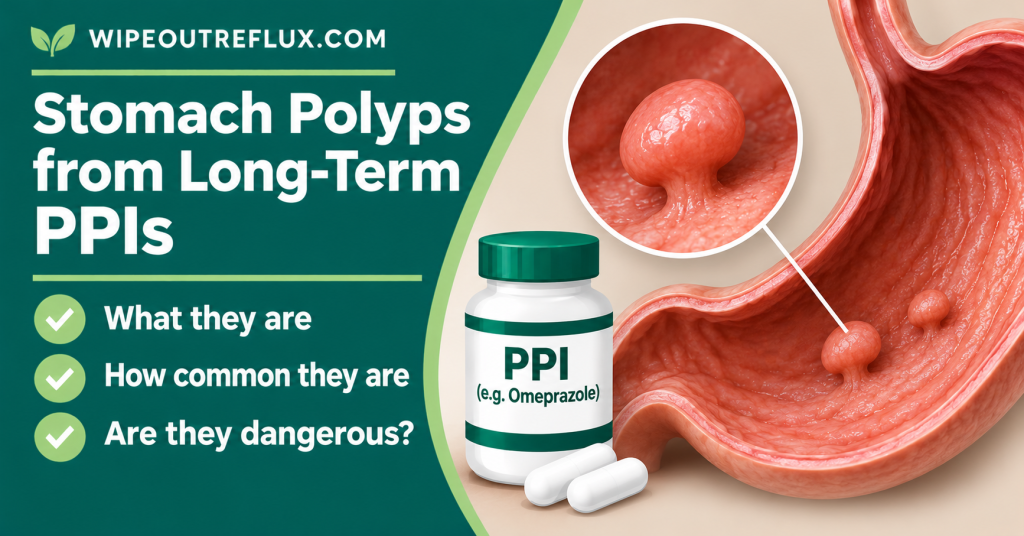
Yes, long-term PPI use can cause stomach polyps. The most common type is the fundic gland polyp: small, smooth bumps in the upper part of the stomach that show up in a large share of people who’ve taken omeprazole, esomeprazole, pantoprazole or similar drugs for a year or more. Less often, PPIs are linked with hyperplastic polyps too.
The reassuring part is that PPI-related fundic gland polyps are almost always benign. The risk of them turning precancerous is around 1%, most never cause symptoms, and current gastroenterology guidance says you don’t need to stop a PPI you genuinely need just because they’ve been found. They also tend to shrink once the PPI is reduced or stopped. What matters most is the polyp type, size and number, and whether you still need the drug at all.
Key Takeaways
- Fundic gland polyps are now the most common stomach polyps in Western countries, largely because of widespread PPI use.
- Long-term PPI use (12 months or more) is linked with roughly two to five times higher odds of fundic gland polyps.
- They form because PPIs raise gastrin and change the acid-producing glands, which swell into small cysts.
- Sporadic, PPI-related fundic gland polyps carry a very low risk of dysplasia (about 1%) and usually need no follow-up if small and benign.
- Higher-risk features include polyps over 1 cm, a stomach carpeted with polyps, or polyps in someone under 40, which can point to a genetic syndrome.
- Hyperplastic polyps can also be linked with PPIs. They’re more likely to bleed and need closer attention.
- PPI-related polyps often shrink after the drug is stopped or stepped down, sometimes within weeks.
- Guidelines say to keep a PPI you clearly need, but to deprescribe it if there’s no clear reason to be on it.
What Are Stomach Polyps?
A stomach (gastric) polyp is a small growth that sticks out from the stomach lining. Most are found by accident during an upper endoscopy done for something else, such as reflux, indigestion or anemia.
There are several types, and they behave very differently:
- Fundic gland polyps: the most common type, strongly linked to PPI use, and nearly always harmless.
- Hyperplastic polyps: usually linked to inflammation, especially H. pylori gastritis, but also seen with long-term acid suppression. Larger ones can bleed.
- Adenomas: uncommon, but genuinely precancerous, so they’re removed and followed up.
- Neuroendocrine tumors and others: rare.
The shift in the polyp landscape over the last few decades tells you a lot. In a US study of more than 120,000 endoscopies, gastric polyps were found in 6.35% of patients, and 77% of them were fundic gland polyps. The authors put the high rate down mostly to widespread PPI use [Carmack et al., American Journal of Gastroenterology, 2009].
How Strong Is the Link Between PPIs and Polyps?
The connection is now well established. Two separate meta-analyses published in 2016 reached the same conclusion.
The first pooled 12 studies covering more than 40,000 people. PPI users had about 2.5 times the odds of fundic gland polyps compared with non-users. The risk climbed with time: roughly 4.7 times higher after six months of use and 5.3 times higher after 12 months [Martin et al., Alimentary Pharmacology and Therapeutics, 2016].
The second, covering more than 87,000 patients, concluded that PPI use for 12 months or more is associated with an increased risk of fundic gland polyps [Tran-Duy et al., Clinical Gastroenterology and Hepatology, 2016].
Put simply, a few weeks of omeprazole for a flare is very unlikely to cause polyps. Years of daily use is a different picture. Studies report fundic gland polyps in roughly 14% to 36% of people taking PPIs [Sano et al., World Journal of Gastrointestinal Oncology, 2021].
Why PPIs Cause Polyps: The Mechanism
This makes more sense once you see what a PPI does to the stomach’s feedback system.
- Acid drops. PPIs shut down the proton pumps in the parietal cells that make acid.
- Gastrin rises. Your stomach senses the lower acid and releases more gastrin, the hormone that tells it to make acid. With the pumps blocked, gastrin keeps climbing.
- The glands change. Gastrin is also a growth signal. Combined with the blocked pumps, it leads to enlarged, overactive parietal cells that bulge into the glands. Secretions get trapped and the glands swell into tiny cysts.
- Polyps form. Clusters of these dilated, cystic glands push up from the lining as smooth, glassy bumps, mostly in the upper part of the stomach where the acid glands are.
A clinical review in the Cleveland Clinic Journal of Medicine notes that the number and size of these polyps are proportional to the dose and duration of PPI therapy [Niu and Qin, Cleveland Clinic Journal of Medicine, 2023]. That’s why the same mechanism also explains why they shrink when the PPI is reduced.
Interestingly, fundic gland polyps are more common in people without H. pylori. A healthy, non-inflamed stomach lining has more working acid glands for the PPI and gastrin to act on.
Are PPI-Related Stomach Polyps Cancerous?
This is the question most people really want answered, so I’ll be direct: for the typical PPI-related fundic gland polyp, the cancer risk is very low.
The 2026 American Gastroenterological Association (AGA) Clinical Practice Update states that the risk of dysplasia (precancerous change) in sporadic fundic gland polyps is very low, at about 1%. That compares with 25% to 46% in fundic gland polyps linked to familial adenomatous polyposis (FAP), an inherited condition [Buchner et al., Clinical Gastroenterology and Hepatology, 2026]. Where dysplasia does occur in sporadic polyps, it appears to progress slowly, if at all [Sano et al., World Journal of Gastrointestinal Oncology, 2021].
The broader question of whether long-term PPIs raise stomach cancer risk is less settled. The Tran-Duy meta-analysis found a possible association but warned it could be biased, given the small number of studies and likely confounding [Tran-Duy et al., Clinical Gastroenterology and Hepatology, 2016]. People who need long-term PPIs often have other risk factors, such as H. pylori, which makes this hard to untangle. I cover the bigger picture in can acid reflux cause cancer.
When polyps deserve more attention
Certain features make your doctor look more closely, either because they raise the risk of dysplasia or because they suggest a genetic syndrome rather than a PPI effect:
- Polyps larger than 1 cm
- More than 20 polyps, or the stomach lining “carpeted” with them
- Polyps in someone under 40
- Polyps in the antrum (lower stomach) rather than the body and fundus
- Dysplasia on biopsy
- A personal or family history of colon polyps or FAP, or adenomas in the duodenum
The CCJM review lists these red flags as reasons to consider an underlying FAP syndrome, which would usually mean a colonoscopy and possibly genetic counseling [Niu and Qin, Cleveland Clinic Journal of Medicine, 2023].
Hyperplastic Polyps and PPIs
Hyperplastic polyps are the second most common type. Classically they grow on inflamed lining, most often from H. pylori or autoimmune gastritis. But there’s growing evidence that strong, long-term acid suppression can encourage them too, again through high gastrin.
The AGA update notes a similar polyp association with newer acid blockers, the potassium-competitive acid blockers (P-CABs) such as vonoprazan. In one trial, the prevalence of hyperplastic polyps rose from 3.7% to 14.7% over three years [Buchner et al., Clinical Gastroenterology and Hepatology, 2026].
Hyperplastic polyps matter more than fundic gland polyps for two reasons. Larger ones can ooze blood and cause iron-deficiency anemia, and they have a small but real potential to develop dysplasia. The AGA advises testing for and treating H. pylori in anyone with hyperplastic polyps, since eradication can shrink or clear them.
Do Polyps Go Away If You Stop the PPI?
Often, yes. This is one of the clearest pieces of evidence that the PPI is the cause.
- In a Japanese study of patients with hyperplastic polyps who’d taken PPIs for over six months, 5 of 6 who stopped the PPI saw their polyps shrink by more than half or disappear, compared with 0 of 17 who continued [Nikaido et al., Journal of Clinical Gastroenterology, 2022].
- In two detailed case reports of people with large fundic gland polyps after more than 10 years on a PPI, the polyps regressed within about two months of stopping. In one, they shrank to under 10 mm within 35 days [Inaba et al., DEN Open, 2025].
Switching to a weaker acid reducer, such as an H2 blocker like famotidine, has also been reported to shrink polyps, presumably because gastrin doesn’t rise as much. If you’re weighing that switch, I compare the two in famotidine vs omeprazole.
Should You Stop Your PPI If You Have Polyps?
Not automatically. This is where the current guidance is quite specific.
The 2026 AGA update says that people taking a PPI for a valid reason don’t need to stop it because of fundic gland polyps. It also advises considering deprescribing when there’s no clear indication. Small (under 1 cm), non-dysplastic, non-syndromic fundic gland polyps usually need no surveillance at all, while larger ones are generally rechecked at one year [Buchner et al., Clinical Gastroenterology and Hepatology, 2026].
So the polyp itself is rarely the reason to stop. The better question is the one I’d ask anyway: do you actually still need daily acid suppression?
Good reasons to stay on a PPI include Barrett’s esophagus, severe erosive esophagitis, a history of bleeding ulcers, ongoing NSAID or anticoagulant use with high bleeding risk, and Zollinger-Ellison syndrome.
Weaker reasons include being started on it years ago for heartburn that was never reassessed, or taking it for throat symptoms that haven’t improved. That second group is common in silent reflux, where PPIs often don’t help much to begin with.
If you fall into the second group, polyps are a reasonable prompt to talk to your doctor about reducing the dose or stopping. Just don’t stop abruptly after long-term use. The same high gastrin that drives polyps also causes rebound acid when you stop suddenly. My guide to getting off PPIs and acid rebound, and my PPI taper schedule, explain how to step down gradually.
Do Stomach Polyps Cause Symptoms?
Usually not. Most fundic gland polyps are only a few millimeters across and are found by chance. They don’t cause reflux, pain or bloating.
Larger polyps, especially hyperplastic ones, can occasionally cause:
- Slow blood loss leading to iron-deficiency anemia (tiredness, breathlessness, pale skin)
- Visible bleeding, such as black stools or vomiting blood, which is rare but needs urgent care
- Very rarely, a large polyp near the stomach outlet can cause fullness or nausea
If you have ongoing indigestion or reflux symptoms, polyps are very unlikely to be the reason. It’s more useful to look at why the reflux itself isn’t controlled. See acid reflux medication not working for the common causes.
Reducing Your Need for Long-Term PPIs
The most effective way to lower your polyp risk, and avoid the other long-term PPI concerns covered in omeprazole side effects, is to need less acid suppression in the first place. For many people with reflux, that’s realistic.
- Diet and meal timing: smaller meals, fewer trigger foods and a longer gap before bed reduce reflux at the source.
- Alginates: these form a protective raft that physically blocks reflux. They work without suppressing acid, so they don’t drive up gastrin.
- Sleep position and bed elevation: these cut night-time reflux, which is often the reason people stay on a PPI.
- Weight loss, where relevant: one of the best-supported lifestyle measures for GERD.
That’s the whole idea behind the Wipeout Diet Plan: building a foundation that lets many people use acid suppression only as an occasional tool, not a lifelong default.
Conclusion
Long-term PPI use does cause stomach polyps, most often fundic gland polyps. The link is well established, it grows with dose and duration, and it works through a clear mechanism: lower acid, higher gastrin, and swollen, cystic acid glands. In a large share of long-term PPI users, they’re simply part of the picture.
The important context is that sporadic, PPI-related fundic gland polyps are almost always benign. The dysplasia risk is around 1%, small ones generally need no follow-up, and guidelines don’t ask you to stop a PPI you genuinely need. Larger polyps, very numerous polyps, polyps at a young age, or hyperplastic polyps get closer attention. The encouraging news is that PPI-related polyps often shrink, sometimes quickly, once the drug is reduced or stopped.
For many readers, the most useful takeaway is that finding polyps is a good moment to ask whether you still need daily acid suppression. If your reflux is driven by diet, meal timing and lifestyle, addressing those directly can let you step down safely. The Wipeout Diet Plan is my complete, in-depth guide to doing that. I built it first and foremost for LPR, the stubborn throat-based form of reflux, but it targets the same root causes as GERD, so it works equally well for classic heartburn. With those foundations in place, many people find they can lean far less on PPIs over the long term.
Frequently Asked Questions
Can omeprazole cause stomach polyps?
Yes. Omeprazole and other PPIs are strongly linked to fundic gland polyps, especially after 12 months or more of use. They’re usually small and benign.
Are fundic gland polyps from PPIs dangerous?
Rarely. Sporadic PPI-related fundic gland polyps have a dysplasia risk of about 1%. Small, non-dysplastic ones generally need no follow-up. Polyps over 1 cm or very numerous polyps get closer monitoring.
Will my stomach polyps go away if I stop taking PPIs?
Often, yes. Studies and case reports show PPI-related polyps shrinking or disappearing after stopping or stepping down, sometimes within a few weeks to months.
Do I need to stop my PPI if I have fundic gland polyps?
Not if you have a valid reason to take it, according to the 2026 AGA guidance. If there’s no clear indication, it’s a good reason to talk to your doctor about tapering off.
How long does it take for PPIs to cause polyps?
The risk rises noticeably after about six months and more so after 12 months. Short courses of a few weeks are very unlikely to cause polyps.
Can famotidine cause stomach polyps?
H2 blockers like famotidine raise gastrin far less than PPIs, and switching to one has been reported to shrink PPI-related polyps. They’re not strongly linked to fundic gland polyps.
Do stomach polyps cause acid reflux symptoms?
No. Most fundic gland polyps cause no symptoms at all. Larger hyperplastic polyps can occasionally bleed and cause anemia, but they don’t cause heartburn or regurgitation.
Research & References
- [Carmack et al., American Journal of Gastroenterology, 2009] — US study of 121,564 endoscopies finding gastric polyps in 6.35% of patients, of which 77% were fundic gland polyps, likely reflecting widespread PPI use.
- [Martin et al., Alimentary Pharmacology and Therapeutics, 2016] — Meta-analysis of 12 studies (over 40,000 subjects) finding increased fundic gland polyps in PPI users, with odds ratios of 4.71 at six months and 5.32 at 12 months of use.
- [Tran-Duy et al., Clinical Gastroenterology and Hepatology, 2016] — Meta-analysis of over 87,000 patients concluding PPI use of 12 months or more is associated with fundic gland polyps; a possible gastric cancer association may be biased by confounding.
- [Sano et al., World Journal of Gastrointestinal Oncology, 2021] — Review reporting fundic gland polyps in 13.6–36% of PPI users and noting sporadic polyps with dysplasia progress to cancer slowly, if at all.
- [Niu and Qin, Cleveland Clinic Journal of Medicine, 2023] — Clinical review explaining that polyp number and size are proportional to PPI dose and duration, and listing features that suggest an underlying FAP syndrome.
- [Buchner et al., Clinical Gastroenterology and Hepatology, 2026] — AGA Clinical Practice Update stating sporadic fundic gland polyp dysplasia risk is about 1%, that a PPI with a valid indication need not be stopped, and that small non-dysplastic fundic gland polyps need no surveillance.
- [Nikaido et al., Journal of Clinical Gastroenterology, 2022] — Case series showing hyperplastic polyps shrank in 5 of 6 patients who stopped PPIs versus 0 of 17 who continued.
- [Inaba et al., DEN Open, 2025] — Two cases of large fundic gland polyps after more than 10 years of PPI use that regressed within about two months of discontinuation.

David Gray
12 years living with LPR · Consultant & researcher
I've lived with LPR for twelve years — the misdiagnoses, the PPI courses that did nothing, the slow work of figuring out what actually helps. Wipeout Reflux is where I translate the research into plain terms for people stuck in the same place. Every claim here is sourced to peer-reviewed work, and I consult one-to-one with LPR sufferers.