
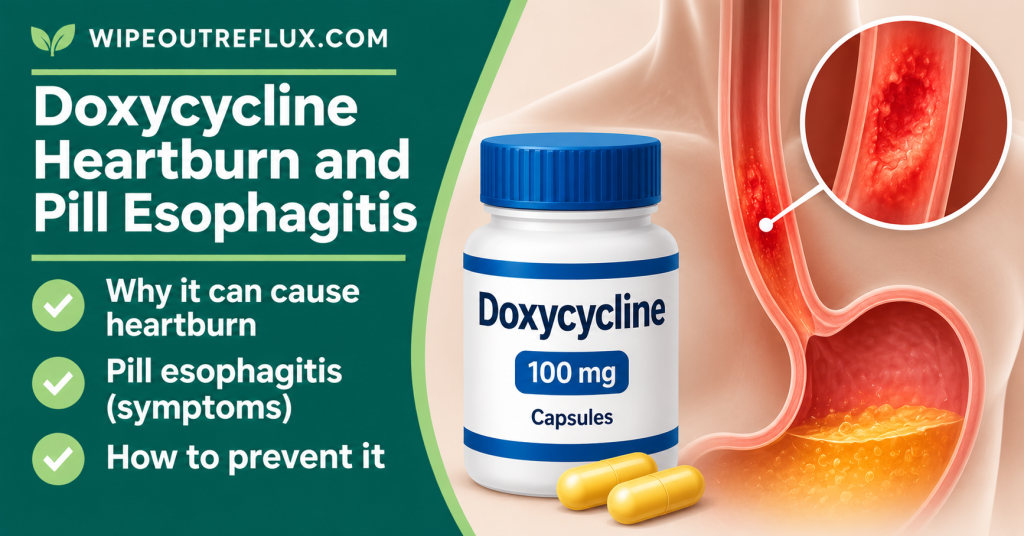
If you’ve started doxycycline and developed a burning pain behind your breastbone, pain when you swallow, or a feeling that something is stuck in your chest, the most likely cause isn’t ordinary acid reflux. It’s pill esophagitis: a chemical burn where the capsule or tablet sat against the lining of your esophagus and dissolved there instead of reaching your stomach.
Doxycycline is one of the most common causes of pill esophagitis, because it’s strongly acidic when it dissolves. The good news is that it’s very preventable, and it usually heals within days to a couple of weeks once the irritation stops. The key is swallowing it properly: a full glass of water, sitting or standing upright, and never right before bed.
Key Takeaways
- “Doxycycline heartburn” is usually pill esophagitis, a direct chemical injury to the esophagus, rather than acid reflux.
- Doxycycline can drop the pH to below 3 where it dissolves, which can burn the esophageal lining within hours.
- Tetracycline-family antibiotics, especially doxycycline, cause a large share of all pill esophagitis cases.
- Typical symptoms are burning chest pain, painful swallowing (odynophagia) and difficulty swallowing, often starting suddenly a few days into treatment.
- The biggest risk factors are taking it with too little water and lying down soon after, especially at bedtime.
- Prevention: take it with a full glass of water and food, stay upright for at least 30 minutes, and don’t take it within a couple of hours of lying down.
- Most cases heal within days to two weeks. Severe pain, inability to swallow, or vomiting blood needs urgent medical care.
Why Doxycycline Causes Heartburn-Like Pain
We tend to assume a pill drops straight into the stomach. Often it doesn’t. Capsules and tablets can stick to the wall of the esophagus, particularly if you swallow them with a small sip of water or lie down afterward.
In a classic study, researchers watched 121 healthy volunteers swallow tablets and capsules under X-ray. Pill transit was delayed in 22% of swallows, and only a third of those people noticed anything. Many pills stuck to the esophageal lining and started to break down in the lower esophagus. The main culprits were swallowing with only 25 ml of water (about a mouthful) and lying down [Hey et al., British Medical Journal, 1982].
Most pills that stick cause no harm. Doxycycline is different because of its chemistry. When it dissolves in a small amount of water or saliva, it can produce a solution with a pH below 3 [Guo et al., Journal of International Medical Research, 2019]. That’s comparable to the acidity of stomach acid, but concentrated in one small patch of tissue that has no protection against it. The result is a localized acid burn, often a discrete ulcer or a pair of “kissing” ulcers on opposite walls.
That’s why it can feel like the worst heartburn you’ve ever had, but it doesn’t behave like reflux. The acid isn’t coming up from your stomach. It’s sitting right where the pill lodged.
How Common Is Doxycycline Esophagitis?
It’s the best-known cause. Antibiotics account for nearly half of all reported cases of drug-induced esophageal injury, and doxycycline alone has been linked to about 27% of them [Al-Mofarreh and Al Mofleh, World Journal of Gastroenterology, 2003]. In a Turkish series of 48 patients with drug-induced esophageal ulcers, tetracycline and doxycycline were responsible for 52% [Dağ et al., Turkish Journal of Gastroenterology, 2014].
Among everyone who takes doxycycline, though, esophagitis is fairly uncommon. In a study of 189 adults taking it for at least a month, 1.6% developed esophagitis and 6.3% had some kind of gastrointestinal side effect. The risk was clearly higher in people aged 50 and over and in those taking 200 mg a day rather than 100 mg [Eljaaly et al., Journal of Infection in Developing Countries, 2023].
It’s also probably underreported, because milder cases get better on their own and never reach an endoscopy suite.
Symptoms: Pill Esophagitis vs Acid Reflux
The two can feel similar, but there are some useful differences.
Typical pill esophagitis symptoms
- Sudden onset of burning or sharp pain behind the breastbone, often waking you a few hours after a bedtime dose
- Pain when swallowing (odynophagia), including saliva and water, which is the most characteristic feature
- Difficulty swallowing or a feeling of food or pills sticking in the chest
- A sense that something is stuck in your chest even when nothing is there
- Less often: nausea, reduced appetite because eating hurts, or in severe cases bleeding
In the acne-treatment case series, symptoms began between 3 and 12 days after starting doxycycline, with an average of about 7 days, and most patients had taken the drug at bedtime, just before lying down, or with too little water [Guo et al., Journal of International Medical Research, 2019]. It can also happen after a single badly swallowed dose.
How it differs from reflux
- Reflux heartburn tends to come after meals, when bending or lying down, and is often eased by antacids. It usually doesn’t make swallowing itself painful.
- Pill esophagitis is tied to the timing of the pill, comes on abruptly, and makes swallowing hurt. Antacids often do little.
If you already have reflux, the two can overlap. Reflux can make pill injury worse, and the inflamed area can make your usual reflux feel sharper. For a fuller picture of what typical heartburn feels like, see what heartburn feels like. For painful swallowing more generally, see throat pain when swallowing.
Chest pain should never be assumed to be the esophagus. If you have pressure, pain spreading to your arm or jaw, breathlessness or sweating, get urgent help. My guide on heartburn or heart attack covers the warning signs.
Who Is Most at Risk?
The single biggest factor is how the pill is taken. In the Turkish series, 85.5% of patients’ injuries were linked to drinking too little water with the pill, taking it lying down, or both [Dağ et al., Turkish Journal of Gastroenterology, 2014]. Other risk factors include:
- Bedtime dosing: swallowing reflexes and saliva drop during sleep, so a stuck pill stays put for hours.
- Capsules: gelatin capsules tend to stick to the esophageal wall more readily than coated tablets.
- Older age and higher doses: as noted above.
- Dry mouth: from medications such as antihistamines and some antidepressants, or conditions like Sjögren’s.
- Esophageal problems: narrowing, a Schatzki ring, motility disorders, or an enlarged heart pressing on the esophagus.
- Taking several pills at once, especially alongside other irritants like NSAIDs, potassium or bisphosphonates.
StatPearls’ review of drug-induced esophagitis identifies taking pills with insufficient water and in a lying position as probably the most important factors overall [StatPearls, Drug-Induced Esophagitis].
How to Take Doxycycline Without Burning Your Esophagus
This is where you can make the biggest difference. The steps below are simple, and they address every major risk factor.
- Take it with a full glass of water, at least 8 oz (about 240 ml). In the BMJ study, at least 100 ml was needed to reliably carry large tablets through, and more is better for capsules [Hey et al., British Medical Journal, 1982].
- Take it with food. New Zealand’s medicines regulator concluded that taking doxycycline with a meal is probably the best single piece of advice to cut esophagitis risk, and food has only a small effect on absorption [Medsafe, Prescriber Update, 1999]. Avoid taking it with dairy, antacids, iron or calcium supplements, which do reduce absorption.
- Stay upright. Sit or stand for at least 30 minutes afterward. Some labels advise up to two hours.
- Never take it right before bed. If you’re on twice-daily dosing, take the evening dose with dinner, not at bedtime.
- Swallow one pill at a time if you take several medications.
- Drink a little more water afterward if you feel any sticking sensation.
If you struggle to swallow pills in general, my guide to trouble swallowing pills has more tips, and ask your pharmacist whether a tablet or liquid form is available instead of a capsule.
What to Do If You Already Have Symptoms
Contact your prescriber
Don’t just push through. Your doctor may switch you to a different antibiotic, change the formulation, or keep you on doxycycline with strict swallowing instructions, depending on what it’s treating. Continuing to take an offending drug the wrong way can delay healing.
Protect and soothe the area
Doctors commonly use an acid reducer (often a PPI) so that stomach acid doesn’t add to the injury, and sometimes sucralfate, which coats ulcerated tissue. In one reported case of doxycycline ulcers, symptoms improved quickly on a PPI plus sucralfate, and a follow-up endoscopy two months later showed complete healing [Almayoof et al., Cureus, 2024]. I explain how sucralfate works in sucralfate (Carafate) for LPR. Don’t take sucralfate at the same time as doxycycline, because it can block absorption. Space them out as your pharmacist advises.
Eat gently while it heals
- Choose soft, cool or lukewarm foods: oatmeal, eggs, yogurt (away from your doxycycline dose), mashed potatoes, soups that aren’t too hot, bananas.
- Avoid anything that scrapes or stings: dry toast, crackers, chips, citrus, tomato, spicy food, alcohol and very hot drinks.
- Take small bites and sip water between them.
- Keep your usual reflux habits too, including not eating late and keeping your head raised at night, so reflux doesn’t keep re-irritating the area.
This is the same gentle-food approach that helps with reflux-related esophageal irritation in general, and it’s laid out in detail in the Wipeout Diet Plan.
How long does it take to heal?
Most mild cases improve within a few days of correcting how the drug is taken or stopping it. New Zealand’s Medsafe notes that symptoms usually resolve within days, but severe cases can take more than two weeks to fully recover [Medsafe, Prescriber Update, 1999]. Deep ulcers can take several weeks.
When to Get Urgent Help
Rarely, pill esophagitis causes bleeding, a stricture (narrowing), or perforation. Seek medical care urgently if you have:
- Severe chest pain, or chest pain with breathlessness, sweating or pain in your arm or jaw
- Inability to swallow liquids or your own saliva
- Vomiting blood or material that looks like coffee grounds, or black, tarry stools
- Fever with worsening chest pain
- Symptoms that don’t improve within about a week, or that keep getting worse
An endoscopy confirms the diagnosis and rules out other causes, such as infection or, in older adults, cancer. For more on deeper injuries, see esophageal ulcers.
Other Ways Antibiotics Can Upset Your Stomach
Not every bit of discomfort on doxycycline is pill esophagitis. It can also cause nausea and stomach upset, which taking it with food usually helps. Antibiotics in general can disrupt gut bacteria and cause bloating or diarrhea. I cover the wider picture in can antibiotics cause heartburn and medications that make acid reflux worse.
Conclusion
Heartburn-like pain on doxycycline is very often pill esophagitis, not reflux. The capsule or tablet lodges in the esophagus, dissolves into a strongly acidic solution, and burns a small patch of unprotected tissue. That’s why the pain tends to be sudden, sharp and worse when you swallow, and why ordinary antacids often don’t touch it.
The encouraging part is how preventable it is. Most cases come down to too little water, lying down soon after, or a bedtime dose. Take doxycycline with a full glass of water and food, stay upright for at least 30 minutes, and keep it well away from bedtime. If symptoms have already started, tell your prescriber, eat soft and gentle foods, and expect most mild cases to settle within days to a couple of weeks. Severe pain, difficulty swallowing liquids or any sign of bleeding needs prompt medical attention.
If this has left you with a sensitive esophagus, or it’s made an existing reflux problem flare, the next step is calming things down day to day. The Wipeout Diet Plan is my in-depth guide to the foods, meal timing and habits that reduce esophageal irritation and keep reflux in check. It was designed first for silent reflux (LPR), where the throat and upper esophagus are especially sensitive, but because it works on the same underlying mechanisms, it’s just as effective for GERD and everyday heartburn.
Frequently Asked Questions
Why does doxycycline give me heartburn?
Usually because the pill has stuck in your esophagus and dissolved there. Doxycycline is strongly acidic as it dissolves, so it can burn the lining. This is called pill esophagitis.
How long does doxycycline esophagitis last?
Mild cases usually improve within a few days of taking the drug properly or stopping it. Severe cases with ulcers can take two weeks or longer to heal fully.
Can I lie down after taking doxycycline?
Not right away. Stay sitting or standing for at least 30 minutes, and don’t take it within a couple of hours of going to bed.
How much water should I drink with doxycycline?
A full glass, at least 8 oz (about 240 ml). Small sips are one of the main reasons pills stick in the esophagus.
Should I take doxycycline with food?
Taking it with a meal lowers the risk of esophagitis and nausea, with only a small effect on absorption. Avoid taking it with dairy, antacids, iron or calcium.
Can I take Tums or Gaviscon for doxycycline heartburn?
Antacids containing calcium, magnesium or aluminum bind doxycycline and reduce absorption. If you use one, separate it from your dose by several hours, and ask your pharmacist about timing.
Should I stop taking doxycycline if it burns?
Don’t stop on your own. Contact your prescriber, who may switch the antibiotic or formulation, or advise you on safer swallowing. Seek urgent care if pain is severe or you can’t swallow.
Research & References
- [Hey et al., British Medical Journal, 1982] — Fluoroscopy study of 121 volunteers showing delayed pill transit in 22% of swallows, mostly with small water volumes and lying down, with many pills adhering to the esophageal lining.
- [Guo et al., Journal of International Medical Research, 2019] — Case series of 12 adults with doxycycline ulcers during acne treatment, with symptom onset 3–12 days after starting; most took it at bedtime or with insufficient water, and doxycycline can produce a pH below 3.
- [Al-Mofarreh and Al Mofleh, World Journal of Gastroenterology, 2003] — Review and clinical series noting antibiotics account for almost 50% of drug-induced esophageal injury cases, and doxycycline alone for 27%.
- [Dağ et al., Turkish Journal of Gastroenterology, 2014] — Series of 48 patients with drug-induced esophageal ulcers: tetracycline or doxycycline caused 52%, and 85.5% were linked to insufficient water, a lying position, or both.
- [Eljaaly et al., Journal of Infection in Developing Countries, 2023] — Study of 189 adults on doxycycline for at least a month: 6.3% had GI adverse effects and 1.6% esophagitis, more often at age 50+ and at 200 mg/day.
- [StatPearls, Drug-Induced Esophagitis] — Clinical review of causes, mechanisms, risk factors and management, identifying insufficient water and a recumbent position as key factors.
- [Medsafe, Prescriber Update, 1999] — New Zealand regulator advice that taking doxycycline with a meal is probably the best way to reduce esophagitis risk; symptoms usually resolve within days, but severe cases may take over two weeks.
- [Almayoof et al., Cureus, 2024] — Case of esophageal ulcers after a single doxycycline capsule, which improved on a PPI and sucralfate and were fully healed at two months.

David Gray
12 years living with LPR · Consultant & researcher
I've lived with LPR for twelve years — the misdiagnoses, the PPI courses that did nothing, the slow work of figuring out what actually helps. Wipeout Reflux is where I translate the research into plain terms for people stuck in the same place. Every claim here is sourced to peer-reviewed work, and I consult one-to-one with LPR sufferers.