
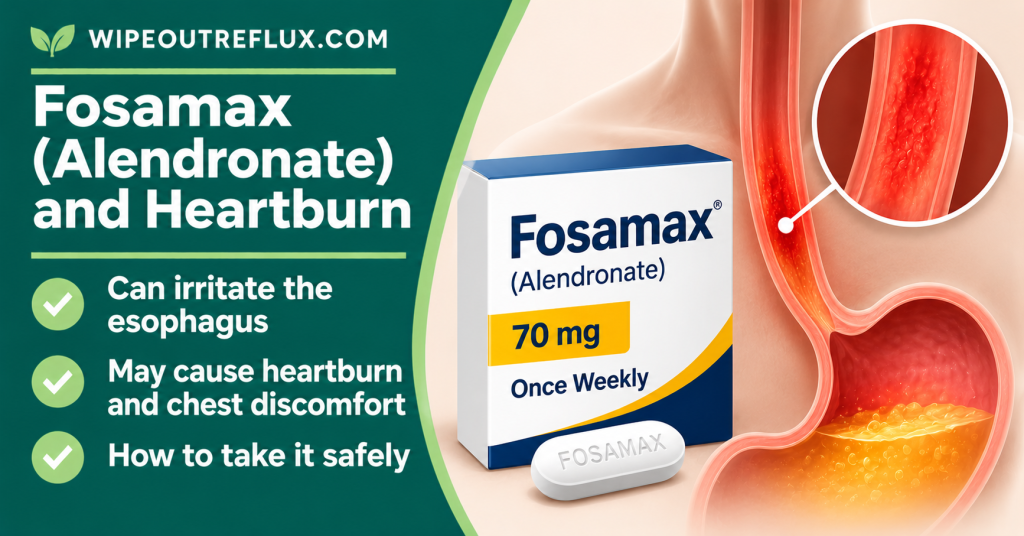
Fosamax (alendronate) can cause heartburn, but usually not in the way people expect. The main problem isn’t stomach acid washing up. It’s the tablet itself irritating the esophagus if it lingers there on the way down. Alendronate is a known cause of pill esophagitis, which can range from mild burning to erosions and ulcers.
The reassuring part is that when it’s taken exactly as directed, large trials show alendronate causes no more upper digestive side effects than a placebo. Nearly all the serious cases involve the dosing rules being skipped: too little water, lying down too soon, or taking it at bedtime. So if Fosamax gives you heartburn, the first step is to check how you’re taking it. If you already have reflux or a swallowing problem, it’s worth talking to your doctor about alternatives that bypass the esophagus altogether.
Key Takeaways
- Alendronate can irritate the esophagus directly, causing esophagitis, erosions and occasionally ulcers.
- Reported cases cluster in people who swallowed it with little water, lay down soon after, or kept taking it once symptoms began.
- In large randomized trials, alendronate taken correctly caused no more upper GI side effects than placebo.
- Take it first thing in the morning with 6–8 oz of plain water, stay upright for at least 30 minutes, and don’t lie down until after you’ve eaten.
- Stop and contact your doctor if you develop painful swallowing, new or worsening heartburn, or chest pain.
- Pre-existing reflux, Barrett’s esophagus or swallowing problems may make another osteoporosis treatment a better fit.
- Be cautious about adding a PPI routinely. In a large Danish study, PPI use was linked to less hip fracture protection from alendronate.
How Fosamax Causes Heartburn
Alendronate belongs to a group of osteoporosis drugs called bisphosphonates. The nitrogen-containing ones, including alendronate, can irritate the lining of the upper digestive tract on contact.
Your stomach lining is built to handle irritants. Your esophagus isn’t. If an alendronate tablet sticks partway down, or dissolves before it reaches the stomach, the drug sits in direct contact with delicate esophageal tissue. That can cause a chemical injury, which feels like intense heartburn or a burning, aching pain behind the breastbone, often with pain on swallowing.
The problem became clear soon after alendronate was launched. A 1996 report in the New England Journal of Medicine described three patients with severe esophagitis shortly after starting the drug and analyzed post-marketing reports to the manufacturer. By then, an estimated 475,000 people had been prescribed it. The endoscopic findings pointed to a chemical esophagitis, with erosions or ulcers and thickening of the esophageal wall. Where the details were known, the injuries seemed tied to swallowing the tablet with little or no water, lying down after taking it, or continuing to take it after symptoms started [de Groen et al., New England Journal of Medicine, 1996].
That’s the same pattern seen with other pill-related injuries, which I cover in pill stuck in throat.
How Common Is It?
This is where the evidence becomes much more reassuring than the early reports suggested.
- A meta-analysis of 42 randomized trials covering more than 39,000 people with osteoporosis found no increase in either minor or severe gastrointestinal side effects with oral bisphosphonates compared with placebo. That held for once-weekly alendronate 70 mg as well [Dömötör et al., Frontiers in Endocrinology, 2020].
- A separate meta-analysis focused only on alendronate, covering more than 15,000 patients, found almost exactly the same rate of upper GI side effects as placebo [Zhou et al., Experimental and Therapeutic Medicine, 2016].
- Real-world numbers are a little higher. In a UK prescription-monitoring study of general practice patients, 1.3% had esophageal events considered possibly related to alendronate [Mackay et al., British Journal of General Practice, 1998].
There’s an important caveat. Clinical trials tend to exclude people with existing digestive problems and teach participants to follow the dosing rules carefully. In everyday life, people forget, take it with coffee, or go back to bed. And people with reflux are exactly the group most likely to notice a problem.
Is It Fosamax or Your Reflux?
If you already have GERD, telling the two apart can be tricky. These clues help:
- Timing. Alendronate irritation usually starts within hours to a few days of a dose. If you’re on weekly Fosamax, symptoms that flare the day you take it and ease over the following days point to the drug.
- Painful swallowing. Pain when you swallow, rather than just burning, suggests direct injury to the esophagus.
- New or different symptoms. Heartburn that’s suddenly worse, or that feels different from your usual reflux, since starting alendronate is a red flag.
- Response to antacids. Ordinary reflux often eases with an antacid or alginate. Pill injury often doesn’t.
Fosamax doesn’t appear to cause reflux by loosening the lower esophageal sphincter. But it can make existing reflux feel worse, because inflamed tissue is more sensitive to acid. The two can feed off each other.
How to Take Fosamax to Protect Your Esophagus
The official instructions are strict for a reason. Each step either helps the tablet reach your stomach quickly or keeps it from coming back up. According to the FDA-approved prescribing information [Fosamax Prescribing Information, FDA, 2026]:
- Take it first thing in the morning, after you get up for the day. Never at bedtime or before you’ve got up.
- Swallow the tablet whole with a full glass (6–8 oz) of plain water. Not coffee, tea, juice, mineral water or milk. Don’t chew or suck it.
- Stay fully upright (sitting, standing or walking) for at least 30 minutes.
- Don’t lie down until after your first food of the day.
- Wait at least 30 minutes before eating, drinking anything other than water, or taking other medicines or supplements, including calcium and antacids.
The label also says to stop alendronate and seek medical advice if you develop trouble swallowing, pain on swallowing, chest pain, or new or worsening heartburn.
A few extra tips I’d add if you have reflux:
- Take it at a time when you can comfortably stay upright and active, such as before your morning routine rather than before going back to bed on a day off.
- Avoid taking it on a morning after a heavy or late meal, when your reflux is more likely to be active.
- Don’t take NSAIDs like ibuprofen around the same time. The label notes they can add to stomach irritation, and I explain why in does ibuprofen cause acid reflux.
Who Should Be More Careful With Fosamax?
The label lists conditions where alendronate shouldn’t be used at all, including esophageal problems that delay emptying (such as a stricture or achalasia) and being unable to sit or stand upright for 30 minutes [Fosamax Prescribing Information, FDA, 2026]. Extra caution is also sensible if you have:
- Active GERD, erosive esophagitis or Barrett’s esophagus
- Swallowing difficulty or a history of pills sticking (see trouble swallowing pills)
- An esophageal stricture or motility disorder
- A large hiatal hernia with frequent regurgitation
- Regular NSAID or aspirin use
None of this means you can’t treat your osteoporosis. It means the delivery method matters.
Alternatives If Fosamax Bothers Your Esophagus
Osteoporosis treatment is important, and stopping without a plan isn’t a good trade. If alendronate keeps causing symptoms despite perfect technique, there are several options to discuss with your doctor:
- Intravenous zoledronic acid: a once-yearly infusion of a bisphosphonate that never touches the esophagus.
- Denosumab: an injection given every six months, which works differently from bisphosphonates.
- Other oral options: different bisphosphonates and formulations, such as a delayed-release risedronate taken after breakfast or an effervescent alendronate dissolved in water first. These may suit some people better, though they still pass through the esophagus.
- Bone-building drugs for people at very high fracture risk, given by injection.
Your doctor will weigh fracture risk, kidney function and other health factors, so this is a conversation rather than a swap you make yourself.
Should You Take a PPI With Fosamax?
It’s tempting to add omeprazole to “protect” the stomach. But PPIs don’t prevent pill esophagitis, which is caused by the tablet itself rather than stomach acid. And there’s a concern that they may blunt alendronate’s benefit.
In a Danish national study of more than 38,000 new alendronate users, those who took alendronate consistently without a PPI had a 39% lower risk of hip fracture. In people also taking a PPI, the reduction was only 19% and not statistically significant, with a bigger effect at higher PPI doses and in older patients. H2 blockers like famotidine didn’t show the same effect [Abrahamsen et al., Archives of Internal Medicine, 2011]. This was an observational study, so it can’t prove cause and effect, but it’s a reason not to add a PPI by default. PPIs also have their own questions around bone health, which I go through in PPIs and bone density.
If you genuinely need acid suppression for reflux, that’s a decision to make with your doctor. Many people with osteoporosis and mild to moderate reflux do well using alginates and diet changes instead, which avoid the PPI question entirely. That approach is exactly what the Wipeout Diet Plan is built around.
One more practical point: calcium-based antacids like Tums will block alendronate absorption if taken too close to your dose. Keep them well away from the 30-minute window, and see are Tums safe for acid reflux for more.
What to Do If Fosamax Has Already Caused Symptoms
- Stop the next dose and call your doctor if you have painful swallowing, chest pain or heartburn that’s new or getting worse. The label specifically advises this.
- Seek urgent care for severe chest pain, inability to swallow liquids, vomiting blood or black stools. Chest pain should always be checked. See heartburn or heart attack for warning signs.
- Eat gently while it settles: soft, lukewarm foods, small bites, and nothing scratchy, acidic, spicy or very hot.
- Expect an endoscopy if symptoms are significant or don’t settle quickly. It can confirm esophagitis or an esophageal ulcer and rule out other causes.
Most mild irritation settles once the drug is stopped or the dosing technique is corrected. Whether you can restart, and how, is something to decide with your doctor.
Reflux, Age and Bone Health
Osteoporosis and reflux often show up together, especially in postmenopausal women and older adults. Both are more common with age, and hormone changes affect both. If that sounds like you, my guides to menopause and acid reflux and acid reflux in older adults cover the wider picture.
Conclusion
Fosamax can cause heartburn, mainly by irritating the esophagus directly when the tablet doesn’t get through quickly. The early case reports were alarming, but the bigger picture is reassuring. In large randomized trials, alendronate taken correctly caused no more upper GI side effects than placebo, and most serious cases involved too little water, lying down too soon, or continuing after symptoms started.
So the dosing rules really matter. Take it first thing in the morning with a full glass of plain water, stay upright, and don’t lie down until you’ve eaten. Stop and call your doctor if swallowing becomes painful or your heartburn changes. If you have active reflux, Barrett’s or a swallowing problem, ask about options that bypass the esophagus, such as a yearly infusion or a six-monthly injection. And think twice before adding a PPI by default, given the evidence that it may weaken alendronate’s protection against hip fractures.
If you’re managing both bone health and reflux, getting your reflux under control without relying on daily acid suppression makes everything easier. The Wipeout Diet Plan is my complete, in-depth guide to the foods, meal timing and habits that calm reflux at its source. I built it originally for silent reflux, but since it targets the same root causes, it works equally well for GERD and classic heartburn. It’s a practical way to protect your esophagus while your bones get the treatment they need.
Frequently Asked Questions
Can Fosamax cause acid reflux?
It mainly causes direct irritation of the esophagus, which can feel like severe heartburn. It doesn’t appear to loosen the reflux valve, but it can make existing reflux feel worse.
How long does Fosamax heartburn last?
Mild irritation usually settles within days of stopping the drug or fixing how it’s taken. Esophagitis or ulcers can take several weeks to heal. See your doctor if it doesn’t improve.
Why do you have to stay upright after taking Fosamax?
Staying upright helps the tablet reach your stomach and stops it from coming back up into the esophagus, where it can cause irritation and ulcers.
Can I take Fosamax if I have GERD?
Many people with GERD take it safely by following the dosing rules exactly. If you have active esophagitis, Barrett’s, a stricture or swallowing problems, discuss alternatives with your doctor.
Can I take omeprazole with Fosamax?
You can if your doctor advises it, but a large study linked PPI use with less hip fracture protection from alendronate. PPIs also don’t prevent pill-related esophagus injury.
Can I take Tums or Gaviscon with Fosamax?
Not close to your dose, because calcium and other minerals block alendronate absorption. Wait at least 30 minutes after your Fosamax, and longer is safer.
Is once-weekly Fosamax easier on the esophagus?
It means fewer doses, and trials show weekly alendronate 70 mg is tolerated similarly to placebo. The same dosing rules still apply every time.
Research & References
- [de Groen et al., New England Journal of Medicine, 1996] — Case reports and post-marketing analysis describing chemical esophagitis with alendronate, linked to swallowing with little water, lying down after dosing, or continuing after symptoms began.
- [Dömötör et al., Frontiers in Endocrinology, 2020] — Meta-analysis of 42 randomized trials (39,047 patients) finding oral bisphosphonates did not increase non-severe or severe GI adverse events versus placebo, including once-weekly alendronate 70 mg.
- [Zhou et al., Experimental and Therapeutic Medicine, 2016] — Meta-analysis of placebo-controlled alendronate trials (15,192 patients) finding a relative risk of upper GI adverse events of 1.02.
- [Mackay et al., British Journal of General Practice, 1998] — UK prescription-event monitoring study in which 1.3% of patients had esophageal events possibly related to alendronate.
- [Fosamax Prescribing Information, FDA, 2026] — Official dosing instructions (6–8 oz plain water, upright for 30 minutes and until after food), contraindications, and advice to stop if esophageal symptoms develop.
- [Abrahamsen et al., Archives of Internal Medicine, 2011] — Danish cohort of 38,088 alendronate users: hip fracture risk fell 39% without PPIs but only 19% (not significant) with concurrent PPI use, with no such effect for H2 blockers.

David Gray
12 years living with LPR · Consultant & researcher
I've lived with LPR for twelve years — the misdiagnoses, the PPI courses that did nothing, the slow work of figuring out what actually helps. Wipeout Reflux is where I translate the research into plain terms for people stuck in the same place. Every claim here is sourced to peer-reviewed work, and I consult one-to-one with LPR sufferers.