
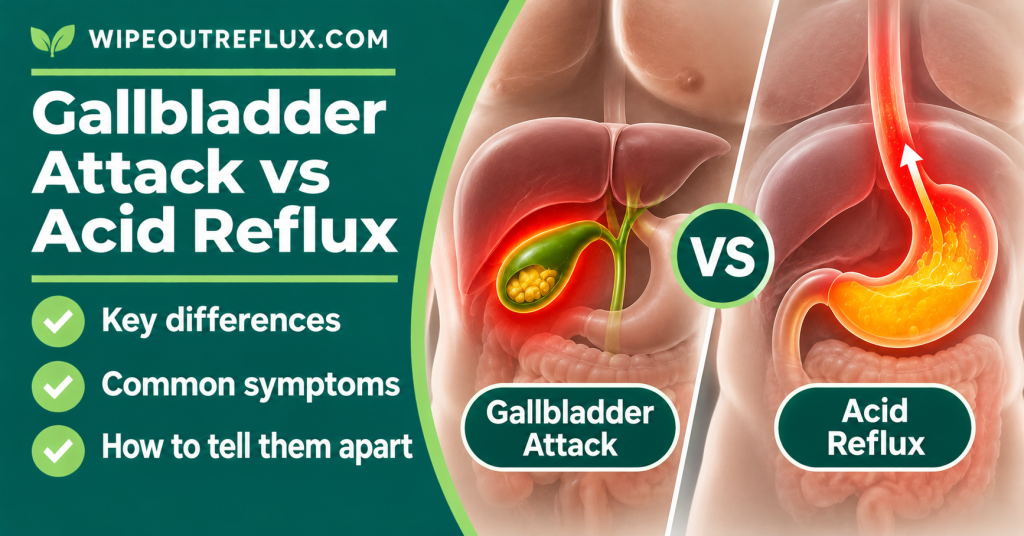
A gallbladder attack and acid reflux can both strike after a rich meal and both cause upper abdominal or chest pain, but they feel quite different once you know what to look for. Acid reflux is a burning sensation that rises behind the breastbone, often with a sour taste, and it usually eases with antacids or sitting upright. A gallbladder attack (biliary colic) is a steady, often severe ache under the right ribs or in the upper middle of the abdomen. It builds over minutes, lasts from about 30 minutes to several hours, can spread to the back or right shoulder blade, and doesn’t respond to antacids or changing position.
The distinction matters because the treatments are completely different. Reflux is managed with diet, habits and acid-reducing or barrier medicines. Recurring gallbladder attacks usually mean gallstones, which may need surgery, and some gallbladder problems need urgent care.
Key Takeaways
- Reflux burns and rises into the chest. Gallbladder pain is a deep, steady ache under the right ribs or in the upper middle abdomen.
- Gallbladder attacks typically last 30 minutes to a few hours, then fade. Reflux comes and goes with meals, bending and lying down.
- Gallbladder pain often spreads to the back or right shoulder blade. Reflux pain tends to travel up toward the throat.
- Antacids and sitting up usually help reflux. They don’t relieve a gallbladder attack, which is one of the official criteria for biliary pain.
- Both can be triggered by large, fatty meals, which is why they’re easily confused.
- Gallstones affect roughly 10–15% of adults, and most never cause symptoms.
- Pain lasting more than 6 hours, fever, chills, or yellowing of the skin or eyes needs urgent medical care.
- Removing the gallbladder treats gallstone attacks but won’t cure reflux, so getting the diagnosis right matters.
What Each Condition Actually Is
Acid reflux
Reflux happens when stomach contents flow back up into the esophagus because the valve at the bottom of it, the lower esophageal sphincter, opens when it shouldn’t. Acid and digestive enzymes irritate the esophageal lining, causing the classic burning of heartburn. In silent reflux (LPR), the refluxed material reaches the throat and causes hoarseness, throat clearing or a lump-in-the-throat feeling, often with little or no heartburn.
A gallbladder attack
Your gallbladder stores bile, which helps digest fat. When you eat a fatty meal, it contracts to squeeze bile into the small intestine. If a gallstone gets pushed into the outlet duct and temporarily blocks it, the gallbladder keeps squeezing against the blockage. That’s what causes the pain. StatPearls describes biliary colic as typically following a large, fatty meal, which triggers the gallbladder to contract [StatPearls, Biliary Colic].
Despite the name “colic,” the pain usually isn’t wave-like. It’s typically constant once it builds. When the stone drops back or passes, the pain eases.
Gallstones are very common. A Cleveland Clinic review puts their prevalence at about 10–15% of US adults, with up to 80% never causing symptoms [Ibrahim et al., Cleveland Clinic Journal of Medicine, 2018]. So it’s entirely possible to have gallstones and reflux at the same time, with only one of them causing your symptoms.
Gallbladder Attack vs Acid Reflux: Side by Side
Where it hurts
- Reflux: behind the breastbone, sometimes in the upper middle abdomen, rising toward the throat.
- Gallbladder: under the right ribs or in the upper middle abdomen (epigastrium). It often spreads to the back, between the shoulder blades, or to the right shoulder.
What it feels like
- Reflux: burning, often with a sour or bitter taste, regurgitation or burping.
- Gallbladder: a deep, gripping, steady ache or pressure. It can be severe enough that you can’t get comfortable or carry on with what you were doing.
How long it lasts
- Reflux: minutes to a couple of hours, often coming and going, flaring with bending, lying down or another meal.
- Gallbladder: builds to a plateau and typically lasts at least 30 minutes, often 1–5 hours, then fades. You may feel a mild ache or tenderness for a day afterward. Attacks can be weeks or months apart.
What triggers it
- Reflux: large meals, fatty or fried food, chocolate, alcohol, coffee, citrus, tomato, late eating, lying down or bending.
- Gallbladder: fatty or heavy meals in particular. Attacks often happen in the evening or wake you at night.
What helps
- Reflux: antacids, alginates, acid reducers, sitting or standing upright.
- Gallbladder: none of those reliably help. Pain eases on its own when the stone moves.
Other symptoms
- Reflux: sour taste, hoarseness, cough, throat clearing, a lump in the throat, burping.
- Gallbladder: nausea and vomiting are common. Fever, chills or yellowing of the skin point to a complication.
The Most Useful Clue: Does Changing Position or an Antacid Help?
The Rome IV criteria, the international standard for diagnosing functional digestive disorders, define biliary pain as epigastric or right upper abdominal pain that builds to a steady level and lasts 30 minutes or longer, recurs at different intervals, is severe enough to interrupt daily activities or lead to an emergency visit, isn’t significantly related to bowel movements, and isn’t significantly relieved by a change in position or by acid suppression [Cotton et al., Gastroenterology, 2016].
That last point is the most practical test you can do at home. If sitting up, standing, or taking an antacid or alginate clearly eases the pain, reflux is far more likely. If nothing touches it and it simply has to run its course, think gallbladder.
Why They’re So Easily Confused
- Same trigger. Fatty meals provoke both. Fat relaxes the esophageal sphincter and slows stomach emptying, and it’s also the main signal that makes the gallbladder contract.
- Overlapping location. Both can cause pain in the epigastrium, the upper middle of the abdomen just below the breastbone.
- Nausea and indigestion. Both can cause nausea, fullness and a general “my digestion is off” feeling.
- Common in the same people. Both are more frequent with age, excess weight and in women.
The reverse confusion happens too. Vague indigestion, bloating and heartburn in someone who happens to have gallstones are often blamed on the stones, but they’re frequently caused by something else. In one study, dyspeptic symptoms improved in only 40% of patients after their gallbladder was removed, even though the classic biliary colic disappeared in all of them [Abu Farsakh et al., Journal of Clinical Gastroenterology, 1996]. I compare indigestion and reflux in indigestion vs acid reflux.
Will Removing My Gallbladder Fix My Reflux?
Generally, no. Gallbladder surgery is very effective for genuine gallstone attacks, but it isn’t a reflux treatment.
The best controlled study on this followed 302 people having either gallbladder removal or hernia repair (as a comparison group) and used validated reflux questionnaires before and after surgery. Gallbladder removal relieved abdominal pain, as expected, but it didn’t change reflux symptoms any more than hernia surgery did [Lin et al., Annals of Surgery, 2010].
Some people do notice more upper digestive symptoms after the operation, including bile reaching the stomach. If that’s you, see acid reflux after gallbladder removal and bile reflux vs acid reflux.
The practical point: if your main symptoms are heartburn, regurgitation or throat symptoms, don’t expect gallbladder surgery to solve them. Make sure reflux is being treated in its own right.
How Each Is Diagnosed
Gallbladder
- Abdominal ultrasound is the first-choice test. It detects most gallstones and signs of inflammation.
- Blood tests check for infection, liver involvement or pancreatitis.
- A HIDA scan may be used if gallbladder function is in question but no stones are seen.
Reflux
- Often diagnosed from symptoms and response to treatment.
- Upper endoscopy looks for esophagitis, hiatal hernia and other causes. See endoscopy for acid reflux.
- pH or pH-impedance monitoring measures reflux directly when the diagnosis is unclear.
For an overview, see how acid reflux is diagnosed.
When to Get Urgent Medical Help
Seek emergency care if you have:
- Upper abdominal pain lasting more than about 6 hours, or getting steadily worse
- Fever or chills with abdominal pain, which can mean an inflamed or infected gallbladder
- Yellowing of your skin or the whites of your eyes, dark urine or pale stools, which can mean a stone blocking the bile duct
- Severe pain spreading through to your back with vomiting, which can mean gallstone pancreatitis
- Chest pain with breathlessness, sweating, or pain in your arm, jaw or neck
That last one is critical. Heart attacks, especially in women and people with diabetes, can feel like indigestion or upper abdominal pain. Never assume chest or upper abdominal pain is digestive without considering your heart. See heartburn or heart attack for the warning signs.
Managing Each Day to Day
If it’s a gallbladder attack
See your doctor after a first suspected attack, even if it settled, since recurrent attacks are common. Laparoscopic gallbladder removal is the standard treatment for symptomatic gallstones [Ibrahim et al., Cleveland Clinic Journal of Medicine, 2018]. While you wait, smaller, lower-fat meals can reduce how often the gallbladder is strongly triggered. Avoid crash dieting, as rapid weight loss can encourage gallstone formation.
If it’s acid reflux
Reflux responds well to a structured approach:
- Smaller meals and less fried and fatty food
- No food for 3 hours before bed
- Raising the head of your bed if you have night-time symptoms
- An alginate after meals and before bed to block reflux
- Identifying your personal trigger foods
I lay all of this out step by step in the Wipeout Diet Plan.
If you’re also dealing with chest discomfort after meals, my guide to chest pain after eating covers the other possibilities.
Conclusion
Gallbladder attacks and acid reflux overlap in their triggers and location, but their character is different. Reflux burns, rises toward the throat, flares with bending and lying down, and usually eases with antacids or sitting up. A gallbladder attack is a deep, steady ache under the right ribs or in the upper middle abdomen. It builds over minutes, lasts from 30 minutes to a few hours, often spreads to the back or right shoulder, and doesn’t respond to antacids or changing position. That last feature is one of the most reliable ways to tell them apart.
Getting it right matters because the treatments differ. Recurrent gallbladder attacks usually need an ultrasound and often surgery. Fever, jaundice or pain lasting more than about 6 hours needs urgent care. Gallbladder surgery won’t cure reflux, so if your symptoms are burning, regurgitation or throat-related, reflux deserves its own treatment plan.
That’s where the Wipeout Diet Plan comes in. It’s my complete, in-depth guide to calming reflux at the source, covering which foods to swap, how to time your meals, and the daily habits that keep reflux from coming back. It was designed first and foremost for silent reflux (LPR), the harder-to-treat throat-based form, but because it works on the same underlying mechanisms, it’s just as effective for GERD and classic heartburn. And since it favors smaller, lighter, lower-fat meals, many people with a sensitive gallbladder find it suits them well too.
Frequently Asked Questions
How can I tell if it’s my gallbladder or acid reflux?
Reflux burns behind the breastbone and usually eases with antacids or sitting up. A gallbladder attack is a steady ache under the right ribs or upper middle abdomen lasting 30 minutes to hours, often spreading to the back or right shoulder, and antacids don’t help.
Can gallbladder problems cause heartburn?
A gallbladder attack can cause upper abdominal pain that people describe as heartburn, plus nausea. True burning heartburn with a sour taste is much more typical of reflux.
Can gallstones cause acid reflux?
Gallstones don’t directly cause acid reflux, but the two often coexist and share triggers like fatty meals. Removing the gallbladder generally doesn’t improve reflux symptoms.
Where is gallbladder pain felt?
Usually under the right ribs or in the upper middle of the abdomen. It often spreads to the back, between the shoulder blades, or to the right shoulder.
How long does a gallbladder attack last?
Typically from about 30 minutes to a few hours. Pain lasting more than about 6 hours, or with fever or yellowing of the skin, needs urgent medical assessment.
Do antacids help gallbladder pain?
No. Lack of relief from antacids, acid suppression or a change of position is one of the formal criteria used to identify biliary pain.
Can you have gallbladder problems and acid reflux at the same time?
Yes. Both are common and share risk factors like age and excess weight. Each needs its own diagnosis and treatment.
Research & References
- [StatPearls, Biliary Colic] — Clinical review describing biliary colic as pain typically after a large, fatty meal that triggers gallbladder contraction, usually constant rather than colicky, and most commonly felt in the right upper abdomen.
- [Ibrahim et al., Cleveland Clinic Journal of Medicine, 2018] — Review reporting gallstones in about 10–15% of US adults, asymptomatic in up to 80%, with laparoscopic cholecystectomy as the standard treatment for symptomatic gallstones.
- [Cotton et al., Gastroenterology, 2016] — Rome IV criteria defining biliary pain as epigastric or right upper quadrant pain lasting 30 minutes or more, recurring at intervals, severe enough to disrupt activity, and not relieved by postural change or acid suppression.
- [Abu Farsakh et al., Journal of Clinical Gastroenterology, 1996] — Study of 30 gallstone patients in which biliary colic resolved in all after surgery, but dyspeptic symptoms improved in only 40%.
- [Lin et al., Annals of Surgery, 2010] — Prospective controlled study of 302 patients showing cholecystectomy reduced abdominal pain but did not change reflux symptoms compared with hernia repair controls.

David Gray
12 years living with LPR · Consultant & researcher
I've lived with LPR for twelve years — the misdiagnoses, the PPI courses that did nothing, the slow work of figuring out what actually helps. Wipeout Reflux is where I translate the research into plain terms for people stuck in the same place. Every claim here is sourced to peer-reviewed work, and I consult one-to-one with LPR sufferers.