
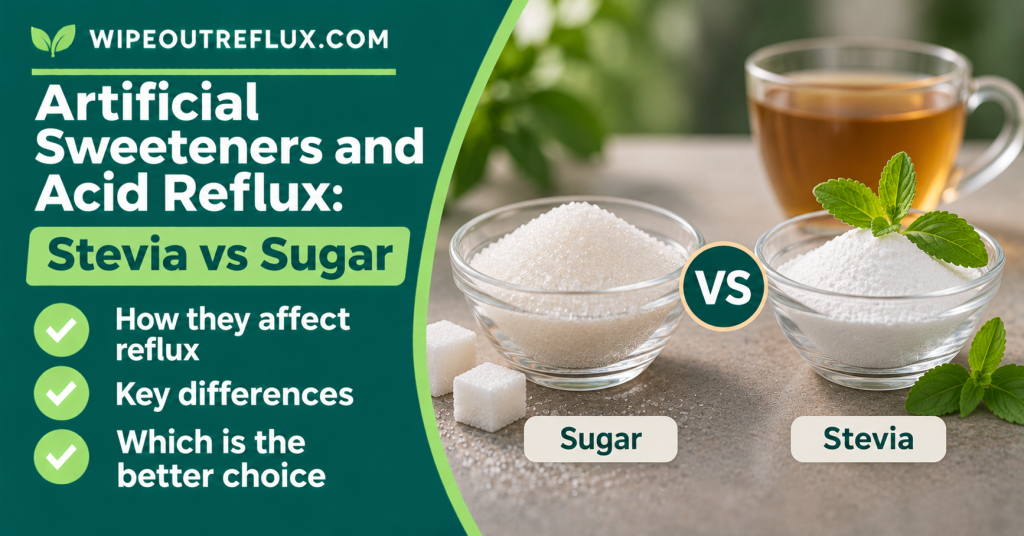
Artificial sweeteners don’t directly cause acid reflux. Stevia, monk fruit, sucralose and aspartame aren’t acidic in the amounts you’d use, and there’s no good evidence that they relax the reflux valve the way fat, chocolate or alcohol do. For most people with GERD or LPR, a little pure stevia or monk fruit in your oatmeal or tea is one of the safest ways to add sweetness.
The problems come from what sweeteners travel with. Sugar alcohols like sorbitol, xylitol and maltitol ferment in the gut and cause gas and bloating, which pushes on the stomach. Diet sodas are fizzy and acidic, whatever sweetener they use. And “sugar-free” sweets and protein bars are often packed with fat, mint or chocolate. Here’s how each one compares, and which I’d choose for reflux.
Key Takeaways
- No sweetener has strong evidence of directly triggering reflux. The issues are indirect: gas, carbonation, acidity and the foods they come in.
- Pure stevia and monk fruit are usually the safest choices for GERD and LPR in small amounts.
- Sugar alcohols (sorbitol, xylitol, maltitol, mannitol) cause dose-dependent gas and bloating, which can worsen reflux.
- Erythritol is better tolerated in the gut than other sugar alcohols, but has been linked with clotting risk in one major study.
- Sucralose and saccharin altered gut bacteria and blood sugar responses in a randomized trial, though they aren’t reflux triggers as such.
- Diet sodas are a problem for reflux because of carbonation and citric or phosphoric acid, not the sweetener.
- Small amounts of sugar, honey or maple syrup are fine for most people. Large amounts of sugary food are more of an issue.
Can Artificial Sweeteners Cause Acid Reflux?
To trigger reflux, something generally needs to do one of three things: weaken the lower esophageal sphincter (LES), raise pressure in the stomach, or irritate the esophagus and throat directly. Fat, chocolate, mint, alcohol and large meals do the first. Big meals, gas and fizzy drinks do the second. Acidic foods and drinks do the third, and for silent reflux they can also reactivate pepsin sitting in throat tissue.
The high-intensity sweeteners are used in tiny quantities and don’t fit any of those categories well. There are no good clinical trials showing that stevia, sucralose or aspartame cause reflux on their own. I want to be upfront about that: the evidence here is about mechanisms and gut effects, not direct reflux studies.
Where sweeteners can cause trouble is the gut, and that’s more relevant to reflux than people realize.
The Real Issue: Fermentation, Gas and Pressure
Sugar alcohols are poorly absorbed in the small intestine. What isn’t absorbed travels to the colon, where bacteria ferment it, producing gas. A systematic review found that polyols cause dose-dependent flatulence, abdominal discomfort and laxative effects in both healthy people and people with IBS [Lenhart & Chey, Advances in Nutrition, 2017].
That matters for reflux for two reasons. First, gas and bloating raise pressure in the abdomen, which pushes up on the stomach. Second, fermentation in the colon seems to affect the reflux valve itself. In a study of people with GERD, adding a fermentable carbohydrate (fructo-oligosaccharides) increased transient relaxations of the LES, the number of acid reflux episodes, and reflux symptoms [Piche et al., Gastroenterology, 2003]. That study used a fiber rather than a sweetener, but sugar alcohols ferment in a similar way, so it’s a plausible route by which large amounts could make reflux worse.
If you also have IBS, SIBO or a lot of bloating, this matters even more. See IBS and acid reflux and acid reflux and gas.
Sweetener by Sweetener: How They Compare for Reflux
Stevia
Verdict: usually a safe choice.
Stevia comes from the leaf of a South American plant. The sweet compounds (steviol glycosides) are used in tiny amounts, aren’t acidic in practice, and aren’t fermented like sugar alcohols. For most people with reflux, a few drops of liquid stevia in tea or a sprinkle in oatmeal is fine.
The catch is that most stevia products in shops aren’t pure stevia. Many granulated “stevia” sweeteners are mostly erythritol or another bulking agent, and stevia sweetened drinks are often carbonated or acidified. Read the label. If you react to “stevia,” it’s often the filler rather than the stevia itself.
Monk fruit
Verdict: usually a safe choice.
Monk fruit (luo han guo) extract works similarly to stevia: intensely sweet, used in small amounts, and not fermented. It has less research behind it, but there’s no particular reason to expect it to trigger reflux. Again, check what it’s blended with, as erythritol is a common partner.
Erythritol
Verdict: gentler on the gut than other sugar alcohols, but with a question mark.
Erythritol is a sugar alcohol, but it’s mostly absorbed in the small intestine and excreted unchanged, so it causes far less gas than sorbitol or xylitol [Mäkinen, International Journal of Dentistry, 2016]. From a pure reflux standpoint, that makes it one of the better-tolerated bulk sweeteners.
However, a 2023 study found that higher blood levels of erythritol were associated with a higher risk of heart attack and stroke in people already at high cardiovascular risk, and erythritol increased platelet clotting in lab and human experiments [Witkowski et al., Nature Medicine, 2023]. It was an association study, and it doesn’t prove that eating erythritol causes heart problems. But if you have heart disease or clotting risk factors, I’d use it sparingly until more is known.
Xylitol, sorbitol, maltitol and mannitol
Verdict: the most likely to cause trouble.
These are the sugar alcohols in most sugar-free gum, mints, chocolate and “diabetic” sweets. They’re poorly absorbed and readily fermented, so in larger amounts they cause gas, bloating and loose stools. Maltitol and sorbitol tend to be the worst for this, while xylitol is somewhat better tolerated.
There’s one exception worth knowing about. Chewing sugar-free gum for half an hour after a meal reduced acid reflux in a controlled study, because chewing increases saliva and swallowing, which clears acid from the esophagus [Moazzez et al., Journal of Dental Research, 2005]. The small amount of xylitol or sorbitol in a piece or two of gum is usually fine. Just avoid mint flavors, which can relax the LES. See chewing gum and acid reflux.
Sucralose (Splenda)
Verdict: not a reflux trigger as such, but not entirely inert.
Sucralose isn’t acidic in the amounts used, and it isn’t fermented like sugar alcohols. But in a randomized trial of 120 healthy adults, two weeks of sucralose or saccharin altered gut bacteria and impaired blood sugar responses, while aspartame and stevia had smaller effects [Suez et al., Cell, 2022]. What that means long-term is still unclear. For reflux specifically, the bigger issue is that sucralose is the sweetener in many diet sodas and flavored waters.
Aspartame
Verdict: no specific reflux concern, but usually found in diet soda.
Aspartame breaks down during digestion and isn’t a known reflux trigger. Its main role in reflux is as the sweetener in diet colas and sugar-free soft drinks, which are problematic for other reasons (below).
Regular sugar, honey and maple syrup
Verdict: fine in small amounts.
A teaspoon of sugar, honey or maple syrup isn’t going to cause reflux. Where sugar becomes a problem is in the foods it comes with: cakes, pastries, chocolate and desserts are usually high in fat too. Very large amounts of sugar can also feed fermentation in people with SIBO or IBS. See is sugar acid or alkaline and is manuka honey good for acid reflux.
Why Diet Sodas Are Still a Problem
People sometimes switch to diet soda thinking they’ve solved the problem. But the sweetener was never the main issue. Diet sodas are:
- Carbonated, which distends the stomach and causes burping, carrying acid up with it.
- Acidic, usually with citric or phosphoric acid, often at a pH around 3. That’s especially bad for silent reflux, as it can reactivate pepsin in the throat.
- Often caffeinated.
See is Coke good for acid reflux, is citric acid bad for acid reflux and is sparkling water bad for acid reflux.
Watch the “Sugar-Free” Label
Sugar-free chocolate is still chocolate. Sugar-free mints are still mint. Many sugar-free protein bars and cookies are high in fat and loaded with sugar alcohols. The sweetener might be the least of your worries with these. Read the full ingredient list, not just the front of the pack.
Which Sweeteners Are Best for GERD and LPR?
My order of preference:
- Pure stevia or monk fruit (check there’s no erythritol or other filler if you’re sensitive)
- Small amounts of honey, maple syrup or regular sugar
- Erythritol in moderation, if you don’t have heart or clotting risk factors
- Sucralose or aspartame occasionally, ideally not in fizzy, acidic drinks
- Sorbitol, maltitol and mannitol last, especially if you bloat easily
And whichever you use, the real gains come from the bigger picture: what you eat, how much, and when. The sweetener question is a detail. The Wipeout Diet Plan covers the bigger picture, including how to keep a bit of sweetness in your diet without setting off symptoms.
How to Test Your Own Tolerance
People react differently, especially to sugar alcohols. If you suspect a sweetener:
- Cut it out completely for one to two weeks.
- Reintroduce one product at a time, in a normal amount, earlier in the day.
- Note gas, bloating, burping, heartburn and throat symptoms over the next 24 hours.
A simple food diary for reflux makes this much easier to track.
Conclusion
Artificial sweeteners aren’t the reflux villains they’re sometimes made out to be. Stevia, monk fruit, sucralose and aspartame aren’t acidic in the amounts you’d use and don’t have good evidence of weakening the reflux valve. Pure stevia and monk fruit are generally the safest choices for both GERD and LPR.
The real issues are indirect. Sugar alcohols like sorbitol and maltitol ferment in the gut and cause gas and bloating, which adds pressure on the stomach. Diet sodas are fizzy and acidic whatever they’re sweetened with. And “sugar-free” treats are often still high in fat, chocolate or mint. Erythritol is easy on the gut, but its link with clotting risk is worth bearing in mind if you have heart concerns.
If you want to get past the detail and fix your reflux at its source, the Wipeout Diet Plan is my complete guide to the foods, drinks and meal timing that calm reflux. It was built first and foremost for LPR, the stubborn throat-based form, though the same approach works just as well for GERD and everyday heartburn.
Frequently Asked Questions
Is stevia bad for acid reflux?
Pure stevia is generally fine for acid reflux. It isn’t acidic in normal amounts and isn’t fermented in the gut. If a stevia product bothers you, check whether it’s blended with erythritol or another sugar alcohol.
Can artificial sweeteners cause heartburn?
Not directly in most cases. Heartburn after sugar-free products is more often due to sugar alcohols causing gas, carbonation in diet drinks, or fat and chocolate in sugar-free treats.
Is Splenda OK for GERD?
Sucralose isn’t a known reflux trigger, and a little in tea or oatmeal is usually fine. Avoid it in fizzy, acidic diet drinks.
Do sugar alcohols make reflux worse?
They can. Sorbitol, maltitol, xylitol and mannitol ferment in the gut and cause dose-dependent gas and bloating, which raises pressure on the stomach. Erythritol is better tolerated.
Is diet soda better than regular soda for reflux?
Not really. Both are carbonated and acidic, which are the main reasons soda worsens reflux. The sweetener makes little difference.
Is honey better than sugar for acid reflux?
Both are fine in small amounts. Some people find honey soothing for the throat, but the portion matters more than the type.
What’s the best sweetener for silent reflux (LPR)?
Pure stevia or monk fruit, or a small amount of honey or maple syrup. Avoid acidic, sweetened drinks, which can reactivate pepsin in the throat.
Research & References
- [Lenhart & Chey, Advances in Nutrition, 2017] — Systematic review finding polyols (sugar alcohols) cause dose-dependent flatulence, abdominal discomfort and laxative effects in healthy people and IBS patients.
- [Piche et al., Gastroenterology, 2003] — Colonic fermentation of a fermentable carbohydrate increased transient LES relaxations, acid reflux episodes and symptoms in GERD patients.
- [Mäkinen, International Journal of Dentistry, 2016] — Review of gastrointestinal effects of sugar alcohols, noting erythritol usually avoids the GI reactions seen with other polyols.
- [Witkowski et al., Nature Medicine, 2023] — Higher blood erythritol levels were associated with major cardiovascular events, and erythritol enhanced platelet clotting in experimental studies.
- [Suez et al., Cell, 2022] — Randomized trial in 120 adults; saccharin and sucralose altered gut microbes and impaired glycemic responses over two weeks.
- [Moazzez et al., Journal of Dental Research, 2005] — Chewing sugar-free gum for 30 minutes after a meal reduced acidic postprandial esophageal reflux.

David Gray
12 years living with LPR · Consultant & researcher
I've lived with LPR for twelve years — the misdiagnoses, the PPI courses that did nothing, the slow work of figuring out what actually helps. Wipeout Reflux is where I translate the research into plain terms for people stuck in the same place. Every claim here is sourced to peer-reviewed work, and I consult one-to-one with LPR sufferers.