
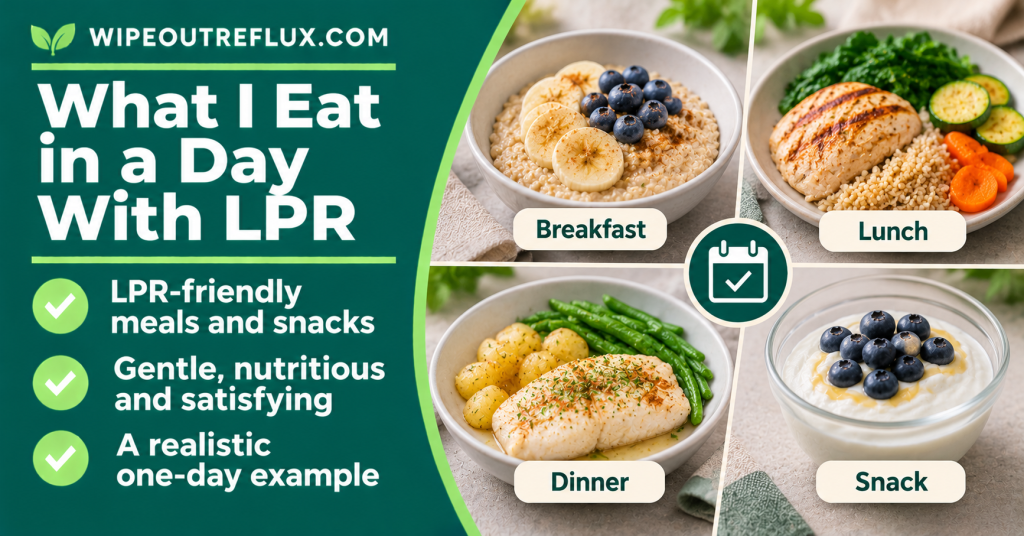
After 12 years of managing LPR, my typical day of eating looks surprisingly normal. Breakfast is either a fruit smoothie on an almond milk base or a bowl of oatmeal with cinnamon, a pinch of salt and a little honey or maple syrup. Lunch is often bread or a simple chicken stir fry with a few vegetables, herbs, and a little butter and honey. Dinner is usually potatoes with meat or fish and vegetables (salmon, beef or chicken), or a bowl of pasta.
That might not sound like a “reflux diet,” and that’s partly the point. It took me years to get here, and in the early days my diet was much stricter. What makes it work now isn’t a list of magic foods. It’s how the meals are built: low in acid, moderate in fat, sensible portions, and good timing. Here’s a real day, why each meal works for me, and what I’ve learned along the way.
Key Takeaways
- A long-term LPR diet can look fairly normal once your throat has settled. It’s the structure of the meals that matters.
- My breakfast is either an almond milk fruit smoothie or oatmeal with cinnamon, salt and a little honey or maple syrup.
- Small amounts of berries work for me because they’re blended into a larger, less acidic base with banana, avocado and almond milk.
- Lunch is bread or a simple chicken stir fry with herbs and a little butter and honey, rather than acidic or spicy sauces.
- Dinner is potatoes or pasta with meat or fish and vegetables, kept to a moderate portion.
- Low-acid eating has research behind it for LPR, not just personal experience.
- Timing matters: an early enough dinner gives my stomach time to empty before bed.
- Everyone’s triggers differ, so treat this as a template, not a prescription.
Why I Eat the Way I Do
When I first had LPR, my worst symptoms were a burning throat, coughing, a lump-in-the-throat feeling and feeling short of breath. PPIs and H2 blockers did nothing for me, and I was told it was anxiety. The turning point was understanding pepsin. When reflux reaches the throat, it carries pepsin, a digestive enzyme, which can lodge in throat tissue. Pepsin is reactivated by acid, so acidic food and drink can keep the irritation going even when you’re not actively refluxing.
That’s why the food side matters so much with LPR, and it’s not just my experience. In a study of people with LPR who hadn’t responded to medication, a strict two-week diet removing everything below pH 5 improved symptoms in 19 of 20 people [Koufman, Annals of Otology, Rhinology & Laryngology, 2011]. Another study found a plant-based Mediterranean-style diet with alkaline water and reflux precautions improved LPR symptoms at least as much as PPIs [Zalvan et al., JAMA Otolaryngology–Head & Neck Surgery, 2017].
My diet today is built on the same principles, just less strict than it was at the start. If you want the full backstory, I’ve written about how I controlled my LPR.
Breakfast: Smoothie or Oatmeal
Option 1: Almond milk fruit smoothie
A typical smoothie for me is:
- Unsweetened almond milk as the base
- A banana
- Some avocado
- A small handful of blueberries and raspberries
People are often surprised by the berries, because blueberries and raspberries are on most “avoid” lists for reflux. On their own, they’re fairly acidic. But in a smoothie, they’re a small part of a much bigger, gentler mix. Almond milk is close to neutral, banana is one of the least acidic fruits you can eat, and avocado is low-acid and adds a creamy texture. Blending the berries into that base dilutes their acidity, so the drink as a whole is far less acidic than eating a bowl of berries on their own. See my acidity of fruits chart for how fruits compare.
A few things I’d point out if you want to try it:
- Keep the berries to a small handful. They’re there for flavor, not as the main ingredient.
- If your throat is in a bad patch, leave the berries out for a while and use banana and avocado on their own.
- Don’t overdo the avocado. It’s a healthy fat, but fat still slows stomach emptying.
- Sip it rather than gulping it down.
More ideas in my acid reflux smoothie recipes, and more on the ingredients in is almond milk good for acid reflux and avocado for acid reflux.
Option 2: Oatmeal with cinnamon, salt and honey
Oatmeal is one of my most reliable breakfasts. Oats are close to neutral, filling, and easy on the stomach. I make it with:
- Plain oats
- A sprinkle of cinnamon
- A small pinch of salt
- A little honey or maple syrup
The salt is something people often skip, but a pinch makes oatmeal taste far less bland without adding anything acidic. Cinnamon is a personal one. It’s fine for me in a small sprinkle, but some people find warming spices irritating, so test it yourself. See does cinnamon help acid reflux and are Quaker oats good for acid reflux.
Lunch: Bread or a Simple Chicken Stir Fry
Lunch for me is often something with bread, or a quick stir fry:
- Chicken
- A little vegetable
- Herbs
- A little butter and honey
The butter and honey give it a gentle, slightly sweet glaze, which I find much easier on my throat than the usual stir fry sauces. Shop-bought stir fry sauces tend to be full of things that cause trouble for reflux: vinegar, chili, lots of garlic and sometimes citrus. Herbs carry a lot of flavor without any of that.
The “little” in “a little butter” matters. Butter is a fat, and fat in larger amounts relaxes the reflux valve and slows stomach emptying. A small knob to cook with is very different from a buttery sauce. See is butter bad for acid reflux, is chicken good for acid reflux and is bread good for acid reflux.
Dinner: Potatoes, Meat or Fish and Vegetables (or Pasta)
Dinner is usually one of these:
- Potatoes with salmon and vegetables
- Potatoes with beef and vegetables
- Potatoes with chicken and vegetables
- Pasta
Potatoes are one of the best foods for reflux. They’re filling, low-acid and versatile, whether baked, boiled or mashed. See are potatoes acidic.
For protein, I rotate between salmon, beef and chicken. Salmon and beef are fattier than chicken breast, so the portion size matters more with those. A moderate portion of either is fine for me. A huge steak late in the evening would not be. See is salmon good for acid reflux and is red meat bad for acid reflux.
Pasta is a great reflux food in itself. The thing that usually causes the trouble is tomato sauce. If you want a sauce, my tomato-free pasta sauce is the one I’d use. More in is pasta good for acid reflux.
The Timing That Keeps It Calm
What you eat is only half of it. When you eat, and how much, matters just as much, especially in the evening.
- Leave a gap before bed. People who go to bed within three hours of dinner have much higher odds of GERD than those who wait four hours or more [Fujiwara et al., American Journal of Gastroenterology, 2005]. For LPR, nighttime reflux is particularly damaging, so I aim to give my stomach time to empty before I lie down. See how long before bed you should stop eating.
- Keep portions moderate. A stretched stomach relaxes the reflux valve, however “safe” the food.
- Eat slowly. Eating a meal in five minutes causes more reflux than eating the same meal over half an hour [Wildi et al., American Journal of Gastroenterology, 2004].
- Stay upright after meals. No lying on the sofa straight after dinner.
What I Still Avoid
Even 12 years in, there are things I keep out of my everyday eating, because they’re the usual suspects for reflux and LPR:
- Tomato-based sauces
- Citrus fruit and juice
- Fizzy drinks
- Vinegar-heavy dressings and pickles
- Chili and very spicy food
- Big, fatty or fried meals, especially late at night
That doesn’t mean never. It means they’re not part of a normal day. See LPR foods to avoid for the full list and the reasons behind it.
What I’d Tell You If You’re Just Starting
Please don’t copy my day exactly if you’re in the early, sore stage of LPR. My diet is less strict now because my throat has had years to settle. When I started, I was far more careful, especially with fruit like berries.
The approach I’d recommend is:
- Calm things down first with a stricter low-acid, low-fat diet and good meal timing.
- Give it time. Throat tissue is slow to heal. See my LPR recovery timeline.
- Reintroduce foods one at a time, and keep a note of how you respond.
- End up with your own version of a normal day, built around what you tolerate.
That staged process is exactly what the Wipeout Diet Plan takes you through, with full meal plans for each stage.
Conclusion
A day of eating with LPR, 12 years in, looks a lot more normal than most people expect. For me it’s a smoothie on an almond milk base or oatmeal with cinnamon, salt and a little honey for breakfast, bread or a simple chicken stir fry with herbs and a little butter and honey for lunch, and potatoes or pasta with salmon, beef or chicken and vegetables for dinner.
What makes it work is the structure behind it: low-acid ingredients, acidic foods like berries kept small and diluted in a gentler base, moderate amounts of fat, sensible portions, slow eating and leaving time before bed. It also took a stricter start and a careful reintroduction process to get here, and your version will look a little different from mine.
If you want to get to your own calm, sustainable version of a day like this, the Wipeout Diet Plan is the complete guide I built from those 12 years: the foods, the meal plans, the timing and the reintroduction steps. I designed it around LPR first, because that’s what I live with, but since it targets the same underlying causes, it works just as well for GERD and classic heartburn.
Frequently Asked Questions
What can I eat in a day with LPR?
Meals built around low-acid foods like oats, bananas, potatoes, rice, pasta, bread, chicken, fish and cooked vegetables, with herbs for flavor and only small amounts of fat.
Are berries OK with silent reflux?
Berries are fairly acidic on their own. Some people tolerate a small amount blended into a less acidic base, like almond milk with banana, once their throat has settled. Leave them out during a flare.
Is oatmeal good for LPR?
Yes, plain oatmeal is one of the most reliable breakfasts for LPR. Keep toppings low-acid, such as banana or a little honey or maple syrup.
Can I eat red meat with LPR?
Many people can in moderate portions, especially earlier in the evening. Red meat is higher in fat than chicken or white fish, so portion size and timing matter.
Is butter OK for acid reflux?
A small amount for cooking is usually fine. Larger amounts and butter-heavy sauces add enough fat to worsen reflux.
How long after eating should I wait to go to bed with LPR?
Aim for two to three hours after your last main meal.
Should I copy someone else’s LPR diet?
Use it as a template, not a rule. Triggers vary, so calm things down first, then reintroduce foods one at a time to find what works for you.
Research & References
- [Koufman, Annals of Otology, Rhinology & Laryngology, 2011] — A strict two-week low-acid diet removing foods and drinks below pH 5 improved symptoms and laryngeal findings in medication-resistant LPR.
- [Zalvan et al., JAMA Otolaryngology–Head & Neck Surgery, 2017] — A plant-based Mediterranean-style diet with alkaline water and reflux precautions improved LPR symptoms at least as much as PPIs.
- [Fujiwara et al., American Journal of Gastroenterology, 2005] — Going to bed within three hours of dinner was linked with about 7.5 times the odds of GERD.
- [Wildi et al., American Journal of Gastroenterology, 2004] — Eating a standard meal in 5 minutes caused more reflux episodes than eating it in 30 minutes.

David Gray
12 years living with LPR · Consultant & researcher
I've lived with LPR for twelve years — the misdiagnoses, the PPI courses that did nothing, the slow work of figuring out what actually helps. Wipeout Reflux is where I translate the research into plain terms for people stuck in the same place. Every claim here is sourced to peer-reviewed work, and I consult one-to-one with LPR sufferers.