
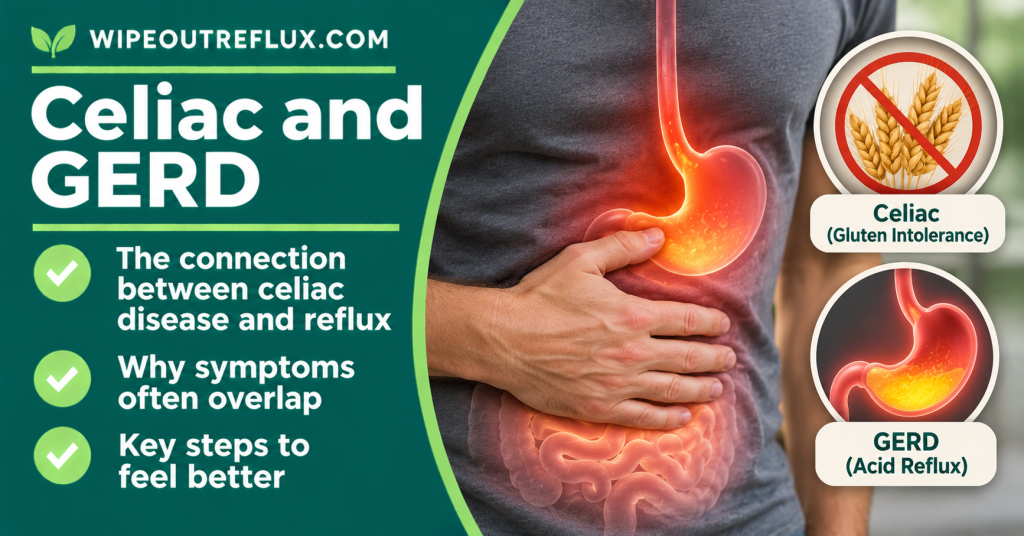
Celiac disease and GERD are more closely linked than most people realize. In studies of adults newly diagnosed with celiac disease, around 3 in 10 had moderate to severe reflux symptoms, compared with about 1 in 20 healthy people. Untreated celiac disease seems to weaken the valve at the bottom of the esophagus, slow down gut movement and make the esophageal lining leakier, all of which make reflux more likely and more painful.
The encouraging part is that this kind of reflux often responds well to the right treatment. In several studies, reflux symptoms in people with celiac disease improved within about three months of going strictly gluten-free, and they were far less likely to come back after a course of acid medication. So if you have stubborn reflux alongside bloating, diarrhea, fatigue or low iron, celiac disease is worth ruling out, and the test needs to be done before you cut out gluten.
Key Takeaways
- Celiac disease is an autoimmune reaction to gluten that damages the small intestine. It affects roughly 1 in 100 people worldwide.
- People with untreated celiac disease have higher rates of heartburn, regurgitation and reflux esophagitis than people without it.
- The likely mechanisms include a weaker lower esophageal sphincter, slower gut and stomach movement, and a leakier esophageal lining.
- In studies, a strict gluten-free diet improved reflux symptoms within about three months and cut the rate of reflux coming back after PPIs.
- Get tested for celiac disease while you’re still eating gluten. Going gluten-free first can make the blood test and biopsy falsely normal.
- If you don’t have celiac disease, gluten itself isn’t a proven reflux trigger, though some wheat-based foods can still cause problems.
- Reflux that persists on a gluten-free diet usually points to hidden gluten or ordinary reflux triggers that need separate attention.
What Is Celiac Disease?
Celiac disease is a permanent immune reaction to gluten, the protein found in wheat, barley and rye. When someone with celiac disease eats gluten, their immune system attacks the lining of the small intestine. Over time this flattens the tiny finger-like villi that absorb nutrients [Rubio-Tapia et al., The American Journal of Gastroenterology, 2023].
It’s more common than many people think. A large meta-analysis found that about 1.4% of people worldwide test positive on celiac blood tests, and about 0.7% have it confirmed by biopsy. It’s more common in women than men [Singh et al., Clinical Gastroenterology and Hepatology, 2018].
The classic symptoms are diarrhea, bloating, weight loss and fatigue. But celiac disease is now recognized as a whole-body condition. Plenty of people have iron deficiency, mouth ulcers, joint pain, skin rashes or mainly upper digestive symptoms instead. Heartburn and regurgitation are among the most overlooked of these.
How Common Is Reflux in Celiac Disease?
Several studies have found that reflux is far more common in people with celiac disease than in the general population.
- In a study of 133 adults newly diagnosed with celiac disease, 30.1% had moderate to severe reflux symptoms, compared with 5.7% of healthy controls. Reflux was most common in people with the classic, more symptomatic form of celiac disease [Nachman et al., Clinical Gastroenterology and Hepatology, 2011].
- An Italian study of 205 adults with celiac disease found reflux esophagitis (visible inflammation on endoscopy) in 19% of them, compared with 8% of people having endoscopy for indigestion [Cuomo et al., Gut, 2003].
The researchers behind that second study concluded that celiac disease may be a risk factor for reflux esophagitis in its own right. That’s a big deal, because it means some people being treated for “ordinary” GERD may have an undiagnosed cause sitting further down the gut.
Why Celiac Disease Can Cause Acid Reflux
Celiac disease affects the small intestine, so it isn’t obvious why it should affect the esophagus. Researchers think several things are going on at once.
1. A weaker valve at the top of the stomach
The lower esophageal sphincter (LES) is the ring of muscle that’s meant to stay closed and keep stomach contents where they belong. Untreated celiac disease has been linked to lower LES pressure, which makes it easier for acid and pepsin to escape upward [Cuomo et al., Gut, 2003]. If you want to understand how this valve works and what weakens it, I explain it in the lower esophageal sphincter and acid reflux.
2. Slower movement through the gut
Motility problems are common in untreated celiac disease. A review of the research found that esophageal, stomach, small bowel and gallbladder movement problems all show up in both children and adults with celiac disease [Usai-Satta et al., Nutrients, 2018]. The authors suggest the inflamed intestinal lining disrupts the hormones and nerve signals that coordinate digestion.
When the stomach empties slowly, food and acid sit there longer, and there’s more pressure pushing upward against the LES. When the esophagus moves sluggishly, any acid that does come up takes longer to clear. It’s the same chain of events I describe in gastroparesis and acid reflux and esophageal motility and acid reflux.
3. A leakier esophageal lining
This is the part I find most interesting. A Canadian study took biopsies from the lower esophagus of people with active celiac disease. Even in celiac patients without reflux symptoms, the gaps between the cells lining the esophagus were wider than normal, similar to what’s seen in people with GERD. They also had lower levels of a key protein that seals cells together. These changes returned to normal after a year on a gluten-free diet [Pinto-Sánchez et al., Canadian Journal of Gastroenterology and Hepatology, 2016].
Wider gaps between cells matter because they let acid and pepsin reach the nerve endings beneath the surface. That means even a normal amount of reflux can feel much worse. It’s one reason I talk so much about protecting the lining rather than only reducing acid.
4. Bloating and pressure from below
Undiagnosed celiac disease often causes a lot of gas and bloating. A distended abdomen squeezes the stomach and pushes contents upward, which is a common pattern I see in people with gut issues lower down, such as IBS and acid reflux and SIBO and acid reflux.
Does a Gluten-Free Diet Help Reflux in Celiac Disease?
For people who actually have celiac disease, the evidence is encouraging.
- Fast symptom relief. In the study of 133 newly diagnosed adults, reflux scores improved significantly within three months of starting a gluten-free diet and stayed in line with healthy people from then on [Nachman et al., Clinical Gastroenterology and Hepatology, 2011].
- Fewer relapses after esophagitis. In the Italian study, everyone with esophagitis took omeprazole for eight weeks. A year later, reflux had come back in 25.6% of celiac patients following a gluten-free diet, compared with 71.8% of non-celiac patients [Cuomo et al., Gut, 2003].
- Fewer relapses in non-erosive reflux. A smaller study followed celiac patients with reflux symptoms but no visible esophagitis. After stopping PPIs, only 20% relapsed at six months and none after that, while 85% of non-celiac controls had relapsed by two years [Usai et al., Journal of Gastroenterology and Hepatology, 2008].
These are fairly small studies, and not all of them were randomized. But the direction is consistent: when celiac disease is the driver, treating it treats the reflux too. That’s a very different picture from regular GERD, where acid medication tends to work only as long as you take it.
Signs Your Reflux Could Be Linked to Celiac Disease
Celiac disease is worth considering if your reflux comes with any of these:
- Chronic diarrhea, loose or greasy stools, or alternating bowel habits
- Lots of bloating and gas, especially after bread, pasta or baked goods
- Iron deficiency anemia that doesn’t fully explain itself
- Unexplained weight loss, fatigue or brain fog
- An itchy, blistering rash (dermatitis herpetiformis)
- Recurring mouth ulcers or dental enamel problems
- A close relative with celiac disease, or other autoimmune conditions such as type 1 diabetes or autoimmune thyroid disease
- Reflux that comes back quickly every time you stop your PPI
None of these prove you have celiac disease. But together with reflux, they’re a good reason to ask your doctor for a blood test.
How to Get Tested (and the Mistake to Avoid)
Testing usually starts with a blood test for tissue transglutaminase (tTG-IgA) antibodies, along with total IgA levels. If it’s positive, most adults then have an endoscopy with small intestine biopsies to confirm the diagnosis [Rubio-Tapia et al., The American Journal of Gastroenterology, 2023]. If you’re already booked for an endoscopy for reflux, it’s worth asking whether duodenal biopsies can be taken at the same time.
The big mistake is going gluten-free before you’re tested. Once you stop eating gluten, the antibodies fall and the intestine starts to heal, which can make both the blood test and the biopsy come back normal even if you have celiac disease. If you’ve already cut gluten out, talk to your doctor about a supervised “gluten challenge” before testing.
Getting a firm diagnosis matters. Celiac disease needs a strict, lifelong gluten-free diet and follow-up for things like iron, vitamin D and bone health. Knowing you have it also changes how seriously you take cross-contamination.
What If You Don’t Have Celiac Disease?
This is where a lot of online advice goes wrong. Gluten isn’t a proven reflux trigger for most people. If your celiac tests are negative, there’s little reason to think gluten itself is burning your esophagus.
That said, many wheat-based foods can trigger reflux for other reasons: they’re often high in fat (pastries, pizza), large in portion size, or high in fermentable carbs (fructans) that cause bloating. Some people with non-celiac gluten or wheat sensitivity also report reflux symptoms. I go through this in detail in gluten and acid reflux, and look at whether swapping your loaf actually helps in is gluten-free bread better for acid reflux.
When Reflux Doesn’t Settle on a Gluten-Free Diet
Most people with celiac disease see their gut symptoms improve on a gluten-free diet, but not everyone. If reflux hangs on, it’s usually one of these:
- Hidden gluten. This is the most common reason celiac symptoms persist. Sauces, soy sauce, stock cubes, oats that aren’t certified gluten-free, shared toasters and restaurant fryers are frequent culprits.
- Gluten-free processed foods. Many are higher in fat, sugar and refined starch than the foods they replace, and they can still trigger reflux.
- Ordinary reflux triggers. Coffee, alcohol, chocolate, late meals and big portions affect people with celiac disease just like anyone else.
- Another condition. Eosinophilic esophagitis, for example, has been reported more often in people with celiac disease, and it can mimic reflux. I explain the differences in eosinophilic esophagitis vs acid reflux.
In my experience, this is where a structured reflux diet makes the biggest difference. Going gluten-free removes one driver, but it doesn’t address meal timing, acidic foods, pepsin exposure or late-night eating. The Wipeout Diet Plan handles those parts, and most of its core meals are naturally free of gluten or easy to adapt.
Practical Tips If You Have Both
- Be strict with gluten. “Mostly gluten-free” isn’t enough for celiac disease, and ongoing gut inflammation will keep feeding the motility problems behind your reflux.
- Build meals around whole foods. Rice, potatoes, oats labeled gluten-free, lean proteins, low-acid vegetables and bananas are naturally gluten-free and reflux-friendly.
- Keep portions moderate. Slow stomach emptying means big meals sit around longer. Smaller, more frequent meals take pressure off the LES.
- Stop eating 3 hours before bed. This matters even more when digestion is sluggish.
- Use an alginate after meals and at bedtime if you need short-term help while your gut heals. See alginates for acid reflux.
- Review your PPI with your doctor. If your reflux was mainly driven by celiac disease, you may not need long-term acid suppression once you’re healing. Taper rather than stopping suddenly, as I explain in getting off PPIs and acid rebound.
Conclusion
Celiac disease and GERD are closely connected. Untreated celiac disease appears to weaken the lower esophageal sphincter, slow gut movement and leave the esophageal lining more permeable, so acid and pepsin cause more damage and more symptoms. That helps explain why heartburn, regurgitation and reflux esophagitis are all more common in people with celiac disease.
The good news is that this type of reflux tends to respond well. In studies, a strict gluten-free diet improved reflux within about three months and greatly reduced relapses after PPI treatment. So if you have reflux with gut symptoms, anemia or a family history of celiac disease, ask for testing, and keep eating gluten until it’s done. If your tests are negative, don’t assume gluten is the problem. Look at the bigger picture of what, when and how much you eat.
Whether celiac disease is part of your story or not, getting the rest of your diet right is what keeps reflux under control for good. The Wipeout Diet Plan is my complete, step-by-step guide to calming reflux through food, meal timing and daily habits. It was built first for silent reflux, the stubborn throat-based kind, but because it targets the same root mechanisms, it works just as well for GERD and everyday heartburn, and it adapts easily to a gluten-free diet.
Frequently Asked Questions
Can celiac disease cause acid reflux?
Yes. Studies show reflux symptoms and reflux esophagitis are more common in untreated celiac disease, probably because of a weaker LES, slower gut movement and a leakier esophageal lining.
Does a gluten-free diet cure GERD?
Not in general. In people with confirmed celiac disease, a gluten-free diet often improves reflux significantly. In people without celiac disease, there’s little evidence that cutting gluten alone fixes GERD.
How long after going gluten-free does reflux improve?
In one study of newly diagnosed celiac patients, reflux scores improved significantly within three months and stayed improved over the following years.
Should I get tested for celiac disease if I have GERD?
Not everyone with GERD needs testing. It’s worth asking about if you also have gut symptoms, iron deficiency, weight loss, a family history of celiac disease, or reflux that returns quickly after stopping PPIs.
Can I test for celiac disease if I’ve already stopped eating gluten?
Testing can be unreliable after cutting out gluten, because antibodies fall and the gut heals. Your doctor may suggest a supervised gluten challenge before testing.
Can celiac disease cause silent reflux or throat symptoms?
The research focuses mainly on heartburn and esophagitis. But the same mechanisms, including a weaker valve and leakier lining, could plausibly contribute to throat symptoms in some people.
Why do I still have reflux on a gluten-free diet?
Hidden gluten is the most common reason. Fatty gluten-free processed foods, standard reflux triggers, late meals and other conditions such as eosinophilic esophagitis can also keep symptoms going.
Research & References
- [Rubio-Tapia et al., The American Journal of Gastroenterology, 2023] — American College of Gastroenterology guideline defining celiac disease as a permanent immune response to gluten, with tTG antibody screening and biopsy confirmation in most patients.
- [Singh et al., Clinical Gastroenterology and Hepatology, 2018] — Meta-analysis of 96 studies estimating global celiac seroprevalence at 1.4% and biopsy-confirmed prevalence at 0.7%, higher in women and children.
- [Nachman et al., Clinical Gastroenterology and Hepatology, 2011] — 30.1% of 133 newly diagnosed celiac adults had moderate to severe reflux versus 5.7% of controls, with rapid, lasting improvement after three months gluten-free.
- [Cuomo et al., Gut, 2003] — Reflux esophagitis was found in 19% of 205 celiac patients versus 8% of dyspeptic controls; relapse after omeprazole was 25.6% in celiacs on a gluten-free diet versus 71.8% in non-celiacs.
- [Usai et al., Journal of Gastroenterology and Hepatology, 2008] — In celiac patients with non-erosive reflux on a gluten-free diet, symptom recurrence after stopping PPIs was 20% at six months and none thereafter, versus 85% of controls by 24 months.
- [Pinto-Sánchez et al., Canadian Journal of Gastroenterology and Hepatology, 2016] — Active celiac disease was linked to dilated intercellular spaces and reduced ZO-1 in the esophageal lining, even without reflux symptoms, normalizing after a year gluten-free.
- [Usai-Satta et al., Nutrients, 2018] — Review finding esophageal, gastric, small bowel and gallbladder motility disorders are common in untreated celiac disease, likely driven by mucosal inflammation.

David Gray
12 years living with LPR · Consultant & researcher
I've lived with LPR for twelve years — the misdiagnoses, the PPI courses that did nothing, the slow work of figuring out what actually helps. Wipeout Reflux is where I translate the research into plain terms for people stuck in the same place. Every claim here is sourced to peer-reviewed work, and I consult one-to-one with LPR sufferers.