
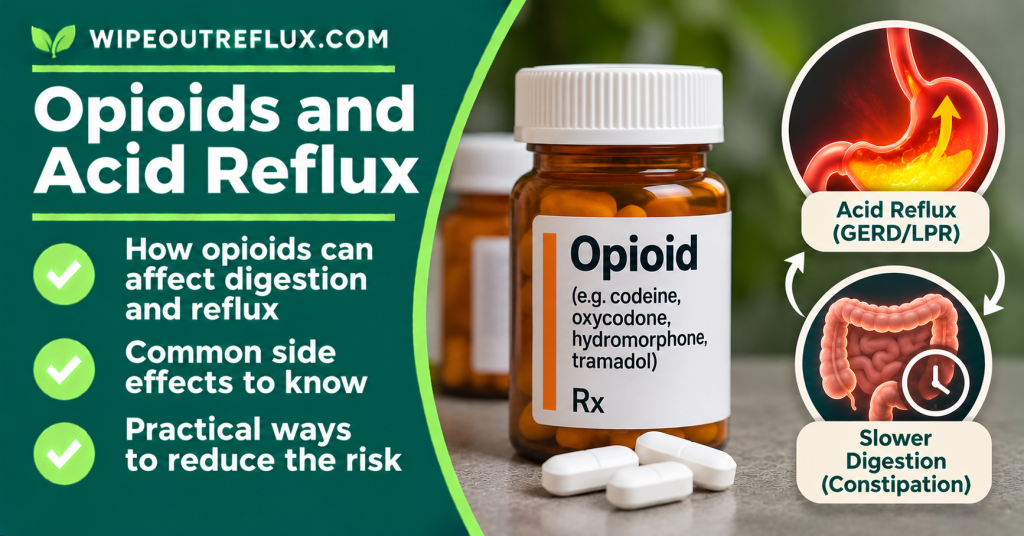
Opioid painkillers like oxycodone, hydrocodone, morphine, codeine and tramadol can cause heartburn-like symptoms, but not usually in the way people expect. Opioids don’t simply loosen the valve and let acid flood up. In fact, one lab study found that morphine reduced the number of reflux episodes in people with GERD. What opioids do is slow down the whole digestive tract, from the esophagus to the bowel. Food lingers in the stomach, the esophagus can go into spasm or fail to empty properly, and constipation builds pressure from below.
That slowdown can produce burning in the chest, a feeling of food sticking, nausea, bloating and regurgitation, all of which feel like reflux. Recognizing what’s really going on matters, because the fixes are different: treating constipation, eating smaller and softer meals, avoiding NSAIDs alongside opioids, and getting new swallowing problems checked, rather than just adding more acid medication.
Key Takeaways
- Opioids slow the whole gut, causing delayed stomach emptying, constipation, bloating and nausea.
- In a controlled study, morphine actually reduced reflux episodes in GERD patients by cutting transient LES relaxations.
- Chronic opioid use is linked to esophageal motility disorders, including outflow obstruction at the bottom of the esophagus and spasm.
- In one study, 27% of people taking opioids had esophageal outflow obstruction, compared with 7% of opioid users who had stopped for 24 hours.
- These esophageal problems cause chest pain, food sticking and regurgitation, which are easily mistaken for heartburn.
- Opioid-induced constipation and slow stomach emptying add upward pressure that can worsen true reflux.
- Pairing opioids with NSAIDs like ibuprofen raises the risk of stomach and esophageal irritation.
How Opioids Affect Your Digestive System
Opioid receptors aren’t only in the brain. There are lots of them throughout the gut, including in the esophagus, stomach and intestines. When opioids bind to these receptors, they slow down the coordinated muscle contractions that move food along and reduce gut secretions.
The collective result is called opioid-induced bowel dysfunction. Constipation is the best-known part, but a major review describes a much broader set of symptoms, including delayed stomach emptying, cramping, spasm, bloating and slowed transit through the gut [Panchal et al., International Journal of Clinical Practice, 2007]. Each of these can contribute to upper digestive symptoms that feel like reflux.
The Surprising Part: Opioids Don’t Simply Cause More Reflux
You might expect opioids to relax the lower esophageal sphincter (LES) and let acid flow up. The evidence suggests otherwise.
In an Italian study, researchers gave morphine to healthy volunteers and people with GERD while measuring reflux. In the GERD patients, morphine halved the number of reflux episodes and reduced acid exposure. It did this by cutting the number of transient LES relaxations, the brief, spontaneous openings of the valve that cause most reflux. When the effect was reversed with naloxone, reflux went back up [Penagini et al., Gastroenterology, 1997].
Another study found that resting LES pressure tended to be higher, not lower, in chronic opioid users who had taken their medication in the last 24 hours [Ratuapli et al., The American Journal of Gastroenterology, 2015].
So if opioids tighten the valve rather than loosening it, why do so many people on painkillers complain of heartburn? The answer lies in what happens above and below the valve.
Opioid-Induced Esophageal Dysfunction
This is a condition many people, and even some doctors, haven’t heard of. Opioids can disrupt the way the esophagus contracts and the way the LES opens when you swallow.
- A Mayo Clinic study of 121 chronic opioid users found that those who’d taken opioids within 24 hours of testing were almost four times as likely to have esophagogastric junction outflow obstruction (27% vs 7%), where the LES doesn’t open properly to let food through. They also had more spastic, premature contractions [Ratuapli et al., The American Journal of Gastroenterology, 2015].
- A US study of people referred for esophageal testing found that about 10% were on daily opioids. They had more swallowing problems, and higher opioid doses predicted worse esophageal function. Opioid users made up nearly half of all cases of type 3 (spastic) achalasia and a third of outflow obstruction cases [Babaei et al., Neurogastroenterology and Motility, 2019].
When the LES won’t open properly and the esophagus squeezes in a disorganized way, food and liquid can get held up in the esophagus. That causes:
- Burning or aching chest pain, often mistaken for heartburn
- A feeling of food sticking in the chest
- Regurgitation of undigested food or saliva
- Pain or difficulty swallowing
Food that sits in the esophagus can also ferment and irritate the lining, adding to the burning. It’s easy to see how this gets labeled as “reflux” and treated with PPIs, which won’t help much if the real problem is a spastic or obstructed esophagus. I explain the differences in esophageal spasm vs acid reflux and achalasia vs acid reflux.
The encouraging finding from the Mayo study is that these changes were less common in people who had stopped their opioids for just 24 hours, which suggests at least some of the effect is reversible.
Slow Stomach Emptying and Constipation
Below the LES, opioids slow everything down.
- Delayed gastric emptying: food stays in the stomach longer, causing fullness, nausea and bloating, and leaving more contents sitting against the valve. It’s the same problem I cover in gastroparesis and acid reflux.
- Constipation: the most common opioid side effect. A backed-up bowel raises pressure inside the abdomen, especially when straining, and may slow the stomach further.
- Nausea and vomiting: common when starting opioids or increasing the dose. Vomiting brings acid up and can irritate the esophagus and throat.
So even though opioids may reduce reflux episodes in a short lab test, the combination of a full stomach, a constipated bowel and nausea over weeks or months can make reflux symptoms worse in everyday life.
Other Reasons Painkillers Cause Heartburn
NSAIDs taken alongside opioids
Many people take an opioid together with ibuprofen, naproxen or aspirin, or use a combination product. NSAIDs are a far more direct cause of heartburn, stomach irritation and ulcers than opioids are. If you’re on both, the NSAID may be the main culprit. See does ibuprofen cause acid reflux.
Lying down after a dose
Opioids cause drowsiness, so people often lie down or nap soon after taking them, sometimes after eating. Lying flat with a full, slow-emptying stomach is a classic setup for reflux.
Tablets sticking
Sleepiness, a dry mouth and a sluggish esophagus all make it more likely that a tablet lingers on the way down, especially if it’s taken lying down or with little water. That can cause a localized burning pain. See pill stuck in throat.
After surgery
Opioids are often given after operations, when other factors like anesthesia, fasting and immobility also affect reflux. I cover that situation in acid reflux after surgery.
How to Protect Against Heartburn on Opioids
Never stop or reduce prescribed opioids suddenly without medical advice, as this can cause withdrawal and uncontrolled pain. These steps can help alongside your treatment:
- Treat constipation early. Don’t wait until you’re badly backed up. Fluids, fiber and a stool softener or osmotic laxative are often recommended from the start of opioid treatment. Ask your doctor or pharmacist what’s right for you, and whether a medication specifically for opioid-induced constipation is an option.
- Eat smaller, softer meals. With slow emptying and a sluggish esophagus, large or dry, chunky meals are harder to move along. Soups, smoothies, eggs, fish, mashed vegetables and well-cooked grains are easier.
- Stay upright after eating and after doses. Wait at least 30 to 60 minutes before lying down, and finish eating three hours before bed.
- Take tablets properly. Use a full glass of water, sit or stand upright, and don’t take them right before lying down.
- Avoid doubling up with NSAIDs unless your doctor has advised it, and ask about stomach protection if you need both.
- Limit other gut-slowing triggers, such as alcohol (which is also dangerous with opioids), large fatty meals and fizzy drinks.
- Use an alginate if you need relief. Alginates form a raft on top of stomach contents. Check timing with your pharmacist so it doesn’t interfere with other medications. See alginates for acid reflux.
- Ask about your pain plan. If digestive side effects are significant, your doctor may be able to adjust the dose, the specific opioid, or add non-opioid pain approaches.
For the diet side, the Wipeout Diet Plan gives you gentle, reflux-friendly meals that are easy to digest, which is exactly what a slowed-down gut needs.
When to See a Doctor
Contact your doctor if you’re on opioids and notice:
- Food or pills sticking, or new difficulty swallowing (see dysphagia)
- Regurgitating undigested food
- Chest pain that doesn’t respond to antacids
- Persistent nausea, vomiting or not being able to keep food down
- No bowel movement for several days, severe bloating or abdominal pain
- Black stools or vomiting blood, especially if you also take NSAIDs
- Unintended weight loss
New chest pain always needs assessment to rule out heart problems. If it comes with breathlessness, sweating or pain spreading to your arm or jaw, get urgent help. See heartburn or heart attack.
If you’ve had swallowing problems or chest pain on long-term opioids that haven’t responded to PPIs, it’s worth asking whether esophageal manometry testing might be useful. It’s the test that picks up opioid-induced esophageal dysfunction.
Conclusion
Opioids can cause heartburn-like symptoms, but usually not by letting more acid reflux. Research shows morphine can actually reduce reflux episodes in the short term by calming the valve. The real problems come from opioids slowing the whole digestive tract: the esophagus may spasm or fail to empty, the stomach empties slowly, and constipation builds pressure from below. Add nausea, NSAIDs taken alongside, and lying down after a dose, and it’s no surprise that many people on painkillers feel burning, fullness and regurgitation.
Knowing this changes how to tackle it. Treat constipation early, eat smaller and softer meals, stay upright after eating and dosing, avoid stacking NSAIDs on top, and get any new swallowing difficulty or food sticking checked, because opioid-induced esophageal dysfunction needs different handling from ordinary reflux.
Getting your daily eating pattern right is one of the most effective things you can do while your gut is running slow. The Wipeout Diet Plan is my complete, in-depth guide to calming reflux through food choices, meal timing and gentle habits. I built it primarily around silent reflux, but because it works on the same root mechanisms, it helps GERD and classic heartburn just as well.
Frequently Asked Questions
Can oxycodone cause heartburn?
It can contribute to heartburn-like symptoms, mainly by slowing stomach emptying and the esophagus, causing constipation and nausea. It doesn’t appear to loosen the LES directly.
Do opioids relax the lower esophageal sphincter?
Research suggests not. Morphine reduced transient LES relaxations and reflux episodes in GERD patients, and chronic opioid users tended to have higher LES pressure.
Why do I feel like food is stuck on opioids?
Opioids can stop the LES from opening properly and cause esophageal spasm, a condition called opioid-induced esophageal dysfunction. New food sticking should be checked by a doctor.
Can tramadol cause acid reflux?
Tramadol commonly causes nausea and constipation, which can worsen reflux symptoms. It also acts partly through opioid receptors, so similar effects on gut movement are possible.
Can I take omeprazole with opioids?
PPIs are commonly used alongside opioids, especially when NSAIDs are also taken. They won’t fix symptoms caused by esophageal dysmotility, though. Check with your pharmacist about your specific medications.
Does opioid constipation make reflux worse?
It can. A backed-up bowel raises abdominal pressure and may slow stomach emptying, both of which make reflux more likely.
Will my heartburn go away when I stop opioids?
Opioid-related gut slowing often improves after stopping, and one study found esophageal changes were less common after just 24 hours off. Never stop opioids without your doctor’s guidance.
Research & References
- [Panchal et al., International Journal of Clinical Practice, 2007] — Review of opioid-induced bowel dysfunction, including constipation, delayed gastric emptying, cramping, spasm, bloating and slowed GI transit.
- [Penagini et al., Gastroenterology, 1997] — Morphine reduced reflux episodes and acid exposure in GERD patients by decreasing transient LES relaxations, an effect reversed by naloxone.
- [Ratuapli et al., The American Journal of Gastroenterology, 2015] — In 121 chronic opioid users, recent opioid use was linked to more EGJ outflow obstruction (27% vs 7%) and spastic peristalsis than in those off opioids for 24 hours.
- [Babaei et al., Neurogastroenterology and Motility, 2019] — Chronic daily opioid users had more dysphagia, impaired LES relaxation and disordered peristalsis, accounting for nearly half of type 3 achalasia cases.

David Gray
12 years living with LPR · Consultant & researcher
I've lived with LPR for twelve years — the misdiagnoses, the PPI courses that did nothing, the slow work of figuring out what actually helps. Wipeout Reflux is where I translate the research into plain terms for people stuck in the same place. Every claim here is sourced to peer-reviewed work, and I consult one-to-one with LPR sufferers.